


Business Analytics Articles
Using Claude for Personalized Content at Scale
How to Use Claude for YouTube Script writing

Get In Touch For Details! Request More Information
What is Predictive Analytics and How Does It Work?
Aug 04, 2026 6 Min Read 254 Views
(Last Updated)
Table of contents
- TL;DR Summary
- Introduction
- What is Predictive Analytics?
- Why Predictive Analytics Matters in Business
- How Predictive Analytics Works
- Step 1: Define the Business Problem
- Step 2: Collect and Clean Data
- Step 3: Choose the Right Predictive Analytics Models
- Step 4: Train, Test, and Improve
- Step 5: Turn Predictions into Action
- Types of Predictive Analytics Models
- Common Predictive Analytics Models
- Predictive Analytics Models vs Machine Learning Analytics
- Predictive Analytics vs Descriptive vs Prescriptive Analytics
- Skills, Tools, and Roadmap to Learn Predictive Analytics
- Predictive Analytics Examples Across Industries
- Retail and E-commerce
- Banking and Finance
- Healthcare
- Marketing and Sales
- Manufacturing and Operations
- Salary and Career Benefits
- Common Mistakes to Avoid in Predictive Analytics
- 1: Starting with Data Instead of a Business Question
- 2: Ignoring Data Quality
- 3: Choosing Complex Models Too Early
- 4: Not Measuring Business Impact
- 5: Forgetting Model Drift
- Wrapping Up
- Frequently Asked Questions
- What is predictive analytics in simple words?
- What are common predictive analytics examples?
- What are predictive analytics models?
- Is predictive analytics the same as AI analytics?
- How is machine learning analytics used in predictive analytics?
- Is predictive analytics useful for business analysts?
- Do I need coding to learn predictive analytics?
- What tools are used in predictive analytics?
- Is predictive analytics a good career skill?
TL;DR Summary
Predictive analytics is the practice of using historical data, statistics, machine learning, and AI analytics to predict what is likely to happen next. Businesses use it to forecast sales, detect fraud, reduce customer churn, plan inventory, assess risk, and make faster decisions. It is not about “guessing the future”; it is about finding patterns in past and current data to make smarter, probability-based decisions. For learners, predictive analytics is a valuable skill because it connects data analysis, business decision-making, forecasting analytics, and machine learning analytics.
Introduction
Companies no longer want reports that only explain what happened last month. They want to know which customers may leave, which products may sell out, which transactions look risky, and which campaigns are likely to work next.
That is where predictive analytics comes in.
In simple terms, predictive analytics helps businesses use data to predict future outcomes and take action before problems become expensive. The demand is rising because organizations are becoming more AI-first, data-driven, and automation-focused. Gartner predicts that more than one in 10 enterprises will be AI-first by 2030, which means analytics skills will become even more central to business decisions.
As per Grand View Research findings, the global predictive analytics market was valued at USD 18.9 billion in 2024 and is projected to reach USD 82.3 billion by 2030, growing at a CAGR of 28.3% from 2025 to 2030.
What is Predictive Analytics?
Predictive analytics is a branch of advanced analytics that uses historical data, statistical techniques, data mining, machine learning, and AI models to estimate future outcomes. It helps answer questions like “What is likely to happen next?” and “Which action should we prepare for?” IBM defines it as using historical data with statistical modeling, data mining, and machine learning to make predictions about future outcomes.
Why Predictive Analytics Matters in Business
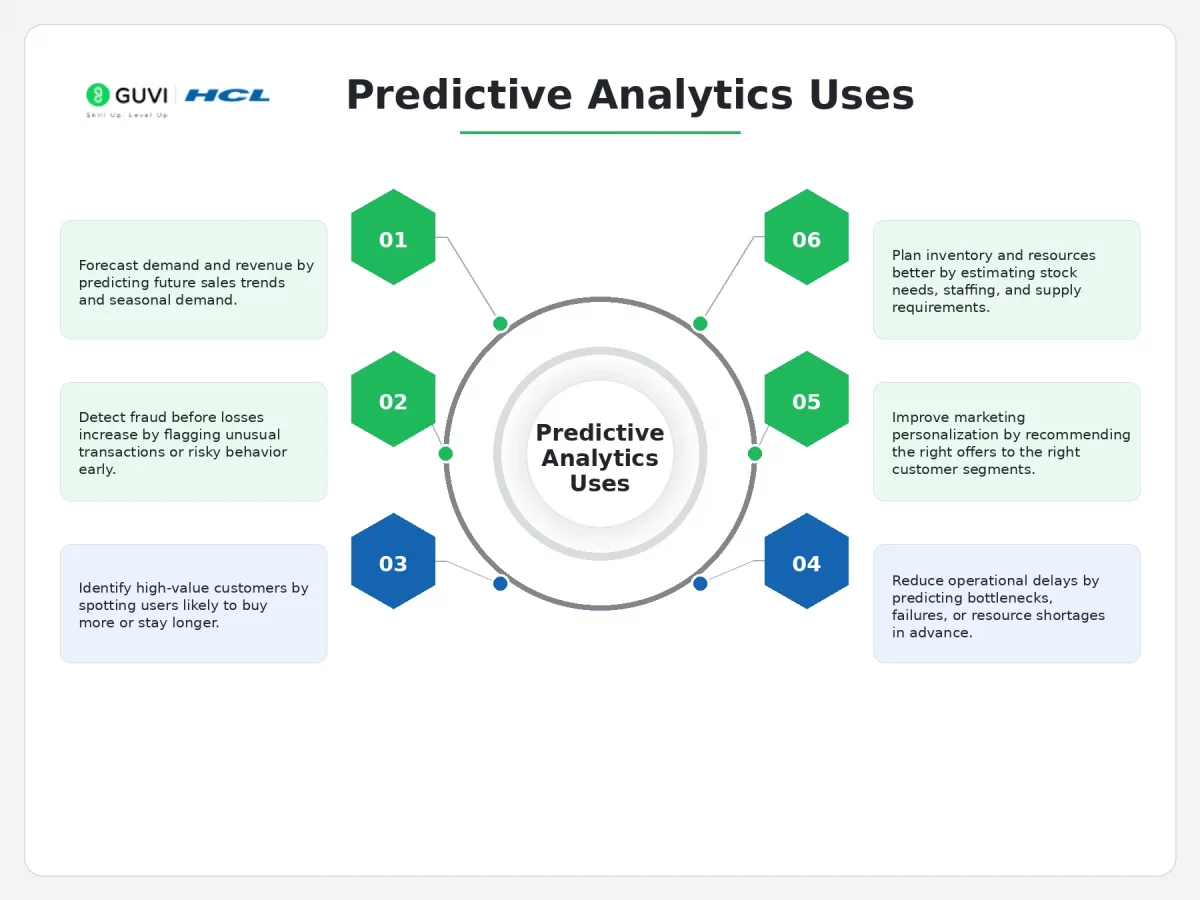
Predictive analytics in business helps teams move from reactive decisions to proactive planning.
For example, instead of waiting for customers to cancel subscriptions, a business can predict churn risk and send targeted retention offers earlier.
One of the earliest famous prediction problems was about guessing the weight of an ox at a county fair. In 1906, Francis Galton found that while most individual guesses were inaccurate, the crowd’s average guess came surprisingly close. Predictive analytics works similarly at scale: it combines many data points to find the most likely outcome.
How Predictive Analytics Works
Predictive analytics does not begin with complex algorithms. It begins with a business question.
For example, “Which customers are likely to stop using our service in the next 30 days?”
As businesses move deeper into AI analytics and automated decision-making, predictive analytics is becoming even more important. McKinsey’s 2025 State of AI survey found that 23% of organizations were already scaling agentic AI systems, while another 39% had started experimenting with AI agents. This shows that companies are not just analyzing data anymore; they are increasingly building systems that can predict, recommend, and act faster.
Step 1: Define the Business Problem
A good predictive analytics project starts with a clear outcome.
Examples:
- Will this customer churn?
- Will this loan applicant default?
- How much inventory will we need next month?
- Which leads are most likely to convert?
Step 2: Collect and Clean Data
Data may come from CRM systems, websites, sales records, payment history, support tickets, IoT sensors, or app usage.
Cleaning is important because wrong, missing, or outdated data can produce misleading predictions.
Step 3: Choose the Right Predictive Analytics Models
The model depends on the type of prediction you need.
A fraud detection use case may need classification, while sales forecasting may need time-series forecasting analytics.
Step 4: Train, Test, and Improve
The model learns patterns from historical data.
Then it is tested on unseen data to check whether predictions are useful in real situations.
Step 5: Turn Predictions into Action
A prediction is valuable only when someone acts on it.
For example, if a model predicts that a customer has an 80% churn risk, the marketing team can send a personalized discount or support call.
Types of Predictive Analytics Models
Predictive analytics models vary based on the business problem you are trying to solve. Some models are easier to explain to stakeholders, while others are better suited for complex, high-volume data.
The key is not to choose the “most advanced” model. The key is to choose the model that answers the business question clearly and reliably.
Common Predictive Analytics Models
| Model Type | Best Used For | Simple Example |
| Regression Models | Used when you want to predict a number or continuous value based on past data and related factors. | A retail team predicts next month’s revenue using past sales, discounts, seasonality, and website traffic. |
| Classification Models | Used when the output has fixed categories, such as yes/no, high/medium/low, or fraud/not fraud. | A bank predicts whether a transaction is suspicious or safe based on spending behavior and location. |
| Time-Series Models | Used when the data changes over time and you want to forecast future trends, demand, or performance. | An e-commerce company forecasts product demand during Diwali, Black Friday, or year-end sales. |
| Clustering Models | Used to group similar customers, products, or behaviors when you do not already know the categories. | A marketing team groups customers into budget buyers, premium buyers, and occasional shoppers. |
| Decision Trees and Random Forests | Used when you need predictions that are easier to interpret and explain to business teams. | A loan team predicts credit risk by checking income, repayment history, existing debt, and employment type. |
| Neural Networks | Used for complex patterns where traditional models may not capture enough detail. | A manufacturing company detects product defects from images captured on the production line. |
IBM notes that predictive analytics models commonly include classification, clustering, and time-series models. Tableau also highlights decision trees, random forests, text analytics, and time-series analysis as commonly used predictive techniques.
Here’s a quirky way to remember it: predictive analytics is like a business weather forecast. It cannot stop the rain, but it can help you carry an umbrella before you step out.
That “umbrella” could be extra inventory, a retention offer, a fraud alert, or a maintenance check before a machine breaks down.
Predictive Analytics Models vs Machine Learning Analytics
Machine learning analytics is often used inside predictive analytics.
Predictive analytics is the broader goal: predicting future outcomes. Machine learning analytics is one way to achieve that goal by training algorithms to learn patterns from data.
Predictive Analytics vs Descriptive vs Prescriptive Analytics
These three analytics types are connected, but they answer different questions.
Descriptive analytics looks backward, predictive analytics looks forward, and prescriptive analytics recommends what to do next.
| Analytics Type | Main Question | Example |
| Descriptive Analytics | What happened? | Sales dropped by 12% last month. |
| Predictive Analytics | What may happen next? | Sales may drop again next month if demand and traffic continue declining. |
| Prescriptive Analytics | What should we do? | Increase stock for high-demand products and target repeat buyers with offers. |
Predictive analytics acts as the bridge between insight and action. Descriptive analytics tells you what already happened, but it does not prepare you for what comes next.
To sum up, predictive analytics fills that gap by showing likely future outcomes. Once you know what may happen, prescriptive analytics can help you choose the best response, such as changing pricing, improving inventory, or prioritizing high-risk customers.
Skills, Tools, and Roadmap to Learn Predictive Analytics
You do not need to become a data scientist on day one. Start with business understanding, then build technical depth step by step.
Let’s take a look at the skills you should be able to master :
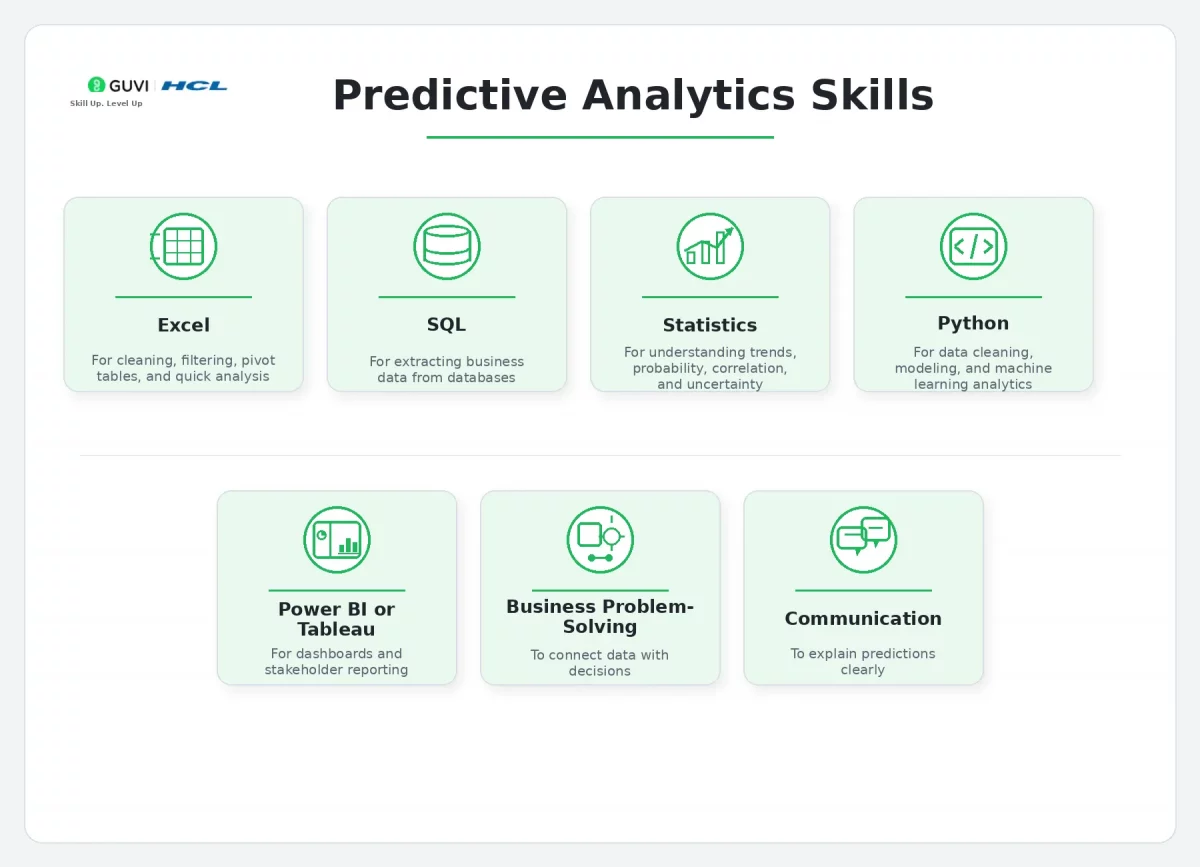
A beginner-friendly path should help you answer three questions: how to read data, how to find patterns, and how to turn those patterns into decisions. Here’s what yours could like:
| Stage | What to Learn | What You Should Be Able to Do | Practice Project |
| Month 1 | Excel, basic analytics, and business metrics | Clean small datasets, create pivot tables, calculate KPIs, and summarize business performance. | Build a monthly sales dashboard with revenue, profit, region-wise sales, and top products. |
| Month 2 | SQL and data extraction | Write queries to filter, join, group, and summarize data from multiple tables. | Analyze customer orders using SQL and find repeat buyers, inactive users, and best-selling products. |
| Month 3 | Statistics and data visualization | Understand averages, variance, correlation, probability, and simple trend analysis. | Create a customer behavior report showing purchase frequency, average order value, and churn signals. |
| Month 4 | Python, pandas, and exploratory data analysis | Clean datasets, handle missing values, create charts, and identify patterns using Python. | Perform churn analysis on a subscription dataset and identify factors linked to cancellations. |
| Month 5 | Regression, classification, and model evaluation | Build basic predictive analytics models and evaluate them using accuracy, precision, recall, or error metrics. | Create a lead scoring model that predicts whether a sales lead is likely to convert. |
| Month 6 | Forecasting analytics and business storytelling | Forecast future trends and explain model results in business-friendly language. | Build a demand forecasting project for retail sales and present recommendations to reduce stockouts. |
| Month 7+ | Portfolio, case studies, and deployment basics | Combine dashboards, models, and business insights into end-to-end analytics projects. | Create a portfolio project that includes SQL extraction, Python modeling, Power BI dashboarding, and business recommendations. |
Start with one small project instead of trying to learn every tool at once. For example, a churn prediction project can teach you data cleaning, customer segmentation, classification models, and business storytelling in one practical workflow.

Once you are comfortable, move to forecasting analytics projects such as sales forecasting, demand planning, or revenue prediction. These projects are especially useful because they closely match real business problems.
Predictive Analytics Examples Across Industries
Predictive analytics examples are everywhere, even when users do not notice them.
Retail and E-commerce
An online store can predict which products will sell more during a festive season.
This helps the business stock inventory, plan discounts, and avoid delivery delays.
Banking and Finance
Banks use predictive analytics to assess credit risk and detect suspicious transactions.
SAS gives credit scores as a well-known example of predictive analytics because they estimate a borrower’s likelihood of default based on relevant financial data.
Healthcare
Hospitals can use predictive models to identify patients at higher risk of readmission.
This helps care teams plan follow-ups, allocate beds, and reduce avoidable costs.
Marketing and Sales
A sales team can predict which leads are most likely to convert.
Instead of calling every lead randomly, the team can prioritize high-intent prospects.
Manufacturing and Operations
Factories can use sensor data to predict machine failure.
This supports preventive maintenance and reduces downtime.
Salary and Career Benefits
Predictive analytics can support roles such as Data Analyst, Business Analyst, BI Analyst, Forecasting Analyst, Risk Analyst, Data Scientist, and AI Analyst.
In India, Indeed reported the average Data Analyst salary at around ₹6,54,680 per year, based on 879 salaries updated in 2026.
The career outlook is also strong globally. The U.S. Bureau of Labor Statistics projects data scientist employment to grow 34% from 2024 to 2034, much faster than the average for all occupations.
Common Mistakes to Avoid in Predictive Analytics
1: Starting with Data Instead of a Business Question
Many beginners open a dataset and immediately start building models. That usually leads to random insights without business value.
Start with a clear question such as “Which customers may churn?” or “What will demand look like next month?”
A strong business question helps you choose the right data, model, metric, and action plan.
Without this clarity, even a technically accurate model may not help the business make a decision.
2: Ignoring Data Quality
Predictive analytics depends heavily on clean and reliable data.
If your dataset has missing values, duplicate records, outdated entries, or inconsistent formats, the model may learn the wrong patterns.
For example, if customer churn data is not updated properly, the model may label active users as inactive.
Always spend enough time cleaning, validating, and understanding the dataset before modeling.
3: Choosing Complex Models Too Early
A complex model is not always a better model.
Beginners often jump into neural networks or advanced AI analytics when a simple regression or decision tree would work better.
Simple models are easier to explain to managers and stakeholders.
Use advanced models only when the business problem, data volume, and accuracy needs justify them.
4: Not Measuring Business Impact
Accuracy alone does not prove business value.
A churn model may be 85% accurate, but the real question is: did it reduce churn, save revenue, or improve customer retention?
Always connect model performance with business KPIs.
This makes predictive analytics more useful for decision-makers.
5: Forgetting Model Drift
Customer behavior, markets, prices, and seasonal patterns change over time.
A model trained six months ago may not perform well today.
Monitor predictions regularly and retrain models when performance drops.
This is especially important in fast-changing areas like e-commerce, finance, and marketing.
After learning the basics, your next step should be practical application: dashboards, SQL queries, forecasting projects, and business case studies. You can explore HCL GUVI’s AI-Powered Business Analytics Course to build hands-on skills in Excel, SQL, Power BI, Tableau, Python, and Generative AI, or start with our Data Science & Analytics Certification Course if you prefer a self-paced and a flexible learning path.
Wrapping Up
Predictive analytics helps you turn data into future-ready decisions. It combines statistics, business thinking, forecasting analytics, machine learning analytics, and AI analytics to predict outcomes such as sales, churn, fraud, risk, and demand. For learners, the best way to start is simple: learn Excel, SQL, statistics, Python, dashboards, and one real business project at a time. As more companies adopt AI-powered decision-making, predictive analytics will remain one of the most practical and career-friendly skills to build.
Frequently Asked Questions
1. What is predictive analytics in simple words?
Predictive analytics uses past and current data to estimate what is likely to happen next. It helps businesses make proactive decisions instead of reacting after problems occur.
2. What are common predictive analytics examples?
Common predictive analytics examples include sales forecasting, customer churn prediction, fraud detection, credit scoring, inventory planning, and machine maintenance prediction.
3. What are predictive analytics models?
Predictive analytics models are statistical or machine learning models that identify patterns in data and predict future outcomes. Examples include regression, classification, clustering, time-series models, and random forests.
4. Is predictive analytics the same as AI analytics?
No. Predictive analytics focuses on forecasting future outcomes, while AI analytics may include prediction, automation, natural language processing, recommendation systems, and decision intelligence.
5. How is machine learning analytics used in predictive analytics?
Machine learning analytics helps predictive systems learn from historical data and improve pattern detection. It is often used for churn prediction, fraud detection, personalization, and demand forecasting.
6. Is predictive analytics useful for business analysts?
Yes. Business analysts use predictive analytics to forecast trends, identify risks, improve dashboards, and support better decisions with data-backed insights.
7. Do I need coding to learn predictive analytics?
You can start with Excel, SQL, and BI tools without deep coding. However, Python becomes important when you want to build machine learning analytics models.
8. What tools are used in predictive analytics?
Common tools include Excel, SQL, Python, R, Power BI, Tableau, SAS, SPSS, and cloud platforms such as AWS, Azure, and Google Cloud.
9. Is predictive analytics a good career skill?
Yes. Predictive analytics is valuable because companies need professionals who can forecast outcomes, reduce risk, and improve decisions using data.
Success Stories








Did you enjoy this article?