


Java Articles
What is ArrayList in Java: A Complete Guide
What is HashMap in Java: How It Works, Methods, and Examples
TCP IP Model: Layers, Functions, and How It Works
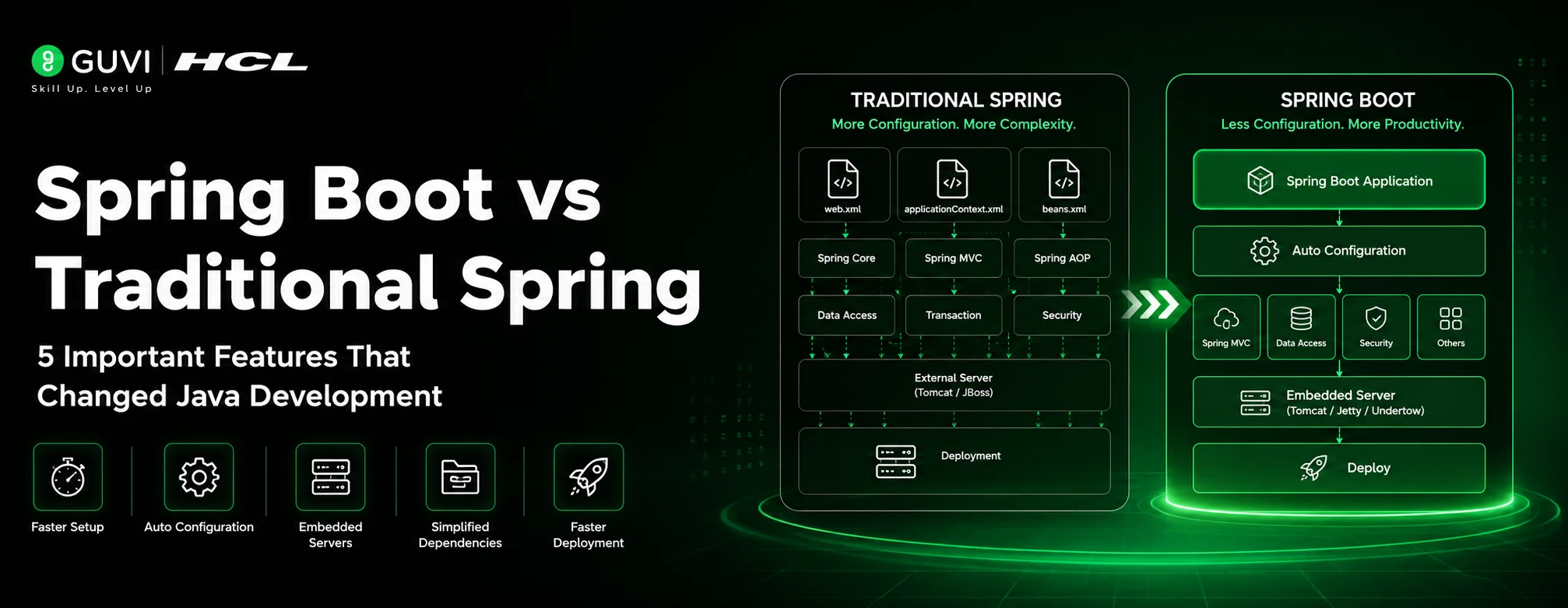
Spring Boot vs Traditional Spring: 5 Important Features That Changed Java Development

Get In Touch For Details! Request More Information
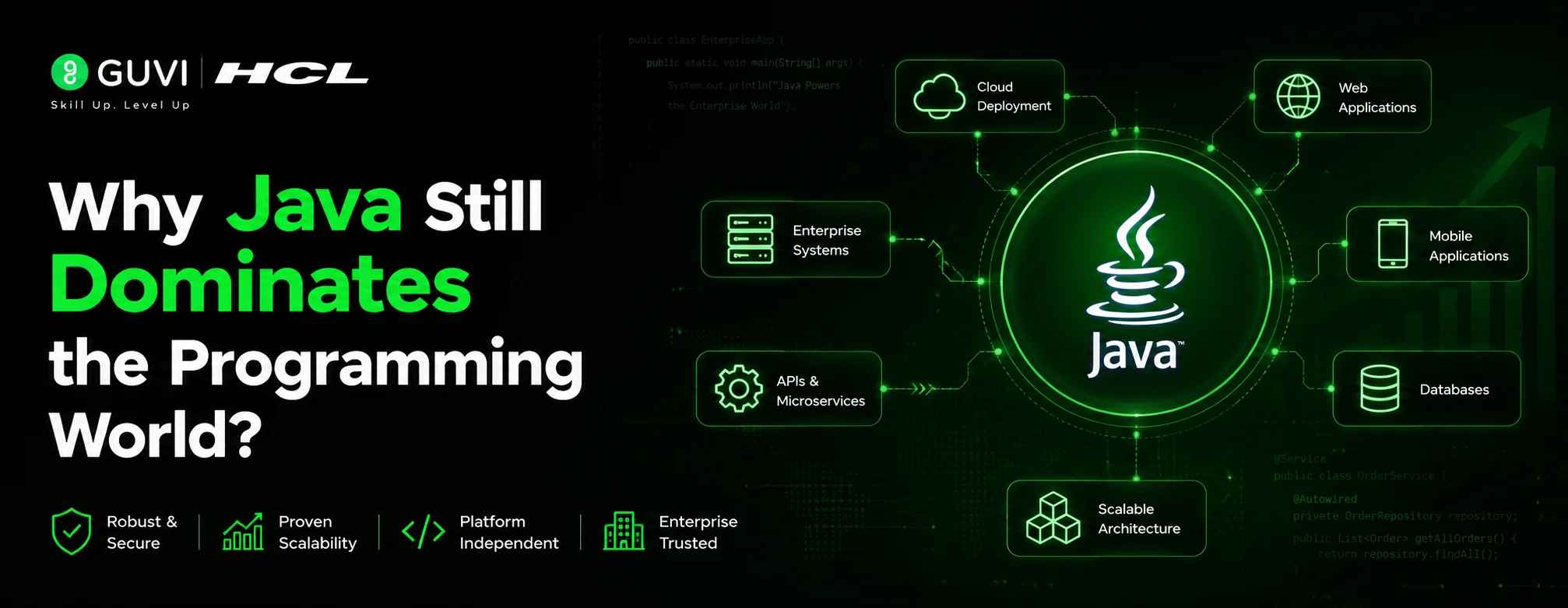
Why Java Still Dominates the Programming World?
Jun 16, 2026 5 Min Read 25 Views
(Last Updated)
It’s been over 30 years since Java debuted in 1995, yet it refuses to fade away. In fact, Java remains one of the most relevant and widely adopted programming languages in the software world as we move through 2025 and into 2026.
Despite the rise of Python, JavaScript, Go, Rust, and dozens of modern languages, Java continues to rank fourth in the TIOBE Index with 8.12% market share as of February 2026. Even more impressively, 29.4% of developers worldwide use Java, making it one of the most commonly used programming languages globally.
So why does Java still dominate the programming world? The answer lies in a powerful combination of enterprise lock-in, performance, ecosystem maturity, and continuous innovation that keeps it competitive with modern alternatives.
Table of contents
- Massive Enterprise Adoption & Legacy Systems
- The Enterprise Moat
- Why Legacy Systems Matter
- Write Once, Run Anywhere (WORA)
- The Original Killer Feature
- Why This Still Matters in 2026
- Mature Ecosystem & Libraries
- Unmatched Tooling & Frameworks
- Why Rails on Rust or Python Can't Compete
- Performance & Scalability
- JVM Optimizations Are Insane
- Real-World Performance
- Backward Compatibility
- The Promise That Keeps Enterprises Happy
- Java Version Adoption (2025)
- Strong Security Features
- Built for Enterprise Security
- Why Security Matters
- Massive Talent Pool & Learning Resources
- Easy to Hire Java Developers
- Learning Resources
- Continuous Innovation
- Java Isn't Stagnant
- Modern Java vs. Old Java
- Open Source Community
- Thriving Open Source Ecosystem
- Cloud-Native Support
- Java in the Cloud Era
- Modern Java Cloud Frameworks
- Java vs. Competitors: Market Share Reality Check
- TIOBE Index (February 2026)
- Stack Overflow Developer Survey (2025)
- When Java Is NOT the Best Choice
- The Future of Java (2026 and Beyond)
- What's Next?
- Key Trends to Watch
- Final Verdict
- Frequently Asked Questions
- Is Java dying in 2026?
- Should I learn Java in 2026?
- Is Java faster than Python?
- What companies use Java?
- Which Java version should I learn?
1. Massive Enterprise Adoption & Legacy Systems
The Enterprise Moat
Java powers 3+ billion devices worldwide, including desktops, mobile phones, point-of-sale terminals, printers, and routers. This isn’t just a statistic—it represents a massive infrastructure moat that’s incredibly difficult to disrupt.
| Industry | Java Usage |
|---|---|
| Banking & Finance | 90%+ of global banks use Java for core systems beecrowd |
| E-commerce | Primary driver for eBay, Amazon, Netflix engines woz-u |
| Android Development | Primary language for Android mobile apps woz-u |
| Big Data | Hadoop, Spark, and Kafka built on Java/Scala |
| Government | Critical infrastructure systems worldwide |
29% of Java users work at enterprise companies with 1,000+ employees. These organizations have invested billions in Java-based systems that run their entire operations. Replacing this infrastructure would cost hundreds of millions of dollars and take years of migration work.
Why Legacy Systems Matter
“There are only two kinds of programming languages: the ones people complain about and the ones nobody uses.” — Bjarne Stroustrup
Java isn’t just complained about—it’s actively used at massive scale. Most large companies requiring big-time scale rely on Java for their critical systems.
2. Write Once, Run Anywhere (WORA)
The Original Killer Feature
Java’s cross-platform capability remains one of its strongest advantages. The “Write Once, Run Anywhere” philosophy means:
- Compile once → Run on Windows, macOS, Linux, Android, embedded systems
- No recompilation needed for different operating systems
- Java Virtual Machine (JVM) handles platform-specific details
- Consistent behavior across all environments
Why This Still Matters in 2026
In today’s multi-cloud, hybrid environment, WORA is more valuable than ever:
- Cloud-native architectures are now mainstream in enterprise Java development
- Microservices deployed across different cloud providers
- Containerization (Docker/Kubernetes) works seamlessly with Java
- No vendor lock-in for your application code
3. Mature Ecosystem & Libraries
Unmatched Tooling & Frameworks
Java has 25+ years of accumulated ecosystem that newer languages simply can’t match:
| Category | Top Java Options |
|---|---|
| Web Frameworks | Spring Boot, Jakarta EE, Micronaut, Quarkus |
| Build Tools | Maven, Gradle, Ant |
| IDEs | IntelliJ IDEA (most popular), VS Code, Eclipse |
| Testing | JUnit, TestContainers, Mockito |
| Databases | Hibernate, jOOQ, MyBatis |
| Messaging | Apache Kafka, RabbitMQ clients |
| Cloud | AWS SDK, Google Cloud Client, Azure SDK |
Jakarta EE has surpassed Spring for the first time, with 58% of respondents using Jakarta EE compared to 56% for Spring. This marks a significant milestone confirming Jakarta EE’s position as the leading Java framework for cloud-native applications.

Why Rails on Rust or Python Can’t Compete
Newer languages might have cleaner syntax, but they lack:
- Production-tested libraries (25+ years of bug fixes)
- Enterprise-grade frameworks with SLA guarantees
- Community support from millions of developers
- Third-party integrations for every business tool imaginable
4. Performance & Scalability
JVM Optimizations Are Insane
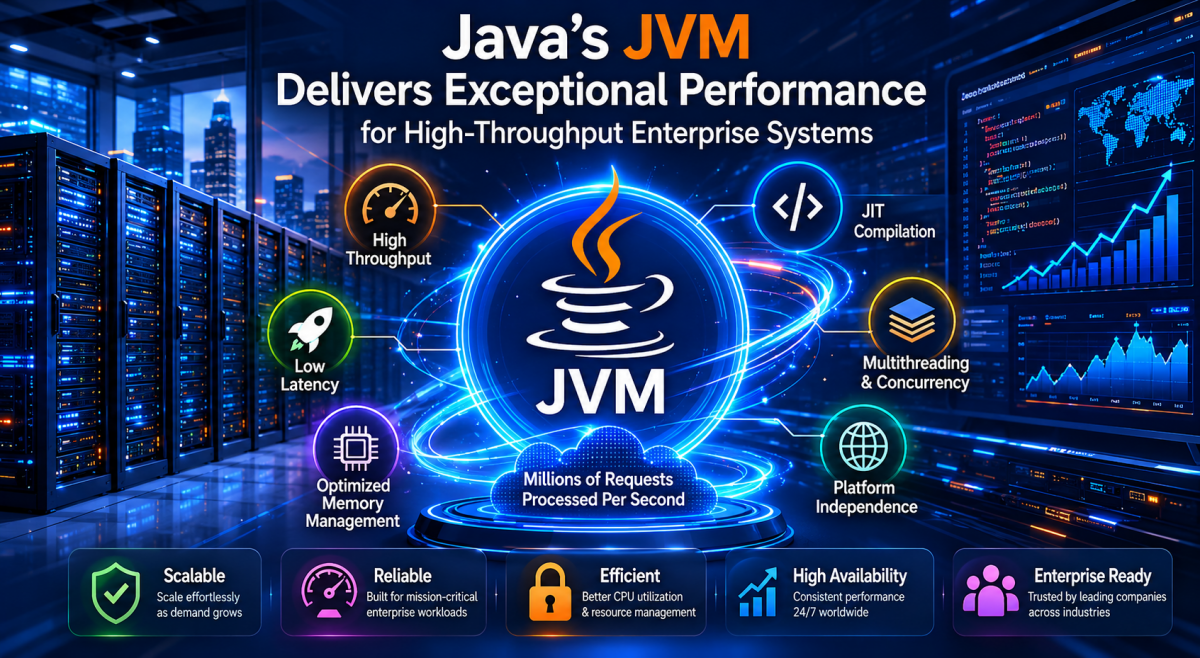
The Java Virtual Machine has undergone decades of optimization that make Java incredibly fast:
- JIT (Just-In-Time) compilation optimizes hot code paths at runtime
- Garbage collection has evolved (G1, ZGC, Shenandoah) for minimal pause times
- Strong multi-threading support for concurrent processing
- Memory management optimized for enterprise workloads
Real-World Performance
Java is a top player in enterprise, backend, and cloud development because of its performance, stability, and mature tooling:
- Netflix: Handles 200M+ users on Java microservices
- Amazon: Processes billions of transactions daily
- Uber: Handles millions of rides per day
- Banks: Process thousands of transactions per second
5. Backward Compatibility
The Promise That Keeps Enterprises Happy
Java almost never breaks backward compatibility. Code written in Java 8 (2014) still runs on Java 21 (2023) with minimal changes.
This matters because:
- Enterprise systems have 10-20 year lifespans
- Migration costs are avoided with seamless upgrades
- Investment protection for decades of code
- Training ROI as developers’ skills remain relevant
Java Version Adoption (2025)
| Java Version | Adoption Rate | Trend |
|---|---|---|
| Java 21 (LTS) | 43% | ⬆️ Jumped from 30% in 2024 newsroom.eclipse |
| Java 17 (LTS) | Declining | Still widely used |
| Java 11 (LTS) | 37% | ⬆️ Rebounded from previous decline heise |
| Java 8 | Declining | Legacy but still significant |
43% of developers are already using Java 21, showing that developers are becoming more willing to adopt newer Java versions shortly after release.
6. Strong Security Features
Built for Enterprise Security
Java provides multiple security features that make it ideal for sensitive enterprise applications:
- Secure memory management prevents buffer overflows
- Bytecode verification ensures code safety before execution
- Encryption APIs (Java Cryptography Architecture)
- Sandboxing isolates untrusted code
- Authentication frameworks (JAAS)
- Regular security patches from Oracle
Why Security Matters
90%+ of global banks use Java for core banking systems because security is non-negotiable. Financial institutions, healthcare systems, and government agencies prioritize Java’s proven security track record over newer languages with unproven security models.
7. Massive Talent Pool & Learning Resources
Easy to Hire Java Developers
Java is one of the most taught programming languages in universities worldwide. This creates a virtuous cycle:
Learning Resources
- Millions of tutorials available online
- Stack Overflow has 1.5M+ Java questions (most answered)
- Books: 10,000+ Java books published
- Courses: Udemy, Coursera, edX all have extensive Java content
- Certifications: Oracle Certified Professional, Spring Professional
29.4% of developers worldwide use Java, making it one of the easiest languages to find talent for.
8. Continuous Innovation
Java Isn’t Stagnant
Contrary to popular belief, Java keeps evolving rapidly:
| Year | Major Release | Key Features |
|---|---|---|
| 2021 | Java 17 (LTS) | Sealed classes, pattern matching |
| 2023 | Java 21 (LTS) | Virtual threads, record patterns newsroom.eclipse |
| 2024 | Java 22 | Unnamed variables, string templates |
| 2025 | Java 23 | Improved performance, new APIs |
Modern Java vs. Old Java
Modern Java (2026) is NOT the same as Java 8 (2014):
- Records for immutable data carriers
- Pattern matching for cleaner code
- Text blocks for multi-line strings
- Switch expressions for better type safety
- Var for local variable type inference
9. Open Source Community
Thriving Open Source Ecosystem
Java has been a major contributor to the open source community for over 20 years:
- Apache Foundation: 300+ Java projects (Kafka, Hadoop, Cassandra)
- Eclipse Foundation: Jakarta EE, Eclipse IDE
- GitHub: 2M+ Java repositories
- Maven Central: 500,000+ open source libraries
66% of Java users still turn to Apache Tomcat as their Java application server of choice today, showing the strength of open source adoption.
10. Cloud-Native Support
Java in the Cloud Era
Cloud-native architectures are now mainstream in enterprise Java development:
| Cloud Strategy | Percentage |
|---|---|
| Lift-and-shift | 22% (leading approach) newsroom.eclipse |
| Gradual microservices migration | 14% newsroom.eclipse |
| Modernizing for cloud features | 14% newsroom.eclipse |
| Fully cloud-based | 14% newsroom.eclipse |
Modern Java Cloud Frameworks
- Spring Boot: Simplified cloud deployment
- Quarkus: Supersonic subatomic Java (optimized for Kubernetes)
- Micronaut: Low-memory, fast-startup framework
- Helidon: Native images with GraalVM
Jakarta EE 11 has already been adopted by 18% of respondents, showing rapid adoption of modern standards.
Java vs. Competitors: Market Share Reality Check
TIOBE Index (February 2026)
| Rank | Language | Market Share | Trend |
|---|---|---|---|
| 1 | Python | 21.81% | ⬇️ Declining from 26.98% infoworld |
| 2 | C | 11.05% | ⬆️ Gaining |
| 3 | C++ | 8.55% | → Stable |
| 4 | Java | 8.12% | → Stable infoworld |
| 5 | C# | 6.83% | → Stable |
TIOBE Index (March 2026 – Updated)
| Rank | Language | Market Share |
|---|---|---|
| 1 | Python | 23.88% |
| 2 | C++ | 11.37% |
| 3 | Java | 10.66% stackademic |
Java has recovered to 10.66% market share in early 2026, showing stability at the top alongside Python and C++.
Stack Overflow Developer Survey (2025)
| Language | Usage Rate |
|---|---|
| JavaScript | 62%+ |
| HTML/CSS | 53% |
| Java | 29.4% statista |
| C# | 27.8% |
| C++ | 23.5% |
Java remains one of the top 5 most used languages globally.
When Java Is NOT the Best Choice
Java isn’t perfect for every scenario. Consider alternatives when:
| Use Case | Better Alternative | Why |
|---|---|---|
| Data Science/AI | Python | Better libraries (TensorFlow, PyTorch) |
| Frontend Web | JavaScript/TypeScript | Runs in browsers |
| System Programming | Rust/C++ | Lower-level control |
| Quick Prototyping | Python/JavaScript | Faster development |
| Mobile (iOS) | Swift | Native iOS support |
| Microservices (small) | Go | Smaller binaries, faster startup |
Python, JavaScript, and Java are currently the most demanded programming languages, with 45.7% of recruiters looking to hire Python developers.
The Future of Java (2026 and Beyond)
What’s Next?
- Virtual Threads: Revolutionizing concurrent programming
- Project Loom: Better concurrency model
- Project Valhalla: Value types for performance
- GraalVM: Native image compilation for faster startup
- AI Integration: Java libraries for machine learning
Java is still a top player in enterprise, backend, and cloud development due to its stability, ecosystem, and adaptability to modern workloads.
Key Trends to Watch
- Jakarta EE momentum grows as the leading cloud-native framework
- Java 21 adoption accelerating (43% and rising)
- Cloud migration strategies becoming more sophisticated
- Smaller companies leading early adoption of new versions
| Reason | Why It Matters |
|---|---|
| Enterprise Lock-in | 3+ billion devices, 29% of developers statista |
| WORA Principle | Works on any platform with JVM delphicomputech |
| Mature Ecosystem | 25+ years of libraries & frameworks delphicomputech |
| Performance | JVM optimized for decades jdd |
| Backward Compatibility | Java 8 code runs on Java 21 newsroom.eclipse |
| Security | Built for banking/finance beecrowd |
| Talent Pool | Easy to hire Java developers statista |
| Continuous Innovation | New features every 6 months newsroom.eclipse |
| Open Source | 2M+ GitHub repositories woz-u |
| Cloud-Native | Mainstream in enterprise jdd |
Final Verdict
Java dominates because it solves real business problems at scale. It’s not about having the sexiest syntax or the newest features—it’s about reliability, performance, and proven track record in mission-critical systems.
The data shows:
- 29.4% of developers use Java globally
- 43% are adopting Java 21 (LTS)
- Third-place in TIOBE Index with 10.66% market share
- 30 years of work still needs to be maintained
As one developer noted: “There’s nothing you can’t do with Java. It might take longer to implement or syntax may not be as nice, but it’s more than capable for any task”.
Java isn’t going anywhere. If anything, its dominance will continue as enterprises double down on cloud-native Java development and newer developers join the ecosystem.
Here are reference to know more about java programming:
Frequently Asked Questions
Is Java dying in 2026?
No. Java remains in the top 4 programming languages with 10.66% market share and is seeing increased adoption of Java 21 (43% adoption).
Should I learn Java in 2026?
Is Java faster than Python?
What companies use Java?
Success Stories

About the Author
Lavish Jain
A Professional Developer Mentor and Corporate Trainer with over 10 years of experience, I have contributed to technological advancements through comprehensive training and mentorship. My journey includes pivotal roles at Cluebix, Focus-4D,ThoughtWorks, and currently with Guvi -HCL Group, where I shape the careers of aspiring developers. I specialize in simplifying complex concepts, making them accessible to learners at all levels, and have successfully trained lakhs of budding developer through corporate and boot camp courses focused on full-stack development.
View all posts by Lavish Jain
Connect with me @








Did you enjoy this article?