


Career Articles
Deloitte India Hiring Process 2026: Best Guide
Deloitte NLA Interview Experience 2026: Rounds, Questions and Preparation - Best Guide
HCL Placement Paper: Sample Quantitative Aptitude Questions With Solutions
HCL TechBee Pros and Cons: Is It Worth Joining After Class 12?


Get In Touch For Details! Request More Information
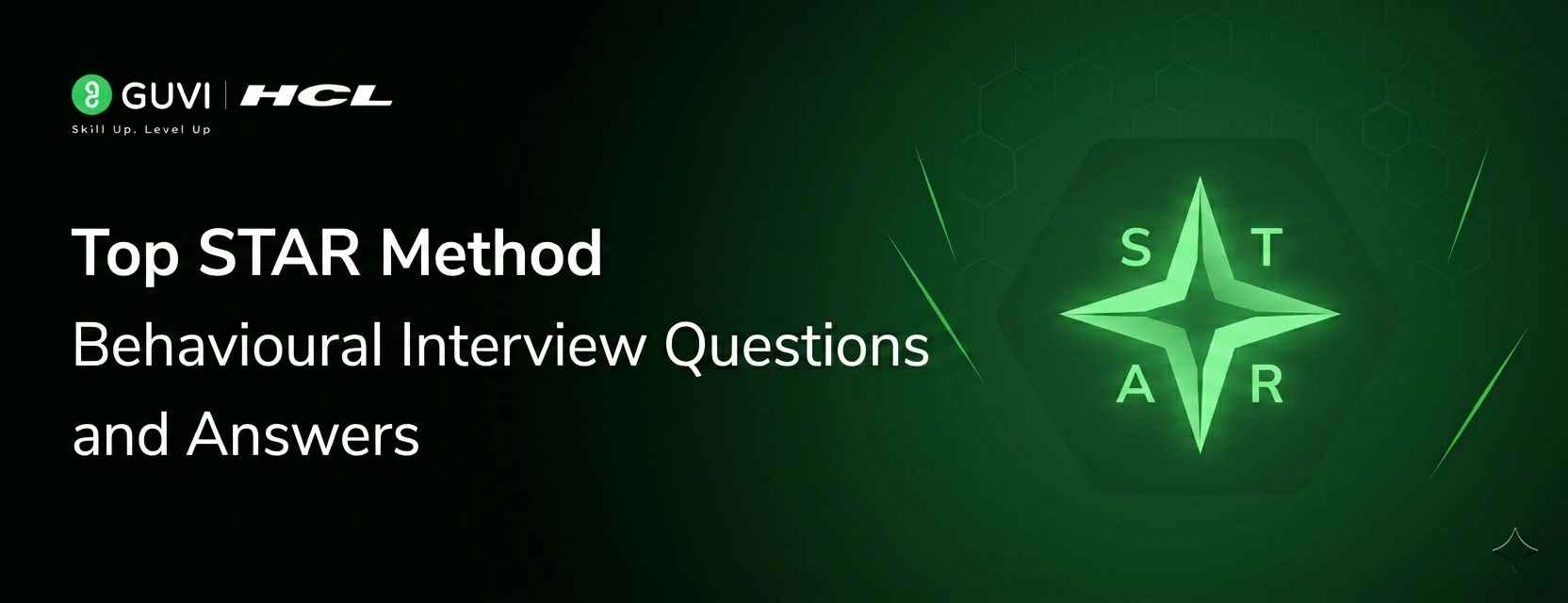
Top STAR Method Behavioral Interview Questions and Answers
Jun 16, 2026 4 Min Read 681 Views
(Last Updated)
Interviews are no longer just about technical skills and qualifications. Recruiters are increasingly using top star method behavioral questions to understand how candidates think, solve problems, handle pressure, and work with others. Instead of asking what you would do, they often ask what you have done in real situations.
This is where the Top Star Method behavioural Interview Questions prove useful. It offers a structured way to answer behavioral interview questions with real experiences, helping you focus and communicate your impact effectively.
Table of contents
- TL;DR
- What are the Top STAR Method behavioural Interview Questions?
- What Is the STAR Method?
- Why Recruiters Use STAR Questions
- How to Answer Using the STAR Framework
- Situation
- Task
- Action
- Result
- Top STAR Method Interview Questions with Sample Answers
- Tell Me About a Time You Faced a Challenge
- Describe a Time You Worked Under Pressure
- Tell Me About a Time You Made a Mistake
- Give an Example of a Conflict With a Team Member
- Tell Me About a Time You Took Initiative
- STAR Answer Template
- Common Mistakes to Avoid
- Giving Long Background Stories
- Focusing Too Much on the Team
- Skipping Results
- Using Hypothetical Examples
- Tips to Ace Behavioral Interviews
- Conclusion
- FAQs
- What does STAR stand for in interviews?
- Why do employers ask STAR interview questions?
- How many STAR examples should I prepare?
- Can freshers use the STAR method?
- What is the most important part of a STAR answer?
TL;DR
- STAR method interview questions are behavioral questions that assess how you’ve handled real workplace situations.
- STAR stands for Situation, Task, Action, and Result.
- Recruiters use these questions because past behavior often helps predict future job performance.
- The STAR framework helps you give clear, concise, and compelling answers.
- Preparing STAR stories in advance can significantly boost your interview performance.
What are the Top STAR Method behavioural Interview Questions?
Top STAR method behavioral interview questions require candidates to describe how they managed a specific situation in the past. These questions typically start with phrases like:
- Tell me about a time when…
- Describe a situation where…
- Give an example of…
- Have you ever…
Unlike theoretical questions, behavioral questions focus on real experiences. Employers use them to evaluate skills such as:
- Problem solving
- Communication
- Leadership
- Teamwork
- Adaptability
- Time management
- Conflict resolution
For example:
“Tell me about a time you faced a difficult challenge at work.”
“Describe a situation where you had to meet a tight deadline.”
“Give an example of a conflict you had with a teammate.”
These questions are best answered using the STAR framework. Similar behavioral scenarios are often included in common job interview questions, making structured responses an essential interview skill.
What Is the STAR Method?
The STAR method is a structured technique for answering behavioral interview questions.
| STAR Component | Meaning |
| Situation | Explain the context |
| Task | Describe your responsibility or objective |
| Action | Explain the steps you took |
| Result | Share the outcome and impact |
A strong STAR answer highlights the actions you personally took and the results you achieved. Recruiters often want to know about your contribution rather than the overall team effort.
Why Recruiters Use STAR Questions
Behavioral questions help employers understand how candidates deal with real workplace situations. Since past actions often indicate future behavior, these questions can provide deeper insights than traditional interview questions.
Recruiters commonly assess:
- Decision making
- Leadership potential
- Accountability
- Problem-solving ability
- Communication style
- Collaboration skills
- Adaptability under pressure
For candidates, STAR answers make responses more organized, clearer, and more convincing.
Many of these competencies are also assessed through HR interview questions, which recruiters use to evaluate communication, attitude, and workplace readiness.
How to Answer Using the STAR Framework
1. Situation
Start by providing the context. Keep it brief but include enough detail for the interviewer to understand the challenge or opportunity.
2. Task
Explain your responsibility in that situation. What goal were you trying to achieve? What problem needed solving?
3. Action
This is the most important part of your answer. Describe your specific actions. Focus on your contributions rather than what the team did.
4. Result
Conclude with tangible outcomes whenever possible. Examples include:
- Increased efficiency by 20%
- Reduced costs
- Completed a project ahead of schedule
- Improved customer satisfaction
If the outcome wasn’t perfect, explain what you learned from the experience.
Top STAR Method Interview Questions with Sample Answers
1. Tell Me About a Time You Faced a Challenge
Situation: During a college project, our team lost access to important research data one week before submission.
Task: I needed to ensure the project was completed on time.
Action: I coordinated tasks, recreated missing research using backup sources, and set daily progress check-ins.
Result: We submitted the project on time and received one of the highest grades in the class.
2. Describe a Time You Worked Under Pressure
Situation: I had to complete three assignments and prepare for a presentation within the same week.
Task: Meet all deadlines without compromising quality.
Action: I prioritized tasks, created a schedule, and allocated focused time blocks for each deliverable.
Result: All assignments were submitted on time, and the presentation received positive feedback.
3. Tell Me About a Time You Made a Mistake
Situation: During an internship, I submitted a report containing incorrect data.
Task: Correct the issue before it affects decision-making.
Action: I immediately informed my supervisor, verified all data sources, and created a validation checklist.

Result: The report was quickly corrected, and the checklist became part of the team’s reporting process.
4. Give an Example of a Conflict With a Team Member
Situation: A teammate and I disagreed on how to approach a project task.
Task: Resolve the disagreement while keeping the project on track.
Action: I scheduled a discussion, listened to their perspective, and proposed a combined solution.
Result: We completed the project successfully and improved collaboration going forward.
5. Tell Me About a Time You Took Initiative
Situation: Our team lacked documentation for a recurring process.
Task: Improve knowledge sharing.
Action: I created step-by-step documentation and organized it in a shared repository.
Result: New team members onboarded faster and required less support.
The STAR framework is particularly useful when answering leadership interview questions that require examples of ownership, initiative, and decision-making.
STAR Answer Template
You can use this simple structure for almost any behavioral question:
- Situation: What happened?
- Task: What was your responsibility?
- Action: What specific steps did you take?
- Result: What outcome did you achieve?
Formula:
Situation → Task → Action → Result
Preparing multiple stories using this template allows you to answer a wide range of interview questions confidently.
Developing a collection of STAR stories can also help you communicate project experience more effectively during technical interviews, where recruiters often ask candidates to explain challenges, solutions, and outcomes.
Common Mistakes to Avoid
Giving Long Background Stories
Interviewers need context, not your life story. Keep the Situation section short and focus on your actions.
Focusing Too Much on the Team
Use “I” when describing your contribution. The interviewer wants to understand your specific role.
Skipping Results
Always explain what happened because of your actions. Quantifiable results make answers more persuasive.
Using Hypothetical Examples
Behavioral interviews usually require real experiences. Choose actual situations whenever you can.
Tips to Ace Behavioral Interviews
Prepare stories for these common competency areas:
- Leadership
- Teamwork
- Problem solving
- Communication
- Adaptability
- Conflict resolution
- Time management
- Initiative
Keep a document with multiple STAR stories from internships, academic projects, volunteer work, and professional experience. You can adapt them to different interview questions.
Along with preparing STAR stories, having a structured job interview preparation strategy can significantly improve your interview performance.
Want to build in-demand AI skills and strengthen your interview profile? HCL GUVI’s Artificial Intelligence and Machine Learning Course offers hands-on projects, industry-relevant tools, and practical learning experiences that help you develop job-ready skills. The real-world projects you complete can also provide strong examples for answering STAR method interview questions during interviews.
Conclusion
Behavioral interviews are now a standard part of the hiring process. Employers want proof of how you’ve handled challenges, collaborated with others, and delivered results in real situations. The STAR framework provides a straightforward yet powerful structure that helps you present your experiences clearly and effectively.
By preparing a collection of STAR stories in advance and practicing your delivery, you can answer behavioral interview questions with confidence and leave a lasting impression on recruiters.
FAQs
1. What does STAR stand for in interviews?
STAR stands for Situation, Task, Action, and Result. It is a framework used to answer behavioral interview questions.
2. Why do employers ask STAR interview questions?
These questions help employers evaluate how candidates have handled real situations in the past and assess skills like problem-solving, teamwork, and leadership.
3. How many STAR examples should I prepare?
Preparing 6 to 10 stories covering leadership, teamwork, challenges, failures, and achievements is usually enough for most interviews.
4. Can freshers use the STAR method?
Yes. Freshers can use examples from academic projects, internships, volunteering, extracurricular activities, and part-time work.
5. What is the most important part of a STAR answer?
The Action section is typically the most vital because it highlights the steps you personally took to address the situation.
Success Stories

About the Author
Vishalini Devarajan
An Aerospace Engineer turned content writer, I focus on making complex concepts easy to understand through well-structured, reader-friendly blogs. Whether it’s a technical topic or a non-technical one, I love creating content that is clear, engaging, and impactful.
View all posts by Vishalini Devarajan
Connect with me @











Did you enjoy this article?