


Python Articles
Ray Serve Tutorial: How to Deploy Scalable ML Models with RayServe
SQLModel: Combining SQLAlchemy + Pydantic for Cleaner Code


Get In Touch For Details! Request More Information
Introduction to Compiler Design: A Complete Beginner’s Guide
Jun 16, 2026 8 Min Read 460 Views
(Last Updated)
Every time you write a Python script or a Java program and run it, your human-readable code is transformed into machine-executable instructions by a compiler. That silent translation from keywords like if, while, and print into binary operations you never write yourself is the core task of compiler design.
Compiler design is a foundational area of computer science that blends mathematics, linguistics, and engineering. A compiler must parse a language’s grammar, perform semantic checks, optimize code for performance and size, and generate correct machine-level output; the algorithms and principles behind these steps shape programming languages, development tools, and the efficiency of virtually all software.
In this article, we will walk through the complete introduction to compiler design. We will cover what a compiler is, how it differs from an interpreter, the seven phases every compiler goes through, the supporting structures that run alongside those phases, the different types of compilers, and why understanding this subject matters for any developer.
Table of contents
- TL;DR
- What Is a Compiler?
- Compiler vs. Interpreter: Understanding the Difference
- The Seven Phases of a Compiler
- Phase 1: Lexical Analysis
- Phase 2: Syntax Analysis (Parsing)
- Phase 3: Semantic Analysis
- Phase 4: Intermediate Code Generation
- Phase 5: Code Optimization
- Phase 6: Code Generation
- Phase 7: Code Linking and Loading
- Two Supporting Structures: Symbol Table and Error Handler
- Types of Compilers
- The Front End and Back End of a Compiler
- The front end
- The back end
- Why Compiler Design Matters for Developers
- Wrapping Up
- FAQ
- What’s the difference between a compiler and an interpreter?
- Why have an intermediate representation (IR)?
- How do compilers detect and report errors?
- When does optimization occur and is it always safe?
- Why should everyday developers learn compiler design?
TL;DR
- A compiler translates high‑level source code into low‑level machine code through a sequence of well‑defined phases: lexical analysis, parsing, semantic analysis, intermediate code generation, optimization, code generation, and linking/loading.
- Lexing turns characters into tokens, parsing builds a syntax tree, semantic analysis enforces type and context rules, and intermediate code decouples front-end and back-end.
- Optimizations (constant folding, dead‑code elimination, loop transforms) improve performance without changing program semantics; register allocation and instruction selection happen during code generation.
- Compilers come in varieties: single-pass vs. multi-pass, cross-compilers, and JITs; the front end is language-specific, and the back end is target-specific (e.g., LLVM separates these cleanly).
- Supporting structures (symbol table, error handler) run across phases; practical knowledge of compilers helps write more efficient, debuggable code and understand toolchain behavior.
What Is Compiler Design?
Compiler design is the field of computer science that focuses on creating compilers, programs that translate high-level programming language code into low-level machine code that computers can execute. It involves the study of theories, algorithms, and engineering techniques used in different stages of compilation, including lexical analysis, syntax analysis, semantic analysis, optimization, and code generation. Compiler design plays a crucial role in improving program efficiency, portability, and execution performance.
What Is a Compiler?
Before understanding how compilers are designed, you need a clear picture of what a compiler actually is and what problem it solves.
- A compiler is just a translator: it translates expressions in a high-level programming language like Python, Java, or C++ to machine-level language understood by the computer. Compiler design aims to do this in an efficient, correct, and error-free way.
- Without compilers, programmers would have to write directly in assembly language or binary machine code, specifying exact memory addresses and CPU instructions for every operation. This would make programming extraordinarily difficult, slow, and error-prone.
- Compilers abstract away all of that complexity. You describe what you want the program to do in a language designed for humans, and the compiler figures out how to make the machine do it.
- Compilers implement phases as modular components, promoting efficient design and correctness of transformations of source input to target output.
- The modular structure is what makes compiler design tractable as an engineering problem: rather than solving the entire translation problem at once, it is broken into well-defined stages, each with clear inputs, outputs, and responsibilities.
Compiler vs. Interpreter: Understanding the Difference
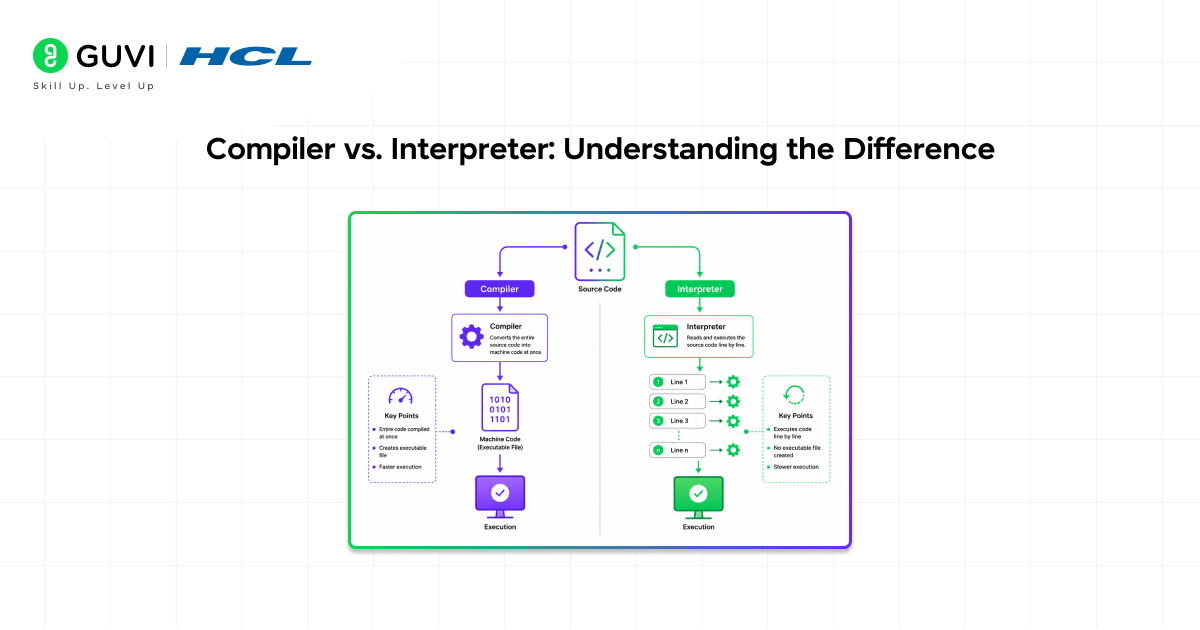
A related but distinct tool is the interpreter, and beginners often confuse the two. Understanding the difference helps clarify what a compiler uniquely does.
- A compiler reads the entire source program, processes it through all translation phases, and produces a complete executable file that can be run later. The compilation happens once. After that, running the program involves executing the compiled output directly, with no source code involved at runtime.
- An interpreter reads and executes source code line by line, translating and running each statement immediately without producing a persistent output file. Python’s interactive shell is an example of interpreted execution. The source code must be present every time the program runs.
- Interpreters support a read-eval-print loop that makes developing new programs much quicker. Compilers force developers to use a much slower edit-compile-run-debug loop. A typical program, when compiled with an ahead-of-time compiler, will, after the program has been compiled, run faster than the same program processed and run with a JIT compiler, which in turn may run faster than the same program run by an interpreter.
- In practice, many modern language implementations blend both approaches. Java compiles source code to bytecode, which is then interpreted or JIT-compiled by the Java Virtual Machine. Python compiles to bytecode before interpretation. The boundary between compilers and interpreters has become increasingly blurred.

The Seven Phases of a Compiler
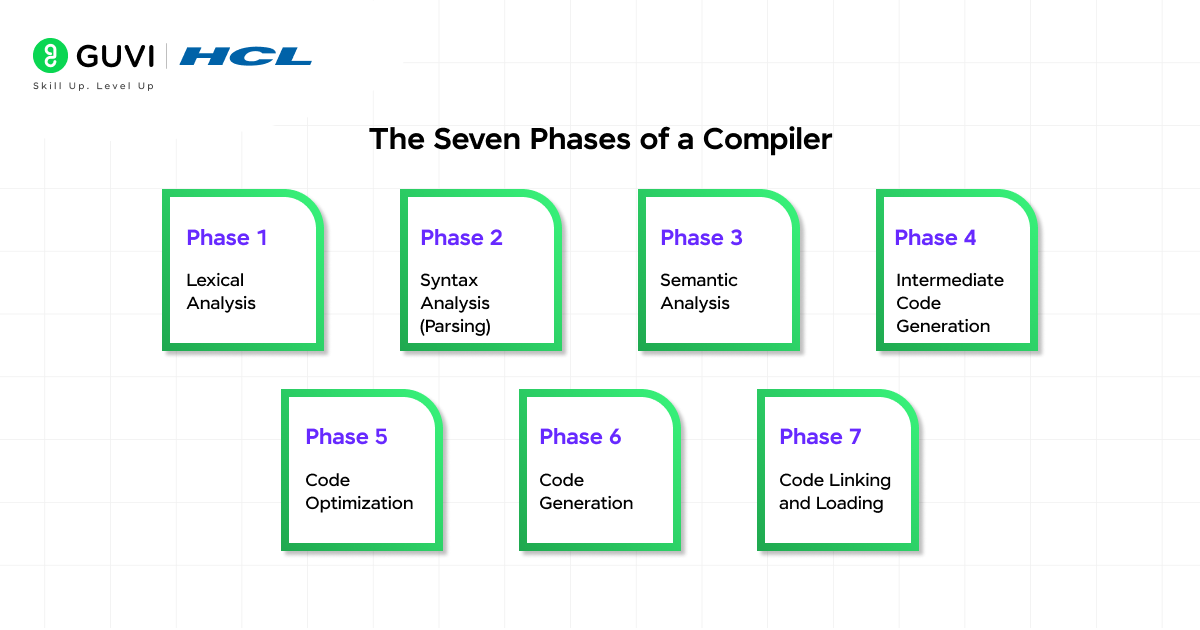
The translation from source code to machine code does not happen in one giant leap. It happens through a structured sequence of phases, each transforming the program into a progressively lower-level representation. The full process includes lexical analysis, parsing, semantic analysis, conversion to intermediate representation, code optimization, and machine-specific code generation.
Phase 1: Lexical Analysis
Lexical analysis is the first phase, and it is the most direct interface between the raw source code text and the compiler’s internal processing.
- Lexical tokenization is the conversion of a text into semantically or syntactically meaningful lexical tokens belonging to categories defined by a lexer program. In the case of a programming language, the categories include identifiers, operators, grouping symbols, data types, and language keywords. A lexer forms the first phase of a compiler frontend in processing.
- To make this concrete, consider a line of code like int x = 42 + y;. The lexer reads this character by character and groups the characters into tokens: int is a keyword, x is an identifier, = is an assignment operator, 42 is an integer literal, + is an arithmetic operator, y is an identifier, and; is a statement terminator. The lexer also strips out whitespace and comments, which carry no meaning for the compiler.
- The compiler reads your source code character by character, forms tokens which are the minimum meaningful units, and eliminates white spaces and comments during this step.
- The output of lexical analysis is a stream of tokens that the next phase can process. If the lexer encounters a character that cannot form any valid token in the language, it reports a lexical error, such as an illegal character.
Phase 2: Syntax Analysis (Parsing)
- With a stream of tokens in hand, the syntax analysis phase checks whether the token sequence follows the grammatical rules of the programming language and builds a tree structure that represents the program’s structure.
- Syntax analysis is responsible for looking at the syntax rules of the language, often as a context-free grammar, and building an intermediate representation of the language. An example of this intermediate representation could be an abstract syntax tree or a directed acyclic graph.
- Parsing forms a parse tree from tokens for structure-checking against programming grammar. Think of the parse tree as a hierarchical diagram of how different parts of your code relate to each other. An expression like 3 + 4 * 2 becomes a tree where multiplication is deeper than addition, reflecting the precedence rules of the language.
- If the token sequence does not match any valid grammatical rule, the parser reports a syntax error. This is the error you see when you forget to close a parenthesis, miss a semicolon, or write if x = 5 instead of if x == 5.
Phase 3: Semantic Analysis
A program can be syntactically correct but still be logically meaningless. Semantic analysis catches these deeper errors.
- Semantic analysis or context-sensitive analysis is a process in compiler construction, usually after parsing, to gather necessary semantic information from the source code. It usually includes type checking, or making sure a variable is declared before use, which is impossible to describe in extended grammar notation and thus not easily detected during parsing.
- In this phase, the compiler ensures that the parse tree conforms to meaning-related rules, like variables being declared before use.
- Practical examples of semantic errors include using a variable before declaring it, passing a string argument to a function that expects an integer, calling a method that does not exist on an object, or returning a value from a void function. None of these are syntax errors. The code is grammatically well-formed. But it violates the semantic rules of the language.
- The output of semantic analysis is an annotated version of the parse tree, enriched with type information and other semantic attributes gathered during this phase.
Phase 4: Intermediate Code Generation
After successfully analyzing the source program, the compiler generates an intermediate representation, a form of code that is between the high-level source language and low-level machine code.
- The compiler converts code into an intermediate form that is neither high-level nor machine code, easing subsequent processing.
- Three-address code is one of the most common forms of intermediate representation. In this format, every instruction has at most three operands. The expression a = b + c * d would be broken into: t1 = c * d, followed by t2 = b + t1, followed by a = t2. Temporary variables hold intermediate results.
- Sophisticated compilers typically perform multiple passes over various intermediate forms. This multi-stage process is used because many algorithms for code optimization are easier to apply one at a time, or because the input to one optimization relies on the completed processing performed by another optimization.
- The intermediate representation also makes it easier to target multiple platforms. If the same front-end phases generate a common intermediate form, different back-end generators can translate that intermediate code into machine code for different processors without duplicating all the analysis work.
Phase 5: Code Optimization
Code optimization improves the intermediate representation to produce faster, smaller, or more efficient machine code without changing what the program does.
- One of the smartest things a compiler can do is improve code without changing the output.
- Common optimization techniques include constant folding, where expressions with all constant operands like 3 + 4 are evaluated at compile time and replaced with their result 7. Dead code elimination removes instructions whose results are never used. Loop optimization reduces the work performed inside loops by moving invariant calculations outside the loop body. Common subexpression elimination avoids computing the same expression multiple times when the result has not changed.
- Each constant expression might be evaluated via compile-time execution to produce a value that results in improved runtime performance.
- Optimization can be applied at multiple levels: locally within a single basic block, at the scope of an entire function, or globally across the whole program. Each level of scope offers more optimization opportunities but requires more analysis.
Phase 6: Code Generation
Code generation is the phase where the optimized intermediate representation is finally translated into the target machine code or assembly language.
- In computing, code generation is part of the process chain of a compiler, in which an intermediate representation of source code is converted into a form such as machine code that the target system can readily execute. The input to the code generator typically consists of a parse tree or an abstract syntax tree. The tree is converted into a linear sequence of instructions, usually in an intermediate language such as three-address code.
- During code generation, the compiler must make decisions about register allocation, deciding which values live in CPU registers versus in memory. It must handle instruction selection, choosing the right machine instruction for each intermediate operation. It must manage memory layout for local variables, function call stacks, and heap allocations.
- The output of code generation is a sequence of machine instructions that the target processor can execute directly, or assembly language that an assembler then converts to binary machine code.
Phase 7: Code Linking and Loading
The final phase links the code with library functions and gets it ready for execution.
- After compilation, the resulting object file may reference functions and variables defined in other files or libraries. The linker resolves these references by combining multiple object files and library files into a single executable. When you call printf in a C program, the linker connects your call to the implementation of printf in the C standard library.
- The loader then takes the executable and prepares it for actual execution, loading it into memory and setting up the execution environment before the operating system hands control to the program’s entry point.
Compiler design is one of the clearest examples of how deep computer science theory powers everyday software engineering. Concepts from formal languages, context-free grammars, and finite automata became the foundation for practical tools that translate human-readable code into efficient machine instructions. Early compiler research made high-level programming languages and portable software possible, while modern infrastructures such as LLVM allow many languages to share the same highly optimized backend. Interestingly, the boundary between compilers and interpreters is often blurred today, since languages like Python first compile code into bytecode and platforms like Java combine bytecode execution with Just-In-Time (JIT) compilation for additional optimization.
Two Supporting Structures: Symbol Table and Error Handler
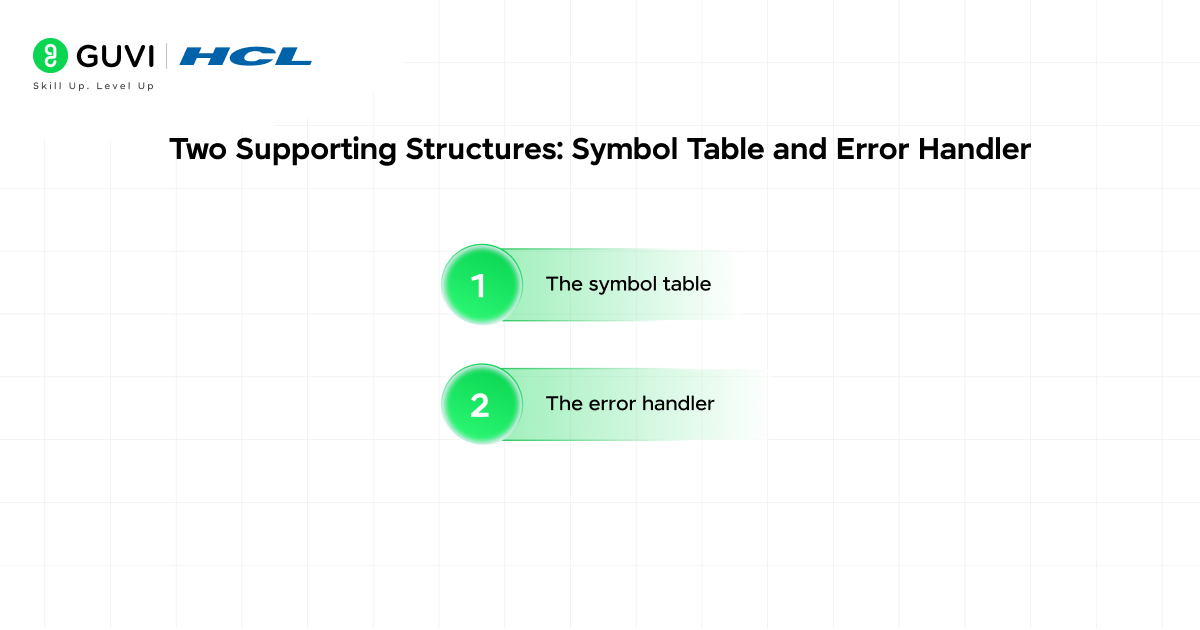
Running alongside all seven phases are two supporting structures that every phase interacts with throughout the entire compilation process.
- The symbol table
It is a shared data structure that stores information about every identifier in the source program, including variables, function names, and class names. Symbol tables for high-level programming languages may store the symbol’s type, such as string, integer, or floating-point; its size, and its dimensions and bounds.
When the semantic analysis phase checks whether a variable has been declared before use, it looks up the symbol table. When the code generation phase needs to know the memory size to allocate for a variable, it queries the symbol table. Every phase both reads from and writes to this central repository.
- The error handler
This manages the detection and reporting of errors across all phases. Rather than stopping at the very first error, a good compiler recovers from errors and continues processing so it can report multiple issues in a single compilation run. Compilation errors include undeclared identifiers, type mismatches, and syntax violations.
Most compilers check for these and provide informative error messages, including the file name, line number, and a description of the problem. The quality of error messages is one of the most important practical aspects of compiler usability.
Types of Compilers
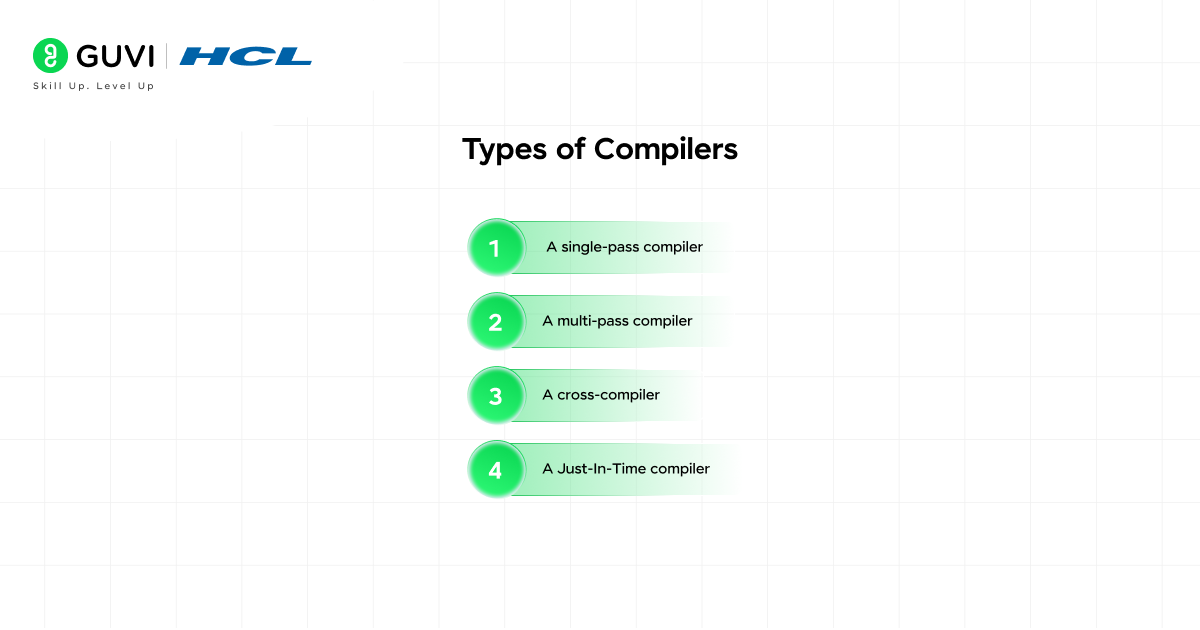
Not all compilers work the same way or serve the same purpose. Several important types exist, each suited to different contexts.
1. A single-pass compiler reads the source program exactly once and produces output in that single traversal. A one-pass compiler is a compiler that processes each compilation unit only once, sequentially translating each source statement or declaration into something close to its final machine code. One-pass compilers are smaller and faster than multi-pass compilers but are unable to generate as efficient programs due to the limited scope of available information.
2. A multi-pass compiler processes the source code or intermediate representation several times. Each pass takes the result of the previous pass as input and creates an intermediate output. In this way, the intermediate code is improved pass by pass until the final pass produces the final code. Multi-pass compilers can see the entire program being compiled, allowing better code generation at the cost of higher compile time and memory consumption.
3. A cross-compiler produces code for a different CPU or operating system than the one on which the cross-compiler itself runs. Cross-compilers are essential in embedded systems development, where the development machine runs a full operating system but the target device runs a microcontroller with no operating system at all.
4. A Just-In-Time compiler, commonly called a JIT compiler, compiles code at runtime rather than ahead of time. JIT compilation is a combination of ahead-of-time compilation and interpretation, combining some advantages and drawbacks of both. It combines the speed of compiled code with the flexibility of interpretation. JIT compilation allows adaptive optimization such as dynamic recompilation and microarchitecture-specific speedups. The JVM and JavaScript engines like Google’s V8 use JIT compilation to achieve near-native performance for managed languages.
The Front End and Back End of a Compiler
Compiler design often divides the compiler into two conceptual halves: the front end and the back end.
1. The front end
It is responsible for everything that depends on the source language: lexical analysis, syntax analysis, and semantic analysis. The front end is language-specific but machine-independent. If you want to support a new programming language, you write a new front end while keeping the same back end.
2. The back end
It is responsible for everything that depends on the target machine: code optimization and code generation. The back end is machine-specific but language-independent. If you want to target a new processor architecture, you write a new back end while keeping the same front end.
This separation is what allows compiler frameworks like LLVM to power compilers for many different languages, including C, C++, Swift, Rust, and Julia, all sharing the same powerful optimization and code generation back end while each using their own front end for language-specific analysis.
Why Compiler Design Matters for Developers
- Career opportunities in system programming, embedded systems, compiler development, and even cybersecurity hold compiler design knowledge in high esteem. Every software that works on a device goes through a compiler. Whether it is a game on your phone or a trading app on a server, it must get translated from human logic into machine action.
- Even if you never build a compiler yourself, understanding how compilers work deepens your practical programming skills in several ways. Knowing how the lexer tokenizes code helps you understand why certain constructs are ambiguous or problematic. Understanding semantic analysis clarifies why type systems exist and what type errors actually mean.
- Knowing about code optimization helps you write code that the compiler can optimize effectively, rather than accidentally writing patterns that prevent optimization. Understanding the linking phase explains why certain errors, like undefined references, only appear at link time rather than compile time.
If you’re serious about mastering compiler design, understanding how high-level code turns into machine instructions, the phases of a compiler, lexical and syntax analysis, and how modern compilers power languages like C, Java, and Python, don’t miss the chance to enroll in HCL GUVI’s Artificial Intelligence & Machine Learning Course, co-designed by Intel.
Wrapping Up
Compiler design is the discipline that makes programming languages practical. Without compilers, the gap between what humans think and what machines execute would be unbridgeable without enormous effort.
The seven-phase pipeline, from lexical analysis through code generation and linking, represents a systematic solution to the translation problem, with each phase making the program progressively closer to what the target hardware needs while catching and reporting errors along the way.
The field is rich with theory from formal language theory, automata, and type theory, but it is also deeply practical engineering. Every optimization that makes your favorite language fast, every error message that guides you to a bug, and every cross-platform tool that lets you write once and run anywhere is the result of careful compiler design.
For anyone serious about computer science, understanding these fundamentals is genuinely worthwhile, both for the theoretical clarity it brings and for the practical intuitions it builds about how the tools you use every day actually work.
FAQ
1. What’s the difference between a compiler and an interpreter?
A compiler translates the whole program ahead of time into executable code; an interpreter executes code statement‑by‑statement at runtime. Many modern systems mix both (bytecode + JIT).
2. Why have an intermediate representation (IR)?
IR decouples language‑specific analysis from machine‑specific code generation, enables multiple optimization passes, and lets one back end support many front ends.
3. How do compilers detect and report errors?
The lexer and parser report lexical/syntax errors; semantic analysis detects type, scope, and usage errors. A good compiler tries to recover and report multiple errors per run via a central error handler.
4. When does optimization occur and is it always safe?
Optimization runs after IR generation and before final code generation, at local, function, or global scope. Optimizations must preserve program semantics; aggressive optimizations require careful analysis to avoid changing observable behavior.
5. Why should everyday developers learn compiler design?
It improves understanding of language behavior, performance implications, debugging (why some errors appear only at link time), and helps write code patterns that compilers can optimize leading to faster, more reliable software.
Success Stories

About the Author
Vishalini Devarajan
An Aerospace Engineer turned content writer, I focus on making complex concepts easy to understand through well-structured, reader-friendly blogs. Whether it’s a technical topic or a non-technical one, I love creating content that is clear, engaging, and impactful.
View all posts by Vishalini Devarajan
Connect with me @










Did you enjoy this article?