


Artificial Intelligence and Machine Learning Articles
Is the HCL GUVI AI/ML Program Right for You? A Quick Self-Assessment
Inside the HCL GUVI AI/ML Curriculum: What You’ll Actually Build


Get In Touch For Details! Request More Information
Search Problem in AI: A Beginner’s Guide
Sep 10, 2026 5 Min Read 794 Views
(Last Updated)
The search problem in AI is all about exploring possible states or actions to find a path that leads to your goal, ideally the cheapest or fastest one. You actually deal with this every day, whether you realize it or not.
Think about planning a road trip with multiple stops. Your brain compares routes, weighs time against traffic, and picks one without much effort. That is search in action, just like AI, only with math instead of instinct.
Table of contents
- TL;DR Summary
- What is a Search Problem?
- Why Search Problems Matter in Artificial Intelligence?
- Parts of a Search Problem
- Initial State
- Goal State
- State Space
- Successor Function
- Path Cost
- Parts of a Search Problem: A Quick Breakdown
- How AI Agents Solve Search Problems
- Step 1: Define the Problem
- Step 2: Explore the State Space
- Step 3: Evaluate Possible Paths
- Step 4: Reach the Goal State
- Types of Search Algorithms in Artificial Intelligence
- Breadth First Search (BFS)
- Depth First Search (DFS)
- Uniform Cost Search
- Greedy Best First Search
- A* Search Algorithm
- Real-World Examples of Search Problems
- Navigation Systems
- Robotics
- Game AI
- Automated Planning
- Challenges in AI Search Problems
- Large State Spaces
- Time Complexity
- Memory Limitations
- Local Optima
- Problem Formulation in AI
- Conclusion
- FAQs
- What is a search problem in AI?
- What is the difference between the initial state and the goal state?
- What is a state space in artificial intelligence?
- Why is the successor function important in AI?
- Which search algorithm is most commonly used in AI?
TL;DR Summary
- This blog covers why search problems matter and what role they play in AI.
- It breaks down the core parts of a search problem, from initial state to path cost.
- It walks you through how AI agents move step by step from a problem to a solved goal.
- It explains major search algorithms like BFS, DFS, and A* and how they differ.
- It shows you where search problems show up in real life, and the challenges they run into along the way.
Chess has more positions than atoms in the observable universe, making it a proving ground for AI search algorithms still used today.
What is a Search Problem?
A search problem defines the task of getting from a starting point to a goal. It lays out the starting point, the goal, the possible actions the agent can take, and the cost of each move.
The agent then works through different options to find a path that actually reaches the goal, often the one that costs the least or takes the least time.
Example: Take Google Maps. When you enter a destination, it looks at available roads, checks traffic and distance, and figures out which route gets you there fastest. Behind that simple result, it has solved a search problem, comparing paths and picking the one that costs you the least time.
Want to actually build the AI systems you just read about, not just understand the theory behind them? The HCL GUVI’s Intel & IITM Pravartak Certified AI ML Course takes you from search algorithms to real-world skills like deep learning, GenAI, and agentic AI, with hands-on projects and placement support. Enroll today and make this your next AI career move!
Why Search Problems Matter in Artificial Intelligence?

Search problems are important because many AI systems work by exploring possibilities before making decisions.
Without proper problem formulation, an AI agent cannot understand:
- What problem does it need to solve
- What actions can it perform
- How success is measured
- Which solution is optimal
Search-based AI is widely used in:
- Robotics
- Self-driving cars
- Virtual assistants
- Game AI
- Route optimization
- Recommendation systems
- Automated planning systems
Modern AI systems also rely on search and optimization techniques behind the scenes to generate intelligent responses and make decisions.
Parts of a Search Problem
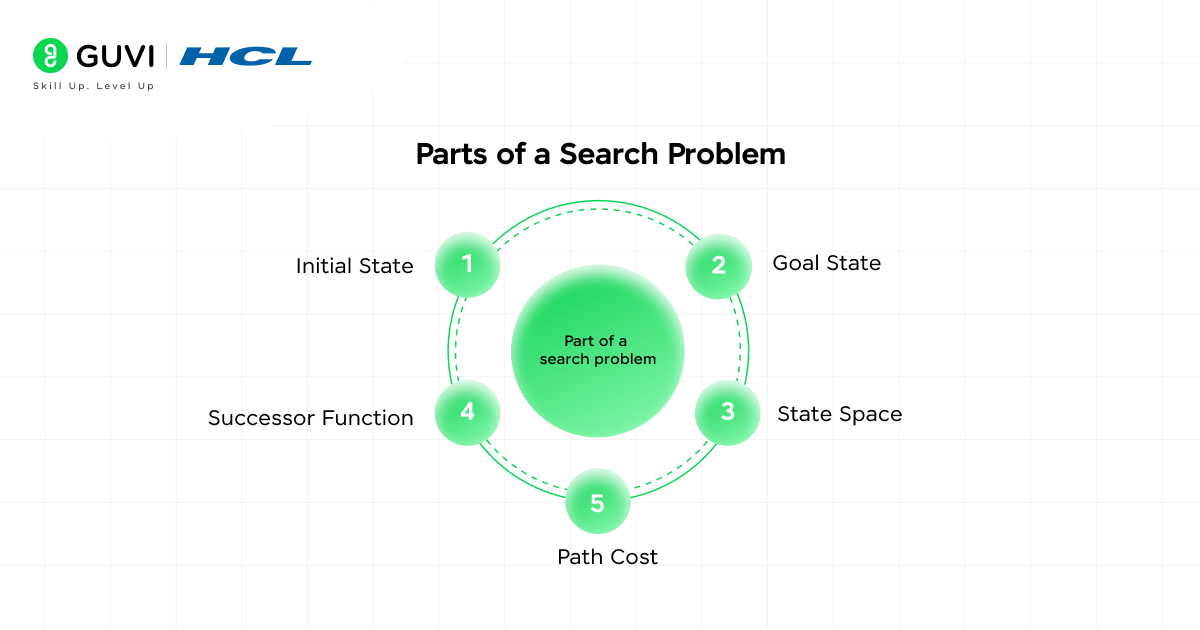
A search problem in artificial intelligence consists of several important components. These components define the environment and guide the AI agent toward the solution.
1. Initial State
The initial state represents the agent’s starting position.
It describes the system’s condition before any action.
For example:
- In chess, the initial state is the starting arrangement of pieces.
- In a maze problem, it is the agent’s starting position.
- In navigation systems, it represents the current location.
The AI agent begins its search from this state.
2. Goal State
The goal state is the desired outcome that the AI agent wants to achieve.
Once the agent reaches this state, the problem is considered solved.
Examples include:
- Checkmating the opponent in chess
- Reaching a destination in navigation systems
- Solving a puzzle configuration
The goal state acts as the target for the search algorithm.
3. State Space
The state space contains all possible states the agent can explore.
Simple problems may have a small state space, while real-world AI systems often contain extremely large numbers of possible states.
For example:
- Tic-tac-toe has a relatively small state space.
- Chess contains billions of possible board configurations.
Efficient AI systems try to reduce unnecessary exploration within the state space.
4. Successor Function
The successor function defines the actions possible from a particular state.
It helps the AI agent move from one state to another.
For example:
- A robot may move left, right, forward, or backward.
- In chess, every legal move creates a new state.
- In navigation systems, connected roads create successor states.
The successor function generates future possibilities for the AI system.
5. Path Cost
Path cost represents the total cost required to reach the goal state.
The cost may include:
- Distance
- Time
- Energy consumption
- Risk
- Resource usage
AI systems generally try to minimize path cost while solving problems.
For example, Google Maps may choose either the shortest or fastest route depending on traffic conditions.
Parts of a Search Problem: A Quick Breakdown
Here’s a quick breakdown of these five components:
| Component | Definition | Real-World Example | Why It Matters |
|---|---|---|---|
| Initial State | The agent’s starting point before any action is taken | The starting arrangement of pieces in chess | Every search begins here, it sets the baseline the agent works from |
| Goal State | The outcome the agent is trying to reach | Reaching your destination in a navigation app | Gives the search direction and tells the agent when to stop |
| State Space | The full set of states the agent could possibly explore | Chess has billions of possible board positions | Shows how complex a problem is and why some searches take longer |
| Successor Function | The set of possible actions from a given state | A robot’s ability to move left, right, forward, or backward | Determines what paths the agent can even consider next |
| Path Cost | The total cost, like time, distance, or resources, to reach the goal | Google Maps picking the fastest route based on traffic | Helps the agent choose the most efficient path, not just any path |
How AI Agents Solve Search Problems

AI agents solve search problems by exploring different states until they reach the goal state.
The process generally follows these steps:
Step 1: Define the Problem
The AI system identifies:

- Initial state
- Goal state
- Possible actions
- Constraints
This stage is known as problem formulation.
Step 2: Explore the State Space
The search algorithm systematically explores possible states.
Depending on the algorithm, exploration may happen:
- Level by level
- Depth-wise
- Cost optimized
- Heuristic driven
Step 3: Evaluate Possible Paths
The AI agent evaluates different paths using metrics such as:
- Distance
- Time
- Estimated success
- Resource efficiency
Step 4: Reach the Goal State
Once the algorithm finds the goal state, it returns the sequence of actions needed to solve the problem.
Types of Search Algorithms in Artificial Intelligence
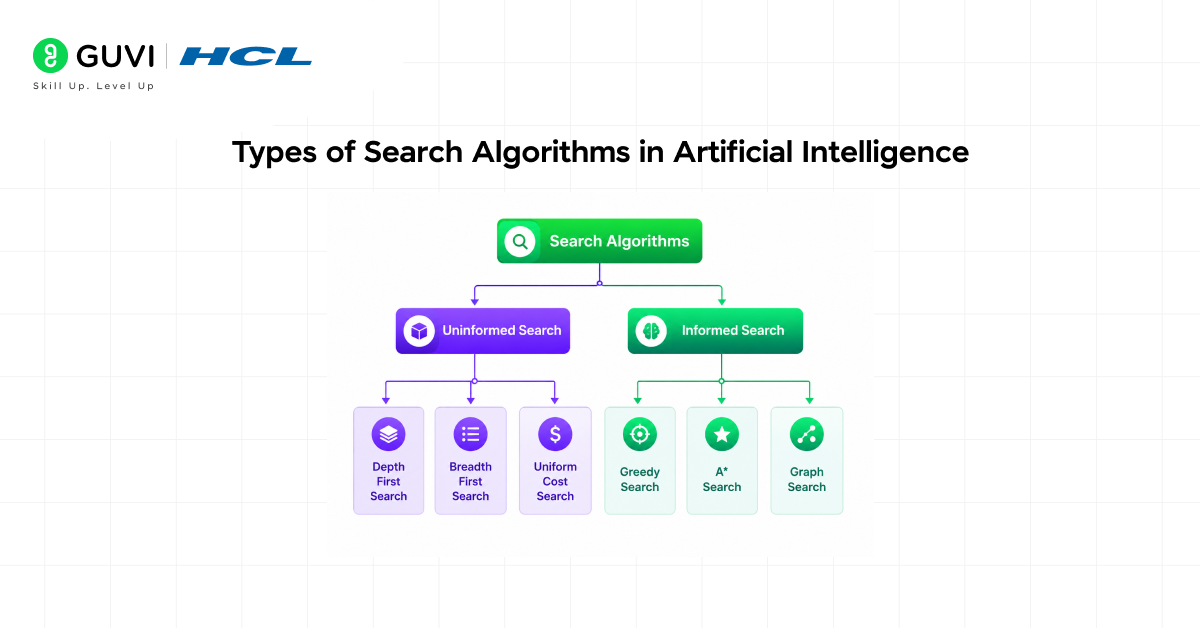
Different search algorithms solve problems differently depending on complexity and efficiency requirements.
Breadth First Search (BFS)
Breadth First Search explores states level by level before moving deeper into the search tree.
Characteristics:
- Guarantees the shortest path in unweighted problems
- Uses a queue data structure
- Requires high memory for large problems
BFS is commonly used for shortest-path and graph-traversal problems.
Algorithms such as BFS and DFS are part of uninformed search strategies in AI, where the system explores states without additional heuristic knowledge.
Depth First Search (DFS)
Depth-first search explores one branch deeply before backtracking.
Characteristics:
- Uses a stack data structure
- Requires less memory
- May not always find the optimal solution
DFS works well when solutions are expected deep inside the search tree.
If you want to understand how DFS explores deep search paths before backtracking, this detailed guide on DFS in AI explains the concept with examples.
Uniform Cost Search
Uniform Cost Search expands the path with the lowest cumulative cost.
It is especially useful when different actions have different costs.
Greedy Best First Search
Greedy Best First Search selects the state that appears closest to the goal.
It uses heuristic functions to estimate future success.
Although fast, it may not always produce the optimal solution.
Greedy approaches are closely related to Best First Search in AI, where algorithms prioritize states that appear closer to the goal.
A* Search Algorithm
A* is one of the most widely used search algorithms in artificial intelligence.
It combines:
- Actual path cost
- Estimated future cost
This makes A* both efficient and optimal in many real-world applications.
To understand how intelligent systems explore possible solutions efficiently, you can also learn about different search algorithms in AI and their real-world applications.
Real-World Examples of Search Problems
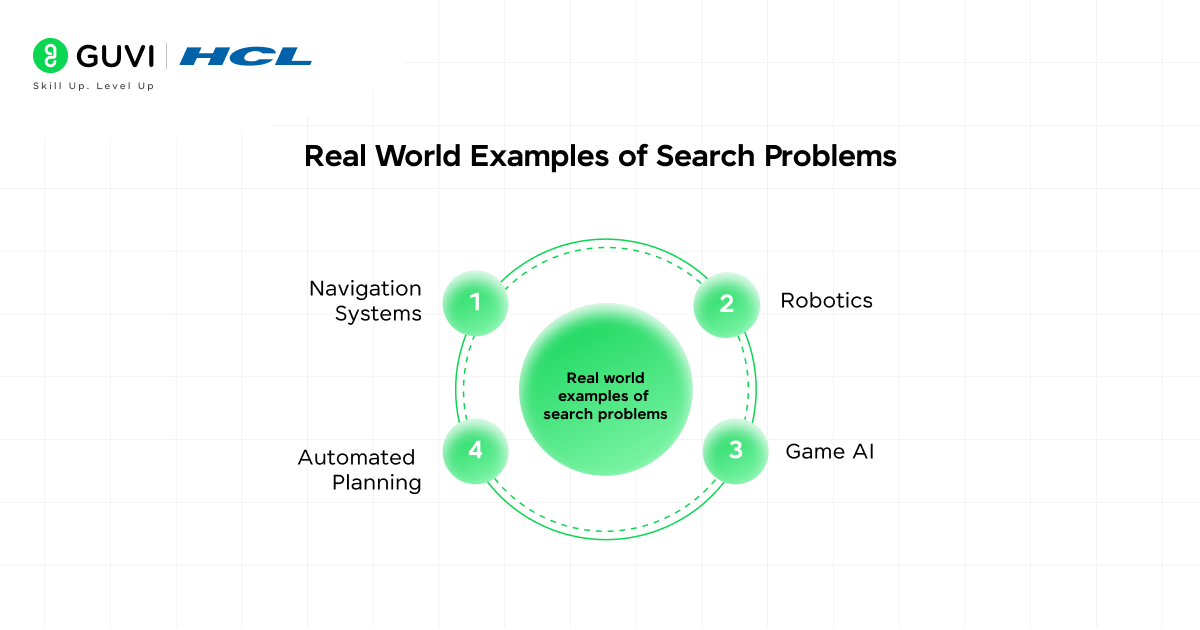
Search problems exist throughout modern technology.
Navigation Systems
Applications like Google Maps search through road networks to find the best route.
The system considers:
- Distance
- Traffic
- Road conditions
- Travel time
Robotics
Robots use search algorithms to navigate environments and avoid obstacles.
Warehouse robots especially rely heavily on AI-based pathfinding.
Game AI
Chess engines and video game opponents use search algorithms to predict future moves and select strategies.
In-game AI systems, concepts such as adversarial search in AI help intelligent agents predict and respond to opponent actions strategically.
Automated Planning
AI assistants use planning and search methods to organize tasks and optimize schedules.
Challenges in AI Search Problems
Although search problems sound simple conceptually, real-world AI systems face major challenges.
Large State Spaces
Some problems contain millions or billions of possible states.
Exploring all possibilities becomes computationally impossible.
Time Complexity
Many search algorithms become slower as the problem size increases.
Memory Limitations
Algorithms like BFS consume large amounts of memory in complex problems.
Local Optima
Certain algorithms may get trapped in solutions that appear good temporarily but are not globally optimal.
This is why heuristic-driven and intelligent search methods are important in modern AI.
Problem Formulation in AI
Problem formulation converts a real-world task into a structured search problem.
A good problem formulation helps AI systems:
- Reduce unnecessary computation
- Improve efficiency
- Reach solutions faster
- Avoid irrelevant states
Poor problem formulation can make even simple problems difficult to solve.
This is why defining the right state space and successor functions is critical in artificial intelligence.
Conclusion
Search problems sit at the core of how AI thinks and acts, quietly powering everything from the apps you use daily to the algorithms shaping the future of automation. Understanding them is not just for engineers or researchers; it is a lens that helps anyone make sense of how intelligent systems make decisions in a world full of choices.
FAQs
1. What is a search problem in AI?
A search problem in AI is a framework where an intelligent agent searches for a sequence of actions that transforms an initial state into a goal state.
2. What is the difference between the initial state and the goal state?
The initial state represents the AI agent’s starting condition, while the goal state represents the desired outcome.
3. What is a state space in artificial intelligence?
A state space is the collection of all possible states that an AI agent can explore while solving a problem.
4. Why is the successor function important in AI?
The successor function defines possible actions from a given state and helps generate future states during problem-solving.
5. Which search algorithm is most commonly used in AI?
A* search is one of the most widely used AI search algorithms because it balances efficiency and optimal pathfinding effectively.
Success Stories













Did you enjoy this article?