


Software Development Articles
System Engineer Roles and Responsibilities: 12 Proven Duties for Growth
SAP Consultant Roles and Responsibilities: 12 Proven Duties for Growth and Success
Network Engineer Roles and Responsibilities: 12 Essential Duties for Success
How to Avoid Burnout as a Software Developer: 7 Practical Strategies


Get In Touch For Details! Request More Information

Monolithic Architecture Explained: A Complete Guide for All
Jun 29, 2026 6 Min Read 591 Views
(Last Updated)
When you’re learning system design, one of the first architectural patterns you’ll come across is the monolith. And for good reason, it’s where most software actually starts.
Before cloud-native platforms, distributed systems, and microservices became industry buzzwords, the monolithic architecture was the default way to build applications. Everything lived under one roof: the user interface, the core business logic, and the database layer — all packaged and deployed together as a single unit.
Today, monolithic architecture is a foundational concept you’re expected to understand as a CS student, especially in system design interviews and software engineering roles. Knowing what it is, how it works, and when its limitations kick in will help you make better architectural decisions throughout your career.
This article walks you through everything you need to know, clearly, practically, and without unnecessary fluff. So, without further ado, let us get started!
Table of contents
- TL;DR Summary
- What is Monolithic Architecture?
- How Does It Work? The Three-Layer Model
- Presentation Layer
- Business Logic Layer
- Data Access Layer
- Types of Monolithic Architecture
- Single-Process Monolith
- Modular Monolith
- Layered (N-Tier) Monolith
- Advantages of Monolithic Architecture
- Simpler to Develop and Understand
- Easier Debugging and Testing
- Straightforward Deployment
- Better Performance for Internal Operations
- Lower Initial Operational Complexity
- Disadvantages of Monolithic Architecture
- Scalability Becomes Difficult
- Deployment Risk Increases Over Time
- The Codebase Becomes Hard to Maintain
- Technology Lock-In
- Single Point of Failure
- Monolithic vs. Microservices: A Quick Comparison
- Real-World Examples
- When Should You Use Monolithic Architecture?
- Conclusion
- FAQs
- What is monolithic architecture in simple terms?
- Is monolithic architecture still used in 2026?
- What are the three layers of monolithic architecture?
- What is the biggest disadvantage of monolithic architecture?
- What is the difference between monolithic and microservice architectures?
TL;DR Summary
- Monolithic architecture is a traditional software design approach where the entire application, UI, business logic, and database layer is built and deployed as a single, unified unit.
- It is one of the most widely taught concepts in system design and is still actively used in production systems across industries today.
- This guide breaks down how monolithic architecture works, the three layers it consists of, and the real trade-offs you’ll face when working with it.
- You’ll also learn about the types of monolithic architecture, when it makes sense to use it, and where it starts to show its limitations as a system grows.
- A brief comparison with microservices is included to help you understand when teams make the switch, and why it’s not always the right call.
What is Monolithic Architecture?
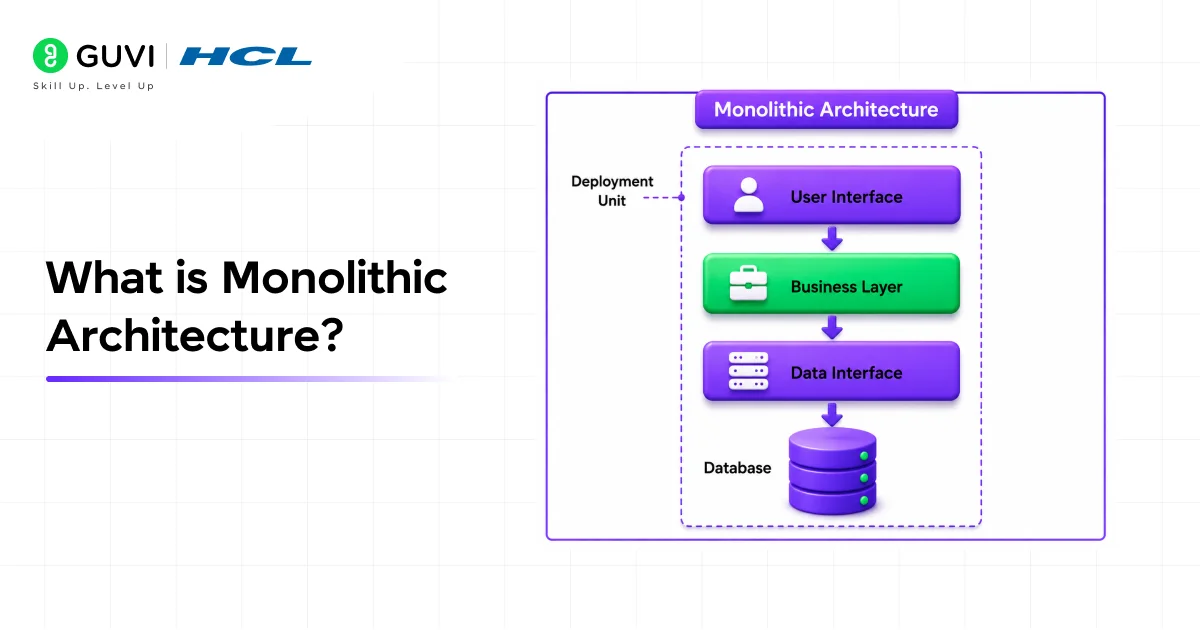
At its core, monolithic architecture is a software design pattern where an application is built as a single, self-contained unit. All the components of the application, the user interface, the business logic, and the data access layer, are tightly coupled and run together as one deployable package.
The term “monolithic” comes from the word monolith, which refers to a single large block of stone. That’s an accurate metaphor for how this architecture behaves: everything is part of one solid, connected structure.
In a monolithic system, there is one codebase, one deployment process, and typically one shared database. When you make a change anywhere in the application, you redeploy the entire thing.
This might sound rigid, but it’s also what makes monolithic systems straightforward to build and understand, especially when you’re just starting out.
How Does It Work? The Three-Layer Model
A standard monolithic application is typically organized into three distinct layers. These layers work together within the same codebase and are deployed as one unit.
Presentation Layer
This is the layer users interact with directly, the user interface. It handles all incoming requests from users, whether through a web browser or a mobile app. In a web application, this might include your HTML templates, CSS, and JavaScript rendered on the server side.
Business Logic Layer
This is the brain of the application. It contains the core rules, workflows, and calculations that define what your application actually does. For example, in an e-commerce app, this layer handles pricing rules, discount logic, and order processing.
Data Access Layer
This layer is responsible for communicating with the database. It reads, writes, and updates records based on what the business logic layer requests. In a monolith, all of these operations go through a single shared database.
Here’s what makes this architecture distinct: all three layers exist within the same codebase, run in the same process, and are deployed together every single time you push an update.
Some of the world’s most successful early-stage companies, including Amazon, Twitter, and Shopify, started as monolithic applications. Amazon, for instance, began as a single monolithic system before its scale forced a migration to a distributed architecture. The monolith wasn’t a mistake; it was the right choice for where they were at the time.

Types of Monolithic Architecture
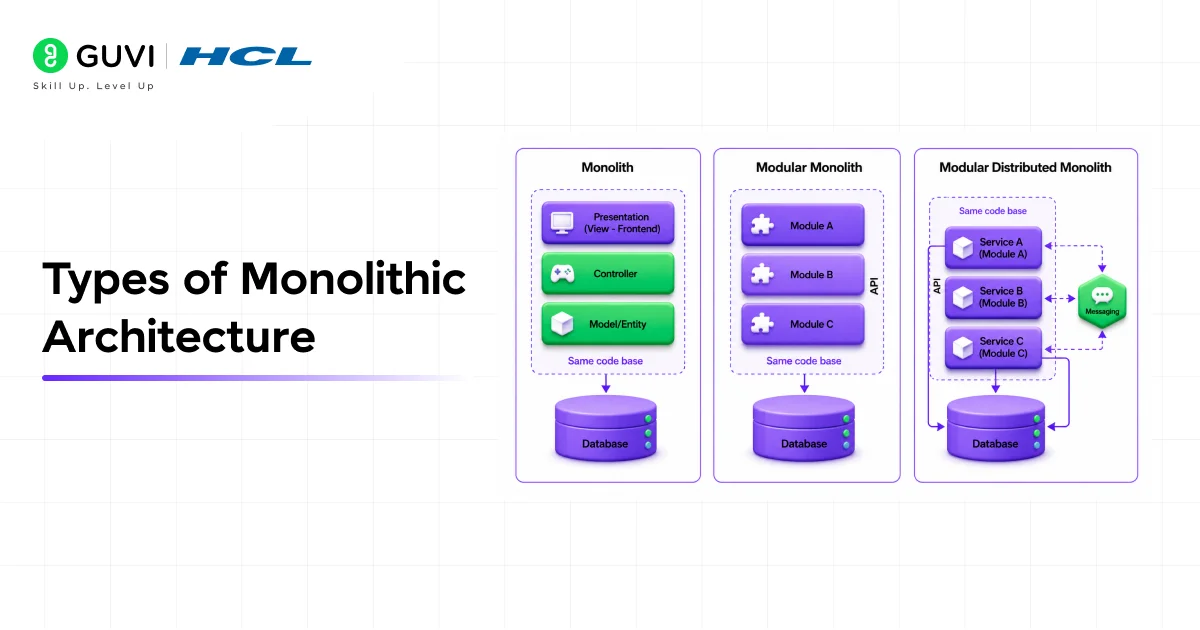
Not all monoliths are structured the same way. As you go deeper into system design, you’ll encounter a few variations worth knowing.
Single-Process Monolith
This is the classic form. The entire application runs as a single process on one server. It’s the simplest version and the one most commonly taught in academic settings.
Modular Monolith
A modular monolith organizes the codebase into separate, well-defined modules, each representing a distinct domain or feature, but still deploys everything together as a single unit. Think of it as a cleaner, more disciplined version of the classic monolith.
This approach gives you better internal structure and makes future separation easier, without taking on the full complexity of microservices.
Layered (N-Tier) Monolith
This is the three-layer model described earlier: presentation, business logic, and data access, structured explicitly within the codebase. Most enterprise applications you’ll encounter in internships or entry-level roles follow this pattern.
Advantages of Monolithic Architecture
Understanding why monolithic architecture is still widely used requires looking at its genuine strengths, not just what’s written in textbooks, but what actually matters in practice.
Simpler to Develop and Understand
When you start working on a project, having everything in one place is a significant advantage. There’s no need to manage multiple services, coordinate deployments across systems, or track down errors across a distributed network. New developers on a team can get productive faster because the entire application is visible in one codebase.
Easier Debugging and Testing
Since all components share the same process, tracing a bug from the user interface all the way down to the database is much more straightforward. You run one application, step through the code in one debugger, and see the full picture. Writing integration tests is also simpler because you don’t need to mock external services.
Straightforward Deployment
In a monolith, deployment means building one artifact and pushing it to a server. There’s one pipeline, one build process, and one thing to monitor. For small teams or early-stage products, this simplicity is genuinely valuable.
Better Performance for Internal Operations
Because all components live within the same memory space, internal communication happens through direct function calls rather than network requests. This eliminates the latency that comes with inter-service communication, which is a real overhead in distributed systems.
Lower Initial Operational Complexity
You don’t need a container orchestration platform, a service mesh, or distributed tracing tools when you’re running a monolith. The infrastructure requirements are minimal compared to managing dozens of independent services.
Disadvantages of Monolithic Architecture
Monolithic architecture works well until it doesn’t, and understanding where it breaks down is just as important as knowing its strengths.
Scalability Becomes Difficult
In a monolith, you can’t scale individual components independently. If your application gets high traffic on the checkout page, you can’t scale just that part. You have to scale the entire application, even the parts that don’t need it. This leads to inefficient resource usage as the system grows.
Deployment Risk Increases Over Time
As the codebase grows, every deployment carries more risk. A small change in one module can unintentionally break another. Since you’re deploying everything at once, even a minor bug can take down the entire application. This is often described as one of the key reasons teams start exploring other architectural patterns.
The Codebase Becomes Hard to Maintain
Over time, without strict discipline, a monolithic codebase can evolve into what developers call a “big ball of mud”, a system where everything is tangled together and making any change feels risky. Adding new features slows down because the team has to understand large, interconnected chunks of code before touching anything.
Technology Lock-In
Because all components share the same codebase and runtime, it’s very difficult to use different technologies for different parts of the application. If your monolith is built in Java, adding a Python-based machine learning component becomes a significant challenge. You’re largely locked into the stack you started with.
Single Point of Failure
If a critical bug crashes the application process, the entire system goes down, not just the affected feature. There’s no fault isolation between components in a standard monolith.
Monolithic vs. Microservices: A Quick Comparison
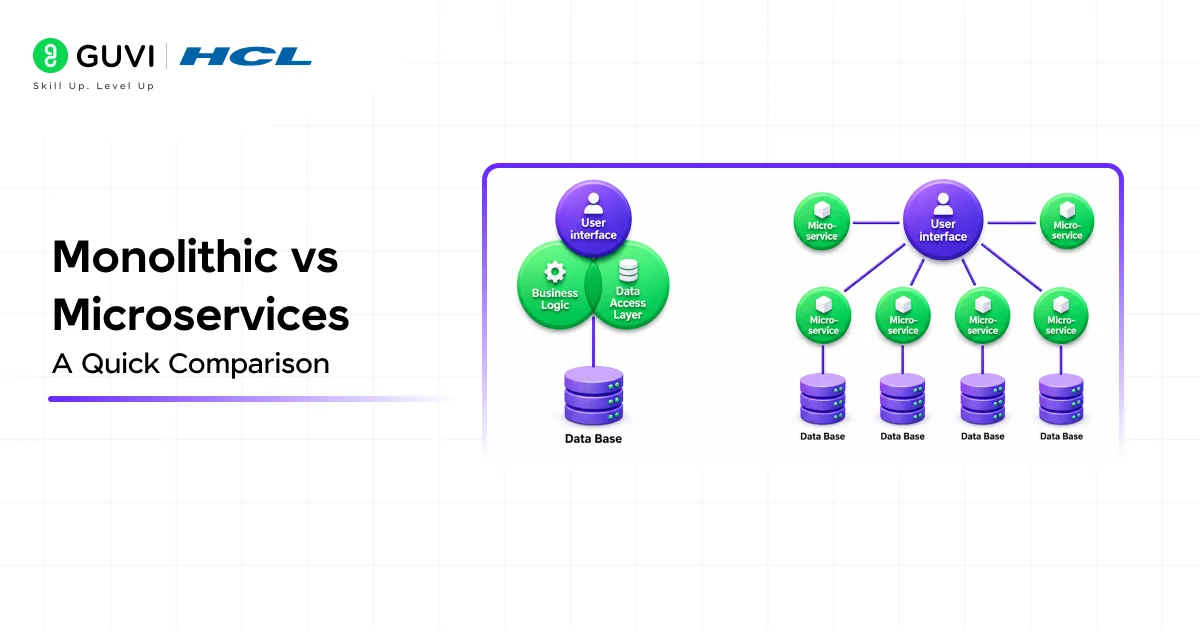
You’ll often hear monolithic architecture discussed in contrast to microservices. Here’s a concise breakdown to help you understand the key differences.
| Feature | Monolithic | Microservices |
| Deployment | Single unit | Independent services |
| Scalability | Scale entire app | Scale individual services |
| Development Speed (early stage) | Faster | Slower |
| Complexity | Lower initially | Higher, but more manageable at scale |
| Fault Isolation | None | Each service fails independently |
| Technology Flexibility | Limited | High |
| Best For | Small teams, MVPs, early-stage products | Large, complex, high-traffic systems |
The important takeaway here is that neither architecture is universally better. Microservices solve the problems that monoliths create at scale, but they introduce their own complexity. Many teams start with a monolith and migrate later, which is a perfectly valid approach.
Know More: Microservices vs. Monolithic Architecture: Key Differences
Real-World Examples
Seeing how monolithic architecture applies in the real world makes the concept much easier to internalize.
Traditional E-Commerce Platforms: A classic e-commerce application with a product catalog, shopping cart, payment processing, and order management, all within a single codebase, is a textbook monolithic system. Many older retail platforms still run this way.
WordPress: WordPress, which powers a significant portion of the web, is a well-known example of a monolithic application. The core themes, plugins, and database interactions all operate within a unified system.
Early Amazon: Amazon started as a monolith. All product listings, user accounts, payments, and recommendations were part of a single application. As the platform scaled to millions of users, the limitations of that architecture became clear, which eventually led to the shift toward distributed services.
Banking and Government Systems: Many legacy banking applications and government portals were built as monoliths decades ago. They still run today, not because they’re ideal, but because they work, and migration at that scale is extraordinarily complex.
Shopify, one of the world’s largest e-commerce platforms, ran as a Ruby on Rails monolith for many years before adopting a modular approach. The company has been vocal about the fact that their monolith enabled rapid early growth, and that moving away from it requires enormous effort even with the resources of a company their size.
When Should You Use Monolithic Architecture?
This is the question that actually matters in practice. Here are the situations where choosing a monolith makes the most sense:
- You’re building an MVP or prototype. Speed to market matters more than architectural elegance in the early stages. A monolith lets you build, test, and iterate faster.
- Your team is small. Managing a microservices infrastructure requires significant DevOps expertise. A monolith keeps things manageable for a small team.
- The domain is not yet fully understood. If you’re still figuring out how different parts of your system interact, a monolith allows you to refactor freely without dealing with distributed system boundaries.
- Performance is a priority for internal operations. If your application relies heavily on internal data processing where latency matters, a monolith’s in-process communication has an edge.
- Your application is simple and unlikely to grow significantly. Not every application needs to scale to millions of users. For internal tools, administrative dashboards, or small-scale platforms, a monolith is often the right long-term choice.
If you want to learn more about system designs like this and want to implement them in your workflow, then consider enrolling for HCL GUVI’s Self-Paced System Design Online Course and dive into the world of low-level and high-level design principles, design patterns, databases, scaling, caching, and more with industry-grade certification!
Conclusion
In conclusion, monolithic architecture is not a relic of the past, it’s a practical, well-understood pattern that remains relevant in 2026. For CS students, understanding it thoroughly is essential, both for system design discussions and for real-world engineering decisions.
The ability to recognize when a monolith is the right choice, and when it’s starting to become a liability, is the kind of judgment that takes time to develop. Start by building something with a monolithic approach. Understand its structure from the inside. That hands-on experience will make concepts like microservices, service decomposition, and distributed systems far more meaningful when you encounter them next.
Architecture is never about following trends; it’s about matching the design to the problem you’re solving right now.
FAQs
What is monolithic architecture in simple terms?
Monolithic architecture is a way of building software where the entire application, user interface, business logic, and database layer are combined into a single codebase and deployed as one unit.
Is monolithic architecture still used in 2026?
Yes, widely. Many production systems, including legacy banking platforms, CMS tools like WordPress, and early-stage startups, continue to use monolithic architecture because of its simplicity and lower operational overhead.
What are the three layers of monolithic architecture?
The three layers are the presentation layer (UI), the business logic layer (core application rules), and the data access layer (database communication). All three operate within the same codebase and deployment.
What is the biggest disadvantage of monolithic architecture?
The most significant limitation is scalability. In a monolith, you cannot scale individual components independently; the entire application must be scaled as one unit, which becomes inefficient and costly at high traffic volumes.
What is the difference between monolithic and microservice architectures?
In a monolith, all components are bundled and deployed together. In microservices, the application is broken into independent services that are deployed and scaled separately. Microservices offer more flexibility at scale but introduce greater operational complexity.
Success Stories

About the Author
Lukesh S
A professional content writer who has experience in freelancing and now working as a Technical Content Writer at HCL GUVI having sound knowledge in Blog Writing and Creative Writing!
View all posts by Lukesh S
Connect with me @














Did you enjoy this article?