


Artificial Intelligence and Machine Learning Articles
AI/ML Skills Gap 2026: Why Companies Can't Find Job-Ready Talent
20 AI/ML Interview Questions Recruiters Can Use Without a Tech Background - Best Guide
How Industry-Backed AI/ML Bootcamps Are Changing the AI/ML Hiring Pipeline - Best Guide 2026
From IT Support to AI Engineer: A Realistic Career Switch Guide 2026


Get In Touch For Details! Request More Information
Simple Reflex Agent: How AI Acts Without Thinking Ahead
Jul 09, 2026 7 Min Read 852 Views
(Last Updated)
You touch a hot stove. You pull your hand back instantly.
No planning. No memory of past burns. No calculation of future consequences. Just stimulus and immediate response.
This is exactly how a simple reflex agent works. It perceives the current environment, matches what it sees to a predefined rule, and acts. No history. No goals. No internal model of the world.
Sounds too primitive to be useful?
This guide will show you exactly how simple reflex agents work, where they perform brilliantly, where they collapse completely, and how understanding them builds the foundation for every more advanced AI agent architecture you will ever encounter.
Table of contents
- Quick TL;DR Summary
- What a Simple Reflex Agent Actually Does
- How the Agent Architecture Works
- Practice problems to try:
- Condition-Action Rules: The Core of Reflex Intelligence
- Limitations That Simple Reflex Agents Cannot Overcome
- Simple Reflex Agent vs. Other Agent Types
- Real-World Applications of Simple Reflex Agents
- Final Thoughts
- FAQs
- Can a simple reflex agent handle environments it has never seen before?
- What is the difference between a simple reflex agent and a model-based reflex agent?
- Is a thermostat really an AI agent?
- Why study simple reflex agents if they are so limited?
- Can simple reflex agents be combined with learning to improve over time?
Quick TL;DR Summary
- A simple reflex agent is the most basic type of AI agent that selects actions based entirely on the current percept using condition-action rules, with no memory of past states.
- It perceives its environment through sensors, matches the current input to a set of predefined rules, and executes the corresponding action immediately.
- This guide explains how the agent architecture works, how condition-action rules are structured, and what kinds of environments suit this agent type best.
- You will learn the difference between simple reflex agents and other agent types like model-based, goal-based, and utility-based agents, including when each is appropriate.
- The article also covers real-world applications, key limitations, and the foundational role simple reflex agents play in understanding intelligent systems in artificial intelligence.
What is a Simple Reflex Agent?
A Simple Reflex Agent is an AI system that makes decisions based only on the current situation, without considering past experiences or future outcomes. It works using predefined condition-action rules, meaning it responds immediately to specific inputs with fixed actions.
What a Simple Reflex Agent Actually Does
- It Responds to the Present, Not the Past
A simple reflex agent has no memory. It does not store what happened in the previous moment, the previous hour, or ever. Every decision is made entirely from what the sensors are reading right now.
This sounds like a weakness and it often is. But in environments where the current state contains all the information needed to make the right decision, this is not a bug. It is an efficient design choice that eliminates unnecessary computational overhead.
- It Uses Condition-Action Rules to Drive Every Decision
The intelligence of a simple reflex agent lives entirely in its rule set.
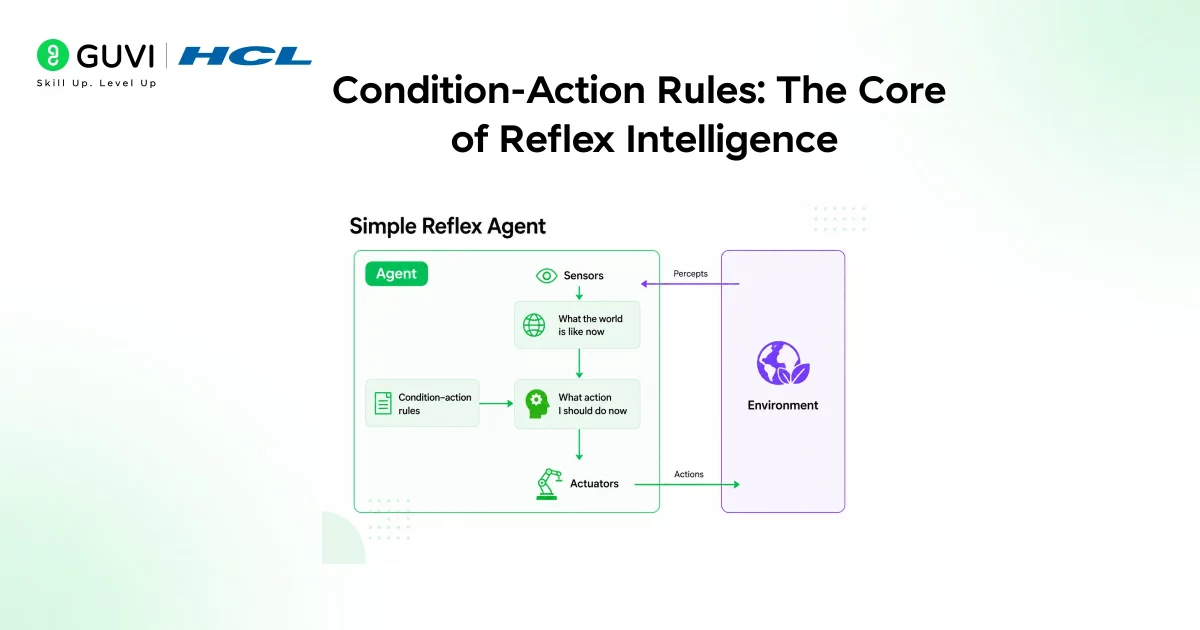
Each rule takes the form: if this condition is true in the current percept, then perform this action. The agent scans its rules, finds the one whose condition matches what it currently perceives, and executes the corresponding action. No deliberation. No ranking of options. No weighing of consequences.
The quality of the agent is therefore determined entirely by the quality of the rules written into it.
- It Operates Through a Perceive-Match-Act Cycle
Every tick of operation follows the same three-step loop.
First, the agent perceives the environment through its sensors and receives a current percept. Second, it matches that percept against its condition-action rules to find which rule applies. Third, it executes the action specified by the matching rule.
Then the cycle repeats. Perceive. Match. Act. Again and again, with no accumulation of experience between cycles.
- It Is Fully Reactive and Architecturally Simple
There is no planning module. No world model. No goal representation. No utility calculation.
This architectural simplicity is what makes simple reflex agents fast, predictable, and easy to build, test, and debug. When the rules are well-designed for the environment, they perform reliably. When the environment changes in ways the rules did not anticipate, they fail transparently.
Read More: Types of AI Agents: A Practical Guide with Examples
How the Agent Architecture Works
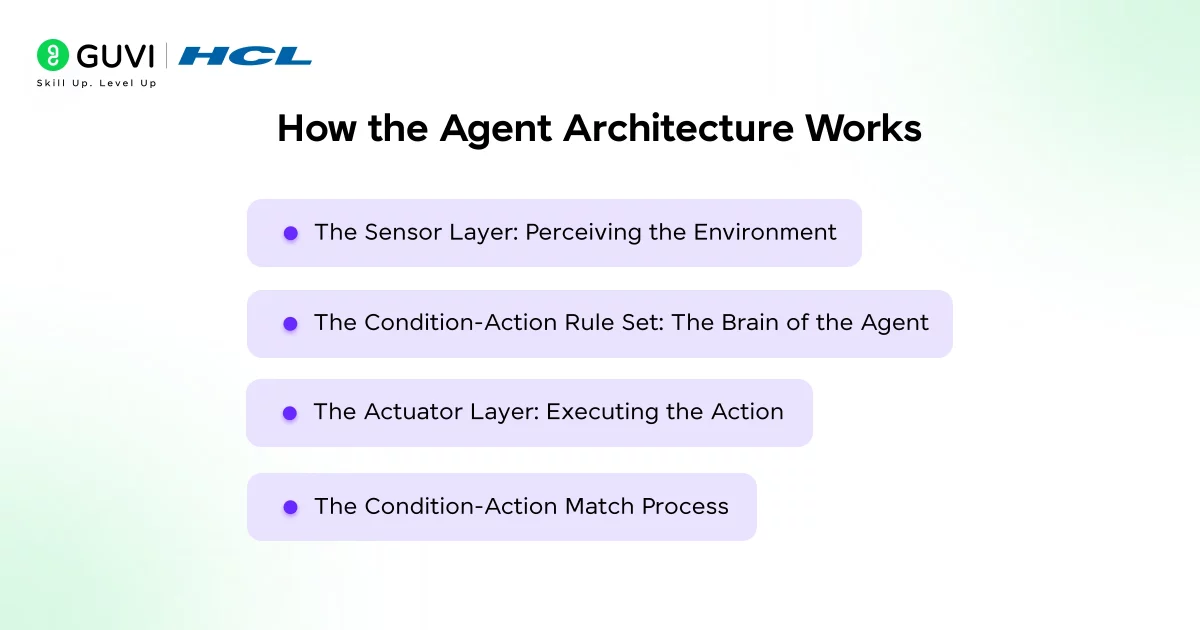
- The Sensor Layer: Perceiving the Environment
Sensors are the agent’s only window into the world. They capture the current state of the environment and convert it into a percept that the agent can process.
In a thermostat, the sensor is a temperature gauge. In a spam filter, the sensor reads incoming email content. In a vacuum cleaning agent, the sensor detects whether the current location is dirty or clean.
The agent knows only what its sensors report at this exact moment. Nothing more.
- The Condition-Action Rule Set: The Brain of the Agent
Rules are evaluated against the current percept to determine action. A well-designed rule set covers every significant percept the agent is likely to encounter and maps each one to a sensible response.
Example rules for a simple vacuum agent:
- If current location is dirty, then suck.
- If current location is clean and position is left, then move right.
- If current location is clean and position is right, then move left.
These three rules are sufficient for the agent to clean a two-location environment indefinitely without any memory of what it cleaned before.
- The Actuator Layer: Executing the Action
Once a matching rule is found, the actuator carries out the specified action in the environment.
In physical systems, actuators are motors, valves, or mechanical components. In software systems, they are function calls, API requests, or state updates. The action changes something in the environment, which the sensors will pick up on the next cycle.
- The Condition-Action Match Process
When multiple rules could potentially match the current percept, the agent needs a priority system or conflict resolution strategy. In most implementations, rules are ordered and the first matching rule wins.
This ordering is the responsibility of the system designer. Getting rule priority wrong is one of the most common sources of unexpected behavior in simple reflex systems.
Practice problems to try:
- Design a complete rule set for a simple reflex agent that controls a traffic light at a single intersection.
- Trace the percept-action cycle for a vacuum agent across a four-room environment using only current-state rules.
- Identify which condition-action rules conflict in this agent specification and propose a resolution.
- Build a simple reflex agent that sorts incoming customer support tickets into three categories based on keyword presence.
- Explain why this simple reflex agent fails in a partially observable version of the same environment.
Want to understand how AI systems like Simple Reflex Agents make decisions and respond to situations in real time? Download HCL GUVI’s free Generative AI eBook and explore the core concepts behind modern AI technologies, explained in a simple and beginner-friendly way.
Condition-Action Rules: The Core of Reflex Intelligence
- Structure of a Condition-Action Rule
Every rule has exactly two parts: a condition and an action.
The condition is a logical test applied to the current percept. It evaluates to either true or false. The action is what the agent does when the condition is true. The simplicity of this structure is deliberate. It makes rules easy to write, easy to verify, and easy to explain.
- What Makes a Good Rule Set
A well-designed rule set for a simple reflex agent covers three things: completeness, correctness, and priority clarity.
Completeness means every percept the agent is likely to encounter has a matching rule. Gaps in the rule set cause undefined behavior when the agent faces an unrecognized situation.
Correctness means each rule maps the right condition to the right action. A rule that fires correctly 90 percent of the time will cause the agent to fail in the remaining 10 percent, sometimes catastrophically.
Priority clarity means when multiple rules could match, the ordering is intentional and the first match always produces the desired behavior.
- What Happens When No Rule Matches
If the agent encounters a percept that matches no rule in its set, it has no guidance for what to do.
Some implementations default to a null action or a safe fallback behavior. Others throw an error. Either way, unmatched percepts reveal gaps in the rule design that need to be addressed before deployment.
The simple reflex agent in artificial intelligence closely mirrors the stimulus–response model from behavioral psychology. The work of B.F. Skinner on conditioned behavior in animals reflects a similar perceive-and-act structure, where responses are triggered directly by environmental stimuli without internal deliberation. This makes reflex agents one of the earliest and most intuitive computational models of “intelligent” behavior, connecting foundational psychology with early AI system design.
Limitations That Simple Reflex Agents Cannot Overcome
- They Fail in Partially Observable Environments
A simple reflex agent can only act on what its sensors currently report. If the environment is partially observable, meaning the sensors do not capture the full state of the world, the agent is making decisions based on incomplete information with no way to compensate.
A human driver who cannot see around a corner adjusts speed cautiously based on experience and inference. A simple reflex agent with no visibility around the corner simply has no rule for that situation.

- They Have No Memory of Previous States
Consider a vacuum agent that just cleaned location A and moved to location B. If it moves back to A and finds it dirty again, it cleans again. It has no knowledge that it was already there. No learning. No efficiency improvement over time.
In environments where history matters for making good decisions, simple reflex agents are structurally incapable of using that history.
- They Cannot Handle Sequences of Actions That Require Planning
Some tasks require a sequence of steps where early actions set up later ones. Opening a door requires moving to it, grasping the handle, turning it, and pulling, all in order.
A simple reflex agent acts only on the current percept. It cannot plan across multiple steps or hold an intermediate goal in mind while executing preparatory actions.
- They Break When the Environment Changes Unexpectedly
The rule set is written at design time based on anticipated environmental conditions. When the environment produces states that designers did not foresee, the agent has no adaptive mechanism.
A customer service reflex agent trained on English queries will misfire on every foreign-language input if no rule addresses it. A thermostat with rules tuned for indoor temperatures will behave erratically when installed outdoors.
Early studies in robotics showed that simple reflex-based controllers could outperform more complex planning systems in highly dynamic environments, where reacting quickly to changes mattered more than computing long-term plans. When the world changes faster than a system can plan, direct stimulus-response behavior becomes more effective than deliberation. This insight played a key role in shaping the field of behavior-based robotics, which emphasizes real-time responsiveness over heavy symbolic planning in uncertain physical environments.
Simple Reflex Agent vs. Other Agent Types
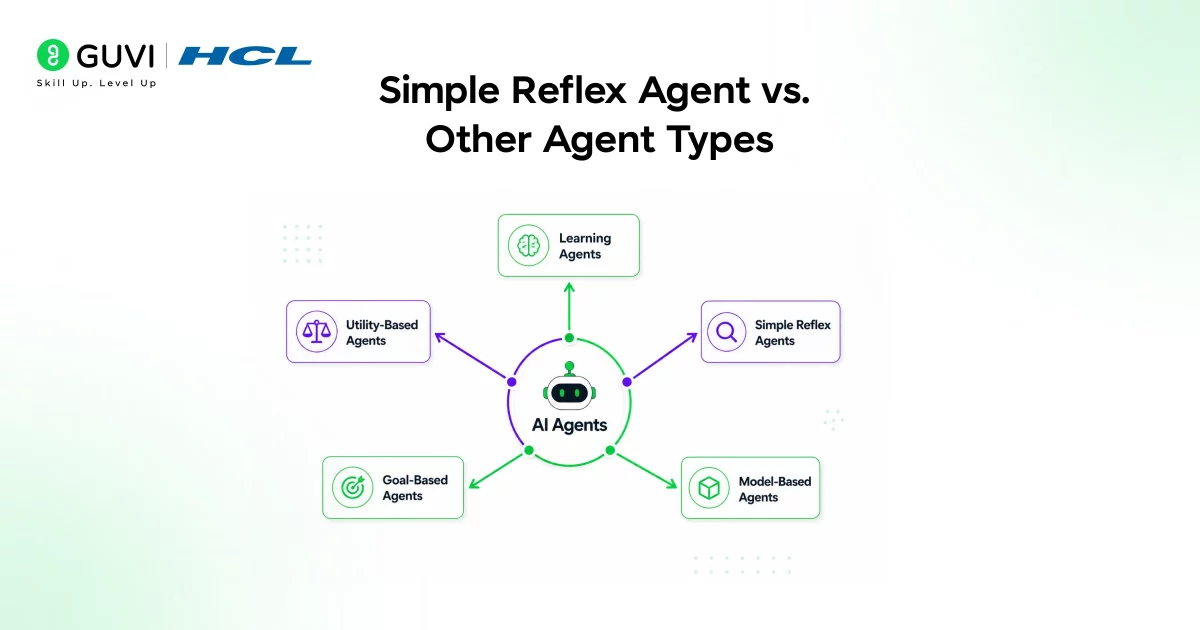
- vs. Model-Based Reflex Agent
A model-based reflex agent maintains an internal state that tracks aspects of the world the sensors cannot currently see. It updates this internal model with each percept and uses both the current input and the model to select actions.
A simple reflex agent has no internal state whatsoever. Every decision is made from the current percept alone.
Model-based agents handle partial observability. Simple reflex agents cannot.
- vs. Goal-Based Agent
A goal-based agent knows what it is trying to achieve and evaluates actions based on whether they move it closer to that goal. It can plan sequences of actions, reason about future states, and choose paths through complex decision spaces.
A simple reflex agent has no goal representation. It does not know what success looks like. It only knows what to do right now based on what it currently sees.
- vs. Utility-Based Agent
A utility-based agent assigns a utility value to different possible states and selects actions that maximize expected utility. It can handle trade-offs, uncertainty, and competing objectives.
A simple reflex agent makes binary decisions. The condition is true or false. The action fires or it does not. There is no concept of better or worse outcomes, only matching rules and executing actions.
- vs. Learning Agent
A learning agent improves its performance over time by updating its knowledge based on feedback from the environment. It adapts to new situations, corrects mistakes, and becomes more capable with experience.
A simple reflex agent does not learn. Its rule set is fixed at design time and never changes during operation. Every interaction begins from the same starting point regardless of what happened before.
Real-World Applications of Simple Reflex Agents
- Thermostats and Environmental Control Systems
The household thermostat is the classic simple reflex agent. If temperature drops below threshold, activate heating. If temperature rises above threshold, deactivate heating. Two rules. One sensor. Fully observable environment. Decades of reliable operation.
The environment is simple and fully observable, which is exactly where simple reflex agents thrive.
- Spam Filters Using Keyword Rules
Early spam filtering systems operated as simple reflex agents. If the email contains certain keywords or patterns, classify it as spam. If not, deliver it to the inbox.
Modern filters are far more sophisticated, but the foundational layer of keyword-based condition-action rules remains in use as a fast first-pass filter before more expensive classifiers run.
- Automated Customer Service Routing
Many customer service systems route incoming queries using reflex logic. If the message contains words related to billing, route to the billing department. If it contains product-related keywords, route to support. If it contains account deletion language, route to retention.
These are condition-action rules operating on the current message with no memory of the customer’s history beyond what the current message contains.
To learn more about Simple Reflex Agents and how AI systems make decisions based on immediate conditions, do not miss the chance to enroll in HCL GUVI’s Intel & IITM Pravartak Certified Artificial Intelligence & Machine Learning course. Endorsed with Intel certification, this course adds a globally recognized credential to your resume, a powerful edge that sets you apart in the competitive AI job market.
Final Thoughts
A simple reflex agent is not a stepping stone you leave behind once you understand it. It is a foundational design pattern that appears inside nearly every more complex agent architecture as a component, a fallback, or a baseline.
Understanding it deeply means understanding the core tension in all of AI agent design: how much of the decision-making burden do you handle at design time through explicit rules, and how much do you leave to the agent to figure out at runtime through memory, planning, learning, and inference?
Simple reflex agents answer that question by placing everything at design time. Every other agent type answers it differently by giving the agent more runtime capability, more internal structure, and more autonomy.
You do not need the most complex agent for every problem. You need the right agent for the right environment, designed by someone who understands exactly where each architecture works and where it breaks.
FAQs
1. Can a simple reflex agent handle environments it has never seen before?
Only if the new environment produces percepts that match existing rules in its rule set. If it encounters a percept with no matching condition-action rule, it has no mechanism to respond appropriately. This is one of the fundamental limitations of the architecture.
2. What is the difference between a simple reflex agent and a model-based reflex agent?
A simple reflex agent acts only on the current percept with no internal memory. A model-based reflex agent maintains an internal state that tracks information about the world beyond what sensors currently report, allowing it to handle partial observability and sequential dependencies.
3. Is a thermostat really an AI agent?
In the technical sense used in artificial intelligence, yes. It perceives its environment through a sensor, applies a condition-action rule, and acts through an actuator. Whether it qualifies as intelligent in a broader philosophical sense is a different question, but architecturally, it fits the definition of a simple reflex agent precisely.
4. Why study simple reflex agents if they are so limited?
Because they form the conceptual and architectural foundation for every more advanced agent type. Understanding what simple reflex agents can and cannot do clarifies exactly what capabilities model-based, goal-based, utility-based, and learning agents add and why those additions matter.
5. Can simple reflex agents be combined with learning to improve over time?
Not within the standard simple reflex architecture. Adding learning mechanisms transforms the agent into a learning agent, which is a distinct category. However, a system can use learning at design time to generate better rules offline, which are then deployed as a fixed rule set in a reflex agent at runtime.
Success Stories

About the Author
Vishalini Devarajan
An Aerospace Engineer turned content writer, I focus on making complex concepts easy to understand through well-structured, reader-friendly blogs. Whether it’s a technical topic or a non-technical one, I love creating content that is clear, engaging, and impactful.
View all posts by Vishalini Devarajan
Connect with me @










Did you enjoy this article?