


AWS Kubernetes Articles
Istio Service Mesh Tutorial for Beginners
Crossplane Tutorial: A Practical Guide for Learners


Get In Touch For Details! Request More Information
What is AWS IoT? A Complete Guide for Beginners
May 14, 2026 5 Min Read 1002 Views
(Last Updated)
Billions of devices are now generating data every second from factory floor sensors and smart thermostats to connected cars and wearable health monitors. Making sense of that flood of data, securely and at scale, is one of the defining challenges of the modern technology era. That is exactly where AWS IoT steps in.
AWS IoT (Amazon Web Services Internet of Things) is Amazon’s suite of cloud services built to connect, manage, and analyze data from IoT devices at any scale, whether you’re handling a dozen devices or hundreds of millions. Since its launch in 2015, AWS IoT has grown into a comprehensive platform powering smart homes, industrial automation, connected healthcare, and much more.
In this guide, you will learn what AWS IoT is, how it works, what services it includes, its key use cases, and why it matters for developers and businesses in 2026.
Table of contents
- What is AWS IoT?
- How Does AWS IoT Work?
- Step 1 — Device Connection
- Step 2 — Secure Authentication
- Step 3 — Message Routing via Rules Engine
- Step 4 — Real-Time Action
- Key AWS IoT Services
- AWS IoT Core
- AWS IoT Greengrass
- AWS IoT Device Management
- AWS IoT TwinMaker
- AWS IoT Analytics
- Core Components of AWS IoT
- AWS IoT Use Cases
- Industrial IoT (IIoT) and Manufacturing
- Smart Home and Consumer Devices
- Connected Healthcare
- Connected and Autonomous Vehicles
- Precision Agriculture
- AWS IoT vs. Azure IoT vs. Google Cloud IoT
- Benefits of AWS IoT
- Conclusion
- FAQs
- What is AWS IoT in simple terms?
- What is the difference between IoT and AWS IoT?
- What protocol does AWS IoT use?
- Is AWS IoT free to use?
- What industries use AWS IoT?
What is AWS IoT?
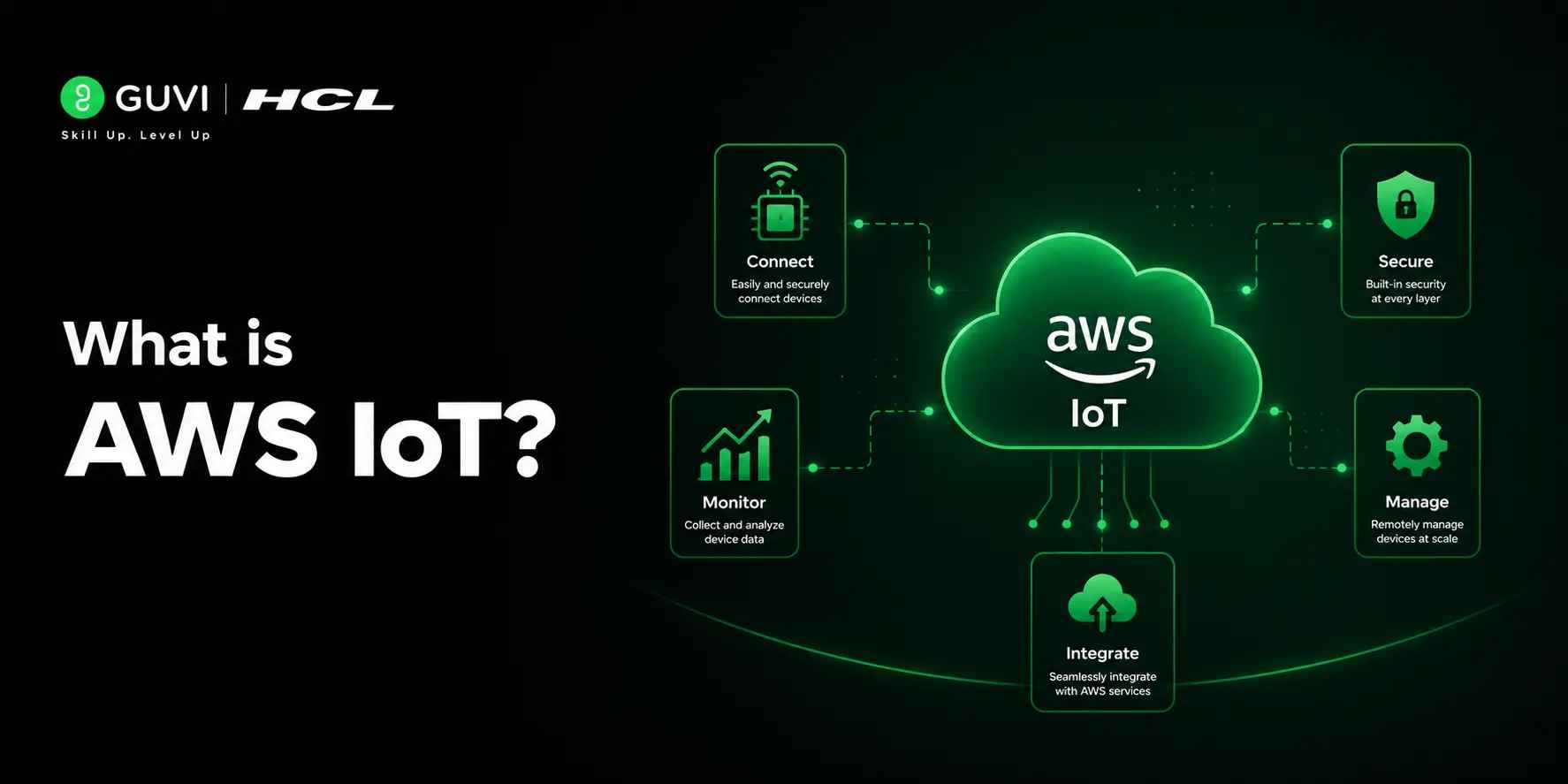
AWS IoT is Amazon Web Services’ managed suite of cloud services designed to connect Internet of Things (IoT) devices to the cloud and to each other. It lets you collect, store, and analyze data from any device, and take action on that data in real time, all without managing the underlying server infrastructure.
The term Internet of Things (IoT) refers to the network of physical objects, sensors, machines, vehicles, and appliances embedded with software that enables them to collect and exchange data over the internet. AWS IoT provides the cloud backbone that makes this possible at an industrial scale.
Data Point
According to IoT Analytics (October 2025), the number of connected IoT devices globally reached 21.1 billion in 2025 — a 14% increase over 2024 — and is projected to hit 39 billion by 2030.
Source
AWS IoT was launched in December 2015 with AWS IoT Core as its foundation a secure message broker built on the MQTT protocol. Over the following decade, it evolved into a full-stack platform spanning device connectivity, edge computing, fleet management, digital twins, and video streaming.
December 2025 marked the 10th anniversary of AWS IoT. Today, hundreds of millions of devices connect to AWS IoT services daily, powering smart homes, connected vehicles, industrial automation, precision agriculture, and intelligent healthcare systems worldwide.
How Does AWS IoT Work?
At its core, AWS IoT creates a secure, bidirectional communication channel between physical devices and the AWS Cloud. Here is a simplified view of how the data flow works:
Step 1 — Device Connection
Physical devices (sensors, machines, smart appliances) connect to AWS IoT Core using supported protocols, primarily MQTT, HTTP, or WebSockets. Each device is registered in the AWS IoT Device Registry, which stores its identity, attributes, and credentials.
Step 2 — Secure Authentication
AWS IoT uses X.509 certificates to authenticate every device before it can send or receive messages. This ensures only authorized devices communicate with the cloud. AWS Identity and Access Management (IAM) policies then control what each device is allowed to do.
Step 3 — Message Routing via Rules Engine
Once connected, device data is published as messages to MQTT topics. The AWS IoT Rules Engine processes these messages using SQL-like syntax filtering, transforming, and routing data to other AWS services such as Amazon DynamoDB, AWS Lambda, Amazon S3, or Amazon Kinesis.
Step 4 — Real-Time Action
Processed data can trigger actions automatically, sending alerts, updating dashboards, running machine learning models, or commanding the device to change its behaviour. Even when a device goes offline, its last known state is preserved using the Device Shadow service.
Processed data can trigger actions automatically, sending alerts, updating dashboards, running machine learning models, or commanding the device to change its behaviour. Even when a device goes offline, its last known state is preserved using the Device Shadow service.
Also Read: AI in IoT
Best Practices
Always assign the minimum necessary permissions to each device using IAM policies. Overly permissive policies are one of the most common IoT security vulnerabilities. Use separate certificates per device, never share credentials across your fleet.
Key AWS IoT Services
AWS IoT is not a single product; it is an ecosystem of services. Each service addresses a specific part of the IoT lifecycle, from device onboarding to data analytics and edge computing.
AWS IoT Core
The foundation of the platform. AWS IoT Core is a fully managed cloud service that lets you securely connect billions of IoT devices to AWS. It handles the message broker (MQTT), rules engine, device registry, and security without any servers to manage. In 2024, AWS added MQTT v5 support to IoT Core, bringing enhanced features like user properties, message expiry, and improved error reporting.
AWS IoT Greengrass
Greengrass extends AWS to the edge, running compute, messaging, and data caching directly on local devices. This is critical when you need low-latency responses or when devices operate in areas with intermittent connectivity. In 2025, AWS released the Greengrass Nucleus Lite runtime, which operates on as little as 5 MB of memory, opening cloud connectivity to an entirely new class of constrained devices.
AWS IoT Device Management
This service handles the full lifecycle of your device fleet onboarding, organizing, monitoring, and remote updates. In March 2025, AWS launched managed integrations for IoT Device Management, enabling developers to unify device control across multiple brands and protocols with built-in support for ZigBee, Z-Wave, and Wi-Fi, plus over 80 device data model templates.
AWS IoT TwinMaker
TwinMaker allows you to create digital twins, virtual replicas of physical systems, using real-time data from your IoT devices. This is widely used in manufacturing, smart buildings, and industrial plants to visualize, monitor, and simulate operations.
AWS IoT Analytics
This service collects, processes, and stores IoT data for downstream analysis. It works natively with Amazon QuickSight for visualization and Amazon SageMaker for machine learning model training.
Core Components of AWS IoT
Understanding the building blocks of AWS IoT helps you design better solutions. Here are the key components you will interact with:
- Message Broker: Message Broker
- Provides a secure, scalable pub/sub messaging system. Devices publish data to named MQTT topics, and other services or devices subscribe to receive it. The broker supports MQTT, MQTT over WebSocket, and HTTP.
- Rules Engine: Rules Engine
- Processes messages using SQL-like syntax. You define rules that filter incoming data and route it to downstream services such as Lambda, S3, DynamoDB, Kinesis, or even other IoT topics — no custom code needed for simple routing.
- Device Registry: Device Registry
- The central store for all your connected devices (called ‘Things’ in AWS terminology). Each Thing can have custom attributes, a unique identity, and associated certificates.
- Device Shadow: Device Shadow
- A persistent JSON document that stores and retrieves the last known state of a device. Even when a device is offline, apps can read or update its desired state; the changes sync automatically when the device reconnects.
- Security & Identity: Security & Identity Service
- Every device must authenticate using X.509 certificates. AWS IoT integrates with AWS IAM and Amazon Cognito to provide fine-grained access control, ensuring only authorised devices and users can interact with your IoT data.
AWS IoT Core supports over 470 million connected cars expected by the end of 2025. Mercedes-Benz migrated its vehicle connectivity workloads to AWS IoT Core to simplify broker infrastructure and improve scalability.

AWS IoT Use Cases
AWS IoT is used across virtually every industry. Here are some of the most impactful real-world applications:
Industrial IoT (IIoT) and Manufacturing
Manufacturing leads all industries in IoT adoption, accounting for 34% of total IoT device deployments in 2025. Factories use AWS IoT Greengrass and IoT Core to monitor equipment health, predict failures before they happen, and automate quality control on production lines, all in real time.
Smart Home and Consumer Devices
AWS IoT powers connected appliances, smart thermostats, security cameras, and voice-assisted devices. Amazon’s own Sidewalk network uses AWS IoT to provide secure, low-power connectivity for smart home devices across neighborhoods.
Connected Healthcare
Healthcare IoT is growing at approximately 32.5% CAGR, the fastest among major verticals. Remote patient monitoring devices use AWS IoT to transmit continuous health data securely to clinicians. In January 2026, CMS broadened reimbursement to cover connected glucose monitors, blood-pressure cuffs, and oximeters, expanding the US remote-monitoring device market by $1.2 billion.
Connected and Autonomous Vehicles
AWS IoT Core handles vehicle telemetry, over-the-air software updates, and connected driver experiences. With over 470 million connected cars expected globally by the end of 2025, the automotive sector is one of the fastest-growing verticals on the platform.
Precision Agriculture
Farmers deploy soil moisture sensors, weather stations, and irrigation controllers connected via AWS IoT to optimize water usage and crop yields. This combination of edge data processing via Greengrass and cloud analytics via IoT Analytics creates highly responsive, low-cost agricultural systems.
Also Read: Real-World Applications of IoT
AWS IoT vs. Azure IoT vs. Google Cloud IoT
Choosing the right cloud IoT platform depends on your existing cloud stack, technical requirements, and scale. Here is a direct comparison:
| Feature | AWS IoT | Azure IoT | Google Cloud IoT |
| Core Service | AWS IoT Core | Azure IoT Hub | Cloud IoT Core |
| Edge Computing | Greengrass (5 MB runtime) | Azure IoT Edge | Edge TPU / Anthos |
| Device Management | IoT Device Management | Azure Device Provisioning | Cloud IoT Core Registry |
| Digital Twins | AWS TwinMaker | Azure Digital Twins | Limited native support |
| Protocol Support | MQTT, HTTP, WebSockets, MQTT v5 | MQTT, AMQP, HTTP | MQTT, HTTP |
| ML Integration | SageMaker, Rekognition | Azure ML, Cognitive Services | Vertex AI, TensorFlow |
| Best For | Large-scale, diverse device fleets | Microsoft enterprise environments | Data analytics-heavy workloads |
Benefits of AWS IoT
AWS IoT stands out for several reasons that matter to both developers and business decision-makers:
- Massive scale without infrastructure management — AWS IoT Core can connect billions of devices simultaneously. AWS manages all the underlying broker infrastructure, so your team focuses on building applications, not maintaining servers.
- Deep AWS service integration — IoT data flows naturally into Amazon EventBridge, AWS Lambda, Amazon S3, Amazon Kinesis, Amazon SageMaker, and more. This means you can build sophisticated data pipelines with minimal custom code.
- Strong security by default — Every device connection requires X.509 certificate authentication. TLS encryption is enforced in transit, and IAM policies provide granular access control.
- Edge intelligence with Greengrass — Run AI models, Lambda functions, and data processing directly on local devices, reducing latency, bandwidth costs, and dependency on cloud connectivity.
- Pay-as-you-go pricing — You pay for the connections and messages you actually use. There are no upfront commitments, making AWS IoT accessible for both startups running a handful of devices and enterprises managing millions.
Related Reads: Is AWS Certification Worth
Warning
67% of organizations cite security as the top barrier to expanding IoT deployments in 2025. Never skip certificate rotation, always enforce least-privilege IAM policies, and regularly audit your device fleet for unauthorized access attempts.
Source
Conclusion
AWS IoT has emerged as the gold standard for building connected device solutions from the edge to the cloud. With a decade of innovation behind it, a portfolio that now spans connectivity, edge computing, fleet management, digital twins, and analytics, it offers everything a developer or organization needs to build production-grade IoT applications.
Whether you are a beginner looking to understand what AWS IoT is, or a developer ready to connect your first device, the platform’s breadth and deep integration with the wider AWS ecosystem make it one of the most powerful tools in cloud computing today. As the world moves toward 39 billion connected devices by 2030, understanding AWS IoT is not just useful; it is essential.
Ready to master DevOps and launch your cloud career? HCL GUVI’s hands-on DevOps Course covers AWS, Docker, Kubernetes, and CI/CD — with live sessions and real-world projects that prepare you for AWS certifications and industry-ready deployments. Start learning today
FAQs
What is AWS IoT in simple terms?
AWS IoT is Amazon’s set of cloud services that connects physical devices, like sensors, machines, and smart appliances, to the internet and to each other. It lets you collect data from those devices, process it in the cloud, and take automated actions in real time, without managing the underlying infrastructure.
What is the difference between IoT and AWS IoT?
IoT (Internet of Things) is the broad concept of connecting physical devices to the internet. AWS IoT is Amazon’s specific platform for building IoT solutions. It provides the connectivity, security, device management, and analytics services that make IoT applications production-ready at scale.
What protocol does AWS IoT use?
AWS IoT Core primarily supports MQTT, a lightweight publish/subscribe protocol designed for constrained devices and low-bandwidth networks. It also supports MQTT over WebSocket and HTTP. In 2024, AWS added MQTT v5 support, which brings enhanced features like message expiry and user properties.
Is AWS IoT free to use?
AWS IoT Core offers a free tier for the first 12 months, including 500,000 messages per month and limited free usage of Device Shadow and Rules Engine. Beyond the free tier, pricing is based on the number of messages, connections, and services used.
What industries use AWS IoT?
AWS IoT is used across manufacturing (34% of IoT deployments), healthcare, automotive (500+ million connected vehicles by 2025), smart home, agriculture, energy, retail, and telecommunications. Its flexibility makes it applicable to virtually any industry that involves physical devices generating data.
Success Stories

About the Author
Kirupa
An avid fiction reader and a health science graduate who found writing most at home. I have worked as a freelancer with a diverse range of brands and projects, turning complex ideas into relatable content. You can find me at GUVI, in the exciting world of EdTech, where I continue to blend my words with creativity and clarity.
View all posts by Kirupa
Connect with me @










Did you enjoy this article?