


Software Development Articles
How to Read and Understand System Design Diagrams?
System Engineer Roles and Responsibilities: 12 Proven Duties for Growth
SAP Consultant Roles and Responsibilities: 12 Proven Duties for Growth and Success
Network Engineer Roles and Responsibilities: 12 Essential Duties for Success


Get In Touch For Details! Request More Information
Types of Software Design Patterns with Real-World Examples
Sep 15, 2026 4 Min Read 1246 Views
(Last Updated)
Modern applications like Netflix, Uber, and Spotify handle massive user traffic, real-time interactions, and constantly evolving features. Building such scalable systems requires more than just writing functional code. It requires strong software design.
This is where software design patterns become important. Design patterns are proven and reusable solutions to common software development problems. In this blog, we will explore software design patterns, their types, advantages, real-world examples, common mistakes, and best practices.
Table of contents
- AI Overview
- Types of Software Design Patterns at a Glance
- What Are Software Design Patterns?
- Types of Software Design Patterns
- Creational Design Pattern
- Properties of Creational Design Pattern
- Key Advantages of Creational Design Pattern
- Main Applications of Creational Design Pattern
- Disadvantages of Creational Design Pattern
- Structural Design Pattern
- Properties of Structural Design Pattern
- Key Advantages of Structural Design Pattern
- Main Application of Structural Design Pattern
- Disadvantages of Structural Design Pattern
- Behavioral Design Pattern
- Properties of Behavioral Design Pattern
- Key Advantages of Behavioral Design Pattern
- Main Application of Behavioral Design Pattern
- Disadvantages of Behavioral Design Pattern
- Real-World Examples of Creational Design Pattern
- Real-World Examples of Structural Design Pattern
- Real-World Examples of Behavioral Design Pattern
- Advantages of Software Design Patterns
- Common Mistakes While Using Software Design Patterns
- Best Practices for Using Software Design Patterns
- Conclusion
- FAQs
- What are the three main types of software design patterns?
- Which design pattern is most commonly used?
- Are design patterns language-specific?
- Why are software design patterns important?
- What is the difference between design patterns and architecture patterns?
AI Overview
Software design patterns are reusable approaches to recurring software design problems. The 23 classic Gang of Four (GoF) patterns are grouped into three categories: Creational, Structural, and Behavioral. Creational patterns focus on object creation, Structural patterns focus on how classes and objects are composed, and Behavioral patterns focus on communication and responsibility between objects. Design patterns are not ready-made code; they provide a design approach that can be adapted to the problem and programming language.
Types of Software Design Patterns at a Glance
| Category | Main Focus | Number of GoF Patterns | Examples |
|---|---|---|---|
| Creational | Object creation | 5 | Factory Method, Builder, Singleton |
| Structural | Class and object composition | 7 | Adapter, Decorator, Facade |
| Behavioral | Object communication and responsibilities | 11 | Observer, Strategy, Command |
The three categories contain all 23 classic GoF design patterns.
What Are Software Design Patterns?
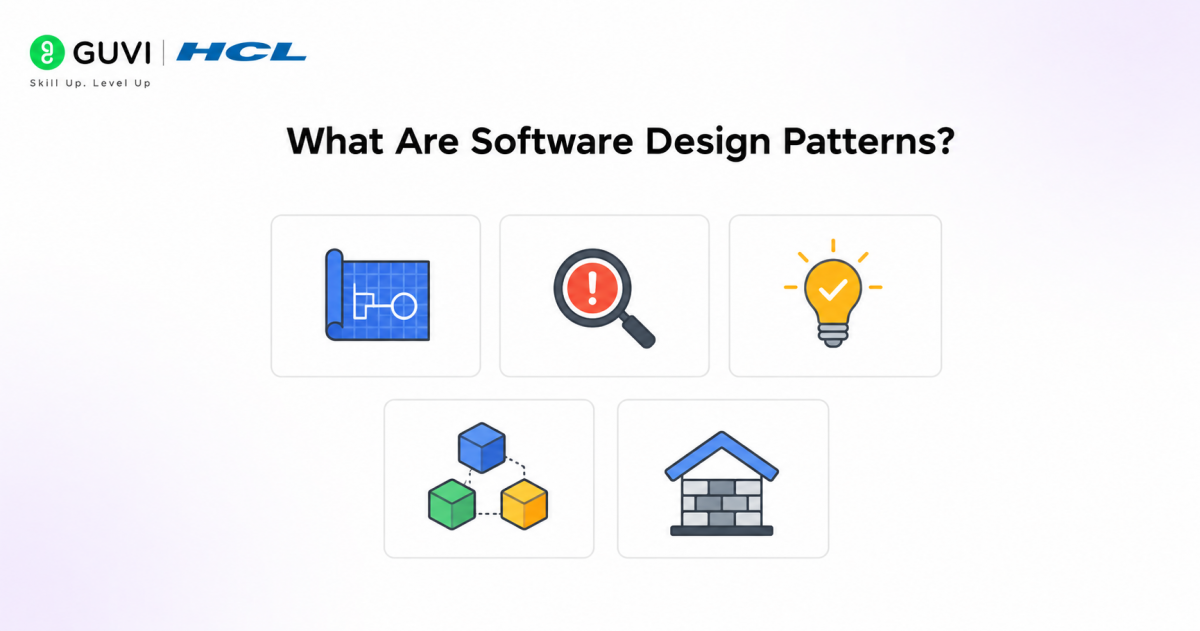
Software design patterns are general reusable solutions to common software design problems. They are not ready-made code but templates or blueprints that developers can adapt based on project requirements.
Design patterns help in:
- Improving code reusability
- Simplifying maintenance
- Enhancing scalability
- Reducing development complexity
- Following clean coding practices
Types of Software Design Patterns
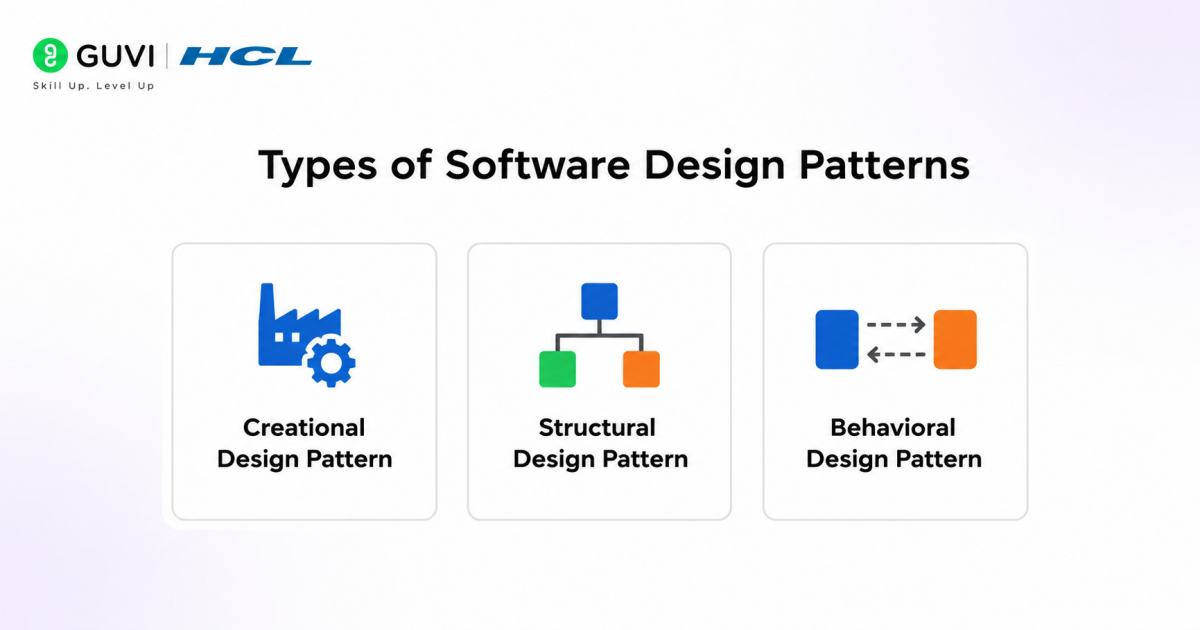
1. Creational Design Pattern
Creational design patterns focus on object creation mechanisms. They simplify the way objects are created while improving flexibility and reducing code dependencies.
Properties of Creational Design Pattern
- Encapsulated Object Creation: Hides complex object initialization logic.
- Flexible Instantiation: Creates objects dynamically based on runtime requirements.
- Reduced Code Duplication: Centralizes object creation processes.
- Loose Coupling: Minimizes dependency between classes and object generation.
- Scalable Architecture: Supports easier expansion of software systems.
Creational patterns are commonly used in enterprise systems, cloud platforms, frameworks, and applications where object lifecycle management is important.
Key Advantages of Creational Design Pattern
- Simplifies complex object creation
- Enhances application scalability
- Improves code reusability
- Reduces hard-coded dependencies
- Supports cleaner architecture
- Makes maintenance easier
Main Applications of Creational Design Pattern
- Database connection management
- Payment gateway setup
- Dependency injection systems
- Cloud service initialization
- Object pooling mechanisms
- Game object creation
Disadvantages of Creational Design Pattern
- Adds architectural complexity
- Increases abstraction layers
- Harder for beginners to understand
- Overuse can reduce readability
- Debugging may become difficult
2. Structural Design Pattern
Structural design patterns focus on organizing classes and objects into larger structures. They improve flexibility while simplifying relationships between components.
Properties of Structural Design Pattern
- Efficient Class Composition: Organizes classes into scalable structures.
- Improved Reusability: Promotes shared interfaces and reusable components.
- Flexible Integration: Connects incompatible modules smoothly.
- Optimized Resource Management: Reduces redundancy across systems.
- Better Maintainability: Simplifies modification of large applications.
Structural patterns are heavily used in UI frameworks, enterprise systems, middleware platforms, and integration-based applications.
Key Advantages of Structural Design Pattern
- Simplifies complex structures
- Improves modularity
- Enhances system flexibility
- Supports scalable applications
- Reduces redundant implementations
- Makes integration easier
Main Application of Structural Design Pattern
- Third-party API integration
- User interface systems
- Middleware architecture
- Plugin-based software
- File hierarchy systems
- Microservices communication
Disadvantages of Structural Design Pattern
- Can create excessive abstraction
- Improper implementation affects performance
- Complex hierarchies become difficult to manage
- Debugging layered systems is challenging
- Learning curve may increase
3. Behavioral Design Pattern
Behavioral design patterns focus on communication and interaction between objects. They help manage workflows, responsibilities, and runtime behavior efficiently.
Properties of Behavioral Design Pattern
- Dynamic Communication Handling: Manages object interactions efficiently.
- Responsibility Separation: Distributes behaviors across components.
- Runtime Flexibility: Allows behavior changes during execution.
- Workflow Optimization: Simplifies event handling and process flows.
- Enhanced Extensibility: Makes application behavior easier to expand.
Behavioral patterns are widely used in event-driven systems, workflow engines, AI systems, and real-time applications.
Key Advantages of Behavioral Design Pattern
- Improves communication between objects
- Enhances runtime flexibility
- Simplifies workflow management
- Reduces tightly coupled logic
- Supports event-driven architectures
- Improves scalability of behaviors
Main Application of Behavioral Design Pattern
- Notification systems
- Real-time chat applications
- Authentication workflows
- AI decision systems
- Event processing platforms
- Middleware request handling
Disadvantages of Behavioral Design Pattern
- Increases the number of classes
- Communication flows may become complex
- Improper usage can impact performance
- Debugging runtime behavior is difficult
- Requires deeper architectural understanding
Real-World Examples of Creational Design Pattern
- Spotify Backend Services
Spotify uses Singleton and Factory patterns to manage streaming sessions, database connections, and personalized music recommendations efficiently across millions of users.
- Uber Ride Booking System
Uber dynamically creates ride objects, driver assignments, fare calculations, and payment workflows using Factory-based object creation mechanisms.
- Minecraft World Generation
Minecraft uses the Prototype pattern to clone game objects, environments, and entities rapidly without rebuilding them from scratch.
Real-World Examples of Structural Design Pattern
- PayPal Payment Gateway Integration
PayPal uses Adapter patterns to connect multiple banking systems and payment providers through one unified transaction interface.

- Adobe Photoshop Layer and Filter System
Photoshop applies Decorator patterns to add filters, visual effects, and editing capabilities dynamically without changing the original image object.
- Google Chrome Browser Extensions
Chrome uses Proxy patterns to securely manage communication between browser processes, tabs, and installed extensions.
Real-World Examples of Behavioral Design Pattern
- YouTube Subscriber Notification System
YouTube uses the Observer pattern to notify subscribers instantly whenever creators upload new content.
- Netflix Video Playback Management
Netflix uses the State pattern to manage playback conditions such as buffering, paused, loading, and streaming states dynamically.
- Slack Real: Time Messaging Workflow
Slack uses Command and Observer patterns to handle notifications, live messaging events, workflow automation, and collaborative updates efficiently.
Advantages of Software Design Patterns
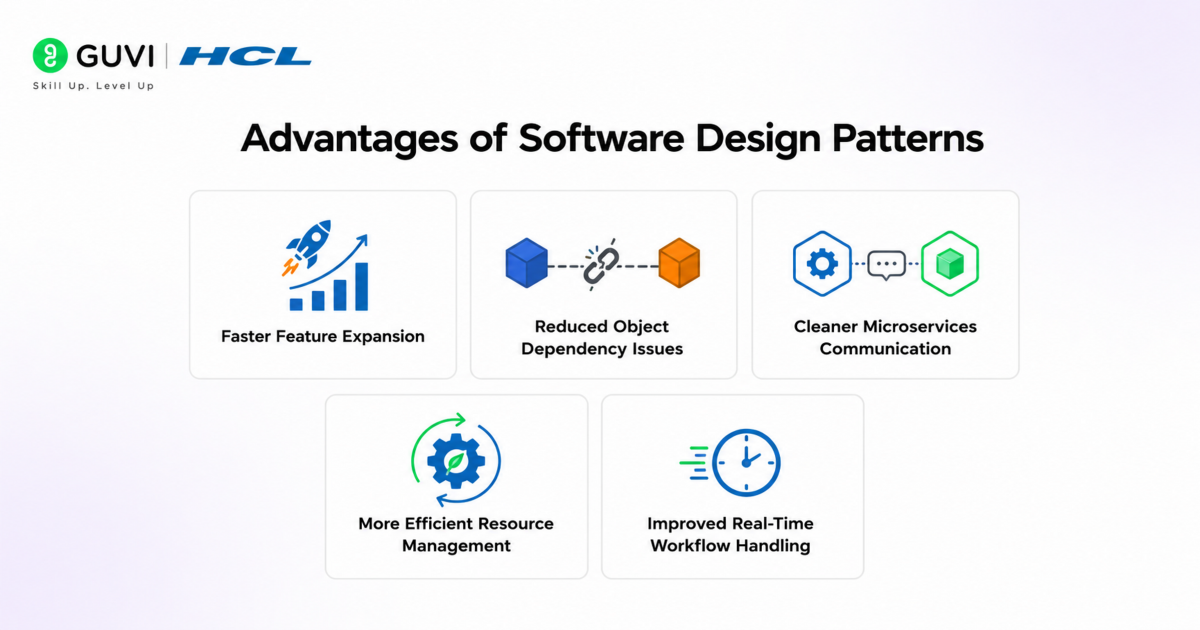
- Faster Feature Expansion: Makes it easier to add new modules, APIs, or functionalities without rewriting large portions of existing code.
- Reduced Object Dependency Issues: Minimizes tight coupling between components, preventing cascading failures during system updates.
- Cleaner Microservices Communication: Helps large distributed systems organize service interactions more efficiently and predictably.
- More Efficient Resource Management: Optimizes memory and object handling through reusable creation and structural mechanisms.
- Improved Real-Time Workflow Handling: Supports event-driven operations like notifications, streaming, messaging, and asynchronous processing more effectively.
Go beyond learning software design patterns theoretically and start building scalable, maintainable applications with industry-ready development skills. Join HCL GUVI’s AI-Powered Software Development Course to learn through live online classes led by industry experts. Master in-demand skills like system design, object-oriented programming, backend development, APIs, databases, and scalable software architectures while working on real-world projects. Get 1:1 doubt support and access placement assistance with 1000+ hiring partners.
Common Mistakes While Using Software Design Patterns
- Overengineering the Application: Using complex design patterns for simple problems increases unnecessary complexity.
- Choosing the Wrong Pattern: Applying an unsuitable pattern can reduce performance and scalability.
- Ignoring Business Requirements: Focusing too much on architecture instead of actual application needs creates impractical systems.
- Creating Excessive Abstraction: Too many layers and interfaces make code difficult to understand and debug.
- Tight Coupling Between Components: Poor implementation can still create dependency issues despite using patterns.
- Forcing Patterns Everywhere: Not every problem requires a design pattern-based solution.
- Poor Documentation Practices: Lack of proper documentation makes patterns difficult for teams to maintain.
- Neglecting Performance Impact: Some patterns may increase memory usage and execution overhead if misused.
Best Practices for Using Software Design Patterns
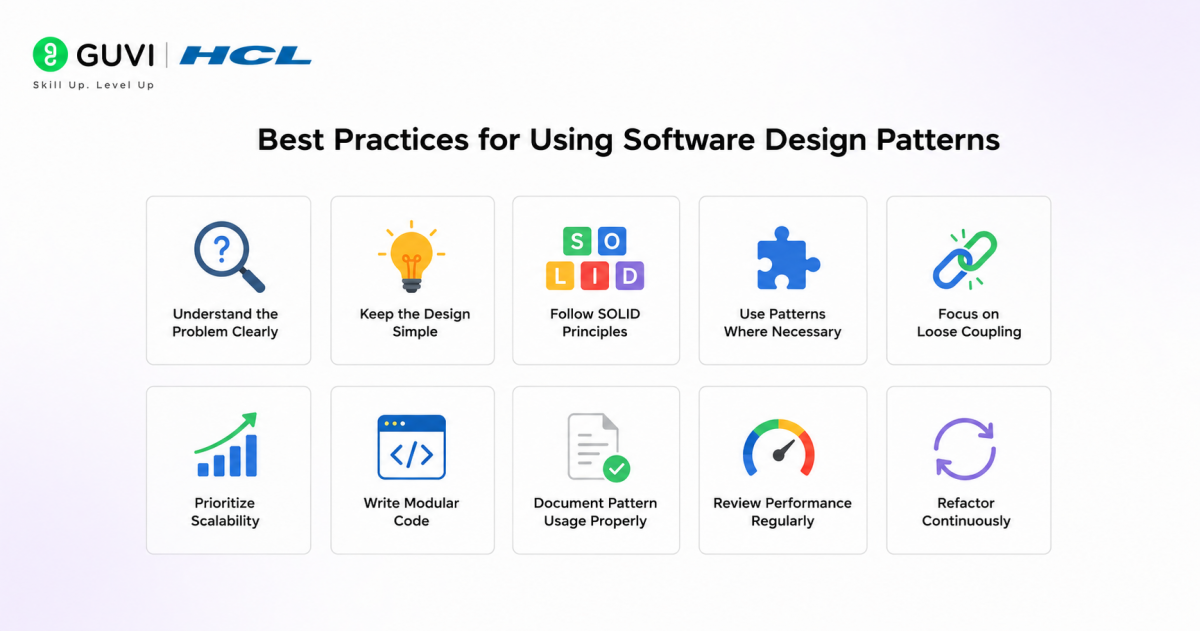
- Understand the Problem Clearly: Choose patterns only after identifying the actual architectural challenge.
- Keep the Design Simple: Prefer clean and maintainable solutions over overly complicated structures.
- Follow SOLID Principles: Combine design patterns with clean coding principles for better architecture.
- Use Patterns Where Necessary: Apply patterns only when they provide measurable design benefits.
- Focus on Loose Coupling: Design systems where components remain independent and flexible.
- Prioritize Scalability: Build patterns that support future application growth and changing requirements.
- Write Modular Code: Keep functionalities separated for easier testing and maintenance.
- Document Pattern Usage Properly: Clearly explain why a pattern is used and how it improves the system.
- Review Performance Regularly: Monitor whether the implemented patterns are affecting system efficiency.
- Refactor Continuously: Improve implementations over time as application requirements evolve.
Conclusion
Software design patterns help developers solve recurring software engineering problems using proven and reusable approaches. From object creation to system architecture and communication handling, these patterns improve scalability, maintainability, and development efficiency. Understanding different types of software design patterns is essential for building modern applications that remain reliable, flexible, and easier to manage as systems grow in complexity.
FAQs
What are the three main types of software design patterns?
The three main types are Creational, Structural, and Behavioral design patterns.
Which design pattern is most commonly used?
The Singleton, Factory Method, and Observer patterns are among the most widely used.
Are design patterns language-specific?
No. Design patterns are conceptual solutions that can be implemented in most programming languages.
Why are software design patterns important?
They improve code maintainability, scalability, readability, and development efficiency.
What is the difference between design patterns and architecture patterns?
Design patterns solve smaller coding problems, while architectural patterns define the overall structure of software systems.
Success Stories

About the Author
Vaishali
I'm a seasoned writer with four years of experience across technical, non-technical, and just about every genre or niche you can imagine. Adaptable and curious, I enjoy exploring new topics and making information engaging and easy to understand. Fueled by a steady stream of tea, I approach each project with creativity, reliability, and genuine enthusiasm for storytelling.
View all posts by Vaishali
Connect with me @
















Did you enjoy this article?