


Artificial Intelligence and Machine Learning Articles
Finance Manager to Data Analytics: Career Growth, Salary and Seniority
How to Evaluate LLM Outputs in Production Deployments
AI/ML Skills Gap 2026: Why Companies Can't Find Job-Ready Talent
20 AI/ML Interview Questions Recruiters Can Use Without a Tech Background - Best Guide


Get In Touch For Details! Request More Information
Top 10 Vibe Coding Courses Online in 2026
Jun 24, 2026 8 Min Read 2998 Views
(Last Updated)
You have an app idea. A problem you want to solve. A side project sitting in a notes app for months. But you do not know how to code, or coding feels too slow for what you want to build. That is exactly the gap a vibe coding course fills. The right vibe coding course can take you from complete beginner to shipping real apps in a matter of weeks. Vibe coding is the new way to build software by describing what you want in plain English and letting AI tools like Cursor, Claude, and GitHub Copilot write the actual code for you.
This blog rounds up the ten best vibe coding course options available right now, from completely free options to structured specialisations with certificates. Each vibe coding course listing includes the price, duration, certificate availability, and a clear breakdown of what you will actually learn. Whether you are a designer, a product manager, a student, or someone who just wants to build their first app, there is a vibe coding course here for you.
Quick Answer
The best vibe coding course teaches you how to build real apps, websites, and tools using AI tools like Cursor, Claude, and GitHub Copilot, without writing code from scratch. The best free option is Great Learning’s Vibe Coding course. The best structured course is the Scrimba Vibe Coding Essentials Specialisation on Coursera. The best course for complete beginners is Vibe Coding Fundamentals by the University of Colorado.
Table of contents
- What is Vibe Coding?
- What Will You Learn in a Vibe Coding Course?
- Quick Comparison: Top 10 Vibe Coding Courses
- Top 10 Vibe Coding Courses
- Vibe Coding Essentials: Build Apps with AI Specialisation
- Vibe Coding Fundamentals
- AI for App Building
- Intro to Vibe Coding
- Vibe Coding from Scratch: Learn to "Code" Using AI
- Vibe Coding Bootcamp: Build Any App, Game or Website with AI
- Vibe Coding: AI-Driven Software Development and Testing
- Vibe Coding: Use AI and Python to Automate and Prototype Ideas
- The Vibe Coding Security and Risk Course
- Vibe Coding with AI Tools
- How to Choose the Right Vibe Coding Course
- Tips for Getting the Most Out of Any Vibe Coding Course
- 💡 Did You Know?
- Conclusion
- FAQs
- Do I need any coding experience to take a vibe coding course?
- Are vibe coding course certificates worth anything?
- How long does it take to complete a vibe coding course?
- What tools will I use after taking a vibe coding course?
- Is vibe coding just no-code or low-code?
What is Vibe Coding?
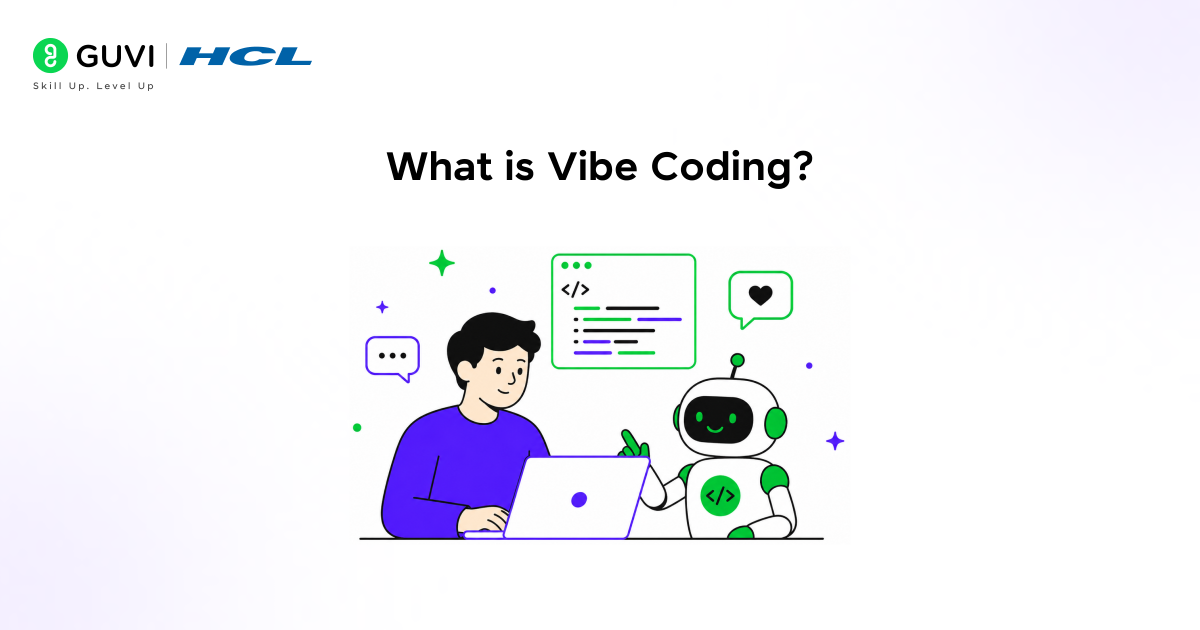
Vibe coding is an AI-assisted approach to software development where you describe what you want to build in natural language and AI tools generate the code for you. The term was coined by AI scientist Andrej Karpathy in early 2025, and it quickly became one of the most talked-about trends in tech.
Think of it this way: instead of writing button.onclick = function() {…}, you tell your AI tool “add a button that saves the form data when clicked” and it writes that code for you. You guide, the AI codes, you review and refine.
Why vibe coding matters in 2026:
- 84% of developers already use or plan to use AI in their daily workflows (Stack Overflow 2025 Developer Survey)
- Vibe coding saves up to 60% of development time on common tasks
- Non-developers, including designers, PMs, and founders, are shipping real products using only vibe coding tools
- Companies like startups and solo founders are building and monetising apps in days instead of months
Thought to ponder: A designer with no Python experience recently built a children’s app called “Storypot” that turns emojis into stories for his 5-year-old son. A Redditor launched a fully native iOS app and monetised it within three weeks. Both used vibe coding. What ideas do you have that are waiting for the right tool to bring them to life?
Hint: You do not need to become a developer to build software anymore. A vibe coding course gives you the mindset, the tools, and the workflow to take ideas from concept to working product. That is the shift.
What Will You Learn in a Vibe Coding Course?
A good vibe coding course covers more than just the tools themselves. Here is what most courses include:
- Fundamentals of vibe coding: What it is, how it started, and how it differs from traditional coding
- Prompt engineering for code: How to describe what you want clearly so the AI produces accurate, useful results
- Tool setup and workflow: How to install and use Cursor, Copilot, Lovable, Bolt, Replit, or similar platforms
- Building real projects: Apps, games, websites, automations, and more, from scratch
- Debugging with AI: How to fix problems by describing them to an AI assistant
- Deploying your apps: Getting your finished project onto the internet using tools like Netlify, Vercel, or GitHub
Do check out HCL GUVI’s Artificial Intelligence and Machine Learning course if you’re interested in learning vibe coding and AI-powered development skills through live online sessions, real-world projects, and structured mentorship designed to make you industry-ready.
Quick Comparison: Top 10 Vibe Coding Courses
| S.No | Course | Platform | Price | Duration | Certificate |
| 1 | Vibe Coding Essentials Specialisation | Coursera (Scrimba) | Free to audit / Coursera Plus $59/mo | 1-2 months | Yes |
| 2 | Vibe Coding Fundamentals | Coursera (Univ. of Colorado) | Free to audit / Coursera Plus $59/mo | ~10 hours | Yes |
| 3 | AI for App Building | Coursera (Google) | Free to audit / Coursera Plus $59/mo | ~6 hours | Yes |
| 4 | Intro to Vibe Coding | Codecademy | Free trial / Paid plan from $16/mo | ~1 hour | Yes |
| 5 | Vibe Coding from Scratch | Udemy | Rs. 799 | ~5 hours | Yes |
| 6 | Vibe Coding Bootcamp | Udemy | ~Rs. 499 (discounted) | ~10 hours | Yes |
| 7 | AI-Driven Software Dev and Testing | Udemy | ~Rs. 499 (discounted) | ~8 hours | Yes |
| 8 | Vibe Coding: AI and Python | Udemy | Free | ~4 hours | Yes |
| 9 | Vibe Coding Security and Risk | Udemy | ~Rs. 499 (discounted) | ~3 hours | Yes |
| 10 | Vibe Coding with AI Tools | Great Learning | Free | ~2 hours | Yes (paid fee) |
Note: Udemy prices vary by region and sale. Indian prices are typically Rs. 399-499 during frequent sales. Always check the current price before purchasing.
Top 10 Vibe Coding Courses
1. Vibe Coding Essentials: Build Apps with AI Specialisation
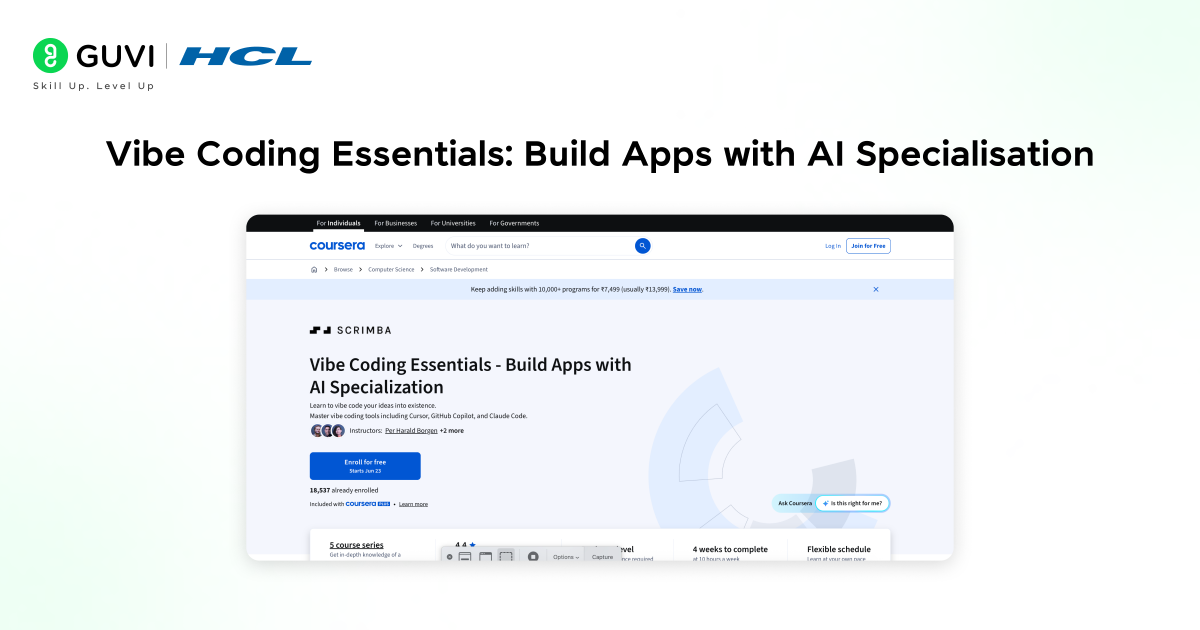
Platform: Coursera (by Scrimba)
Price: Free to audit | Full access via Coursera Plus ($59/month or $239/year)
Duration: 1 to 2 months at 10 hours per week
Certificate: Yes, shareable on LinkedIn
What this vibe coding course covers:
- Vibe coding fundamentals and the philosophy behind AI-first development
- Building real apps using GitHub Copilot, Cursor AI, and Claude Code
- MCP (Model Context Protocol) integration for connecting AI to external services
- Deploying apps using GitHub and Netlify
- Basics of HTML, CSS, and JavaScript for understanding what the AI builds
- Building a personal portfolio website, Chrome extensions, and a mobile app
Who it is for: Complete beginners with no coding background. Designers, marketers, accountants, and creative professionals who want to build software faster.
Why it stands out: This is a full vibe coding course specialisation, not just a single lesson. It covers multiple tools in depth and ends with projects you can put on your portfolio. Scrimba’s interactive format lets you write and run code directly inside the lesson window.
2. Vibe Coding Fundamentals
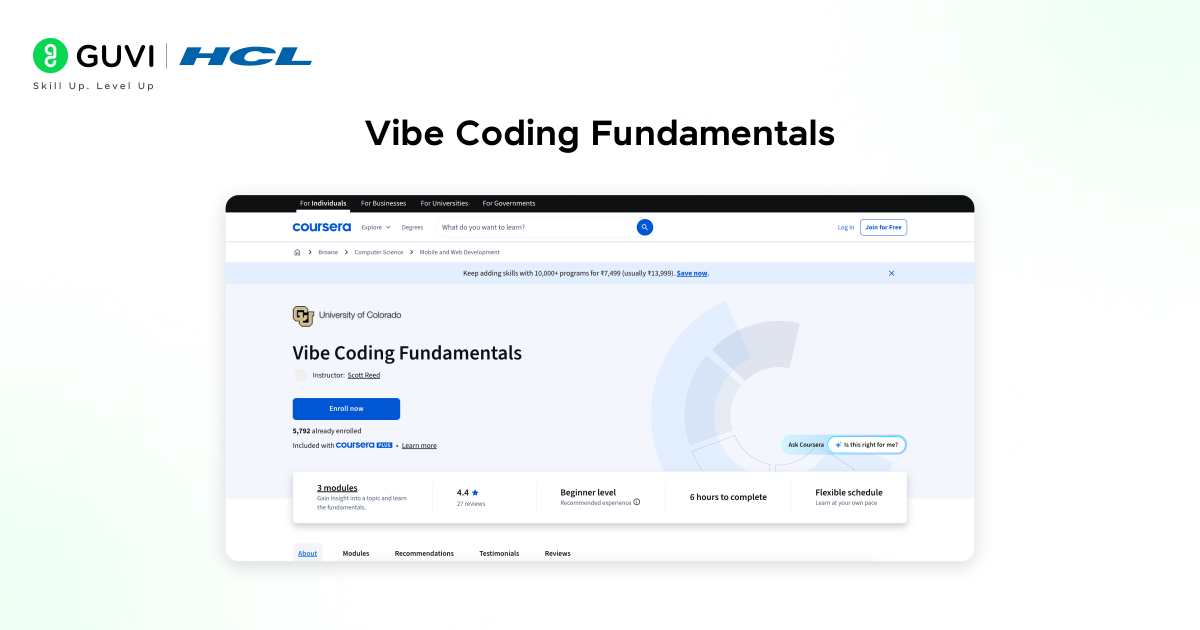
Platform: Coursera (by University of Colorado System)
Price: Free to audit | Certificate via Coursera Plus
Duration: Approximately 10 hours (self-paced)
Certificate: Yes
What this vibe coding course covers:
- How vibe coding differs from traditional programming
- Choosing and using the right AI model (LLMs, context windows, agents)
- Writing precise, effective prompts that generate working code
- Building functional applications on Replit, Lovable, and Bolt
- Debugging, error handling, and rolling back to earlier project versions
- Security, bias awareness, and responsible AI use in development
Who it is for: People completely new to coding who want a structured academic introduction. Rated 4.5/5 based on recent learner reviews.
Why it stands out: Backed by a recognised university, this course gives you the conceptual foundation that pure tool-based courses skip. Understanding why vibe coding works makes you better at using it.
3. AI for App Building
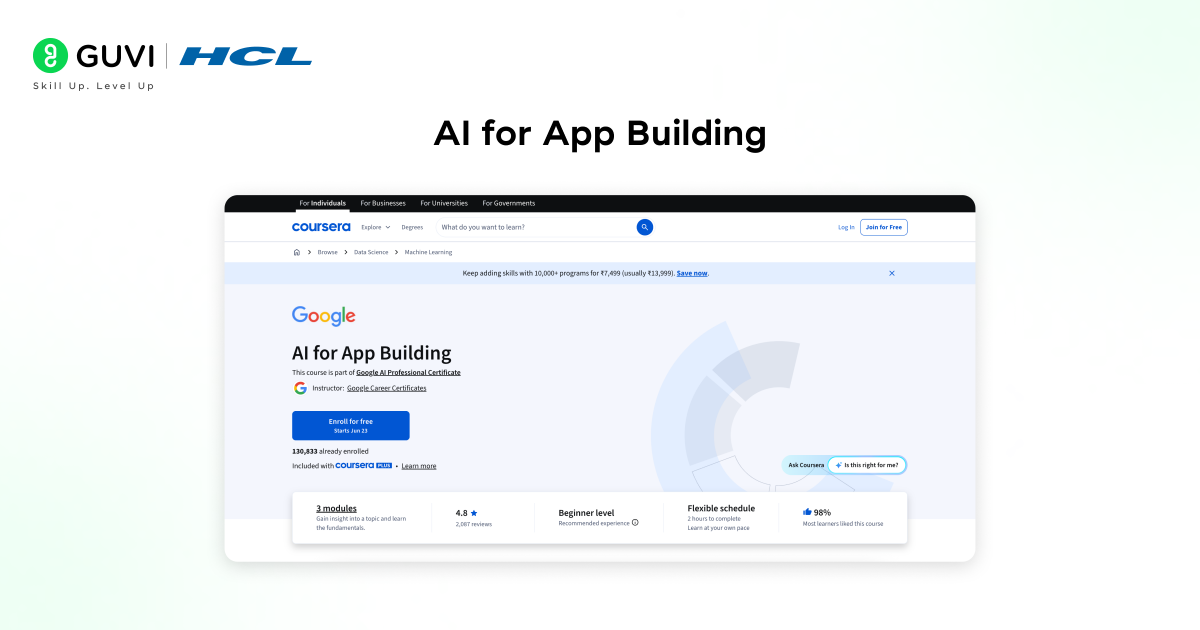
Platform: Coursera (by Google)
Price: Free to audit | Certificate via Coursera Plus
Duration: Approximately 6 hours (self-paced)
Certificate: Yes (part of a Google Professional Certificate)
What this vibe coding course covers:
- Communicating with AI using everyday language to generate and test code
- Auditing your professional workflow to find the best opportunity to use AI
- Building a functional, shareable app using Google AI Studio
- Diagnosing and debugging code using AI conversations
- Responsible vibe coding practices and common pitfalls to avoid
Who it is for: Professionals who want to build a real tool to solve a problem at work. Rated an exceptional 4.9 out of 5 with over 700 reviews.
Why it stands out: Created by Google, this vibe coding course is deeply integrated with Google AI Studio. Incredibly practical. You leave the course with a working app built to solve an actual workplace problem.
4. Intro to Vibe Coding
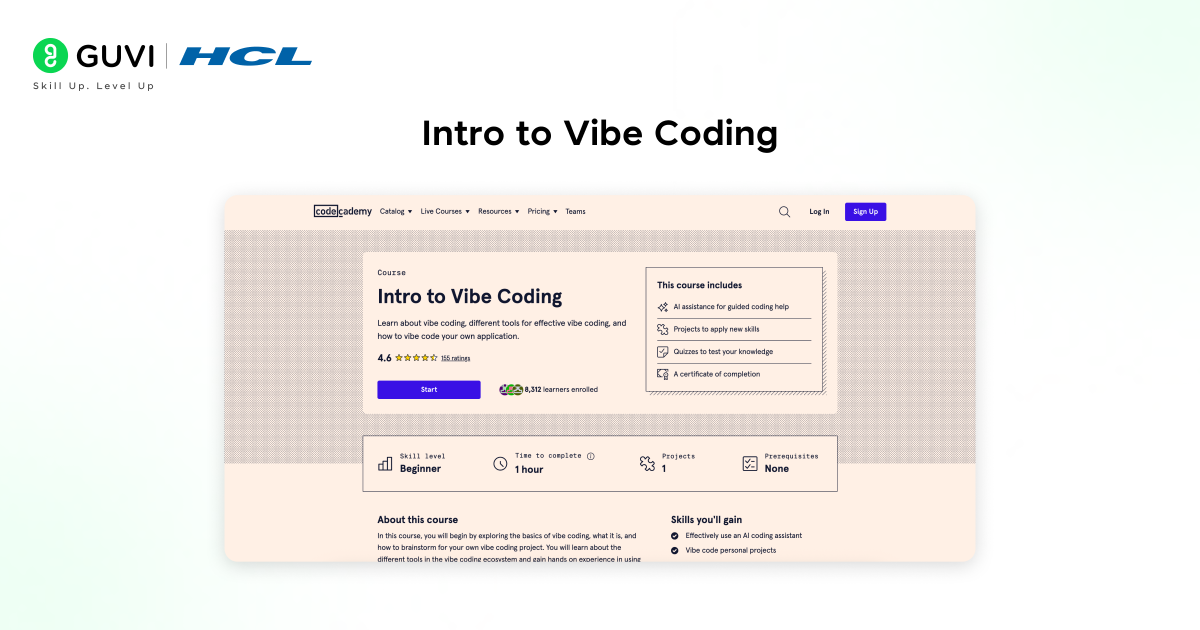
Platform: Codecademy
Price: Free trial available | Paid plans from $16/month
Duration: Less than 1 hour
Certificate: Yes (certificate of completion)
What this vibe coding course covers:
- The history and context of vibe coding
- How to brainstorm and plan a vibe coding project
- Overview of tools in the vibe coding ecosystem
- Building a web app using Cursor IDE
- How to know when to use AI assistance and when to work without it
Who it is for: True beginners who want a quick, friendly introduction before committing to a longer course. Perfect for exploring whether vibe coding is right for you.
Why it stands out: Codecademy’s AI Learning Assistant gives you instant personalized feedback inside the course. The fastest entry point on this list and a great starting point before committing to a longer vibe coding course option.
5. Vibe Coding from Scratch: Learn to “Code” Using AI
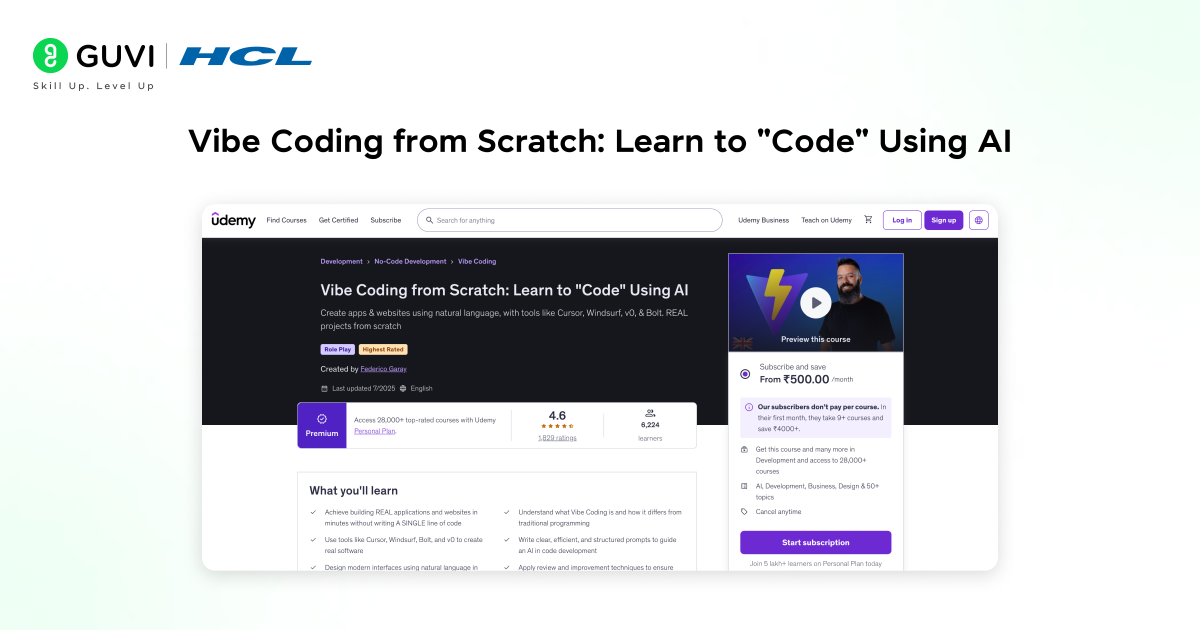
Platform: Udemy
Price: Rs. 799
Duration: Approximately 5 hours
Certificate: Yes (certificate of completion)
What this vibe coding course covers:
- What vibe coding is and how it is transforming the software industry
- Using Cursor, Windsurf, Bolt, and v0 from installation to first project
- Hands-on projects: a note-taking app, a memory game, an event landing page, and more
- Prompt engineering strategies for clear and efficient AI communication
- Code quality checks and ethical considerations in AI-generated code
Who it is for: Designers, content creators, product managers, and entrepreneurs with ideas who want to build without depending on a developer.
Why it stands out: Four complete hands-on projects, one per tool. You graduate with real, working apps rather than just theoretical knowledge. Very practical for total beginners.
6. Vibe Coding Bootcamp: Build Any App, Game or Website with AI
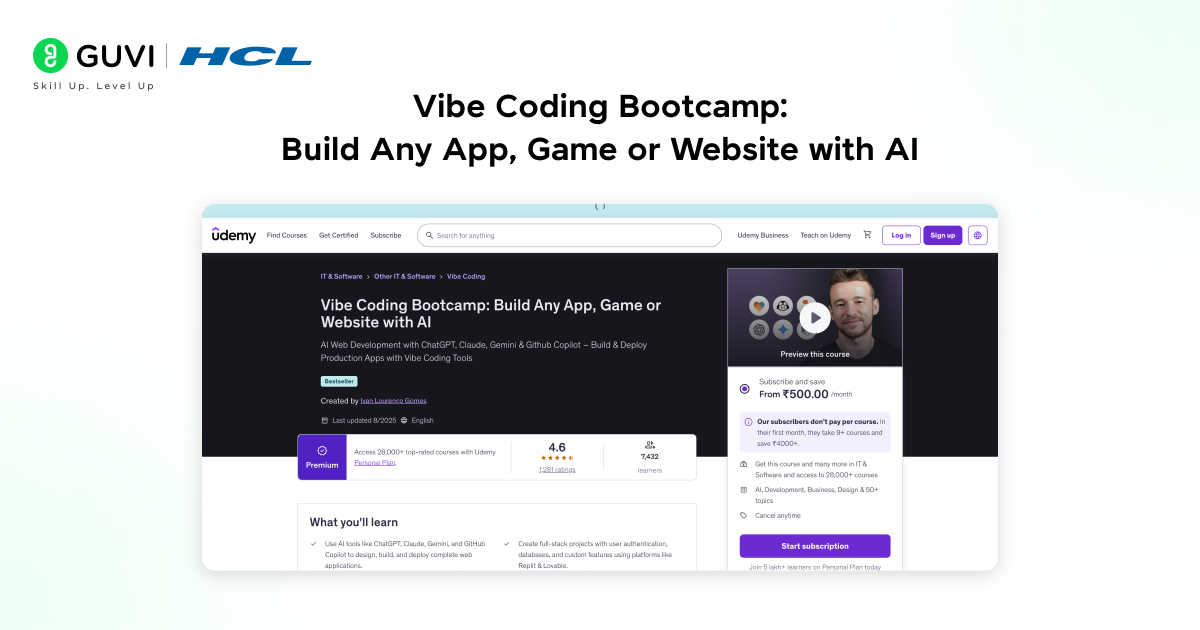
Platform: Udemy
Price: Approximately Rs. 499 (frequently discounted)
Duration: Approximately 10 hours
Certificate: Yes (certificate of completion)
What this vibe coding course covers:
- Building simple projects like landing pages and games using Claude, Gemini, and ChatGPT Canvas
- Full-stack development with Replit and Lovable including authentication and databases
- Managing admin panels, dynamic content, and user data
- Translating Figma designs into working websites using AI
- Component architecture, unit testing, and state management guided by AI
- Deploying production-ready applications
Who it is for: Beginner and intermediate developers who want a comprehensive, full-stack vibe coding experience using multiple tools.

Why it stands out: One of the most comprehensive vibe coding courses on Udemy. Goes all the way from simple pages to full-stack apps with real databases, making it excellent value for the price.
7. Vibe Coding: AI-Driven Software Development and Testing
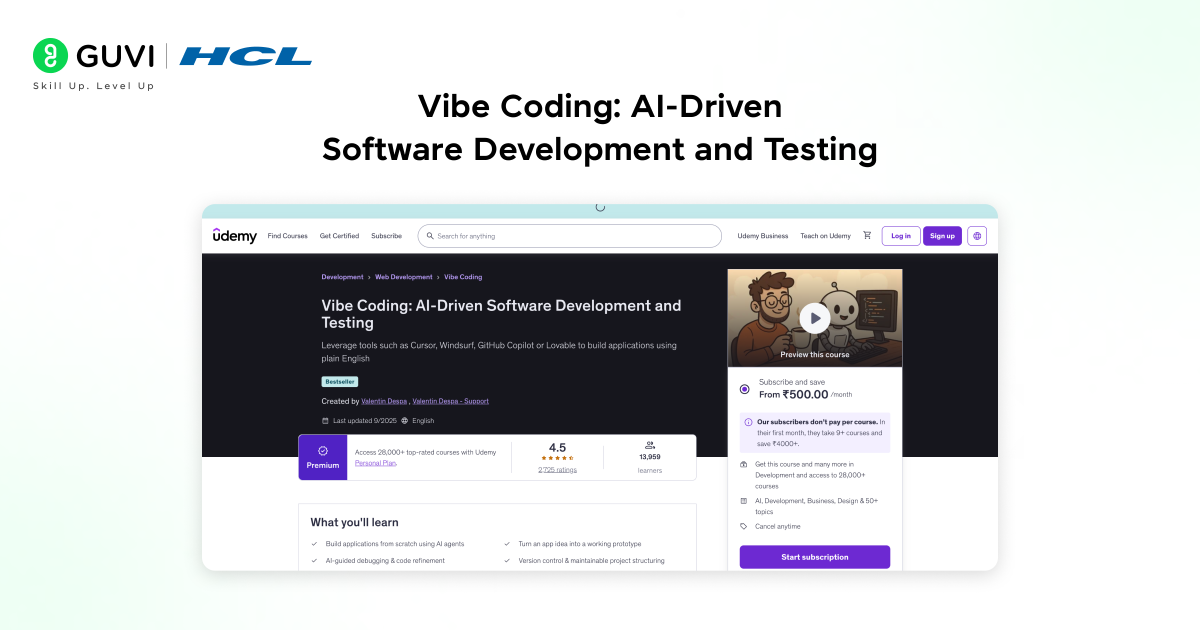
Platform: Udemy
Price: Approximately Rs. 499 (frequently discounted)
Duration: Approximately 8 hours
Certificate: Yes (certificate of completion)
What this vibe coding course covers:
- The vibe coding mindset and its origins with Andrej Karpathy
- Overview of leading tools: Cursor, Windsurf, Lovable, and GitHub Copilot
- Hands-on projects with real AI-generated code from natural language instructions
- Best practices for vibe coding in professional development workflows
- Core software development practices adapted for AI workflows
Who it is for: Complete beginners and developers who want to understand how to guide AI output rather than write every line of code. Over 4,400 students enrolled.
Why it stands out: Strong focus on development best practices alongside the vibe coding tools. Teaches you not just how to use the tools, but how to use them well and ship reliable software.
8. Vibe Coding: Use AI and Python to Automate and Prototype Ideas
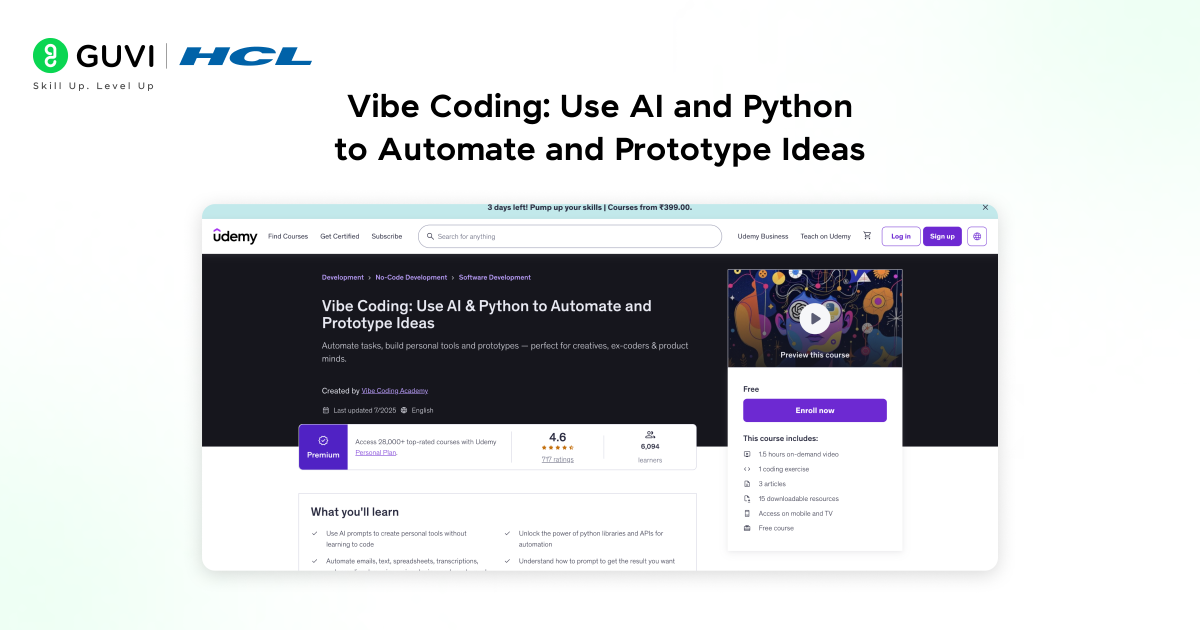
Platform: Udemy
Price: Free
Duration: Approximately 4 hours
Certificate: Yes (certificate of completion)
What this vibe coding course covers:
- Prompting LLMs to write and debug working Python code
- Building automation tools: email senders, web scrapers, spreadsheet processors
- Exploring powerful APIs: OpenAI, Google, YouTube (Pytube), and more
- Creating small creative apps: games, voice cloners, and image stylisers
- Running code in Google Colab (no installation needed) or locally via VS Code
Who it is for: Ex-coders returning after a break, product managers, freelancers, and creative professionals who want to automate repetitive tasks using AI and Python.
Why it stands out: This vibe coding course focuses on real automation, not just app building. If you want to save hours on boring tasks using AI, this is the most practical option on this list.
9. The Vibe Coding Security and Risk Course
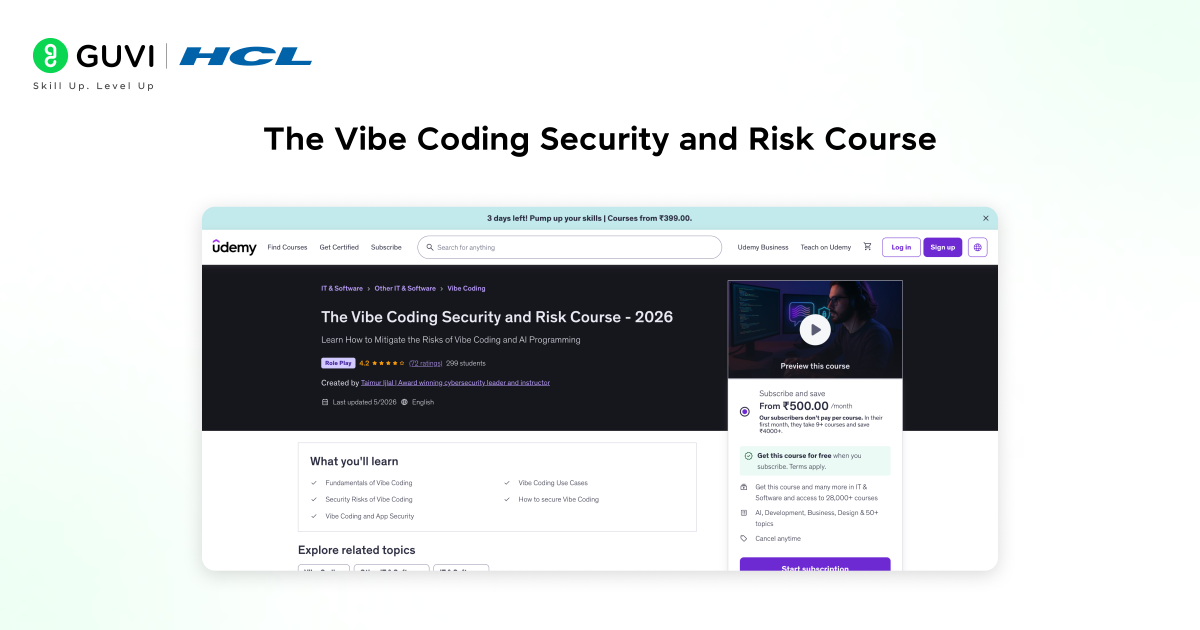
Platform: Udemy
Price: Approximately Rs. 499 (frequently discounted)
Duration: Approximately 3 hours (22 lectures)
Certificate: Yes (certificate of completion)
Rating: 4.4 out of 5
What this vibe coding course covers:
- The security risks of AI-generated code: hallucinations, prompt injection, and data leakage
- Dependency poisoning, slopsquatting, and insecure default patterns
- How to use Cursor Rules and prompt engineering to improve code safety
- Vibe hacking, social engineering risks, and the broader impact on software security
- Building AI output review gates and secure coding workflows
Who it is for: Developers, security professionals, and anyone building with AI who wants to understand the risks and ship responsibly. No development or security expertise required.
Why it stands out: The only vibe coding course on this list dedicated entirely to security. As vibe coding becomes mainstream, understanding these risks is no longer optional. Essential reading before you ship anything to real users.
10. Vibe Coding with AI Tools
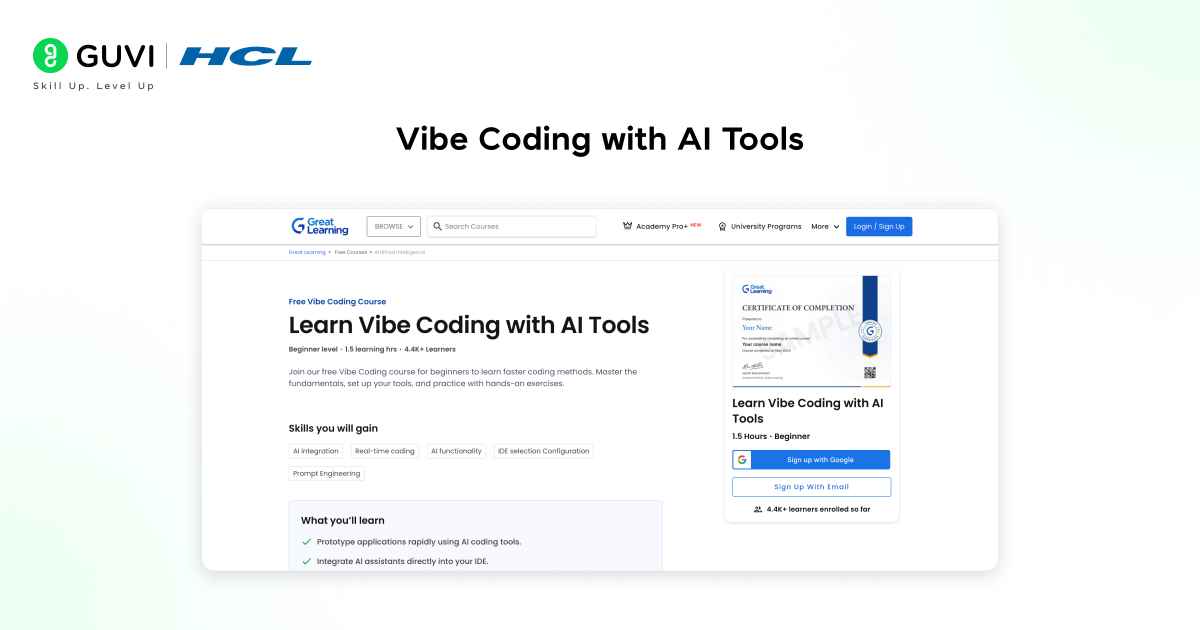
Platform: Great Learning
Price: Free to enrol | Small paid fee for certificate
Duration: Approximately 2 hours
Certificate: Yes (paid fee required)
What this vibe coding course covers:
- Fundamentals of vibe coding and how it differs from traditional coding
- Setting up a development environment and exploring AI-powered IDEs
- Overview of AI tools that enhance vibe coding productivity
- Integrating AI tools with vibe coding through practical demonstrations
- A live demo module showing vibe coding in real time
- Best practices and future trends in AI-assisted development
Who it is for: Complete beginners who want a free, no-pressure introduction to the concepts and tools before committing to a paid course.
Why it stands out: The best zero-cost entry point on this list. The free content is genuine and useful, and the live demo module gives you a real feel for what vibe coding looks like in practice before you invest time or money in a longer programme.
How to Choose the Right Vibe Coding Course
Not every vibe coding course is right for every learner. Here is a simple way to pick based on your situation:
| Your Goal | Best Vibe Coding Course |
| I want to start for free today | Great Learning or Codecademy Intro |
| I want a university-backed certificate | Vibe Coding Fundamentals (Univ. of Colorado) |
| I want to build work tools using Google AI | AI for App Building (Google on Coursera) |
| I want the most comprehensive beginner path | Scrimba Vibe Coding Essentials Specialisation |
| I want to build full-stack apps fast | Vibe Coding Bootcamp (Udemy) |
| I want to automate tasks with Python | Vibe Coding: AI and Python (Udemy) |
| I need to understand security risks | Vibe Coding Security and Risk (Udemy) |
| I want a quick overview in under an hour | Intro to Vibe Coding (Codecademy) |
Do check out HCL GUVI’s AI & ML 5-Day Email Course, which is a beginner-friendly option that delivers short daily lessons covering AI basics, real-world use cases, career paths, and project ideas, making it a simple way to understand how AI and machine learning work without a heavy time commitment.
Tips for Getting the Most Out of Any Vibe Coding Course
- Build while you learn: Do not just watch the videos. Open your tool, follow along, and build something at the same time. The real learning happens when you are prompting and reviewing real code.
- Start with one tool: Every vibe coding course introduces multiple tools. Pick one (Cursor is the most popular in 2026) and master it before exploring others.
- Expect to revise prompts: Your first prompt rarely produces exactly what you want. Learning to refine prompts is a skill in itself and is a core part of every good vibe coding course.
- Review AI output before using it: Never ship code you do not at least broadly understand. Read what the AI writes, ask it to explain anything unclear, and test before deploying.
- Join the community: Most vibe coding platforms (Cursor, Replit, Lovable) have active Discord communities. Real users share prompts, workflows, and tips that no course can fully cover.
💡 Did You Know?
- The term “vibe coding” was coined by AI scientist Andrej Karpathy in early 2025. He described it as “fully giving in to the vibes, embracing exponentials, and forgetting that the code even exists.”
- 84% of developers reported using or planning to use AI coding tools in their daily work in 2026, according to the Stack Overflow Developer Survey.
- Vibe coding can reduce development time by up to 60% on routine tasks, according to research. One developer reported building 12 separate apps in the time it would have previously taken to build one.
Conclusion
A strong vibe coding course is not just about learning tools. It is about shifting how you think about building software. Developers, designers, founders, and students are shipping real products using AI tools right now, many of them after taking just one good vibe coding course.
If you have never tried it, start with the free Great Learning vibe coding course or the Codecademy intro. Both take under two hours and give you a real feel for what vibe coding involves. If you are ready to commit, the Scrimba Vibe Coding Essentials Specialisation on Coursera is the most structured and comprehensive vibe coding course available.
The tools will keep getting better. The time to learn the workflow is now.
FAQs
1. Do I need any coding experience to take a vibe coding course?
No. Most vibe coding course options on this list are designed for complete beginners with zero coding background. You need basic computer skills, a working internet connection, and a willingness to experiment and iterate.
2. Are vibe coding course certificates worth anything?
Certificates from Coursera specialisations backed by Google or a university carry real weight on a LinkedIn profile or resume. Udemy and Great Learning certificates are less recognised but still useful for demonstrating the skill and commitment to learning.
3. How long does it take to complete a vibe coding course?
You can understand the basics in a single day using a free vibe coding course. Building real, useful applications typically takes two to four weeks of consistent practice with a structured vibe coding course. The Scrimba vibe coding course estimates one to two months at ten hours per week.
4. What tools will I use after taking a vibe coding course?
The most commonly taught tools are Cursor, GitHub Copilot, Claude Code, Lovable, Bolt, Replit, Windsurf, and v0. Cursor is the most popular choice for individual developers in 2026.
5. Is vibe coding just no-code or low-code?
No. Vibe coding is different from traditional no-code tools. No-code tools use drag-and-drop interfaces with limited flexibility. Vibe coding uses AI to generate real code from natural language, giving you full access to the underlying software while removing the need to write syntax manually.
Success Stories

About the Author
Jebasta
I translate the language of data into stories that anyone can understand. As a writer with a data science background, I simplify analytics, AI, and decision-making so beginners and enthusiasts can confidently explore the world of data.
View all posts by Jebasta
Connect with me @






Did you enjoy this article?