


VFX Articles
Top 16 AI-Driven Tools for 3D Animation and VFX
9 Must-Know VFX Project Ideas for Beginners in 2026


Get In Touch For Details! Request More Information
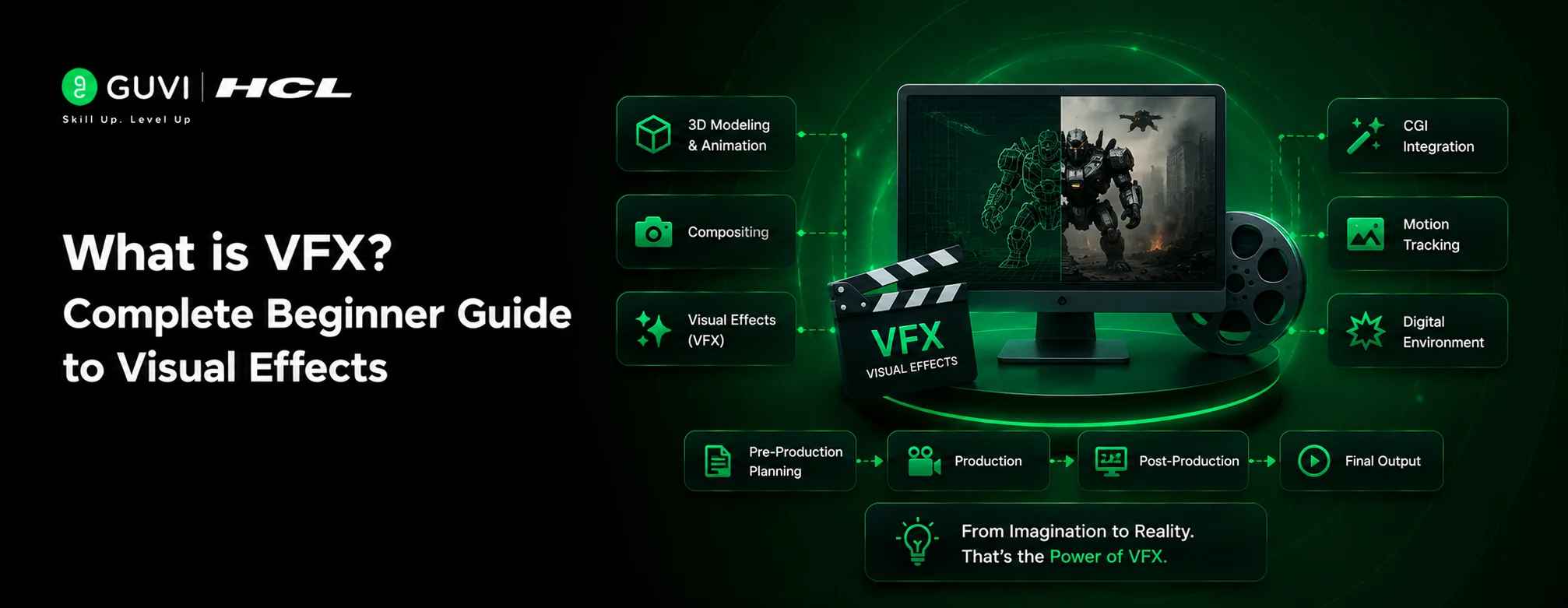
What is VFX? Complete Beginner Guide to Visual Effects in 2026
Jul 21, 2026 4 Min Read 14437 Views
(Last Updated)
When we see Hollywood movies, especially movies that portray a larger-than-life world like Avatar, Marvel Cinematic Universe, and so on, we will be amazed by the world they have created out of sheer imagination. How do you think they did so?
Those awe-inspiring visuals that make you gasp are thanks to the magic of Visual Effects, or VFX for short. In simple terms, Visual Effects refer to the techniques used to create or manipulate imagery that cannot be captured during live-action filming.
This article explains everything related to Visual Effects including its types, evolution of it, and how to learn it efficiently. So, without further ado, let us get started!
Table of contents
- TL;DR Summary
- What is VFX?
- VFX vs SFX vs CGI — Complete Difference Explained
- Types of VFX explained
- How to Start Learning VFX in India: Step By Step
- VFX Career Scope and Salary in India 2026
- Common Mistakes Beginners Make
- Conclusion
- FAQs
- What is VFX in simple terms?
- Is VFX the same as CGI?
- Can I learn VFX without a film degree?
- Which software should a beginner learn first?
- How much does a VFX artist earn in India?
- How long does it take to become job-ready in VFX?
TL;DR Summary
- VFX (Visual Effects) means creating or altering imagery digitally, things a camera cannot capture on its own, like dragons, explosions, or alien worlds.
- VFX is different from SFX (physical, on-set effects) and CGI (a specific VFX technique using 3D computer graphics).
- The three core VFX types are CGI, compositing, and motion capture, each using different software like Blender, Nuke, or Maya.
- You can start learning VFX in India with free tools like Blender, structured courses, and a strong beginner portfolio.
- VFX salaries in India range from around ₹2.5 to ₹4.5 LPA for freshers to ₹12 to ₹20+ LPA for senior artists, depending on skill and city.
What is VFX?
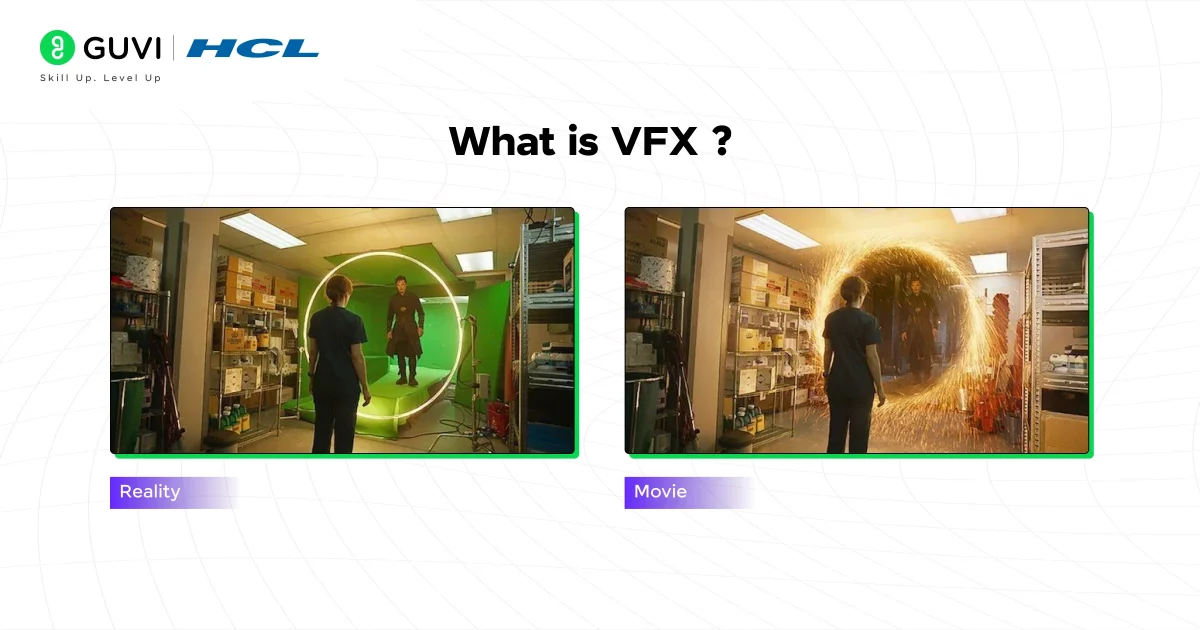
VFX stands for Visual Effects. It’s the process of creating or manipulating imagery for film, TV, ads, or games, imagery that would be impossible, unsafe, or too expensive to capture with a camera alone.
Think about the last superhero movie you watched. That mid-air battle, the collapsing city skyline, the glowing energy blast, none of it was filmed for real. VFX artists built it digitally and blended it into the live footage so seamlessly that you never questioned it.
You’ll find VFX everywhere today, not just in Hollywood. Indian OTT shows, regional cinema, mobile game cinematics, and even product ads now lean heavily on visual effects to tell bigger stories on smaller budgets.
VFX vs SFX vs CGI — Complete Difference Explained
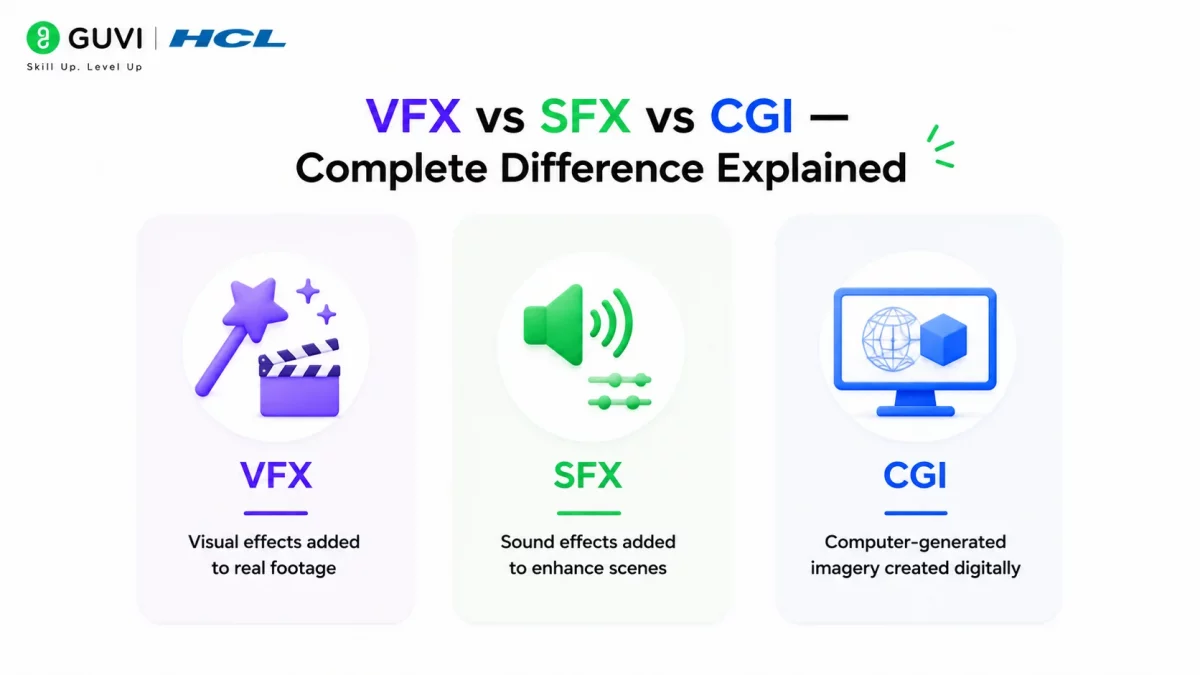
This is one of the most searched questions from beginners, and it trips up a lot of people. Here’s the difference in one line each: SFX happens physically on set, CGI is a specific digital technique, and VFX is the umbrella term that includes CGI along with everything else done in post-production.
| Aspect | VFX | SFX | CGI |
|---|---|---|---|
| Meaning | Digital creation or manipulation of imagery | Physical effects created on set | 3D computer-generated imagery |
| Where it happens | Post-production, on a computer | During filming, on location | Post-production, on a computer |
| Example | Adding a digital dragon to a scene | A real explosion using pyrotechnics | Building a 3D spaceship model |
| Tools used | After Effects, Nuke, Houdini | Prosthetics, animatronics, pyrotechnics | Blender, Maya, ZBrush |
| Relationship | Umbrella term, includes CGI | Independent of VFX | A type of VFX |
| When it’s used | For scenes impossible to film live | For scenes safe and cheap to film live | For fully digital characters or worlds |
Many blockbuster scenes actually blend SFX and VFX together. A real fire on set (SFX) is often extended digitally with extra smoke, sparks, or scale (VFX) to make it look bigger than what was safe to film.
Types of VFX explained
Not all VFX work looks the same. Depending on what a scene needs, artists pick from a few core techniques, each with its own software and skill curve.
| VFX Type | Software Used | Movie Examples | Difficulty |
|---|---|---|---|
| CGI (3D Modeling) | Blender, Maya, ZBrush | Dinosaurs in Jurassic Park, Thanos in Avengers | Hard |
| Compositing (Chroma Keying) | Adobe After Effects, Nuke | Green-screen scenes in Avatar | Moderate |
| Motion Capture | Vicon, MotionBuilder | Gollum in Lord of the Rings, Na’vi in Avatar | Hard |
| Simulation (fire, smoke, water) | Houdini | Explosions in Avengers: Endgame | Hard |
| Matte Painting | Photoshop, Nuke | Fantasy backdrops in Game of Thrones | Moderate |
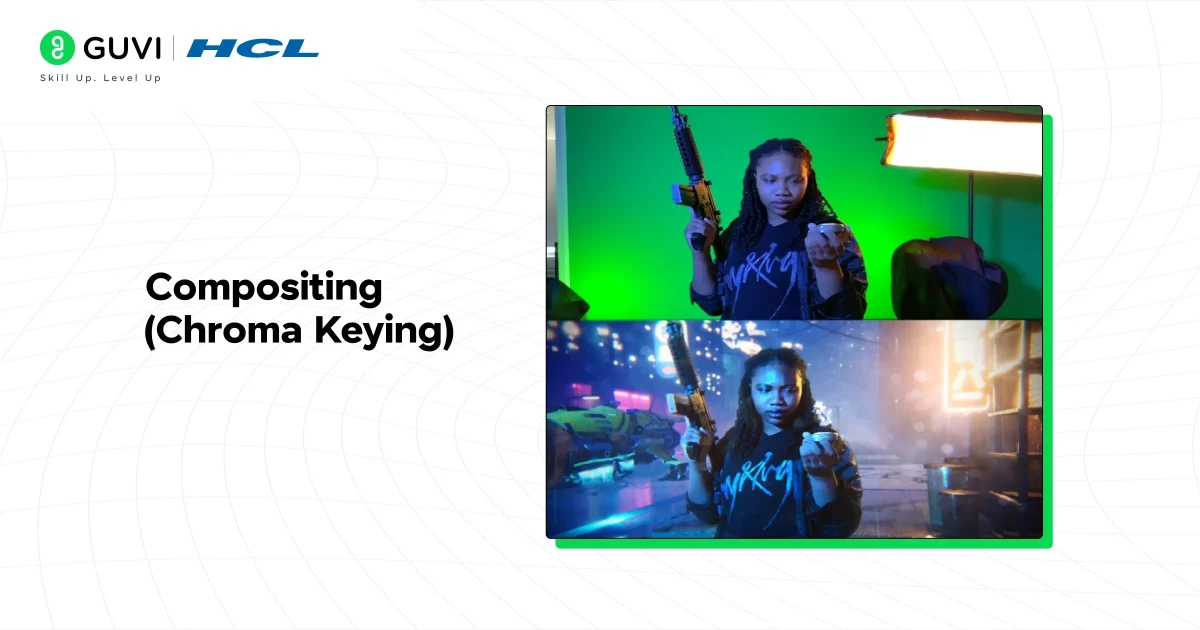
If you’re just starting out, compositing is usually the easiest entry point. It has a shorter learning curve than 3D modeling or simulation work, and free tools like After Effects trials or DaVinci Resolve let you practice right away.
How to Start Learning VFX in India: Step By Step
You don’t need a film school degree to start. You need the right sequence of skills and consistent practice.
- Get comfortable with the basics of your device first. Before touching VFX software, know your way around file management and basic video formats.
- Start with one free tool. Blender is free, powerful, and has a massive beginner community. Learn 3D modeling basics here before moving anywhere else.
- Learn compositing next. Adobe After Effects is the industry standard for green-screen work and motion graphics. Most entry-level VFX jobs expect at least working knowledge of it.
- Follow structured tutorials, not random videos. YouTube is great for quick tricks, but a structured course keeps you from skipping foundational concepts.
- Build a small portfolio early. Recreate one green-screen shot, one basic 3D object, one simple simulation. Recruiters care more about your showreel than your certificates.
- Specialize once you know the basics. Pick one lane, compositing, modeling, or simulation, and go deep. Generalists struggle to get hired at bigger studios.
Want a guided path instead of figuring this out alone? HCL GUVI’s Adobe After Effects for VFX Course takes you from software basics to a job-ready portfolio with mentor support and real project work. It’s built for exactly the kind of beginner-to-career jump this section walks through.

VFX Career Scope and Salary in India 2026
India’s VFX industry has grown fast, largely because international studios outsource a big share of their post-production work here. That means more studios, more openings, and a wider range of roles than most beginners expect.
| Experience Level | Typical Roles | Salary Range (India, 2025) |
|---|---|---|
| Fresher (0-2 yrs) | Roto artist, junior compositor, trainee 3D modeler | ₹2.5-4.5 LPA |
| Mid-level (2-6 yrs) | Compositor, 3D modeler, VFX artist | ₹5-8 LPA |
| Senior (6+ yrs) | VFX supervisor, FX technical director, lead compositor | ₹10-20+ LPA |
Cities like Mumbai, Hyderabad, and Pune host most of India’s major VFX studios, so salaries there tend to run higher than in smaller cities. Specializing in in-demand skills like Houdini simulations or Nuke compositing also pushes pay up faster than staying a generalist.
Common Mistakes Beginners Make
- Trying to learn every tool at once: Jumping between Blender, Maya, and Houdini in your first month leaves you shallow in all three. Master one before adding the next.
- Skipping the fundamentals for flashy effects: Beginners often chase explosions and creatures before understanding lighting, tracking, and basic compositing. The fundamentals make everything else easier later.
- No portfolio, only certificates: Studios hire based on what you can show, not what you’ve completed. Build shots, not just course completions.
Conclusion
In conclusion, Visual Effects have revolutionized the way stories are told on screen, enabling creators to push the boundaries of imagination and bring the impossible to life.
Whether you’re a movie enthusiast who looks keenly at VFX masterpieces or an aspiring artist eager to create your own, understanding the world of VFX opens up endless possibilities.
So, next time you watch a film, take a moment to appreciate the artistry and technology that went into crafting those mesmerizing visuals. Who knows? Maybe one day, you’ll be the one creating them!
FAQs
What is VFX in simple terms?
VFX is the use of digital tools to create or change imagery that can’t be filmed live, like fantasy creatures, explosions, or entire digital environments.
Is VFX the same as CGI?
No. CGI is one technique inside VFX, specifically 3D computer-generated imagery. VFX also includes compositing, motion capture, and simulation.
Can I learn VFX without a film degree?
Yes. Most working VFX artists in India today learned through online courses, free tools like Blender, and self-built portfolios rather than a formal film degree.
Which software should a beginner learn first?
Start with Blender for 3D basics and Adobe After Effects for compositing. Both have strong free learning resources and are widely used in the industry.
How much does a VFX artist earn in India?
Freshers typically start around ₹2.5-4.5 LPA, while senior artists and supervisors can earn ₹12-20+ LPA depending on specialization and studio.
How long does it take to become job-ready in VFX?
Most beginners take 6-12 months of consistent practice to build a portfolio strong enough for entry-level roles, depending on how much time they can dedicate weekly.
Success Stories

About the Author
Lukesh S
A professional content writer who has experience in freelancing and now working as a Technical Content Writer at HCL GUVI having sound knowledge in Blog Writing and Creative Writing!
View all posts by Lukesh S
Connect with me @







Did you enjoy this article?