


Artificial Intelligence and Machine Learning Articles
Finance Manager to Data Analytics: Career Growth, Salary and Seniority
How to Evaluate LLM Outputs in Production Deployments
AI/ML Skills Gap 2026: Why Companies Can't Find Job-Ready Talent
20 AI/ML Interview Questions Recruiters Can Use Without a Tech Background - Best Guide


Get In Touch For Details! Request More Information

What is Responsible AI Frameworks: A Beginner’s Guide
Sep 07, 2026 4 Min Read 309 Views
(Last Updated)
As artificial intelligence becomes part of business, healthcare, finance, education, and everyday applications, organizations need ways to develop and use AI responsibly. Responsible AI Frameworks provide structured principles and practices for addressing issues such as fairness, transparency, privacy, safety, accountability, and reliability. This guide explains what Responsible AI frameworks are, their key principles, how they work across the AI lifecycle, and why they matter for modern AI development.
Table of contents
- TL;DR Summary
- Why Responsible AI Matters
- What Are Responsible AI Frameworks?
- Key Principles of Responsible AI
- Fairness
- Transparency
- Accountability
- Privacy
- Safety and Reliability
- Security
- How Responsible AI Frameworks Work
- Step 1: Define the Use Case
- Step 2: Assess the Data
- Step 3: Evaluate the Model
- Step 4: Establish Human Oversight
- Step 5: Deploy Responsibly
- Step 6: Monitor Continuously
- Responsible AI Across the AI Lifecycle
- Benefits of Responsible AI Frameworks
- Better Risk Management
- Greater Trust
- Stronger Governance
- More Reliable AI
- When Should You Use Responsible AI Frameworks?
- High-Impact AI Systems
- Generative AI Applications
- Sensitive Data
- Enterprise AI
- Public-Facing AI
- Key Concepts to Remember
- A Practical Responsible AI Workflow
- Define the AI Use Case
- Assess Data and Privacy
- Identify AI Risks
- Test the Model
- Establish Accountability
- Document the System
- Monitor After Deployment
- Best Practices
- Conclusion
- FAQs
- What are Responsible AI Frameworks?
- Why is Responsible AI important?
- What are the main principles of Responsible AI?
- When should Responsible AI be considered?
- Who is responsible for AI governance?
- Does Responsible AI apply only to high-risk systems?
- How can organizations implement Responsible AI?
TL;DR Summary
- Responsible AI frameworks guide ethical AI development and use.
- They address fairness, transparency, safety, privacy, and accountability.
- Frameworks can be applied throughout the AI lifecycle.
- Risk assessment helps identify potential AI harms.
- Continuous monitoring is important after deployment.
Direct Answer
| Responsible AI Frameworks are structured guidelines that help organizations develop, deploy, and manage AI systems responsibly. They typically address principles such as fairness, transparency, accountability, privacy, safety, security, and reliability. By incorporating these principles into the AI lifecycle, organizations can identify risks earlier, improve oversight, and build AI systems that are more trustworthy and appropriate for real-world use. |
Why Responsible AI Matters
AI systems can influence important decisions and affect individuals, organizations, and society. Responsible AI practices help teams identify potential risks before and after deployment.
Key goals include:
- Improving fairness
- Protecting privacy
- Increasing transparency
- Strengthening accountability
- Improving AI safety
- Managing potential risks
What Are Responsible AI Frameworks?
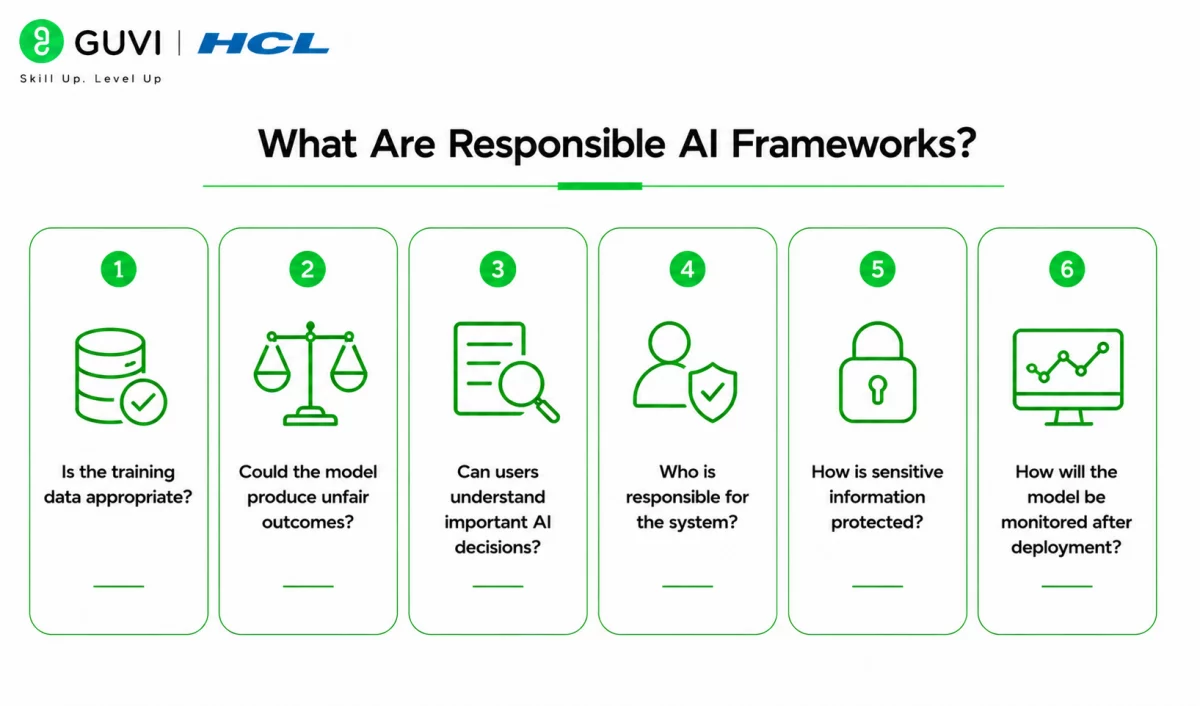
Responsible AI Frameworks are organized sets of principles, processes, and controls that help organizations manage the risks associated with AI systems.
A framework can guide teams through questions such as:
- Is the training data appropriate?
- Could the model produce unfair outcomes?
- Can users understand important AI decisions?
- Who is responsible for the system?
- How is sensitive information protected?
- How will the model be monitored after deployment?
Key Principles of Responsible AI
Different frameworks use different terminology, but several principles commonly appear.
Fairness
AI systems should be evaluated for potentially unfair or discriminatory outcomes.
Transparency
Organizations should provide appropriate information about how AI systems are developed and used.
Accountability
Clear responsibility should exist for AI system decisions, risks, and outcomes.
Privacy
AI systems should handle personal and sensitive information appropriately.
Safety and Reliability
Systems should be tested to identify failures and unexpected behavior before and after deployment.
Security
AI systems should be protected against misuse, attacks, unauthorized access, and other security threats.
How Responsible AI Frameworks Work
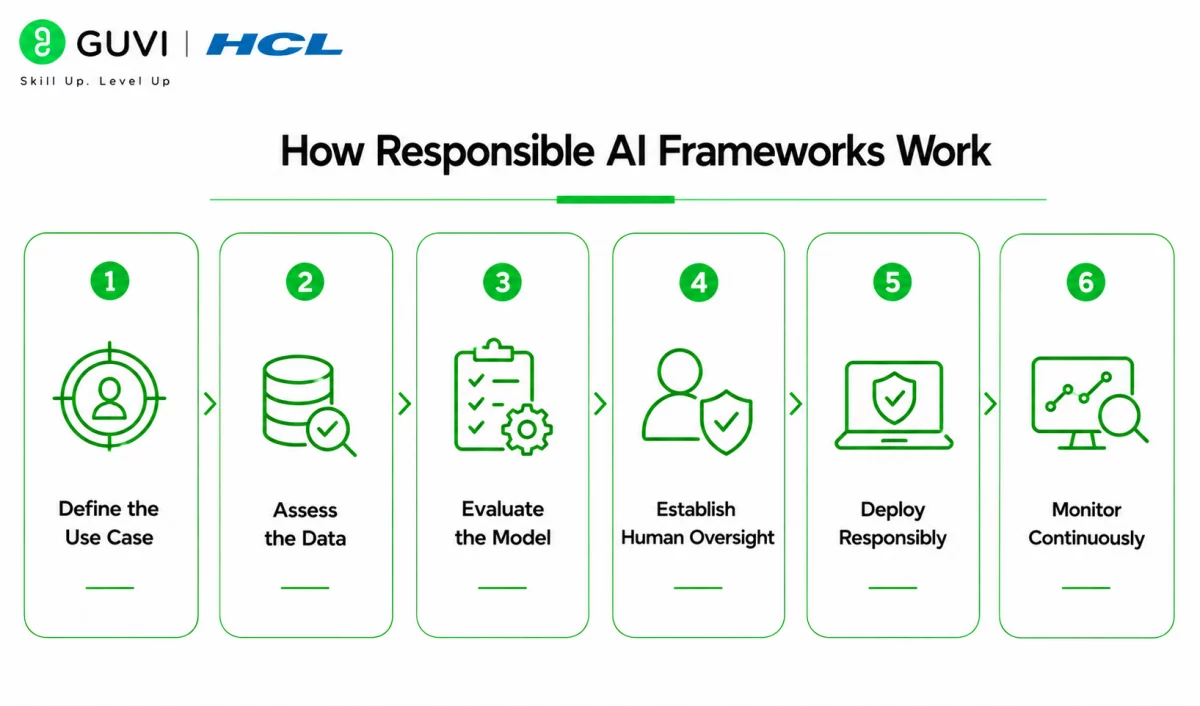
Responsible AI practices can be integrated throughout the AI lifecycle.
Step 1: Define the Use Case
Clearly establish what the AI system will do, who will use it, and what potential risks could arise.
Step 2: Assess the Data
Review data quality, representation, privacy considerations, and potential sources of bias.
Step 3: Evaluate the Model
Test performance, fairness, robustness, safety, and other requirements relevant to the application.
Step 4: Establish Human Oversight
Define when humans should review, approve, override, or investigate AI-generated decisions.
Step 5: Deploy Responsibly
Implement appropriate security, documentation, access controls, and monitoring processes.
Step 6: Monitor Continuously
Track model behavior and emerging risks after deployment and update the system when necessary.
Responsible AI Across the AI Lifecycle
A practical framework can be viewed as:
Planning → Data → Development → Evaluation → Deployment → Monitoring
Responsible AI should not be treated as a final checklist. Risks can emerge at any stage, so teams should continuously evaluate the system as it develops and operates.
Do not treat Responsible AI as only an ethics document. The most useful frameworks turn principles such as fairness, privacy, safety, and accountability into specific processes, tests, documentation, ownership, and monitoring requirements that development teams can actually follow.
Benefits of Responsible AI Frameworks
Better Risk Management
Frameworks help organizations identify potential AI risks systematically.
Greater Trust
Clear processes and appropriate transparency can improve confidence among users and stakeholders.
Stronger Governance
Defined responsibilities make it easier to manage AI systems throughout their lifecycle.
More Reliable AI
Testing and monitoring can identify problems that may otherwise remain unnoticed.
Professionals interested in artificial intelligence, machine learning, AI governance, and responsible technology can strengthen their expertise through HCL GUVI’s Artificial Intelligence and Machine Learning Course.
When Should You Use Responsible AI Frameworks?
Responsible AI Frameworks are useful whenever AI systems can create meaningful risks for users, organizations, or society. They are particularly important for systems that process sensitive information or influence important decisions.
High-Impact AI Systems
Use responsible AI practices for applications involving hiring, lending, healthcare, education, or other consequential decisions.
Generative AI Applications
Apply governance practices when deploying chatbots, content-generation tools, AI assistants, or other systems that can produce unpredictable outputs.

Sensitive Data
Responsible AI frameworks are especially important when systems process personal, confidential, or sensitive information.
Enterprise AI
Organizations can use frameworks to establish clear responsibilities, approval processes, documentation, risk assessments, and monitoring requirements.
Public-Facing AI
AI systems used directly by customers or the public should be evaluated for safety, fairness, privacy, transparency, and reliability.
Key Concepts to Remember
Understanding these principles makes Responsible AI Frameworks easier to apply.
- Fairness focuses on reducing unjustified disparities.
- Transparency helps users understand appropriate information about AI systems.
- Accountability establishes ownership of AI decisions and risks.
- Privacy protects personal and sensitive information.
- Safety helps prevent harmful or unexpected system behavior.
- Security protects AI systems from misuse and attacks.
- Human oversight provides additional review where automated decisions require judgment.
A Practical Responsible AI Workflow
A framework becomes more useful when its principles are converted into concrete processes.
1. Define the AI Use Case
Document the system’s purpose, users, expected outcomes, and potential risks.
2. Assess Data and Privacy
Review data quality, representation, sensitive information, and potential sources of bias.
3. Identify AI Risks
Consider risks involving fairness, safety, privacy, security, reliability, and misuse.
4. Test the Model
Evaluate the system against relevant performance, fairness, robustness, and safety requirements.
5. Establish Accountability
Assign clear owners for model development, approval, monitoring, incident response, and updates.
6. Document the System
Maintain appropriate records about data, model behavior, limitations, evaluations, and deployment decisions.
7. Monitor After Deployment
Track performance and emerging risks continuously rather than treating governance as a one-time activity.
The HCL GUVI’s Artificial Intelligence eBook introduces the fundamentals of artificial intelligence, machine learning, generative AI, and intelligent automation. It helps learners build a broader understanding of AI technologies and responsible approaches to developing intelligent systems.
Best Practices
- Define responsible AI requirements before development.
- Document data sources and important model limitations.
- Evaluate fairness and safety using appropriate tests.
- Protect sensitive information throughout the AI lifecycle.
- Assign clear ownership for AI risks and decisions.
- Keep humans involved where automated decisions have significant consequences.
- Monitor deployed systems continuously.
- Update governance practices as the system, data, or use case changes.
Conclusion
Responsible AI Frameworks help organizations move beyond simply building AI systems toward developing them with appropriate safeguards, accountability, and oversight. By addressing fairness, transparency, privacy, safety, security, and reliability throughout the AI lifecycle, teams can identify risks earlier and manage them more effectively. A strong framework turns responsible AI principles into practical processes that support safer and more trustworthy AI deployment.
FAQs
1. What are Responsible AI Frameworks?
Responsible AI Frameworks are structured principles and processes that help organizations develop, deploy, and manage AI systems while addressing risks related to fairness, privacy, safety, transparency, and accountability.
2. Why is Responsible AI important?
Responsible AI helps organizations identify potential harms, manage risks, improve oversight, and build AI systems that are more reliable and appropriate for their intended use.
3. What are the main principles of Responsible AI?
Common principles include fairness, transparency, accountability, privacy, safety, security, and reliability.
4. When should Responsible AI be considered?
Responsible AI should be considered throughout the entire lifecycle, from planning and data collection through development, evaluation, deployment, and ongoing monitoring.
5. Who is responsible for AI governance?
Responsibility should be clearly assigned within an organization. Depending on the system, this can involve developers, data scientists, product teams, security teams, legal or compliance teams, and organizational leadership.
6. Does Responsible AI apply only to high-risk systems?
No. While high-impact applications require particularly strong safeguards, responsible AI principles can improve the development and management of AI systems across many different use cases.
7. How can organizations implement Responsible AI?
Organizations can establish clear governance processes, assess risks, evaluate models, document systems, protect data, define accountability, involve human oversight where appropriate, and continuously monitor deployed AI systems.
Success Stories

About the Author
HCL GUVI
This article was selected and published as part of the HCL GUVI AI Blogathon 2026, an initiative designed to encourage students, AI enthusiasts, and aspiring tech writers to simplify complex AI concepts through impactful technical content. The contest recognized high-quality, original, and insightful AI-focused blogs, with selected authors receiving publication opportunities on the HCL GUVI blog platform along with official author credits and recognition.
View all posts by HCL GUVI
Connect with me @











Did you enjoy this article?