


Data Science Articles
My Data Scientist Interview Experience: From Rejection to 6-Figure Offer
My Data Analyst Interview Experience: From Rejection to Success Story
Validation and Metrics: Are They Being Ignored in Modern Data Science?


Get In Touch For Details! Request More Information

Lambda Architecture Explained: A Simple Guide for Beginners [2025]
Jan 03, 2026 5 Min Read 1261 Views
(Last Updated)
Lambda architecture has become a critical solution for modern data challenges, especially as 90% of organizations report struggling with ever-increasing data volumes. If you’ve been feeling overwhelmed by the complexity of handling both historical and real-time data processing, you’re not alone.
Essentially, a lambda architecture is a design pattern that enables the processing of large data sets in both a scalable and fault-tolerant way. With this powerful framework, your organization can increase business agility by up to 20% through real-time analytics, while still maintaining the batch processing capabilities that 85% of businesses continue to rely on.
This guide will break down everything you need to know about the Lambda architecture in simple, beginner-friendly terms. Let’s begin!
Table of contents
- What is Lambda Architecture?
- Why it matters in big data
- Where it is used today
- The Three Layers of Lambda Architecture
- 1) Batch Layer: Historical data processing
- 2) Speed Layer: Real-time data processing
- 3) Serving Layer: Querying and combining results
- Tools Commonly Used in Lambda Architecture
- 1) Apache Hadoop and HDFS
- 2) Apache Spark and Storm
- 3) Apache Kafka and Cassandra
- 4) HBase for serving layer
- Pros and Cons of Lambda Architecture
- 1) Advantages:
- 2) Disadvantages:
- Concluding Thoughts…
- FAQs
- Q1. What is Lambda Architecture, and why is it important?
- Q2. What are the three main layers of Lambda Architecture?
- Q3. What tools are commonly used in Lambda Architecture?
- Q4. What are the main advantages of using Lambda Architecture?
- Q5. What are the challenges associated with implementing the Lambda Architecture?
What is Lambda Architecture?
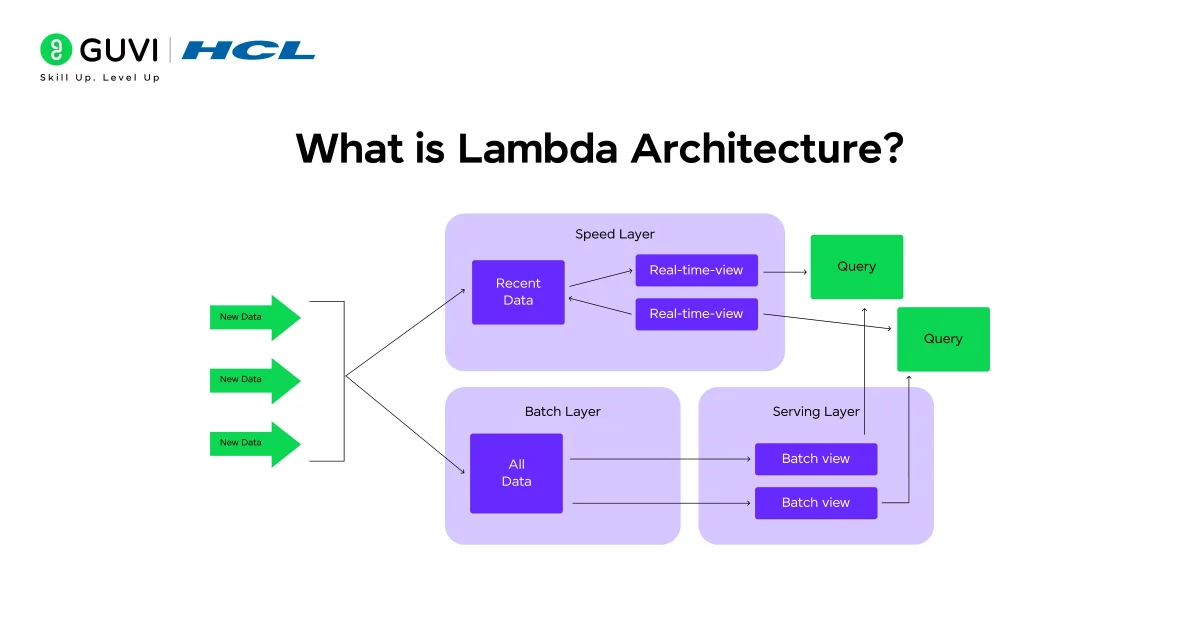
Lambda architecture is a data-processing framework that combines both batch and stream-processing methods to balance latency, throughput, and fault-tolerance. At its core, this architecture works with an append-only, immutable data source that serves as the system of record.
The name “Lambda” was introduced by Nathan Marz, who initially called it the “batch/realtime architecture” in his blog post about overcoming the CAP theorem challenges. This hybrid approach consists of three fundamental layers:
- Batch Layer: Processes all available data for comprehensive accuracy
- Speed Layer: Handles real-time data streams for minimal latency
- Serving Layer: Responds to queries by combining results from both layers
Furthermore, this architecture allows you to preserve a complete historical record of your data alongside real-time processing capabilities—giving you the best of both worlds.
Why it matters in big data
Lambda architecture solves critical problems in the big data landscape. For instance, traditional batch processing systems excel at comprehensive data analysis but lack speed, whereas real-time processing sacrifices completeness for immediacy.
This architecture matters because:
- It enables real-time analytics while maintaining batch processing capabilities
- It creates a fault-tolerant system that guarantees data integrity
- It allows automatic scaling to meet fluctuating business demands
Above all, the lambda architecture provides a solution for accessing real-time and near-real-time data, which is increasingly important as businesses strive to become more data-driven in the face of rapidly generated information.
Where it is used today
Lambda architecture has found practical applications across numerous industries. Many tech companies use this framework to process data for their most critical decisions and initiatives.
Notable use cases include:
- Financial systems: Processing transactions in real-time while analyzing historical patterns
- IoT environments: Managing sensor data from smart devices
- Real-time recommendation engines: Combining historical preferences with current behavior
Prominent examples include Metamarkets, which employs a version of lambda architecture using Druid for analytics in the programmatic advertising space. Similarly, Yahoo has implemented this approach for its advertising data warehouse using Apache Storm, Apache Hadoop, and Druid.
Despite its complexity and maintenance challenges, the lambda architecture remains an excellent choice when you need both real-time capabilities and comprehensive historical analysis.
The Three Layers of Lambda Architecture
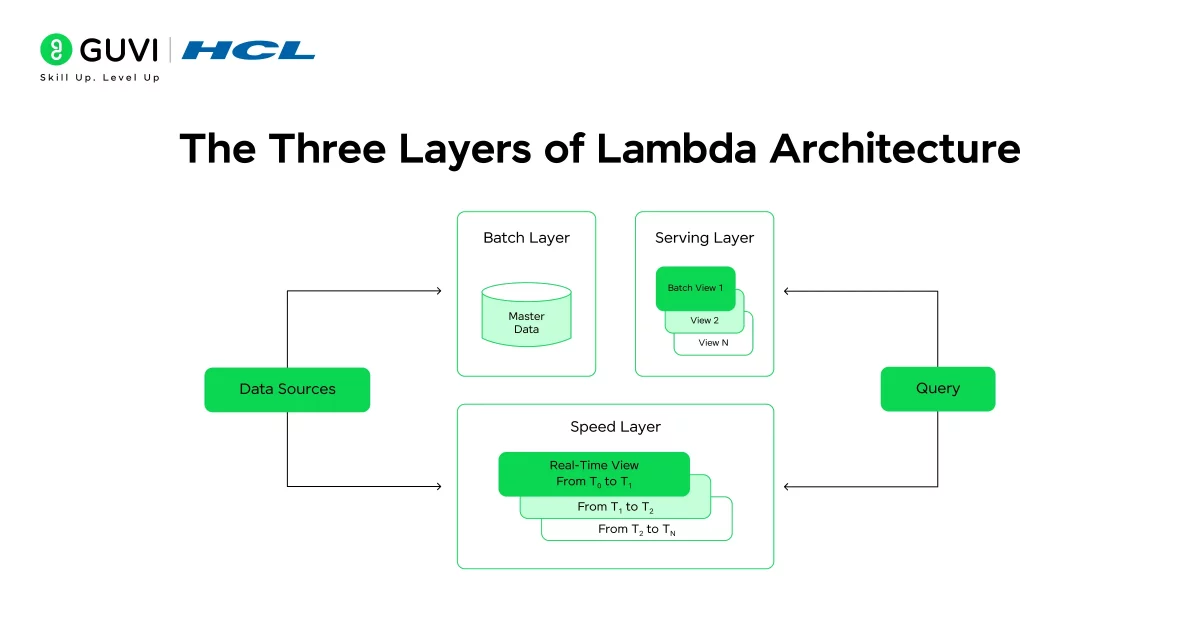
The power of lambda architecture lies in its three-layer approach to data processing, each serving a distinct purpose in the overall system. These layers work together to handle big data quickly and reliably.

1) Batch Layer: Historical data processing
The batch layer manages large volumes of historical data and processes it in groups. This layer:
- Handles complete datasets (both old and new) to provide a full, accurate view of your data
- Operates slowly but with high precision
- Stores raw data as immutable and append-only, creating a trusted historical record
- Runs on predefined schedules, typically once or twice daily
Technologies commonly used in this layer include Apache Hadoop, Spark, Snowflake, and Amazon S3. The batch layer acts as the foundation of your data analysis, delivering comprehensive insights through pre-computed batch views.
2) Speed Layer: Real-time data processing
The speed layer complements the batch layer by processing data streams as they arrive. This layer:
- Processes incoming data immediately to minimize latency
- Handles real-time streams from IoT devices, social media, or financial transactions
- Fills the “gap” caused by the batch layer’s processing delay
- Creates real-time views that may be less accurate but are available instantly
Popular technologies for implementing the speed layer include Apache Kafka, Storm, Flink, and Spark Streaming. This layer ensures you have access to the latest information for time-sensitive decision-making.
3) Serving Layer: Querying and combining results
The serving layer acts as the bridge between processed data and end-users. This layer:
- Combines results from both the batch and speed layers into a unified view
- Indexes batch views for efficient querying on an ad-hoc basis
- Receives near real-time views from the speed layer and batch views from the batch layer
- Provides query capabilities for various applications and analytics tools
Notably, as the serving layer completes a new indexing job, data that was previously handled by the speed layer is no longer needed and gets removed. This coordination between layers ensures you have access to both comprehensive historical analysis and up-to-the-minute insights through a single interface.
Here are some interesting facts about the origins and evolution of Lambda Architecture that many beginners overlook:
1. The Concept Originated from Twitter: Nathan Marz developed the idea of Lambda Architecture while working at Twitter to handle massive real-time data streams efficiently.
2. The Name “Lambda” Isn’t About Math: Despite the name, it doesn’t directly reference the mathematical lambda (λ) symbol — it represents the architectural combination of batch and speed layers into one unified system.
3. It Inspired New Frameworks: Lambda Architecture later inspired the creation of Kappa Architecture, a simplified model proposed by Jay Kreps that eliminates the batch layer entirely.
These facts show how Lambda Architecture emerged from real-world scalability challenges and continues to shape modern big data design patterns today.
Tools Commonly Used in Lambda Architecture
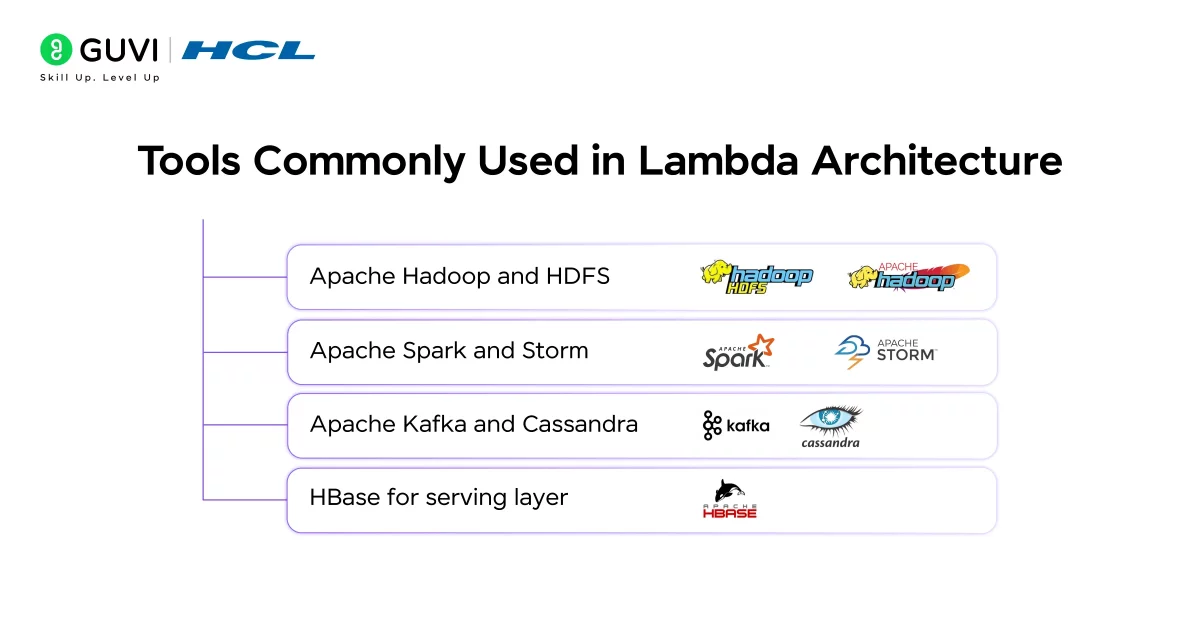
Implementing a successful lambda architecture requires specific technologies for each layer. Let’s examine the most popular tools that power this data processing framework.
1) Apache Hadoop and HDFS
Apache Hadoop emerged as a leading batch processing system by 2014. This highly scalable open-source framework excels at handling structured and unstructured data across computer clusters. Key components include:
- Hadoop Distributed File System (HDFS) – The most commonly used technology for storage in the batch layer, providing a resilient, append-only environment for your master dataset
- MapReduce – A programming paradigm that processes data in parallel, making it ideal for the batch layer’s historical data processing
Hadoop’s strength lies in its ability to scale from one server to hundreds while maintaining performance, though it processes data in batches rather than in real-time.
2) Apache Spark and Storm
For real-time processing in the speed layer, two technologies stand out:
- Apache Spark processes data in-memory up to 100 times faster than Hadoop. It offers both batch and stream processing capabilities, allowing code sharing between layers. Spark Streaming divides input data streams into micro-batches for processing.
- Apache Storm, meanwhile, was the original speed layer technology suggested by Nathan Marz. Unlike Spark’s micro-batching approach, Storm processes each record individually, resulting in even lower latency for time-sensitive applications.
3) Apache Kafka and Cassandra
a) Apache Kafka serves as the messaging backbone in the lambda architecture. This distributed pub-sub system:
- Ingests data from various sources (user activities, application logs, IoT sensors)
- Duplicates incoming data, sending copies to both batch and speed layers
- Allows message rewinding and replay in case of failures
b) Apache Cassandra typically stores the real-time views generated by the speed layer. This distributed database provides:
- Excellent write and read performance
- Linear scalability with no single point of failure
- Optimal storage for time-series data
4) HBase for serving layer
Apache HBase frequently powers the serving layer, where it:
- Stores and manages indexed data from both batch and speed layers
- Provides excellent read and write performance for real-time queries
- Handles large-scale data as part of the Hadoop ecosystem
Additionally, technologies like Apache Druid, Apache Pinot, ClickHouse and Tinybird offer single platforms that handle output from both layers, simplifying the architecture.
Pros and Cons of Lambda Architecture
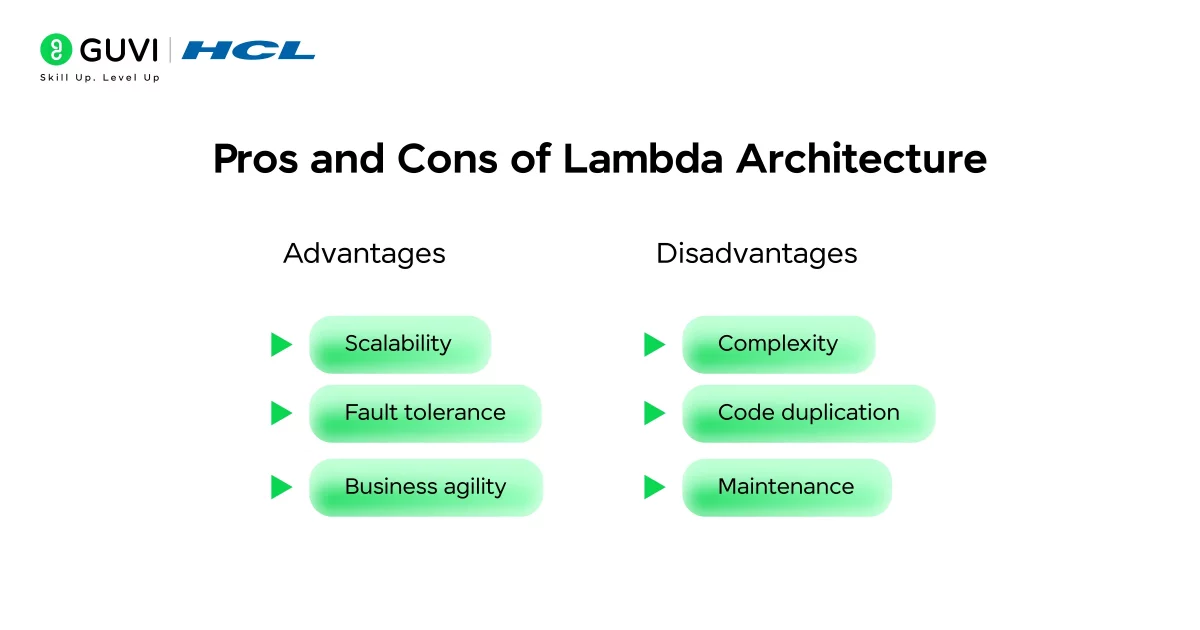
Every architectural approach comes with its own set of trade-offs. Lambda architecture offers compelling benefits alongside some significant challenges that you should consider before implementation.
1) Advantages:
Lambda architecture excels in several critical areas:
- Scalability: The framework scales horizontally at every layer by simply adding more nodes, making it suitable regardless of data volume.
- Fault tolerance: Since raw data is preserved as immutable in the batch layer, your system can recover from failures by reprocessing data, ensuring human fault tolerance as well.
- Business agility: The architecture allows you to react immediately to changing business scenarios through real-time processing.
- Flexibility: You can simultaneously analyze historical patterns and capture real-time insights, providing comprehensive data views.
- Automated high availability: The built-in redundancy guarantees all requests receive responses, whether successful or not.
2) Disadvantages:
Alternatively, the lambda architecture presents several challenges:
- Complexity stands as the biggest drawback. Managing multiple layers with different technologies requires specialized skills across batch processing, streaming, and querying systems.
- Code duplication creates another significant hurdle. You’ll typically need to implement the same business logic twice—once for batch processing and once for real-time processing. This duplication increases both development effort and the risk of inconsistencies between layers.
- Maintenance becomes resource-intensive. Synchronizing batch and speed layers to ensure consistent results demands careful orchestration and ongoing monitoring. Organizations often need dedicated teams with specialized knowledge, increasing operational costs.
Indeed, these challenges have led some organizations to explore alternatives like kappa architecture, which aims to simplify the approach by using a single processing path.
Ready to turn your understanding of Lambda Architecture from concept to career boost? Enroll in HCL GUVI’s Data Science Course offers live sessions, expert mentorship, real-world projects, and placement support so you can confidently apply architectural patterns like Lambda in production.
Concluding Thoughts…
Lambda architecture stands as a powerful solution for organizations facing the dual challenge of processing historical data while simultaneously handling real-time streams. Throughout this guide, you’ve seen how this framework combines batch processing’s thoroughness with stream processing’s immediacy through its three-layer approach.
Ultimately, lambda architecture remains an excellent choice when your data strategy requires both deep historical analysis and real-time capabilities. Though challenging to implement, this balanced approach helps you transform massive data volumes into actionable insights, whether you’re developing financial systems, managing IoT environments, or building recommendation engines.
FAQs
Q1. What is Lambda Architecture, and why is it important?
Lambda Architecture is a data processing framework that combines batch and stream processing methods to handle large volumes of data. It’s important because it allows organizations to process historical data while simultaneously managing real-time data streams, providing both comprehensive analysis and immediate insights.
Q2. What are the three main layers of Lambda Architecture?
The three main layers of Lambda Architecture are the Batch Layer for processing historical data, the Speed Layer for handling real-time data streams, and the Serving Layer for combining and querying results from both layers.
Q3. What tools are commonly used in Lambda Architecture?
Common tools used in Lambda Architecture include Apache Hadoop and HDFS for batch processing, Apache Spark and Storm for real-time processing, Apache Kafka for data ingestion, Cassandra for storing real-time views, and HBase for the serving layer.
Q4. What are the main advantages of using Lambda Architecture?
The main advantages of Lambda Architecture include scalability to handle large data volumes, fault tolerance through immutable data storage, flexibility to analyze both historical and real-time data, and improved business agility through immediate access to insights.
Q5. What are the challenges associated with implementing the Lambda Architecture?
The primary challenges of Lambda Architecture include its overall complexity, the need for code duplication between batch and speed layers, and the intensive maintenance requirements. These factors can lead to increased development effort, potential inconsistencies, and higher operational costs.
Success Stories

About the Author
Jaishree Tomar
A recent CS Graduate with a quirk for writing and coding, a Data Science and Machine Learning enthusiast trying to pave my own way with tech. I have worked as a freelancer with a UK-based Digital Marketing firm writing various tech blogs, articles, and code snippets. Now, working as a Technical Writer at GUVI writing to my heart’s content!
View all posts by Jaishree Tomar
Connect with me @









Did you enjoy this article?