


Artificial Intelligence and Machine Learning Articles
Getting Started with LangChain Prompt Templates in 2026
Cursor 2.0: Trending AI Model Explained In-Depth
Creating Custom Swag Merchandise Using Generative AI
Create a Recipe with ChatGPT: A Guide to AI-Assisted Cooking


Get In Touch For Details! Request More Information

What is Bootstrapping in Machine Learning? A Guide for Beginners [2025]
Sep 18, 2025 6 Min Read 1515 Views
(Last Updated)
What is bootstrapping? The term takes its name from the phrase “pulling yourself up by your bootstraps,” because this powerful statistical technique allows you to do so much with very little data.
At its core, the bootstrapping method is a resampling technique that helps you estimate the uncertainty of your statistical models. With bootstrapping, you can take a distribution of any shape or size and create a new distribution of resamples to approximate the true probability distribution.
In fact, the key concept behind bootstrapping in machine learning is sampling with replacement, which means each sample drawn from your dataset can include duplicate entries. And this guide will help you understand what bootstrapping is and all its aspects. Let’s begin!
Table of contents
- What is Bootstrapping in Machine Learning?
- Why bootstrapping is useful in ML
- How it differs from traditional sampling
- Types of Bootstrapping Methods
- 1) Parametric bootstrapping
- 2) Non-parametric bootstrapping
- When to use each method
- Applications of Bootstrapping in Machine Learning
- 1) Estimating model performance
- 2) Creating confidence intervals
- 3) Improving model robustness
- 4) Feature selection and importance
- Best Practices and Common Pitfalls
- 1) Choosing the number of bootstrap samples
- 2) Handling missing data
- 3) Avoiding overfitting with bootstrapping
- 4) Computational considerations
- Concluding Thoughts…
- FAQs
- Q1. What is bootstrapping in machine learning, and why is it important?
- Q2. How does bootstrapping differ from traditional sampling methods?
- Q3. What are the main types of bootstrapping methods?
- Q4. How can bootstrapping improve feature selection in machine learning?
What is Bootstrapping in Machine Learning?
Bootstrapping is a statistical resampling technique that involves repeatedly drawing samples from your source data with replacement to estimate population parameters. The key phrase here—”with replacement”—means that the same data point may appear multiple times in your resampled dataset.
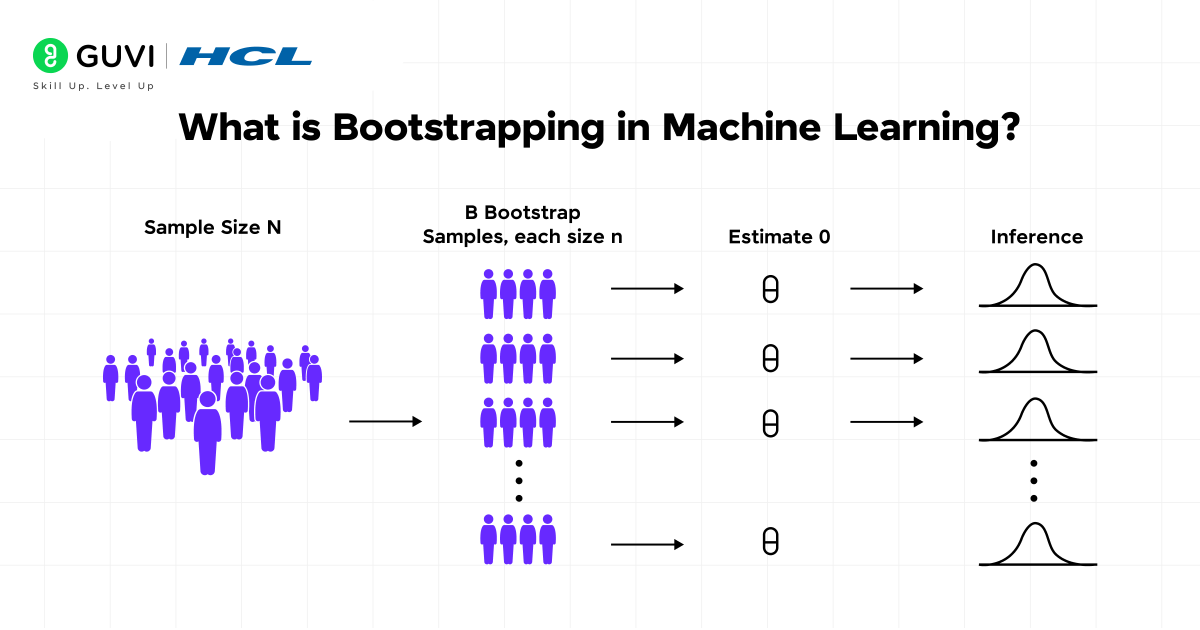
The term itself has an interesting origin. It comes from the impossible idea of lifting yourself up without external help by pulling on your own bootstraps. This metaphor perfectly captures what the technique accomplishes—creating something seemingly impossible (reliable statistical estimates) from limited resources (a single dataset).
Why bootstrapping is useful in ML
Bootstrapping offers several key advantages that make it particularly valuable for machine learning applications:
- Uncertainty estimation: Instead of generating just a single point estimate, bootstrapping creates a distribution of estimates, providing critical information about certainty (or lack thereof).
- Confidence intervals: The method allows you to compute confidence intervals without making strong assumptions about your data’s distribution.
- Model robustness: By training on multiple bootstrap samples, you can build more stable models that are less prone to overfitting.
- Performance assessment: Bootstrapping helps estimate a model’s accuracy and identify areas needing improvement.
How it differs from traditional sampling
- Traditional sampling takes a single sample from a population, while bootstrapping creates multiple simulated samples from the original dataset.
- Bootstrap sampling is distribution-free, unlike parametric methods that assume specific distributions.
- Differs from cross-validation, which focuses on model validation, while bootstrapping centers on understanding model uncertainty.
- Uses existing data instead of collecting new samples, making it economical.
- The jackknife is reproducible and samples without replacement, whereas bootstrapping samples with replacement.
- Bootstrapping estimates the sampling distribution of almost any statistic, making it invaluable for modern machine learning applications.
Types of Bootstrapping Methods
Fundamentally, bootstrapping methods in machine learning fall into two main categories—parametric and non-parametric. These approaches differ significantly in their assumptions and applications, offering data scientists different tools for different scenarios.
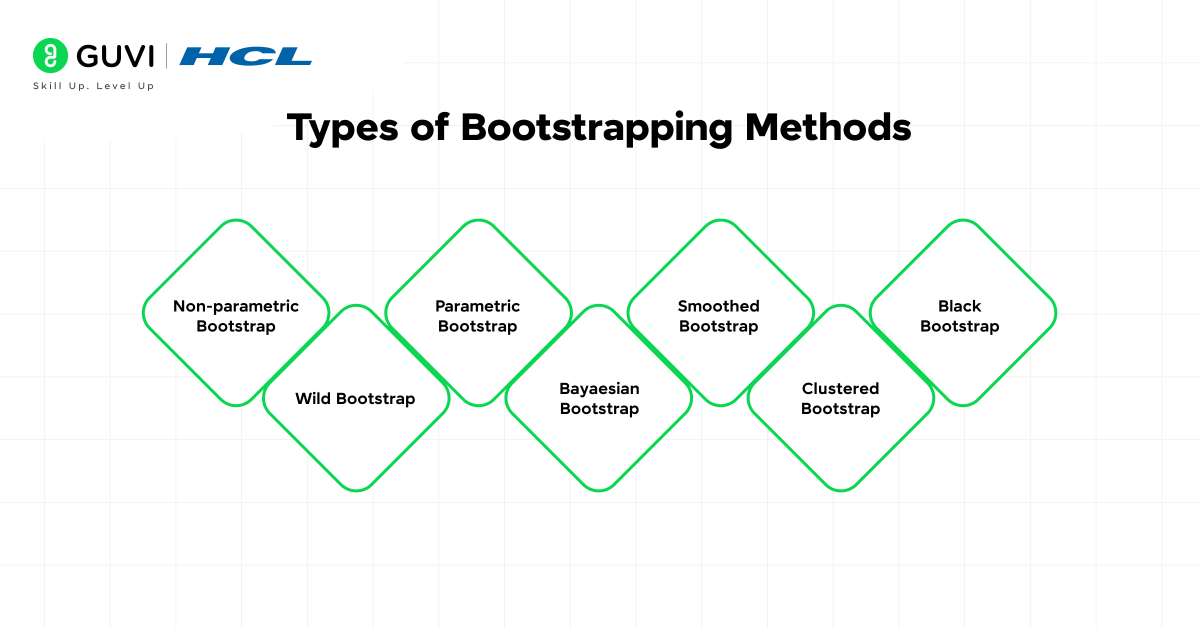
1) Parametric bootstrapping
Parametric bootstrapping makes specific assumptions about the underlying distribution of your data. This method involves fitting a parametric model to your original dataset, estimating the parameters, and then generating numerous simulated datasets based on those estimated parameters.
For example, if you believe your data follows a normal distribution, you would:
- Calculate the mean and variance from your sample
- Generate new samples by drawing random numbers from a normal distribution with those parameters
- Calculate your statistic of interest on each generated sample
The key advantage of parametric bootstrapping lies in its efficiency. If your model assumptions are correct, parametric bootstrapping typically produces more precise confidence intervals. This method is particularly valuable when you have prior knowledge about your data’s distribution pattern or strong theoretical reasons to believe a specific distribution applies.
Nevertheless, the validity of this approach hinges completely on the correctness of your assumed model. If your distribution assumption is wrong, your bootstrap results may be misleading or biased.

2) Non-parametric bootstrapping
Unlike its parametric counterpart, non-parametric bootstrapping makes no assumptions about the underlying distribution of your data. This method resamples directly from the observed data with replacement, letting the data speak for itself.
The procedure is straightforward:
- Draw samples randomly from your original dataset with replacement
- Calculate your statistic of interest on each resampled dataset
- Use the distribution of these statistics to estimate confidence intervals or standard errors
This approach offers remarkable flexibility, making it ideal for real-world datasets with unknown or complex distributions. It assumes only that each data point is an independent observation. Consequently, non-parametric bootstrapping has become the more commonly used method in practice, as it’s safer when the true distribution is uncertain.
One limitation worth noting is that non-parametric bootstrapping with very small samples (10 or fewer observations) may underestimate the population’s variability. This happens because small samples cover a restricted range of values.
When to use each method
The choice between parametric and non-parametric bootstrapping ultimately depends on your confidence in the data’s distribution and your sample size.
Choose parametric bootstrapping when:
- You have strong theoretical reasons to believe your data follows a specific distribution
- You need narrower, more precise confidence intervals
- Your sample size is very small (fewer than 10 observations)
- You can verify your distributional assumptions through diagnostic tests
Choose non-parametric bootstrapping when:
- You’re uncertain about the underlying distribution
- Your data may not follow standard distributions
- You want a more robust approach that requires fewer assumptions
- Your sample size is moderate to large
Applications of Bootstrapping in Machine Learning
Bootstrapping extends far beyond theoretical statistics—it offers practical, powerful applications across the machine learning landscape. Let’s explore how this versatile technique helps data scientists build better models in real-world scenarios.
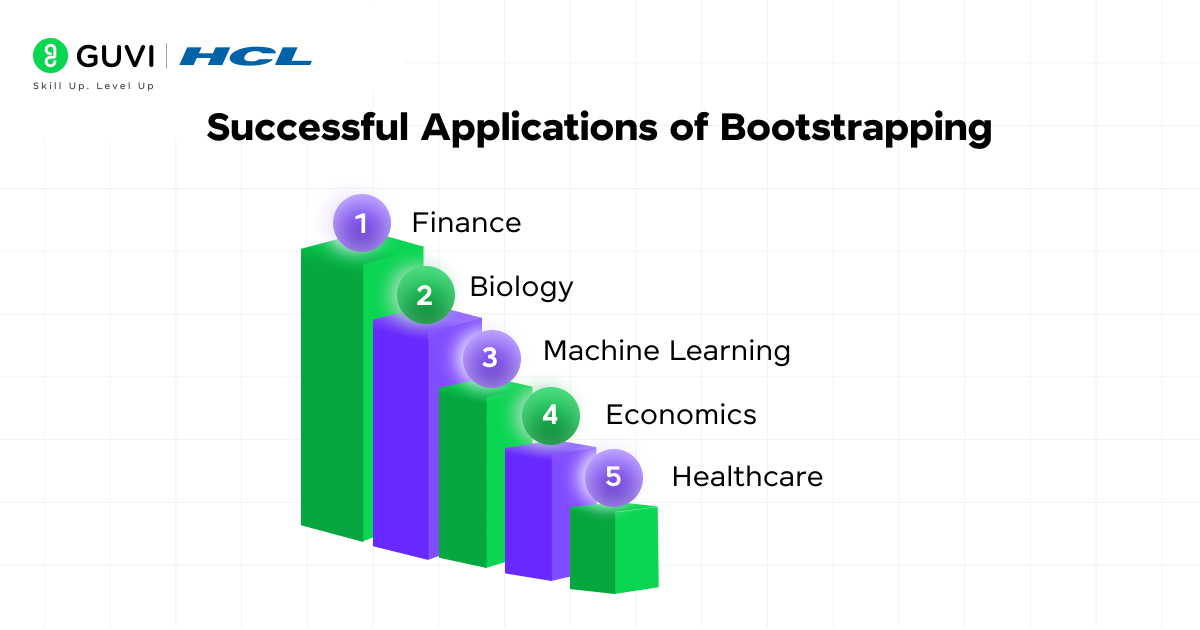
1) Estimating model performance
One of bootstrapping’s most valuable applications is its ability to provide reliable estimates of model performance. Traditional validation methods often require splitting your dataset, which can be problematic when working with limited data. Bootstrapping solves this problem elegantly.
The out-of-bag (OOB) approach is particularly useful. After training on bootstrap samples, the model is evaluated on data points not included in the bootstrap sample. These OOB observations yield what’s called the OOB error, often considered an unbiased estimator for the true error rate.
To implement this in practice:
- Create multiple bootstrap samples from your training data
- Train your model on each sample
- Evaluate performance on the OOB observations
- Average the results across iterations
This technique is crucial for building robust and accurate models. Beyond simple accuracy metrics, bootstrapping helps calculate precision, recall, and F1 scores across multiple simulated datasets, giving you a more complete picture of performance. Great, right?
2) Creating confidence intervals
A single performance metric like “94.8% accuracy” means little without understanding its reliability. Bootstrapping excels at creating confidence intervals that quantify uncertainty around your model’s predictions.
The percentile bootstrap method for calculating confidence intervals works as follows:
- Generate multiple bootstrap samples from your test data
- Calculate your performance metric on each sample
- The 95% confidence interval is given by the 2.5th to 97.5th percentile of these values
This approach is valuable primarily when dealing with small datasets or when traditional parametric methods might not be appropriate. Furthermore, bootstrapping confidence intervals don’t require assumptions about your data’s distribution, making them more robust for real-world applications.
For classification tasks, confidence intervals are particularly important with imbalanced datasets, where performance metrics can be misleading without proper context.
3) Improving model robustness
Bootstrapping fundamentally improves model stability and reduces overfitting. By creating multiple subsets of data, it reduces the risk of overfitting and enhances accuracy.
This principle underpins powerful ensemble methods like bagging (Bootstrap Aggregating), which involves training multiple models on different bootstrap samples and combining their predictions.
Random Forests represent the most famous application—they leverage bootstrapping to create diverse decision trees, resulting in more stable and accurate predictions.
In neural networks, bootstrap aggregation (BAGNET) has been shown to produce models that are both more accurate and more robust than single networks. Essentially, bootstrapping helps your models generalize better to unseen data, rather than memorizing peculiarities of your training set.
4) Feature selection and importance
Identifying which features truly matter (feature selection) is a perpetual challenge in machine learning. Bootstrapping offers powerful solutions through:
- Variance reduction: Bootstrapping reduces the variance and bias between features, minimizing overfitting problems
- Stability improvement: It increases the robustness of feature selection methods across different samples
- Importance estimation: By analyzing the distribution of feature importance across bootstrap iterations, you can quantify the uncertainty associated with each feature
A practical framework involves generating multiple bootstrap samples, applying feature selection methods to each, and then aggregating the results. This approach has been shown to outperform single-run feature selection methods, especially when dealing with noisy data.
Here are some interesting tidbits about the bootstrapping technique in statistics and machine learning:
The Term’s Origin is a Metaphor: The phrase “pulling yourself up by your bootstraps” originally meant attempting something impossible. In statistics, bootstrapping captures this spirit—creating reliable estimates even when you have very little data.
Pioneered in the Late 1970s: The modern statistical bootstrap method was introduced by Bradley Efron in 1979. His work revolutionized data analysis by making it possible to estimate uncertainty without heavy mathematical assumptions.
From its quirky name to its powerful role in machine learning, bootstrapping proves that sometimes the most ingenious methods come from simple, resourceful ideas!
Best Practices and Common Pitfalls
Even the most powerful machine learning techniques require proper implementation to be effective. Bootstrapping, although robust, comes with its own set of best practices and potential pitfalls that practitioners should navigate carefully.
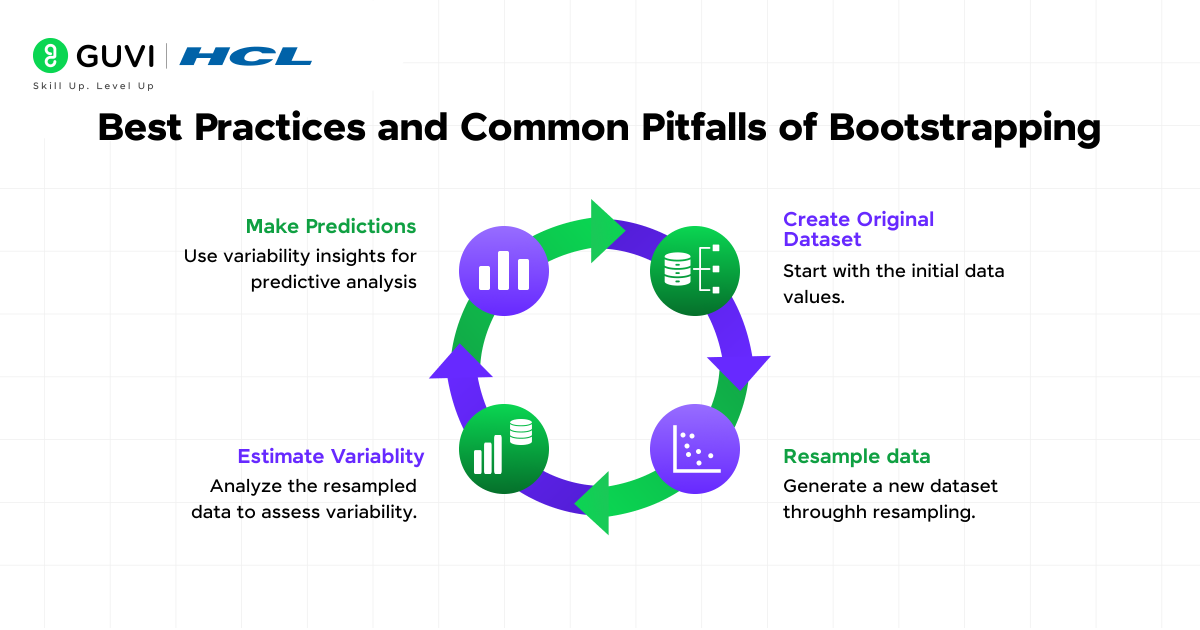
1) Choosing the number of bootstrap samples
The number of bootstrap samples (B) represents a critical parameter that directly impacts the reliability of your results. Experts recommend using between 100 and 1000 samples, depending on your specific application and available computational resources.
Consider these guidelines:
- For preliminary analysis or when computational resources are limited, 100 samples can provide initial insights
- For research publications or critical applications, aim for 500-1000 samples to ensure statistical validity
- Always monitor convergence—if your results fluctuate significantly between runs, increase your sample count
As a rule of thumb, statisticians typically won’t take bootstrap results seriously unless the number of iterations exceeds 1,000. This ensures that your results have sufficient statistical power to be meaningful.
2) Handling missing data
Missing data presents a significant challenge when implementing bootstrapping. Several approaches exist:
First, you can impute missing values using suitable methods like mean or median imputation before bootstrapping. Although straightforward, this approach may lead to biased estimates if the imputation model isn’t correctly specified.
Alternatively, multiple imputation combined with bootstrapping offers a more robust solution. This technique involves:
- Creating multiple versions of complete data by imputing missing values multiple times
- Bootstrapping each imputed dataset
- Combining results using established statistical rules
Research shows that when using multiple imputation with bootstrapping, you should use a reasonably large number of imputations to maintain statistical efficiency.
3) Avoiding overfitting with bootstrapping
While bootstrapping helps evaluate model performance, it can sometimes contribute to overfitting if implemented incorrectly.
To prevent this:
- Ensure any data preparation or hyperparameter tuning occurs within each bootstrap iteration to avoid data leakage
- Remember that bootstrapping small samples (fewer than 10 observations) may underestimate population variability
- Use bootstrapping to compare multiple models rather than repeatedly tuning a single model
Fundamentally, bootstrapping works asymptotically if a central limit theorem can also be applied. This means its effectiveness improves with larger sample sizes.
4) Computational considerations
The computational intensity of bootstrapping cannot be overlooked, particularly when working with large datasets or complex models.
To manage computational resources effectively:
- Consider parallel computing for large-scale bootstrap operations
- For enormous datasets, sample a smaller percentage (50-80%) of the data while maintaining representativeness
- Use efficient algorithms like the scikit-learn resample() function, which handles sampling with replacement
Methods embedding multiple imputation in bootstrap typically require significantly more computation time—potentially hours compared to minutes for simpler approaches. Hence, balance statistical rigor against practical time constraints based on your project requirements.
Would you like to be able to easily implement bootstrapping? HCL GUVI’s Artificial Intelligence & Machine Learning Course, co-designed by IIT-M Pravartak and Intel, empowers learners with live workshops, mentor support, and capstone projects covering AI fundamentals, NLP, deep learning, and ML model deployment—all in just five months
Concluding Thoughts…
I bet, like me, all you ML enthusiasts can see why bootstrapping stands as a remarkable statistical technique that transforms limited datasets into powerful insights for your machine learning models. Throughout this guide, you’ve learned how this method creates multiple samples from your original data, essentially allowing you to pull yourself up by your statistical bootstraps.
This technique allows you to quantify uncertainty, build more robust models, and make better-informed decisions with your data. As you continue your machine learning journey, bootstrapping will surely become an essential technique in your data science toolkit, helping you develop models that perform reliably in real-world applications.
Do reach out to me through the comments section below if you have any doubts. Good Luck!
FAQs
Q1. What is bootstrapping in machine learning, and why is it important?
Bootstrapping in machine learning is a resampling technique that involves drawing multiple samples from a dataset with replacement. It’s important because it allows for estimating model performance, creating confidence intervals, and improving model robustness, especially when dealing with limited data or complex distributions.
Q2. How does bootstrapping differ from traditional sampling methods?
Unlike traditional sampling, which typically involves taking a single sample from a population, bootstrapping creates multiple simulated samples from an original dataset. It’s distribution-free, making fewer assumptions about the data, and allows for working with existing data rather than collecting new samples.
Q3. What are the main types of bootstrapping methods?
There are two main types of bootstrapping methods: parametric and non-parametric. Parametric bootstrapping assumes a specific distribution for the data, while non-parametric bootstrapping makes no such assumptions and resamples directly from the observed data.
Q4. How can bootstrapping improve feature selection in machine learning?
Bootstrapping can enhance feature selection by reducing variance between features, improving the stability of selection methods, and providing a way to estimate feature importance across multiple iterations. This approach often outperforms single-run feature selection methods, especially with noisy data.
Success Stories

About the Author
Jaishree Tomar
A recent CS Graduate with a quirk for writing and coding, a Data Science and Machine Learning enthusiast trying to pave my own way with tech. I have worked as a freelancer with a UK-based Digital Marketing firm writing various tech blogs, articles, and code snippets. Now, working as a Technical Writer at GUVI writing to my heart’s content!
View all posts by Jaishree Tomar
Connect with me @














Did you enjoy this article?