


Artificial Intelligence and Machine Learning Articles
AI/ML Skills Gap 2026: Why Companies Can't Find Job-Ready Talent
20 AI/ML Interview Questions Recruiters Can Use Without a Tech Background - Best Guide
How Industry-Backed AI/ML Bootcamps Are Changing the AI/ML Hiring Pipeline - Best Guide 2026
From IT Support to AI Engineer: A Realistic Career Switch Guide 2026


Get In Touch For Details! Request More Information

Understanding Claude’s Constitutional AI Safety Model
Aug 17, 2026 3 Min Read 300 Views
(Last Updated)
Claude’s Constitutional AI is an AI safety approach that trains the model to follow a defined set of principles, or a “constitution,” when generating responses. Instead of relying solely on human feedback, the model learns to evaluate and improve its own outputs based on these guiding principles. The goal is to produce responses that are more helpful, honest, and harmless while maintaining high-quality performance.
Table of contents
- TL;DR
- What Is Claude's Constitutional AI?
- Why Was Constitutional AI Developed?
- How Does Constitutional AI Work?
- What Are the Core Goals of Constitutional AI?
- How Does Constitutional AI Compare to Traditional AI Safety Training?
- Why Does Constitutional AI Matter for Users?
- Key Takeaways
- Conclusion
- FAQs
- What is Claude's Constitutional AI?
- Why is it called Constitutional AI?
- Does Constitutional AI replace human feedback?
- What are the main goals of Constitutional AI?
- Does Constitutional AI guarantee perfect responses?
TL;DR
- Constitutional AI is the safety framework behind Claude’s behavior.
- It uses a set of guiding principles to evaluate and improve responses.
- The approach reduces harmful outputs while encouraging helpful and honest answers.
- Constitutional AI complements, rather than replaces, other AI safety techniques.
- Understanding this framework helps users know why Claude responds the way it does.
Want to build responsible AI and machine learning solutions that go beyond model training? Explore HCL GUVI’s Artificial Intelligence & Machine Learning Course, where you’ll learn machine learning, deep learning, NLP, AI ethics, and real-world AI development with hands-on projects.
What Is Claude’s Constitutional AI?

Claude’s Constitutional AI is a training methodology designed to make AI systems safer and more reliable. Instead of depending only on human reviewers to evaluate responses, the model is trained to critique and revise its own outputs using a predefined set of principles known as a constitution.
These principles guide the model toward generating responses that are helpful, honest, and harmless while reducing the likelihood of producing unsafe or misleading content.
Some key goals of Constitutional AI include:
- Improving response quality.
- Reducing harmful outputs.
- Encouraging transparency.
- Supporting responsible AI behavior.
Did You Know? Constitutional AI introduces a self-improvement process where the model learns to evaluate its own responses against guiding principles during training.
Read More: How to Build AI Apps with Claude and Share Them Easily
Why Was Constitutional AI Developed?
As AI systems became more capable, ensuring they produced safe and trustworthy responses became increasingly important. Traditional approaches relied heavily on human feedback, which can be time-consuming and difficult to scale.
Constitutional AI was developed to make the training process more efficient by allowing the model to critique and refine its own responses according to established principles.
Some benefits of this approach include:
- Improved scalability. Self-evaluation reduces dependence on large amounts of human review.
- Greater consistency. Responses are guided by the same set of principles throughout training.
- Enhanced safety. The model learns to avoid harmful or inappropriate outputs.
- Better alignment. AI behavior becomes more closely aligned with intended safety goals.
Data Point: Constitutional AI builds on existing alignment techniques by combining principle-based self-improvement with other safety training methods to improve response quality.
How Does Constitutional AI Work?
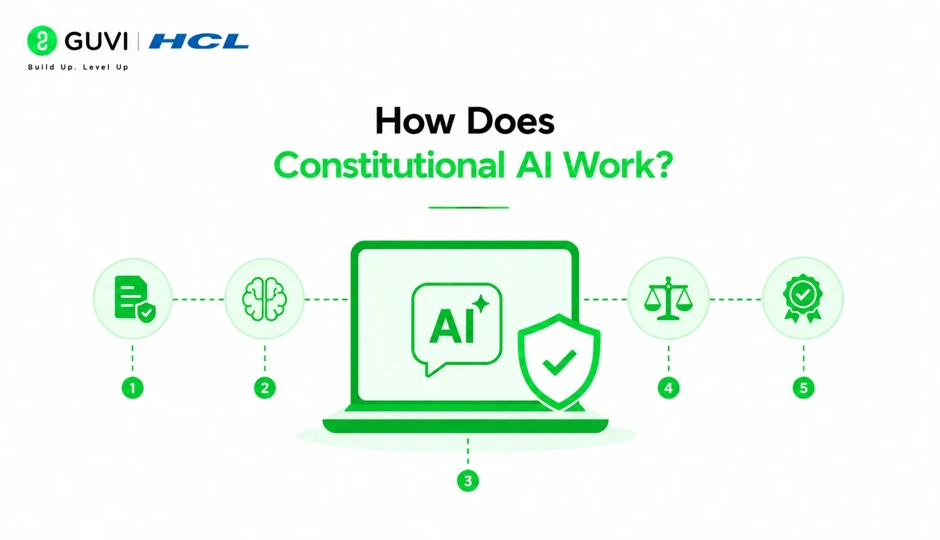
Constitutional AI trains the model through a structured process that encourages self-evaluation.
A simplified workflow looks like this:
- The model generates an initial response.
- It evaluates the response against its guiding principles.
- It identifies areas for improvement.
- It revises the response.
- The improved response becomes part of the training process.
Rather than simply memorizing rules, the model learns how to apply principles when responding to different types of requests.
Pro Tip: Think of Constitutional AI as a built-in review process that encourages the model to improve its own responses before presenting them.
Want to build responsible AI and machine learning solutions that go beyond model training? Explore HCL GUVI’s Artificial Intelligence & Machine Learning Course, where you’ll learn machine learning, deep learning, NLP, AI ethics, and real-world AI development with hands-on projects.
What Are the Core Goals of Constitutional AI?
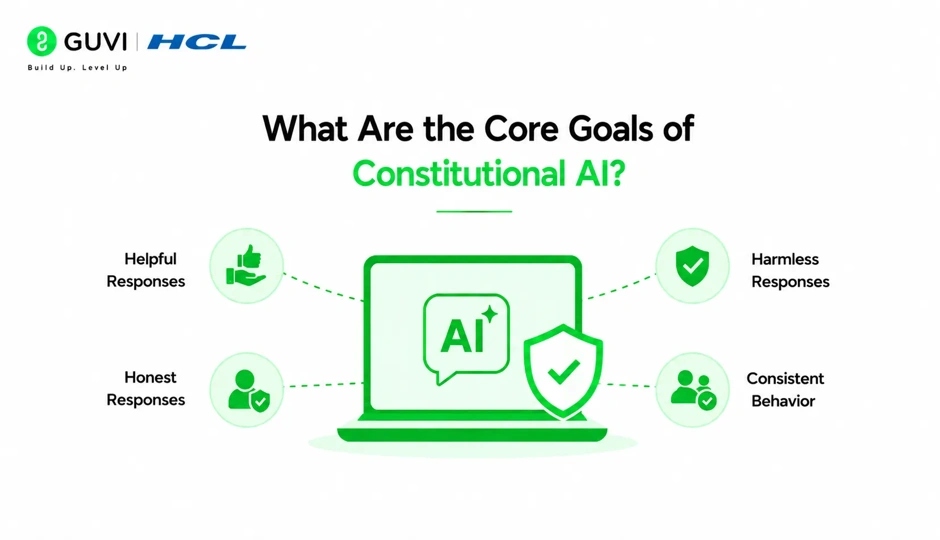
The Constitutional AI framework is designed around several important objectives that improve both safety and usability.
- Helpful Responses
The model aims to provide useful, relevant, and informative answers that address the user’s request whenever possible.
- Honest Responses
Rather than presenting uncertain information as fact, the model is encouraged to acknowledge uncertainty and avoid making unsupported claims.
- Harmless Responses
The framework helps reduce outputs that could promote harmful, unsafe, or inappropriate activities while still providing useful assistance where appropriate.

- Consistent Behavior
Using guiding principles encourages more consistent responses across different conversations and use cases.
Warning: Constitutional AI improves safety, but no AI system is perfect. Users should still verify important information, especially for medical, legal, financial, or safety-related decisions.
How Does Constitutional AI Compare to Traditional AI Safety Training?
Earlier AI alignment methods relied primarily on human feedback to teach models which responses were preferred. Constitutional AI adds another layer by introducing principle-based self-evaluation during training.
| Approach | Primary Method | Main Focus |
| Human Feedback Training | Human reviewers evaluate responses | Learning preferred behavior |
| Constitutional AI | Principle-based self-evaluation with human guidance | Improving safety, consistency, and alignment |
Both approaches contribute to safer AI systems, and they are often used together rather than as competing methods.
Why Does Constitutional AI Matter for Users?
Although most users never see the training process, Constitutional AI directly influences how Claude responds during everyday conversations.
Some practical benefits include:
- More balanced responses.
- Better handling of complex questions.
- Improved transparency about uncertainty.
- Reduced likelihood of unsafe or misleading outputs.
- More consistent interactions across different topics.
These improvements help create a more reliable experience for both individuals and organizations using AI.
Many organizations evaluating AI systems consider safety, transparency, and reliability to be just as important as raw model performance. Factors such as explainability, risk management, data privacy, and consistent outputs often play a critical role in determining whether an AI solution is suitable for real-world business use, especially in regulated industries and enterprise environments.
Key Takeaways
- Constitutional AI is the safety framework that guides Claude’s behavior.
- It uses predefined principles to help the model evaluate and improve its own responses.
- The framework emphasizes helpfulness, honesty, and harmlessness.
- Constitutional AI works alongside other AI safety and alignment techniques.
- It improves consistency while encouraging responsible AI behavior.
- Users should still verify important information when accuracy is critical.
Conclusion
Constitutional AI represents an important step forward in AI safety by teaching models to evaluate their own responses against a defined set of guiding principles. Rather than relying only on human feedback, this approach encourages more consistent, transparent, and responsible behavior across a wide range of conversations.
For users, the result is an AI assistant designed to provide helpful information while reducing harmful or misleading outputs. While no safety framework can eliminate every limitation, Constitutional AI plays a significant role in making AI systems more trustworthy and reliable.
FAQs
What is Claude’s Constitutional AI?
Claude’s Constitutional AI is a training approach that teaches the model to evaluate and improve its responses using a predefined set of guiding principles. Its goal is to produce responses that are more helpful, honest, and harmless.
Why is it called Constitutional AI?
The name comes from the use of a “constitution,” which is a collection of principles that guide the model’s behavior during training. These principles help shape how the AI evaluates and refines its responses.
Does Constitutional AI replace human feedback?
No. Constitutional AI complements human feedback by adding a principle-based self-evaluation process during training. Both methods contribute to improving AI safety and alignment.
What are the main goals of Constitutional AI?
The primary goals are to generate responses that are helpful, honest, and harmless while improving consistency and reducing unsafe outputs.
Does Constitutional AI guarantee perfect responses?
No. While it improves safety and reliability, no AI system is perfect. Users should verify important information, especially for high-stakes decisions.
Success Stories

About the Author
Vishalini Devarajan
An Aerospace Engineer turned content writer, I focus on making complex concepts easy to understand through well-structured, reader-friendly blogs. Whether it’s a technical topic or a non-technical one, I love creating content that is clear, engaging, and impactful.
View all posts by Vishalini Devarajan
Connect with me @













Did you enjoy this article?