


Artificial Intelligence and Machine Learning Articles
CI/CD Pipelines for Machine Learning Projects
A/B Testing for Machine Learning Models
Canary Deployment Strategies for ML Models
What is Model Drift Detection: Keeping Models Accurate in Production


Get In Touch For Details! Request More Information

The Productivity Impact of Coding Agents: The Real Truth
Jun 05, 2026 5 Min Read 862 Views
(Last Updated)
The promise of coding agents sounds almost too good to be true. Build software ten times faster. Let AI write the code while you focus on the bigger picture. Never get stuck on boilerplate again. These claims have driven massive adoption, and they hold real truth.
But the full story of coding agents’ impact on developer productivity is more nuanced, interesting, and actionable than any headline suggests. Adoption stats are striking: In 2026, 84% of developers use AI tools, writing 41% of all code, with 51% of pros using them daily. Yet productivity remains complicated.
Over 75% now rely on AI coding assistants, but many organizations see a disconnect: developers feel faster, while teams show no gains in delivery velocity or business outcomes. This feeling-vs-reality gap is modern software’s biggest puzzle.
In this article, we will walk through what the research actually says about Productivity Impact of Coding Agents, why results are so different across different developers and contexts, what the parallel processing insight changes about the whole conversation, where coding agents genuinely deliver and where they do not, and the most practical ways to get real productivity gains from them.
Table of contents
- Quick TL;DR:
- Overview of the Impact of Coding Agents
- What the Research Actually Found
- The Shocking Slowdown
- Perception vs. Reality
- Quality Suffers Over Time
- Rapid Evolution, Unsettled Truth
- The Survey Data: What Developers Actually Report
- Real-World Gains from Surveys and Telemetry
- Nuanced Insights from Stack Overflow
- The Parallel Processing Insight That Changes Everything
- Throughput > Speed (Plus Backlog Killer)
- What Tasks Coding Agents Actually Do Well
- Tasks Where Agents Excel
- Tasks Agents Struggle With
- The Code Quality Problem You Cannot Ignore
- How to Actually Get Productivity Gains
- Master the One-Shot Prompt
- Enable Autonomous Validation
- Leverage CI and Tests as Force Multipliers
- What the Numbers Are Starting to Show at Scale
- FAQs
- Do coding agents really make devs 10x faster?
- Why did METR find that AI slows devs down?
- Which tasks should I give autonomous agents?
- How do I avoid AI code quality pitfalls?
- What's the real productivity metric for agents?
Quick TL;DR:
- Adoption exploding: 84% devs use AI, writes 41% of code, 51% daily users
- Gains uneven: 3.6 hrs/week saved, but 41% see “little effect”; 19% slowdown in trials
- Parallel power: Autonomous agents = Task A handler; you do Task B → throughput soars
- Task sweet spot: Boilerplate/tests/bugs yes; architecture/debug no
- Quality first: AI amps vulns 322%; CI/tests/reviews essential for real ROI
What Is the Actual Productivity Impact of Coding Agents?
Coding agents produce measurable productivity gains in specific task categories, but overall team productivity depends on how they are integrated into workflows. Faster individual output does not automatically translate into faster project delivery.
Overview of the Impact of Coding Agents
AI-authored code now makes up 26.9% of all production code. Daily AI users can merge approximately 60% more PRs. Onboarding time, measured by time to the 10th pull request, has been cut in half quarter over quarter from Q1 2024 through Q4 2025.
These are real numbers from production environments, and they coexist with studies showing that some experienced developers work 19% slower with AI tools turned on.
What the Research Actually Found
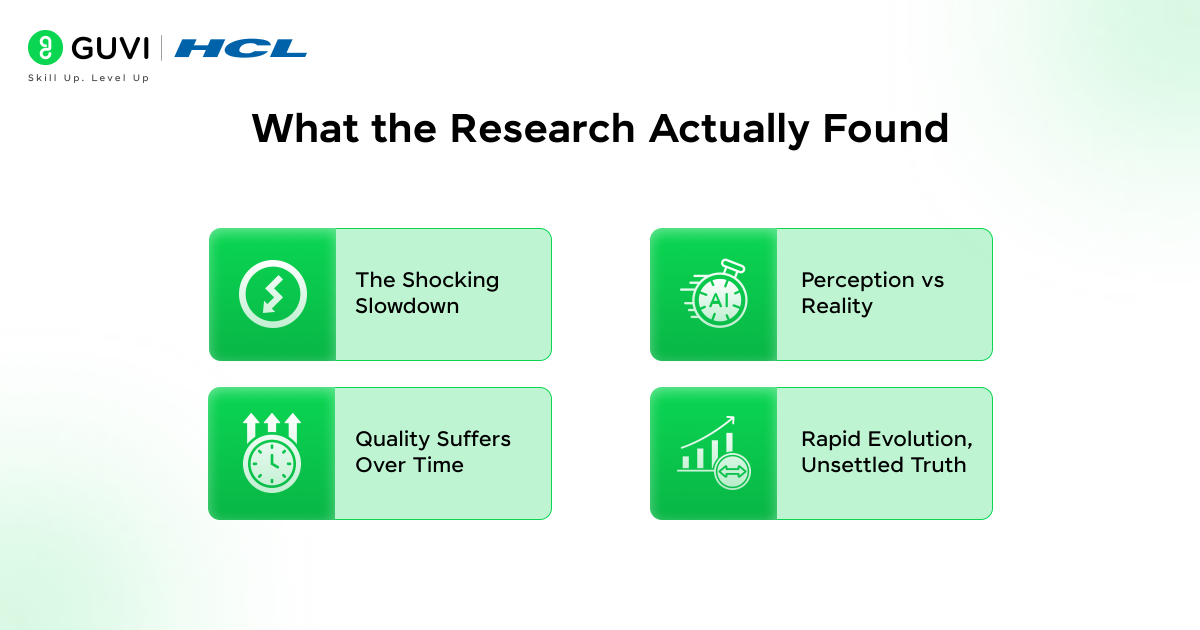
The most surprising research came from METR, a safety-focused AI lab, which ran a randomized controlled trial with experienced open-source devs on their own repos.
1. The Shocking Slowdown
When developers used AI tools, they took 19% longer than without AI, actually making them slower. This went viral because it clashed with devs’ gut feelings of speedup.
2. Perception vs. Reality
Devs felt faster and more productive subjectively. But the objective task completion time showed the opposite. Welcome to the productivity placebo: AI feels speedy, measurable gains. Marginal or negative.
3. Quality Suffers Over Time
Speed’s one issue; quality’s worse. Long AI sessions degrade output models, dragging in irrelevant context from prior prompts, causing context rot and plummeting accuracy.
4. Rapid Evolution, Unsettled Truth
METR notes devs are likely faster with AI in early 2026 vs. 2025 estimates. Some self-report huge gains (though unreliable). Bottom line: it hinges on dev skill, task type, tool, and workflow.
The Survey Data: What Developers Actually Report
Real-World Gains from Surveys and Telemetry
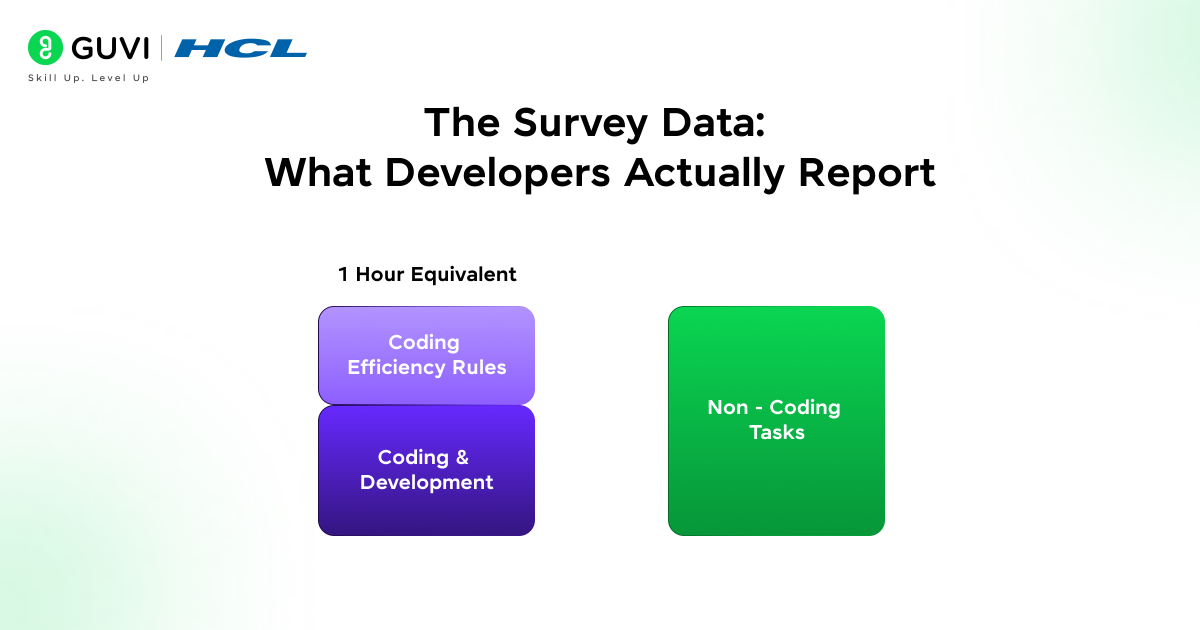
Outside controlled trials, large-scale surveys, and telemetry paint a different picture from METR. A DX dataset of 135,000 developers shows 3.6 hours saved per dev per week, not 10x but meaningful: nearly a full workday recovered every two weeks.
Nuanced Insights from Stack Overflow
The 2025 Stack Overflow survey adds depth: Only 16.3% said AI boosted productivity “to a great extent.” Most (41.4%) reported little/no effect, with many in the middle seeing modest gains. Productivity lifts are real, but uneven developers capture big value, and others see minimal shifts. The gap isn’t random; decoding it is research’s key takeaway.
The Parallel Processing Insight That Changes Everything
The most transformative insight comes from practitioners, not academics: background agents aren’t about speeding up your workflow; they enable parallel processing.
- Watching autonomous agents on Task A takes longer than supervised work
- But you tackle Task B simultaneously with a supervised agent
- Simple tasks parallelized = major throughput gains
- Focus: multiple tasks done, not single-task speed
Throughput > Speed (Plus Backlog Killer)
Research fixates on the wrong metric. Measure throughput (tasks completed per time unit), not speed (single task time).
- Spot a bug elsewhere? Hand it to the autonomous agent instantly, no backlog
- Every noticed issue gets fixed now, not queued
- Backlogs shrink, total output explodes
- Individual tasks unchanged; overall productivity soars
What Tasks Coding Agents Actually Do Well
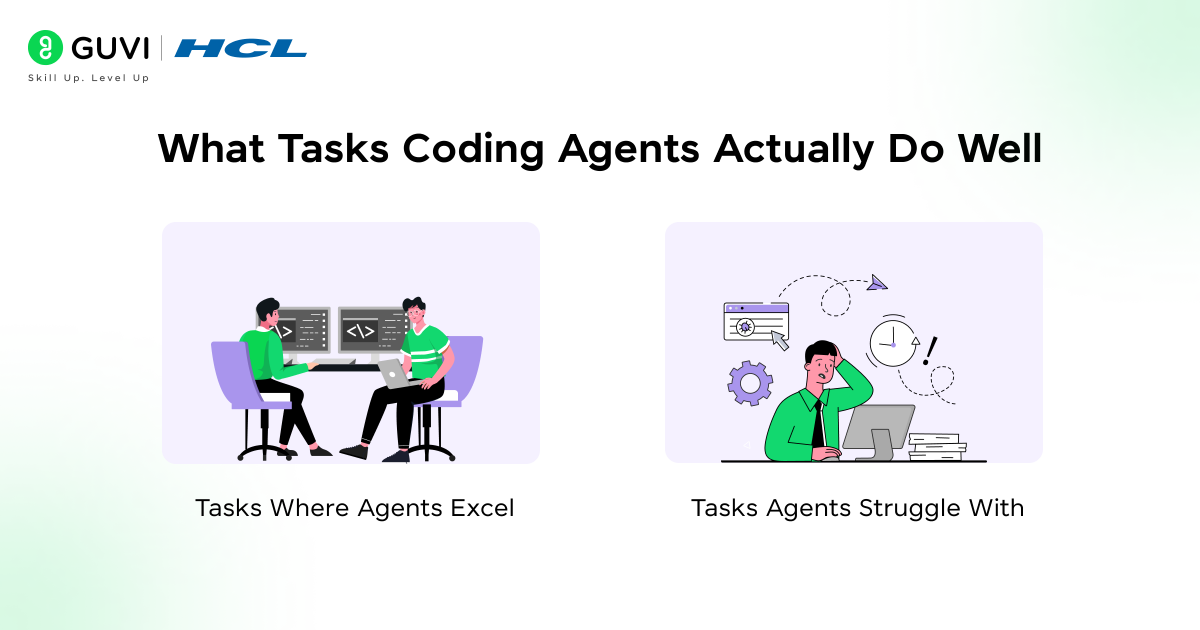
Research on experienced developers using coding agents reveals a clear pattern: certain tasks thrive with agents, others don’t. Seasoned devs reserve agents for well-defined work, plan, rigorously validate outputs, and prioritize quality alongside speed.
1. Tasks Where Agents Excel
Coding agents reliably shine on clearly specified, self-contained tasks that don’t demand deep architectural or business reasoning.
These are small, simple changes a dev could knock out with time: straightforward refactors, documentation updates, boilerplate code, tests for existing functions, minor bug fixes in known spots, and small, well-defined features. Here, agents deliver solid output and clear productivity wins.
2. Tasks Agents Struggle With
The flip side fails spectacularly: ambiguous problems needing research, architecture calls with trade-offs, performance tweaks requiring codebase mastery, and complex debugging spanning files. Keep these for human devs; use AI for targeted questions instead.
The biggest rookie mistake? Handing agents overly complex work, watching them flail, then dismissing agents entirely. The real skill is smart task selection.
The Code Quality Problem You Cannot Ignore
Any honest discussion of coding agent productivity has to include the code quality dimension, because faster code that introduces security vulnerabilities is not a productivity gain; it is a liability.
- Apiiro’s 2024 research showed AI-generated code introduced 322% more privilege escalation paths and 153% more design flaws compared to human-written code.
- AI-assisted commits were merged into production 4x faster than regular commits, which meant insecure code bypassed normal review cycles.
- Projects using AI assistants showed a 40% increase in secrets exposure, mostly hard-coded credentials and API keys generated in scaffolding code.
- These numbers are stark enough to shape how you structure your agent workflows. Independent code analyses, notably CodeRabbit’s December 2025 report, found approximately 1.7 times more issues in AI-co-authored pull requests.
- The productivity gain from faster code generation is real only if the review process catches the quality issues that agents introduce at higher rates than human developers.
- Trust in AI outputs is low in 2026, with only about 29 to 46% of developers trusting the results. Many developers manually review AI-generated code due to accuracy concerns.
- The developers who are seeing the best productivity gains are the ones who have structured their review process to be rigorous without being so slow that it negates the speed advantage.
In 2026, AI is estimated to write 41% of code across 84% of developer workflows, yet only 16.3% of developers report “great” productivity gains.
Some studies even show experienced developers being slowed down by AI tools, highlighting a potential “productivity placebo” effect.
At the same time, real-world usage data shows daily AI users merging up to 60% more PRs, and onboarding time dropping significantly between 2024 and 2025.
However, research also indicates that AI-generated code can introduce up to 322% more privilege escalation risks, proving that speed without quality can be a liability.
The biggest gains come from parallel workflows, where AI agents handle one task while developers focus on another—boosting overall throughput rather than just raw coding speed.

How to Actually Get Productivity Gains
Practitioners and researchers who’ve studied coding agents most rigorously agree: a consistent set of practices separates developers who get massive productivity boosts from those who don’t.
Master the One-Shot Prompt
To unlock real gains, agents must complete tasks in one shot; tweaking code or re-prompting kills momentum. I invest upfront in crafting clear, thorough prompts that specify the task, relevant code locations, expected outputs, and constraints. This isn’t overhead; it’s the key driver of first-try success, slashing correction time.
Enable Autonomous Validation
For peak performance, set up environments where agents can build, lint, and run tests independently, just like human devs. When builds fail, agents diagnose and fix iteratively. Linting and robust tests guide them toward correct solutions, amplifying their effectiveness.
Leverage CI and Tests as Force Multipliers
Agents with access to running tests and seeing real outputs deliver dramatically better results than those in blind environments. Your CI pipeline and test coverage supercharge agent productivity far more than they do for humans, turning validation into a competitive edge.
What the Numbers Are Starting to Show at Scale
Despite the mixed picture in controlled research, the aggregate production data from 2025 and 2026 show meaningful signals.
- Looking at about 4.2 million developers between November 2025 and February 2026, AI-authored code now makes up 26.9% of all production code.
- Daily AI users are hitting a milestone where nearly a third of the code they merge, which passes review and goes into production, is written by AI.
- By 2026, AI tools may write and refactor entire modules on command, turning engineers into high-level architects.
- IDEs will likely have AI built in natively, blurring the line between editor and agent. Future ROI will depend on adapting to the tech.
- Developers will specify high-level tasks such as “implement this feature,” and AI will generate complete solutions. Performance metrics may evolve into prompt-to-release time.
- This shift in what gets measured from lines of code written to time from idea to deployed feature is the right framing for the next phase of coding agent productivity.
Unlock pro tips on measuring the real productivity impact of coding agents—beyond hype like 10x claims to realistic 20-40% gains, quality trade-offs, and workflow optimization—by enrolling in HCL GUVI’s Intel & IITM Pravartak Certified Artificial Intelligence & Machine Learning course
Final Thoughts
The productivity impact of coding agents is real, uneven, and highly dependent on how they are used. The 10x claims are overstated for most developers in most situations. The productivity placebo is real. Subjective feelings of productivity often outrun measurable gains.
But the parallel processing insight, the throughput framing, and the specificity of which tasks agents handle well all point toward a genuine and growing advantage for developers who structure their work around these tools correctly.
Experienced developers value agents as a productivity boost, but they retain their agency in software design and implementation out of an insistence on fundamental software quality attributes, employing strategies for controlling agent behavior and leveraging their expertise.
That combination of agents handling the execution and experienced developers handling the design and quality is where the real productivity story lives. The developers seeing the biggest gains are not the ones using agents the most. They are the ones using them the most strategically.
FAQs
1. Do coding agents really make devs 10x faster?
No hype overstated. Real gains average 3.6 hours/week (DX data), with parallel processing unlocking bigger throughput wins. 10x is rare.
2. Why did METR find that AI slows devs down?
Experienced devs took 19% longer in trials due to over-editing and context rot. They felt faster (placebo), but the objective time showed a slowdown.
3. Which tasks should I give autonomous agents?
Small, well-defined ones: boilerplate, tests, minor bugs/refactors/docs. Avoid architecture, research, or complex debugging; those need human reasoning.
4. How do I avoid AI code quality pitfalls?
Rigorous CI/CD, linting, tests, and manual reviews. Agents amplify flaws (322% more vulns), so validation is non-negotiable.
5. What’s the real productivity metric for agents?
Throughput (tasks done per time), not speed (single-task time). Parallelize simple tasks + kill backlogs for massive gains.
Success Stories

About the Author
Vishalini Devarajan
An Aerospace Engineer turned content writer, I focus on making complex concepts easy to understand through well-structured, reader-friendly blogs. Whether it’s a technical topic or a non-technical one, I love creating content that is clear, engaging, and impactful.
View all posts by Vishalini Devarajan
Connect with me @











Did you enjoy this article?