


Data Science Articles
How to Move From International BPO to Data Analytics After 4+ Years of Experience
Can a Claims Professional Become a Data Scientist?
Call Volume Forecasting to Data Science: A Learning Path for Workforce Analysts
From Process Compliance to Data Analytics: An Alternative Career Path for BPO Professionals

Get In Touch For Details! Request More Information
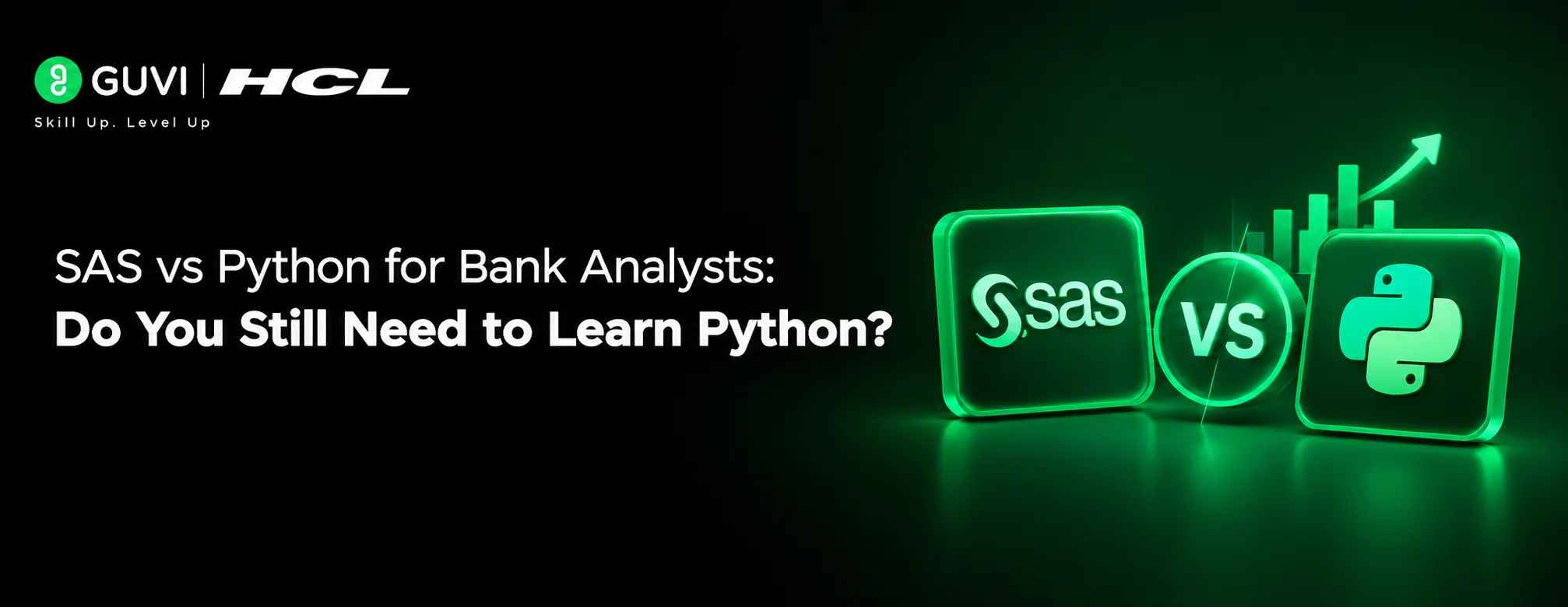
SAS vs Python for Bank Analysts: Do You Still Need to Learn Python?
Oct 27, 2026 5 Min Read 18 Views
(Last Updated)
If you work as a bank analyst, you have probably heard the debate over SAS vs. Python. SAS has been the banking standard for decades, while Python appears in more job descriptions every year.
So do you still need to learn Python? In this blog, we compare the two tools, look at where each fits in banking work, and help you decide what to learn next.
Table of contents
- TL;DR Summary
- SAS vs Python for Bank Analysts: The Quick Answer
- Why Banks Still Depend on SAS
- Is Python Used in Banks? Yes, Here’s Where
- SAS vs Python for Bank Analysts: Key Differences in Daily Work
- Is SAS Going Away in Banks?
- How Python Skills Boost a Bank Analyst's Career
- How a SAS User Can Start with Python
- Final Verdict: Do You Still Need to Learn Python?
- FAQs
- Is SAS still used in banks?
- Is Python replacing SAS in banking?
- Should a bank analyst learn Python or SAS first?
- Can you use SAS and Python together?
- Is Python harder to learn than SAS?
TL;DR Summary
- This blog covers SAS vs Python for bank analysts, showing where each tool stands in banking today.
- It explains why banks still rely on SAS and where Python already fits into daily work.
- It helps you understand the practical differences in cost, support, data handling, and governance.
- It also explores whether SAS is going away and how Python skills can lift your career.
- It guides you through a simple way to start with Python if you already know SAS, so you can decide your next step with confidence.
SAS vs Python for Bank Analysts: The Quick Answer
Yes, you still need to learn Python, but you don’t have to drop SAS (Statistical Analysis System). Most banks still run core reporting and risk work in SAS, so it remains a useful skill to list on your resume.
At the same time, more teams are bringing Python into their daily work because it is free, flexible, and easy to pair with newer tools. Knowing both gives you a solid foundation, since you can support today’s SAS systems while still moving with the bank as its tools change.
Your next career chapter starts with a single decision. Join HCL GUVI’s Advanced Data Science & Generative AI Program and, in 6 months, build 10+ real projects through live online classes, 1:1 doubt sessions, and expert mentorship. Earn an IITM Pravartak certification, get placement support, and step into AI-ready roles with confidence!
Why Banks Still Depend on SAS
Banks don’t pick tools casually because auditors and regulators may check every number they produce. SAS earned its place by being dependable in that environment, and switching away from it takes time and carries real risk.
Reasons for Dependence on SAS
- Regulatory comfort: Regulators and auditors have reviewed SAS-based models for decades, so banks know how they will be received during inspections.
- Existing code: Many banks have years of production programs built in SAS. Rewriting them is expensive, and any mistake can affect live reports.
- Vendor support: SAS provides official support, documentation, and training. When something breaks, the bank has a company to call and not just an online community.
- Audit and governance: SAS environments make it easy to log what was run, by whom, and when, which helps with traceability and internal controls.
- Stable batch processing: Banks run large scheduled jobs on huge volumes of data, and SAS has a long record of handling these reliably.
Areas Where SAS Is Used in Banks
- Credit risk modeling
- Fraud detection
- Anti-money laundering monitoring
- Regulatory and statutory reporting
- Stress testing
- Customer analytics and campaign analysis
SAS began as a university project at North Carolina State University in the late 1960s to analyze agricultural data. It became a company in 1976, when James Goodnight and his co-founders launched SAS Institute.
Is Python Used in Banks? Yes, Here’s Where
Python is already part of daily work in most banks, though it rarely replaces SAS outright. It tends to show up in newer projects, in analytics teams, and in places where speed and flexibility matter more than long-established processes. Here is where analysts actually run into it.
- Data analysis and reporting: Analysts use libraries like pandas to clean, join, and summarize large datasets, then produce reports that once took hours in Excel. It handles messy data from different systems well, which is common in banks.
- Credit risk modeling: Teams build scorecards and probability of default models with tools like scikit-learn and statsmodels. Many banks still do final production runs in SAS, but model development and experimentation are moving to Python.
- Fraud detection: Machine learning models spot unusual card and transaction behavior, and Python has the strongest toolset for this. Analysts train models like gradient boosting in Python and then connect them to the systems that score transactions.
- Automation of manual work: Scripts handle tasks like reconciliations, report generation, file checks, and email distribution. This is often the first place an analyst uses Python, because the time savings show up right away.
- Data engineering and pipelines: Python, often with PySpark, moves and transforms data between warehouses, cloud platforms, and reporting layers. Banks adopting cloud data platforms depend heavily on it here.
- Dashboards and visualization: Libraries like Plotly and Streamlit let analysts build interactive views for managers without waiting on a separate BI team. It suits quick internal tools better than formal, audited reporting.
- Text analysis and customer insight: Python helps analyze complaints, call notes, and documents using natural language processing. Banks use it to find patterns in customer feedback that numbers alone would not show.
- Model validation and testing: Independent validation teams use Python to rebuild models, run backtests, and challenge results. Its open nature makes it easy to inspect exactly what a model is doing.
SAS vs Python for Bank Analysts: Key Differences in Daily Work
The main differences between SAS and Python for bank analysts come down to cost, support, data handling, and how each tool fits into daily work, as the comparison below shows:
| Factor | SAS | Python |
|---|---|---|
| Cost | Paid commercial license | Free and open source |
| Learning curve | Structured syntax that is easier for non-programmers | Steeper at the start, but useful well beyond analytics |
| Support | Official vendor support and training | Community forums and public documentation |
| Large data handling | Processes data from disk step by step, which suits big batch jobs | Works in memory by default, so very large data needs tools like PySpark |
| Libraries and tools | Built-in procedures from a single vendor | Thousands of libraries for analysis, automation, and visualization |
| Machine learning | Available, but newer methods arrive more slowly | Latest machine learning and AI tools appear here first |
| Audit and governance | Built-in logs and validated procedures that regulators know well | Depends on how the team sets up version control and documentation |
| Setup and maintenance | Managed centrally on bank-approved servers | Needs package and version management to keep results consistent |

Is SAS Going Away in Banks?
No, SAS is not going away from banks anytime soon, but its role is changing. Most large banks still rely on it for core risk and reporting work, while adopting Python for newer projects alongside it.
What the numbers show:
- Wide reach: According to SAS, more than 1,600 banks in 92 countries use its software, including over 90% of the world’s 100 largest banks.
- Strong standing: SAS placed second overall in the 2025 Chartis RiskTech100, a respected ranking of risk technology vendors.
- Hard to replace: One Canadian bank spoke about running roughly 300 SAS applications on 52TB of data. A setup that large takes years to move, not weeks.
- Python is growing too: A 2024 note from the consulting firm Zanders said about 80% of Dutch banks use Python or R for their models.
How Python Skills Boost a Bank Analyst’s Career
Python won’t replace your banking knowledge, but it makes that knowledge easier to apply and easier for others to notice.
- Faster, cleaner work: A short script can automate tasks like reconciliations, monthly reports, and data checks, freeing up hours for analysis that actually needs your judgment.
- Wider job options: Many banks, fintech firms, and consulting companies now list Python in their analyst and risk roles, so knowing it opens doors beyond your current team.
- Access to modern techniques: Python is often used to develop machine learning, text analysis, and advanced visualisation tools, letting you work on projects like fraud models and customer insights.
- Stronger pay prospects: Analysts who can code and also understand banking data are harder to find, and that combination gives you a better case when negotiating a raise or a move.
- Smoother path to senior roles: Moving into model development, data science, or analytics leadership is easier when you can build and explain your own work instead of depending on others for it.
How a SAS User Can Start with Python
If you have years of SAS behind you, the logic is already in your head. You need the Python version of those steps, so start from what you know, not a beginner course.
1. Set up a working environment
Install Anaconda, or use VS Code with Jupyter notebooks. Add the core libraries: pandas, NumPy, statsmodels, scikit-learn, and matplotlib. Notebooks feel similar to SAS Studio because you run code in small chunks and check results as you go.
2. Map your SAS skills to their Python equivalents
| In SAS | In Python |
|---|---|
| DATA step | pandas DataFrame operations |
| PROC SQL | pandas merge and query, or SQL run through a connector |
| PROC MEANS, PROC FREQ | describe(), groupby(), value_counts() |
| PROC LOGISTIC, PROC REG | statsmodels or scikit-learn |
| PROC SGPLOT | matplotlib or seaborn |
| Macros | Functions and loops |
3. Rebuild a job you already own
Pick a report or dataset prep you run regularly and recreate it in Python. Compare the output with your SAS result row by row. Because you know the expected answer, any mismatch quickly teaches you something, like how Python handles missing values or date logic differently.
4. Connect it to your existing SAS data
You don’t need to convert anything first. pandas can read SAS dataset files directly, and the saspy package lets you run SAS code from a Python session. If your bank uses SAS Viya, PROC PYTHON lets you run Python inside your usual SAS workflow.
5. Pick up the habits SAS never required
Use Git for version control, keep separate environments for each project, and turn repeated code into reusable functions. This is where Python work differs most from SAS, and it matters in teams where several people share the same code.
Starting with a task you already understand keeps the learning curve short and gives you something useful from the first week.
Final Verdict: Do You Still Need to Learn Python?
Yes. If you work in banking analytics, relying on SAS alone is a career risk because new projects, automation, and model development increasingly use Python. Your bank may run on SAS for years, but your next employer, or the next team you join, may not.
Dropping SAS would be a mistake, though. It still powers the regulated, audited work at most large banks, and that experience is worth keeping. Treat SAS as your foundation and Python as the skill that keeps you employable, since analysts who can do both are the hardest to replace.
FAQs
1. Is SAS still used in banks?
Yes, most large banks still run credit risk, fraud, and regulatory reporting work on SAS.
2. Is Python replacing SAS in banking?
Not fully, but banks are adding Python for newer projects, automation, and model development.
3. Should a bank analyst learn Python or SAS first?
If you are starting fresh, Python offers more job options, but SAS is still the safer pick if your target bank runs on it.
4. Can you use SAS and Python together?
Yes, tools like saspy and PROC PYTHON in SAS Viya let you run Python alongside SAS code.
5. Is Python harder to learn than SAS?
It feels harder at first, but analysts with SAS experience usually pick it up quickly because the logic is the same.
Success Stories










Did you enjoy this article?