


Forward Deployed Engineer Articles
Debugging Latency Issues in Customer-Deployed AI Systems
Go vs Python for Forward Deployed Engineering Workloads
Forward Deployed Engineering in Government and Public Sector
Forward Deployed Engineering in Manufacturing and Industrial AI


Get In Touch For Details! Request More Information
Python for Forward Deployed Engineers: What You Actually Need to Know
Sep 25, 2026 4 Min Read 26 Views
(Last Updated)
Python for forward deployed engineers is less about becoming a Python language expert and more about using Python to solve practical customer problems. FDEs may use Python to build integrations, automate repetitive tasks, process data, create APIs, troubleshoot systems, or connect AI models with existing applications.
Because FDE work often involves unfamiliar customer environments, engineers need to write readable code quickly and adapt it to different requirements. Strong Python fundamentals can make it easier to prototype solutions, debug issues, and move from an idea to a working implementation.
This article explains the Python skills FDEs actually need, the libraries and frameworks worth learning, common use cases, and how you can build practical Python experience for a Forward Deployed Engineer role.
Table of contents
- TL;DR Summary
- Why Is Python Useful for Forward Deployed Engineers?
- How Much Python Do FDEs Actually Need?
- Which Python Skills Should FDEs Learn?
- Working With APIs
- Automation
- Data Processing
- Debugging and Error Handling
- How Do FDEs Use Python in Real Projects?
- Which Python Libraries Should FDEs Know?
- How Can You Practice Python for FDE Roles?
- API Integration Project
- Automation Project
- Data Pipeline
- Customer Support Tool
- What Python Mistakes Should FDEs Avoid?
- Start Your Learning Journey with HCL GUVI
- Conclusion
- FAQs
- Do Forward Deployed Engineers need to know Python?
- How much Python should an FDE know?
- Is Python enough to become a Forward Deployed Engineer?
- Which Python libraries should FDEs learn?
- What Python projects are good for FDE preparation?
- Should FDEs learn advanced Python?
TL;DR Summary
- Python for forward deployed engineers focuses on practical problem-solving rather than advanced language expertise.
- FDEs should understand Python fundamentals, APIs, automation, data processing, error handling, and debugging.
- Libraries such as Requests, Pandas, and FastAPI can be useful for customer-focused projects.
- Python can help FDEs build prototypes, integrate systems, automate workflows, and develop AI applications.
- Strong Python fundamentals make it easier to work with unfamiliar systems and customer requirements.
- Build practical projects that combine Python with APIs, databases, cloud services, and automation.
Why Is Python Useful for Forward Deployed Engineers?
Python is useful for FDEs because it supports a wide range of technical tasks without requiring large amounts of code.
A customer might need data extracted from an API, transformed into a specific format, stored in a database, and connected to another application. Python can be used across much of this workflow.
Common FDE use cases include:
- API integrations
- Automation scripts
- Data processing
- Backend services
- AI and machine learning applications
- Testing and debugging
- Prototyping
- Log analysis
The flexibility of Python allows FDEs to adapt quickly when customer requirements change.
Strengthen your Python and AI skills with HCL GUVI’s Artificial Intelligence & Machine Learning Course. Develop practical knowledge through hands-on projects focused on AI, machine learning, and real-world application development.
How Much Python Do FDEs Actually Need?
FDEs do not necessarily need to know every advanced Python feature. The priority should be writing reliable, readable code that solves real problems.
You should be comfortable with:
- Variables and data types
- Conditions and loops
- Functions
- Lists, dictionaries, sets, and tuples
- Classes and objects
- Exception handling
- File handling
- Modules and packages
- Virtual environments
- Working with JSON
- Reading and writing files
You should also understand basic software engineering practices such as modular code, logging, testing, version control, and configuration management.
Python’s standard library includes many modules for common programming tasks, which can help engineers build useful prototypes without adding unnecessary dependencies.
Which Python Skills Should FDEs Learn?
1. Working With APIs
API integration is one of the most practical Python skills for FDEs.
You should know how to:
- Send HTTP requests
- Work with GET, POST, PUT, and DELETE
- Handle JSON responses
- Use authentication
- Manage API errors
- Read API documentation
For example, an FDE might use Python to connect a customer’s internal application to a third-party service.
2. Automation
Automation can reduce repetitive manual work.
Python scripts can automate tasks such as:
- File processing
- Report generation
- Data transformation
- System checks
- Scheduled workflows
- Log processing
The goal is not simply to write scripts but to identify processes that can be made faster and more reliable.
3. Data Processing
FDEs often encounter customer data in different formats.
Python can help clean, transform, validate, and analyze this data before sending it to another system.
Pandas is particularly useful for working with structured datasets.
4. Debugging and Error Handling
Customer environments rarely behave perfectly. FDEs need to understand why an integration or application is failing.
Python knowledge should include:
- Reading tracebacks
- Using exceptions
- Logging errors
- Inspecting variables
- Testing individual components
- Reproducing problems
Good debugging skills are often more valuable than simply knowing advanced syntax.
How Do FDEs Use Python in Real Projects?
Python becomes especially useful when several systems need to work together.
Imagine a customer receives order information from one platform but needs it synchronized with an internal database.
An FDE could:
- Connect to the external API using Python.
- Retrieve the order data.
- Validate and transform the information.
- Store it in the customer’s database.
- Add logging and error handling.
- Schedule the workflow.
- Monitor whether synchronization succeeds.
This example demonstrates why FDEs need practical Python knowledge. The challenge is not just writing the code. It is understanding the customer’s workflow and creating a reliable solution.

Which Python Libraries Should FDEs Know?
You do not need to memorize hundreds of libraries. Focus on tools that support common FDE tasks.
| Library/Framework | Common FDE Use |
| Requests | API communication |
| FastAPI | Building APIs |
| Flask | Lightweight web applications |
| Pandas | Data processing |
| NumPy | Numerical computing |
| SQLAlchemy | Database interaction |
| Pydantic | Data validation |
| Pytest | Testing |
| Boto3 | AWS automation |
For AI-focused FDE roles, you may also encounter libraries and frameworks used for machine learning, LLM applications, retrieval systems, and model deployment.
The best way to learn Python for forward deployed engineers is through projects that simulate customer problems.
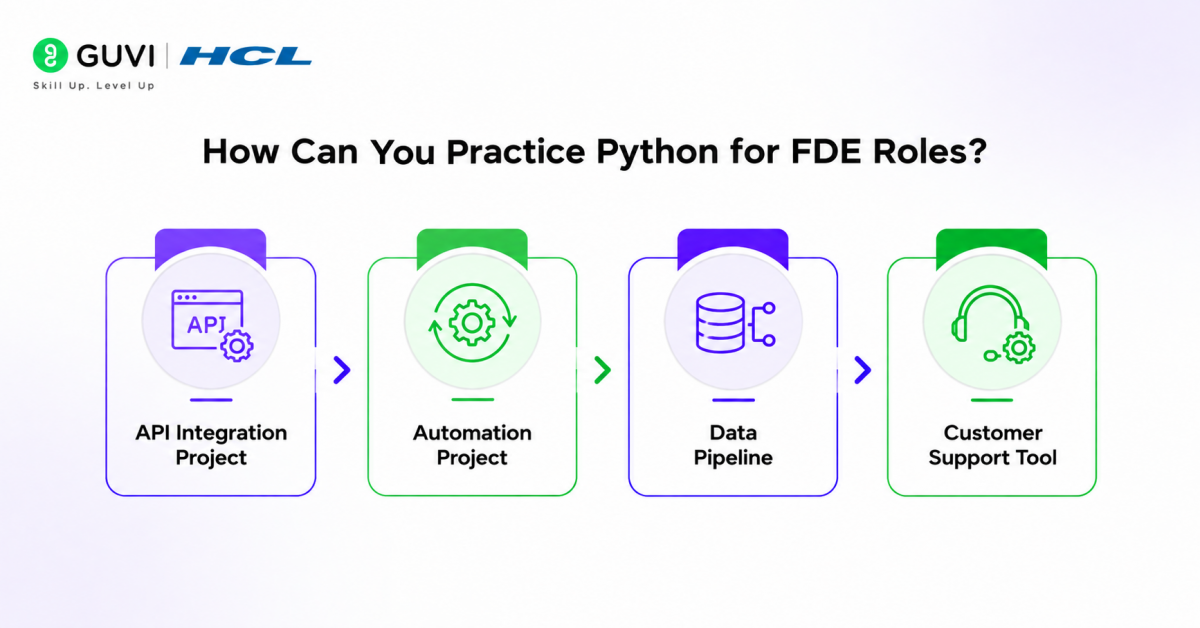
How Can You Practice Python for FDE Roles?
Try building:
1. API Integration Project
Connect two APIs and transfer information between them. Add authentication, error handling, logging, and retry logic.
2. Automation Project
Build a Python script that processes files, generates reports, or automates a repetitive workflow.
3. Data Pipeline
Create a small pipeline that extracts data, cleans it, transforms it, and stores it in a database.
4. Customer Support Tool
Build an application that receives support requests through an API, stores them, and provides basic search or reporting functionality.
Pro Tip: Do not stop after making the project work. Add logging, validation, documentation, tests, and error handling to make it closer to a real customer deployment.
What Python Mistakes Should FDEs Avoid?
Some Python habits can make customer solutions harder to maintain.
Avoid:
- Writing everything in one large script
- Hardcoding passwords or API keys
- Ignoring errors
- Skipping input validation
- Using unnecessary dependencies
- Avoiding documentation
- Writing code that only works on your local machine
Instead, use environment variables for secrets, organize code into modules, add useful logs, and document how the solution should be configured and deployed.
Best Practice: Treat even small customer scripts as maintainable software. Someone else may need to troubleshoot or modify your solution later.
Start Your Learning Journey with HCL GUVI
Strengthen your Python and AI skills with HCL GUVI’s Artificial Intelligence & Machine Learning Course. Develop practical knowledge through hands-on projects focused on AI, machine learning, and real-world application development.
Conclusion
Learning Python for forward deployed engineers does not mean mastering every feature of the language. The real goal is to become comfortable using Python to understand problems, build integrations, automate workflows, process data, and troubleshoot customer environments.
Start with strong Python fundamentals and gradually add APIs, databases, cloud services, testing, and automation. As you build projects, focus on making your solutions reliable and easy to understand. This practical approach will prepare you better for the unpredictable, customer-focused nature of Forward Deployed Engineering.
FAQs
Do Forward Deployed Engineers need to know Python?
Python is highly useful for many FDE roles, particularly those involving APIs, automation, data, AI, and backend development. However, the exact language requirements depend on the company and role.
How much Python should an FDE know?
An FDE should have strong fundamentals and be comfortable with APIs, JSON, error handling, automation, data processing, debugging, and basic software engineering practices.
Is Python enough to become a Forward Deployed Engineer?
No. Python is only one part of the skill set. FDEs also benefit from knowledge of APIs, databases, cloud platforms, DevOps, system integration, and customer communication.
Which Python libraries should FDEs learn?
Useful libraries include Requests, Pandas, FastAPI, Flask, SQLAlchemy, Pydantic, Pytest, and cloud-specific libraries such as Boto3.
What Python projects are good for FDE preparation?
API integrations, automation tools, data pipelines, backend services, and customer-focused applications are excellent projects because they demonstrate practical problem-solving.
Should FDEs learn advanced Python?
Advanced Python can be useful, but it should come after strong fundamentals. FDEs generally benefit more from writing reliable, maintainable code and understanding how Python connects with real systems.
Success Stories

About the Author
HCL GUVI
This article was selected and published as part of the HCL GUVI AI Blogathon 2026, an initiative designed to encourage students, AI enthusiasts, and aspiring tech writers to simplify complex AI concepts through impactful technical content. The contest recognized high-quality, original, and insightful AI-focused blogs, with selected authors receiving publication opportunities on the HCL GUVI blog platform along with official author credits and recognition.
View all posts by HCL GUVI
Connect with me @






Did you enjoy this article?