


Career Articles
Android Development Roadmap :10-Step Guide to Become an Android Developer
Network Engineer Roadmap: From Beginner to Expert
VLSI Roadmap: 11 Steps to Become a Successful VLSI Engineer
Azure Certification Roadmap 2026: 7 Best Certifications Beginners Must Know


Get In Touch For Details! Request More Information
Complete Guide for Non-CS Students to Get Software Jobs
Feb 05, 2026 7 Min Read 1279 Views
(Last Updated)
A tech career is fascinating and highly rewarding. With every passing year, interest grows stronger, not weaker. Not just among students but also among working professionals.
If you’re the one imagining a career in IT, then you’re choosing the most loved profession of all time: software engineering.
But there’s a persistent myth: “Software jobs are only for CS students.”
No. Anybody can enter the IT industry with the right skill set, adaptability, and the mindset of a lifelong learner.
You may ask, “What about the degree then?” No, you don’t need to spend another four years earning a CS degree to become a software engineer.
Whether you’re a student of Arts (B.A., B.Com., BBA), Science (B.Sc.), or any engineering discipline (EEE, ECE, ME, CE), you can become a software engineer and enter the IT sector.
This blog will be the Non-CS Students Software Jobs Guide and answer common questions like how to land software jobs. You will get a complete roadmap, from knowing the essential skills to landing your internship without a CS degree.
Quick Answer:
For Non-CS Students to Get Software Jobs, all you need is Python or Java basics, SQL, problem-solving skills, and 3–5 solid projects to build a strong portfolio. With consistent learning and placement-focused training programs like HCL GUVI Zen Class.
Table of contents
- Why Non-CS Students Are Now Entering the Tech Industry
- Common Question Non-CS Students ask
- What Software Roles Are Open to Non-CS Students?
- Software Developer
- QA / Software Tester
- Data Analyst
- Business Analyst
- UI/UX Designer
- Cloud & DevOps Roles
- Product Management
- Skills Non-CS Students Need to Learn
- Programming Languages (Python/Java)
- Data Structures Basics
- Databases & SQL
- Step-by-Step Roadmap to Get a Software Job
- Step 1 — Choose the Right Career Path
- Step 2 — Learn Job-Relevant Skills
- Step 4 — Get Certifications & Online Courses
- Step 5 — Prepare Your Resume & LinkedIn
- Step 6 — Apply for Jobs & Internships
- Step 7 — Prepare for Interviews
- How to Gain Real Industry Experience Without a Tech Degree
- Freelancing, internships, live projects: where to find them
- Crafting a Job-Winning Portfolio for Non-CS Candidates
- The 3 essential project types that impress recruiters
- Common Challenges Non-CS Students Face
- Lack of Coding Background
- Fear of Technical Interviews
- No Industry Exposure
- How to Overcome These Challenges
- Start with Beginner-Friendly Resources
- Practice Consistently with Projects
- Use Mock Interviews & Mentorship
- Practical Career Strategies
- Networking, Mentorship, and Building Industry Visibility
- Final Tips to Get a Software Job Without a CS Degree
- TL; DR- How Non CS Students Can Get Software Jobs
- Wrapping Up
- Frequently Asked Questions
- Can a non-CS student get a software job?
- Which software job is best for non-CS beginners?
- Is coding necessary for all IT jobs?
- What skills should a non-CS student learn first?
- How long does it take for a non-CS student to get job-ready?
- Do non-CS students face difficulties in coding interviews?
- Is a certificate enough to get a software job?
Why Non-CS Students Are Now Entering the Tech Industry
In the current scenario, companies are opening doors to diverse backgrounds and valuing skills over formal degrees. With companies like Cognizant increasing hiring for non-STEM graduates, there’s a growing recognition of diverse talent pools.
As Artificial Intelligence (AI) revolutionises market trends, organisations are seeking candidates who understand users, markets, and human behaviours, and skills that don’t require a computer science degree.
The top priority for many Gen Z individuals is striking that sweet spot between work-life balance and continuous learning opportunities. So, IT has become a go-to career path.
And if you’re curious, driven, and ready to break into tech with no traditional CS background, there’s never been a better time to leap.
Tech Talent Gap: As traditional education no longer fits the industry demand, there is a growing talent gap in the tech industry.
Diversity: When companies hire people from a variety of backgrounds, they introduce new ways of thinking. Research also shows that teams with diverse skill sets are more effective at solving complex problems and identifying potential blind spots.
Increase in demand: Tech jobs aren’t just in Silicon Valley anymore! Industries like healthcare, finance, retail, and education are all going digital and need people with tech skills.
Soft Skills: In tech jobs, soft skills are equally important, and companies expect strong teamwork and collaboration. Soft skills will enhance individual performance and base for future leadership.
Specialised Roles: Many tech roles, like UX design or business analysis, require skills (communication, problem-solving, empathy) that are honed in non-CS degrees.
Common Question Non-CS Students ask
Can I get a software job if I studied B.Com or B.A.?
Do I need strong maths to learn programming?
How long will it take to get job-ready?
What is the easiest tech role for beginners?
Is Python enough for non-CS students?
Can I get into AI without engineering?
What Software Roles Are Open to Non-CS Students?
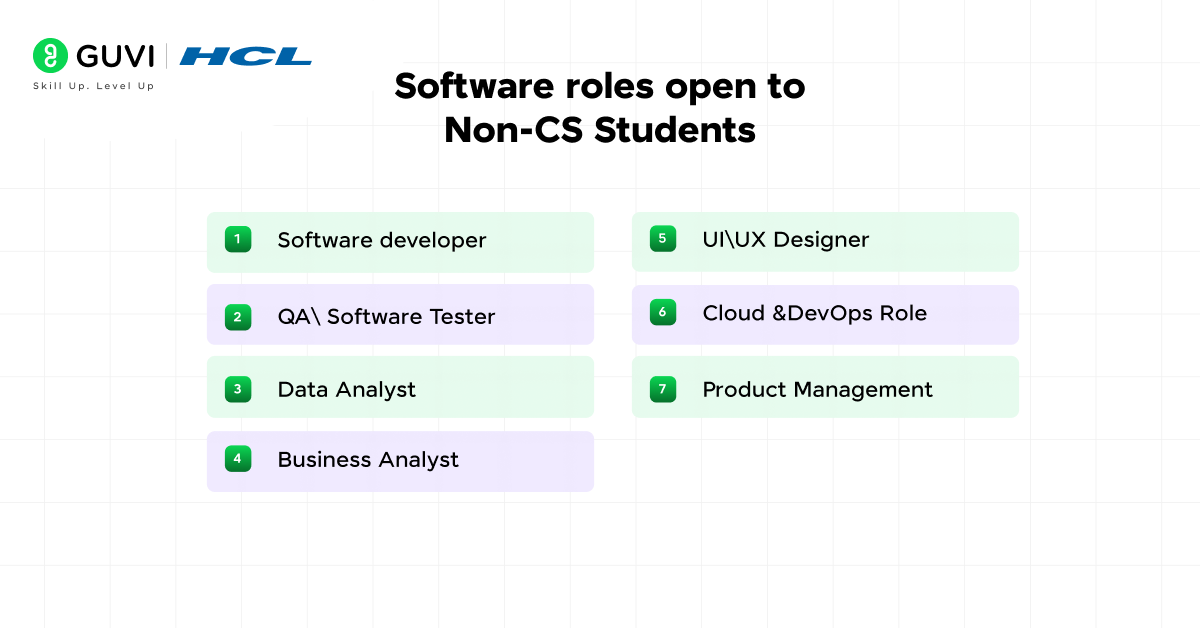
The term “software job” is much broader than you think. Here are great starting points:

1. Software Developer
Definition: A software developer builds applications, websites, or systems using programming languages like Python, Java, or JavaScript.
This is still possible! Companies often look for passion and project experience over a specific degree. You might start in front-end development (the visual part of a website) as the barrier to entry can be slightly lower.
2. QA / Software Tester
Definition: A QA engineer tests software, finds bugs, and ensures the product works correctly.
Quality Assurance (QA) is crucial. Your job is to find bugs and ensure the software works as expected. It requires attention to detail and logical thinking more than complex coding.
3. Data Analyst
Definition: A data analyst uses tools like SQL and Python to interpret data and help businesses make decisions.
A highly popular role for math, economics, or statistics majors. You use tools like SQL and Python to clean, analyse, and interpret data to help the business make decisions.
4. Business Analyst
Definition: Business analysts bridge communication between business and technical teams.
This role acts as a bridge between the business side and the technical team. You translate business needs into technical requirements. You blend communication & tech skills.
5. UI/UX Designer
Definition: UI/UX Designers create user-friendly interfaces and improve digital product experience.
If you have a background in design, psychology, or art, this is a perfect fit. You focus on how the user interacts with the product (UX) and how it looks (UI). Coding is often minimal.
6. Cloud & DevOps Roles
Definition: DevOps engineers manage software deployment, cloud services, and automation tools.
These are about managing and deploying software infrastructure. While it has a steep learning curve, you can often start with certifications and practical skills instead of a CS background.
7. Product Management
Definition: Product Managers decide what features should be built and why, based on user and business needs.
This role decides what the software should do. It requires strong leadership, market understanding, and communication skills, often developed in non-technical majors.
Skills Non-CS Students Need to Learn
To make a successful pivot, you need to acquire a foundational technical skillset.
Programming Languages (Python/Java)
Start with one. Python is often recommended for its simple syntax and wide use in data science, web development, and automation.
Data Structures Basics
You don’t need to master advanced algorithms, but understanding how data is organised (like arrays, lists, and dictionaries) is essential for any technical interview.
Databases & SQL
The language for interacting with databases. Nearly every application uses a database, so mastering SQL (Structured Query Language) is a fundamental skill for almost all tech roles.
Beginner-friendly learning resources to start with
Coding Foundations:
- HCL GUVI Python Course
- freeCodeCamp
- Codecademy
Data Skills:
- HCL GUVI Data Analytics Program
- DataCamp
- Kaggle
Cloud Certifications:
- AWS Cloud Practitioner
- Google Cloud Associate
Version Control:
- Git + GitHub
Interview Prep:
- LeetCode
- HCL GUVI Mock Interviews
Bharat Kumar Gurappa is an Electrical Engineer who dreamed of working in AI and building real-life AI solutions. He was super interested in machine learning, but switching from electronics felt like a huge step.
Still, he didn’t give up on his dream. He decided to learn the skills he needed.
That’s when he joined the ML program at HCL GUVI. With the help of great mentors and consistent learning, he landed a job as a Junior ML Engineer. And the coolest part? He got a 50% salary hike and now works on real AI projects.
Read the complete success story →
Step-by-Step Roadmap to Get a Software Job
This seven-step plan is your blueprint for success.
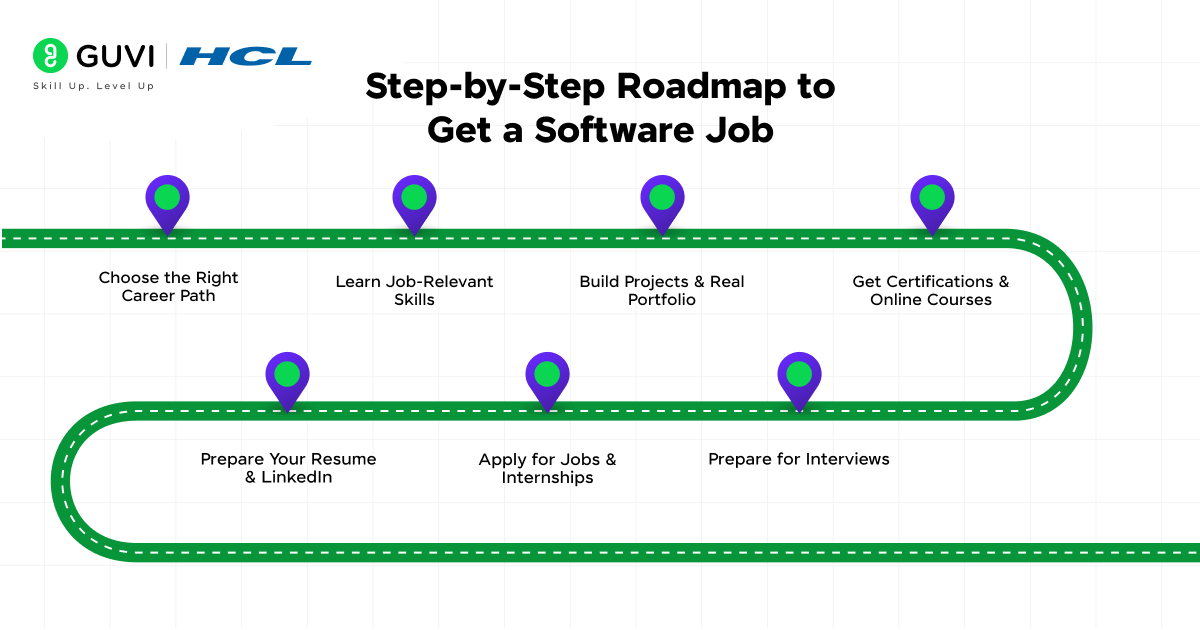
Step 1 — Choose the Right Career Path
Don’t just chase the “Developer” title. Review the roles above and pick the one that matches your existing strengths and genuine interests (e.g., Data Analyst if you love math, UI/UX if you love design).
Step 2 — Learn Job-Relevant Skills
Use online courses, bootcamps, and free resources (like freeCodeCamp, The Odin Project) to build your technical foundation.
If you prefer a structured, mentor-led path, HCL GUVI’s Zen Class Courses offers project-based career training with placement assistance. You’ll learn with guidance from mentors working in top tech companies like Google, Microsoft, and Freshworks.
Step 3 — Build Projects & Real Portfolio
This is the most important step. Courses teach you theory; projects prove you can build things. Focus on building real applications, not just tutorial copies.
Step 4 — Get Certifications & Online Courses
While optional, certain certifications (like AWS Cloud Practitioner or Google Data Analytics) can help validate your learning and get your resume noticed.
Step 5 — Prepare Your Resume & LinkedIn
Tailor your resume to highlight transferable skills (e.g., “Managed complex projects” becomes “Managed JIRA board for a 5-person project”).
Your LinkedIn should show your learning journey and projects.
Step 6 — Apply for Jobs & Internships
Start applying widely. Look for internships, apprenticeships, or junior roles. Don’t be afraid to apply for roles that ask for 1 year of experience—your projects count!
Step 7 — Prepare for Interviews
Practice technical questions relevant to your chosen path and, most importantly, prepare behavioural stories about how you solved problems (your non-CS skills are great here!).
Example 90 Day learning plan for CS Beginner
Days 1–15:
Learn Python basics
Practice small exercises daily
Days 16–30:
Learn SQL + Git/GitHub
Build 1 beginner project
Days 31–60:
Build 2–3 real projects
Learn basic Data Structures
Days 61–90:
Create a portfolio website
Apply for internships & practice interviews
How to Gain Real Industry Experience Without a Tech Degree
Recruiters want proof you can perform in a real-world setting. Your non-CS background makes this proof even more critical.
Project-based learning vs. course collecting
Course Collecting: Watching videos and getting completion certificates. Low value.
Project-based Learning: Taking the skills you learned and building a unique, complete application from scratch. High value.
Open-source contribution strategies for beginners: Look for open-source projects on GitHub that have a “good first issue” tag. Start with small, non-code contributions like improving documentation or fixing a minor UI bug. This shows you can collaborate with a real team.
Freelancing, internships, live projects: where to find them
Freelancing: Start on platforms like Upwork or simply offer to build a basic website for a small local business.
Internships: Many companies now offer paid apprenticeships or “Returnship” programs designed for career changers.
How to document your learning publicly to attract opportunities? Start a simple blog or a LinkedIn series where you document your projects.
Example: “Day 10 of learning Python: Built a simple calculator.” This establishes you as a consistent, public learner and attracts recruiters.
Crafting a Job-Winning Portfolio for Non-CS Candidates
Your portfolio is your substitute for a CS degree. It must be compelling.
What does a “portfolio” mean beyond coding? For a Data Analyst, the portfolio is a collection of case studies and clean dashboards.
For a UX Designer, it’s a presentation of your design process and wireframes.
The 3 essential project types that impress recruiters
- The Foundational Project: A simple project that proves you know the basics (e.g., a To-Do App).
- The API/Data Project: A project that interacts with external data (e.g., a weather app or a Reddit scraper).
- The Original, Unique Project: Solve a problem you personally have. This shows creativity and drive.
Writing technical case studies (with templates) For each project, write a short document explaining:
- The Problem: What issue did you set out to solve?
- The Process: Which technologies did you use and why? What challenges did you face?
- The Result: What does the final product do?
GitHub structure for absolute beginners Keep it clean! Use a good README file for every project that explains what the project is, how to run it, and what technologies it uses.
Common Challenges Non-CS Students Face
It won’t be easy, but you can plan for these common hurdles.
Lack of Coding Background
You may feel like you’re playing catch-up, especially with core computer science concepts.
Fear of Technical Interviews
Many non-CS students panic about whiteboard coding and deep theoretical questions.
No Industry Exposure
Without a college career fair or alumni network in tech, it can be hard to know where to start applying.
How to Overcome These Challenges
Start with Beginner-Friendly Resources
Don’t jump straight into advanced topics. Use platforms known for being beginner-friendly (e.g., freeCodeCamp, CS50, or paid bootcamps).
Practice Consistently with Projects
The only way to build muscle memory in coding is by coding every day. Consistency beats intensity.
Use Mock Interviews & Mentorship
Practice technical interviews with peers or sign up for services that offer mock interviews. Finding a mentor (on LinkedIn or a platform like Plato) can provide invaluable guidance.
Practical Career Strategies
After learning the basics, you must position yourself well in the industry. Here, you’ll find simple tactics to boost your visibility and confidence.
Networking, Mentorship, and Building Industry Visibility
Your biggest advantage is your ability to connect with people and communicate.
How to network effectively when you’re new to tech: Don’t ask for a job. Ask for advice. Schedule a 15-minute virtual meeting with people doing the job you want and ask: “What was the most important skill you learned after you started?”
Using LinkedIn strategically (value posts, skill narratives, commenting strategy)
Value Posts: Share helpful resources for beginners.
Skill Narratives: Write a short post about a difficult bug you solved on a project.
Commenting Strategy: Engage thoughtfully with posts from industry leaders, don’t just hit “like.”
Finding mentors in the tech space. Use platforms like ADPList or just send a polite, personalised connection request on LinkedIn to senior people in a company you admire.
Participating in hackathons, challenges, and tech communities. Hackathons are a brilliant way to gain project experience under pressure and meet people. Look for local or online communities specific to your chosen role (e.g., a local Python group).
Join platforms like HCL GUVI’s coding challenges and community events, which help you practise real-world problem-solving while connecting you to mentors and learners.
Final Tips to Get a Software Job Without a CS Degree
- Focus on the Value: The company doesn’t care about your degree; they care about what you can build and how you can help their business.
- Be Humble, but Confident: Acknowledge you are learning, but stand by the quality of your projects.
- Start Small: Be open to roles like ‘Tech Support’ or ‘Intern’ that get your foot in the door.
TL; DR- How Non CS Students Can Get Software Jobs
Yes, non CS Students can get software jobs
Pick a beginner-friendly role (QA, Data, UI\UX, Frontend Developer)
Learn Python, SQL, and basic problem-solving skills
Build 3-5 projects + GitHub portfolio
Apply for interviews
Join a structured program like HCL GUVI Zen class Course if you need mentor support.
Wrapping Up
If you’ve got the grind, the curiosity, and a willingness to learn, there’s a spot for you in the software world. Whether you’re building apps, analysing data, or designing sleek interfaces, companies are actively looking for people with real skills and fresh perspectives
The roadmap is clear: pick your path, level up your skills, build projects that slap, and show up confident in interviews. Your non-CS background? It’s not your barrier.
The journey is challenging, but the destination is worth the effort!
Frequently Asked Questions
1. Can a non-CS student get a software job?
Yes. Companies hire based on skills, projects, and problem-solving ability, not degree.
2. Which software job is best for non-CS beginners?
Popular beginner-friendly roles include Software Tester (QA), UI/UX Designer, Frontend Developer, Data Analyst, and Business Analyst.
3. Is coding necessary for all IT jobs?
No. Roles like Business Analyst, UI/UX Designer, Product Manager, and Technical Writer require minimal or no coding.
4. What skills should a non-CS student learn first?
Start with Python, SQL, basic Data Structures, Git/GitHub, and one specialization like UI/UX or Data Analytics.
5. How long does it take for a non-CS student to get job-ready?
With consistent learning, it takes 4–8 months to become job-ready through structured courses or bootcamps.
6. Do non-CS students face difficulties in coding interviews?
Initially, yes. But with practice in problem-solving and projects, non-CS learners perform as well as CS students.
7. Is a certificate enough to get a software job?
Certificates alone are not enough. You need projects, internships, and a strong portfolio to stand out.
Success Stories

About the Author
Salini Balasubramaniam
A curious, information-savvy writer loves to turn deep insights into authentic and engaging content that connects. With experience in writing for brands and driving audience engagement, I believe that words can make a powerful difference.
View all posts by Salini Balasubramaniam
Connect with me @














Did you enjoy this article?