


Software Development Articles
How to Read and Understand System Design Diagrams?
System Engineer Roles and Responsibilities: 12 Proven Duties for Growth
SAP Consultant Roles and Responsibilities: 12 Proven Duties for Growth and Success
Network Engineer Roles and Responsibilities: 12 Essential Duties for Success


Get In Touch For Details! Request More Information
Multiprogramming and Multitasking: A Comparison Guide
Aug 31, 2026 8 Min Read 3429 Views
(Last Updated)
Have you ever wondered how your computer manages to juggle several things at once while still keeping everything running smoothly? When you start exploring how operating systems work, two ideas appear right away: multiprogramming and multitasking.
They sound similar, and they’re connected, but they solve different problems. Understanding the difference gives you a clearer picture of why modern systems feel so responsive and why older systems worked the way they did.
In this article, we will walk you through what Multiprogramming and Multitasking mean, how they differ, and why it matters. So, without further ado, let us get started!
Table of contents
- Quick Answer:
- Quick Comparison: Multiprogramming vs Multitasking vs Multiprocessing vs Multithreading
- What is Multiprogramming?
- Key Characteristics
- Advantages & Disadvantages
- What is Multitasking?
- Key Characteristics
- Advantages & Disadvantages
- Multitasking and Multiprogramming: Side-by-Side Comparison
- Multiprogramming vs Multitasking: The Subtle Difference Explained
- Multiprogramming focuses on CPU utilization
- Multitasking focuses on responsiveness
- The key difference
- Why Does It Matter to You?
- Use Cases and Practical Scenarios
- Multiprogramming
- Multitasking
- Real OS Examples That Use Multiprogramming vs Multitasking
- Multiprogramming in operating systems
- Multitasking in modern operating systems
- How Context Switching Works in Multiprogramming
- Why context switching matters
- Multiprogramming Exam Questions for OS Subjects
- What is multiprogramming in an operating system?
- What is the main objective of multiprogramming?
- What is the difference between multiprogramming and multitasking?
- Does multiprogramming mean that programs execute simultaneously?
- What is context switching?
- What happens when a process waits for I/O in a multiprogramming system?
- What are the advantages of multiprogramming?
- What are the disadvantages of multiprogramming?
- What is the difference between multiprogramming and multiprocessing?
- Why is multiprogramming important in modern operating systems?
- Conclusion
- FAQs
- What is the main difference between multiprogramming and multitasking?
- Is multitasking faster than multiprogramming?
- Can a modern operating system use both?
- Does multiprogramming mean multiple CPUs are used?
- Which is better for user-facing applications?
Quick Answer:
Multiprogramming boosts CPU usage by running several programs in memory and switching when one waits for I/O, while multitasking focuses on user responsiveness by rapidly time-sharing the CPU across multiple active tasks.
Quick Comparison: Multiprogramming vs Multitasking vs Multiprocessing vs Multithreading
| Feature | Multiprogramming | Multitasking | Multiprocessing | Multithreading |
|---|---|---|---|---|
| Basic idea | Keeps multiple programs in memory and switches between them | Allows multiple tasks to share CPU time | Uses multiple CPUs or CPU cores to execute processes | Runs multiple threads within a process |
| Main goal | Maximize CPU utilization | Improve responsiveness and allow concurrent tasks | Achieve true parallel execution | Improve responsiveness and resource sharing within an application |
| CPU requirement | Traditionally one CPU | Can work on one or multiple cores | Requires multiple processing units/cores for parallel execution | Can run on one or multiple cores |
| Execution unit | Programs/processes | Processes or tasks | Processes | Threads |
| Switching/parallelism | CPU switches when a running program waits, such as for I/O | CPU rapidly switches between tasks, often using time slices | Processes can execute simultaneously on different cores | Threads can execute concurrently within the same process |
| Example | Program A waits for disk I/O, so the CPU runs Program B | Browser, music player, and editor appear to run at the same time | Different CPU cores execute different processes simultaneously | A browser uses separate threads for UI, networking, and other work |
| Primary focus | CPU efficiency | User responsiveness | Parallel processing | Efficient concurrent execution |
Easy way to remember:
- Multiprogramming: Keep the CPU busy.
- Multitasking: Keep the system responsive.
- Multiprocessing: Use multiple processors/cores.
- Multithreading: Run multiple execution paths inside one process.
These concepts can coexist in a modern operating system rather than being mutually exclusive.
What is Multiprogramming?
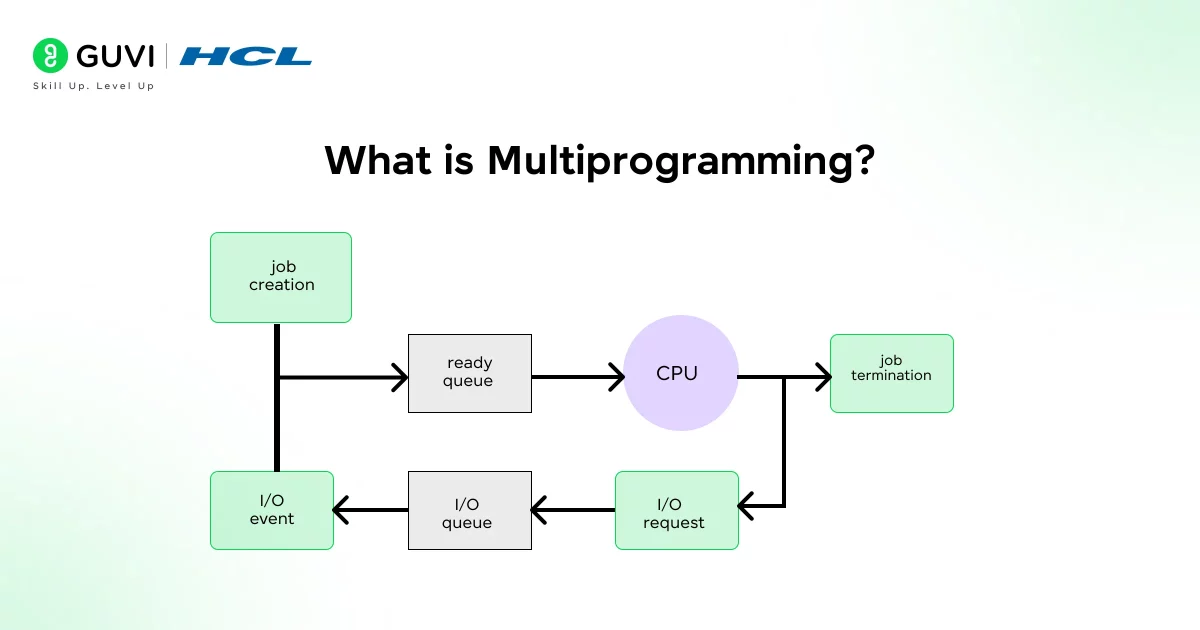
In a multiprogramming system, the Operating System loads multiple programs (jobs) into main memory at once. When one job is waiting (for example, for I/O), the CPU doesn’t sit idle; it switches to another job in memory and executes that. In effect, you keep the CPU busy.
Key Characteristics
Here are some of the core characteristics of multiprogramming:
- Single CPU: There’s one CPU that executes jobs. Multiprogramming doesn’t necessarily require many CPUs.
- Multiple programs in memory: Several programs are present in memory at the same time; when one must wait (e.g., for I/O), another can use the CPU.
- Scheduling and switching: The OS schedules which job gets the CPU next when the current job cannot proceed (e.g., waiting for I/O). This involves context switches (saving job state, loading next job) but not necessarily a strict time-slice preemption.
- Improves CPU utilization: The main aim is to reduce idle CPU time, increase throughput (number of jobs completed).
- Batch-oriented: Historically, multiprogramming was used in batch systems where user interactivity was minimal; jobs would run until waiting or completion.
Advantages & Disadvantages
Advantages
- Better CPU utilization: because the CPU won’t sit idle when a program waits for I/O.
- Increased throughput: more jobs get processed in the same time frame compared to strictly sequential execution.
- More efficient use of system resources (memory, I/O devices) if implemented well.
Disadvantages
- Memory management becomes more complex: since multiple programs must reside in main memory, fragmentation and allocation matters arise.
- The scheduling logic is non-trivial: deciding which job to run next, when to switch, etc.
- Response time for individual jobs may not be optimal: because a job might wait until another job frees the CPU.
- Doesn’t by itself guarantee interactivity or fairness among users/tasks.
What is Multitasking?
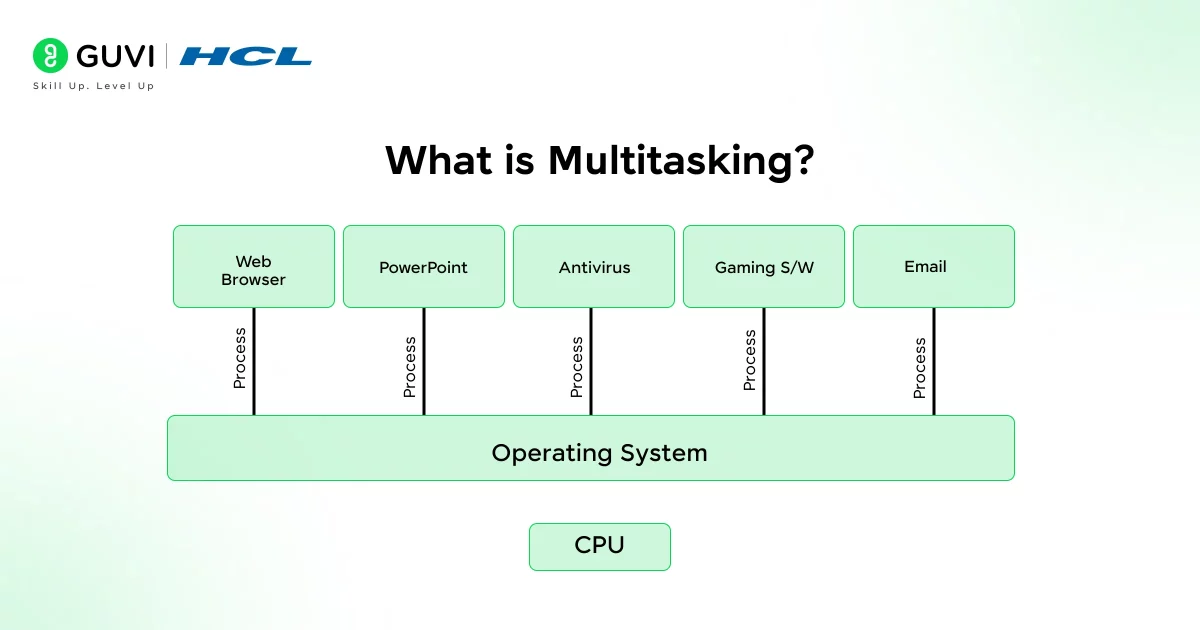
Multitasking (also called time-sharing when referring to interactive systems) is an extension of the multiprogramming idea. Here, the OS allows the execution of multiple tasks (processes or threads) seemingly simultaneously by switching the CPU among them frequently and allocating short time slices. The switching happens so fast that the user experiences multiple tasks happening at once.
Key Characteristics
- Time-sharing/time-slice: Each task/process gets a small “quantum” of CPU time; after the quantum expires or a task blocks, the CPU moves to the next task.
- Switching via context-switch: Because tasks share the CPU, switching between them involves saving and restoring states (context switch).
- User interactivity: Multitasking supports interactive systems (e.g., desktop OS) where multiple applications are running and the user switches between them.
- Multiple tasks per program / multiple users: Unlike multiprogramming, which focuses on multiple programs in memory, multitasking deals with several tasks (which might belong tothe same or different programs) running concurrently.
- Potential for multiple CPUs: Although not strictly required, multitasking systems can exploit multiple processors/cores for better parallelism. Some descriptions mention multicore environments.
Advantages & Disadvantages
Advantages
- Improved responsiveness: Because tasks get CPU time frequently, the system responds better to user commands or interactive workloads.
- Allows multiple applications to run “at once” (in the user’s perception): e.g., you might browse the web, play music, run background tasks.
- Better target for modern interactive operating systems (desktop, mobile) and “multi-user” scenarios.
Disadvantages
- Complexity: Scheduling and managing time slices, ensuring fairness, prioritization, handling interrupts, and dealing with resource contention is non-trivial.
- Overhead from context switching: Frequent switching incurs overhead (saving/restoring registers, flushing TLBs, etc).
- If tasks are too heavy or quantum too small/large, you may end up with overhead or poor utilization.
- Hardware constraints: On slower processors or with limited resources, multitasking might degrade performance rather than help.
Multitasking and Multiprogramming: Side-by-Side Comparison
| Aspect | Multiprogramming | Multitasking |
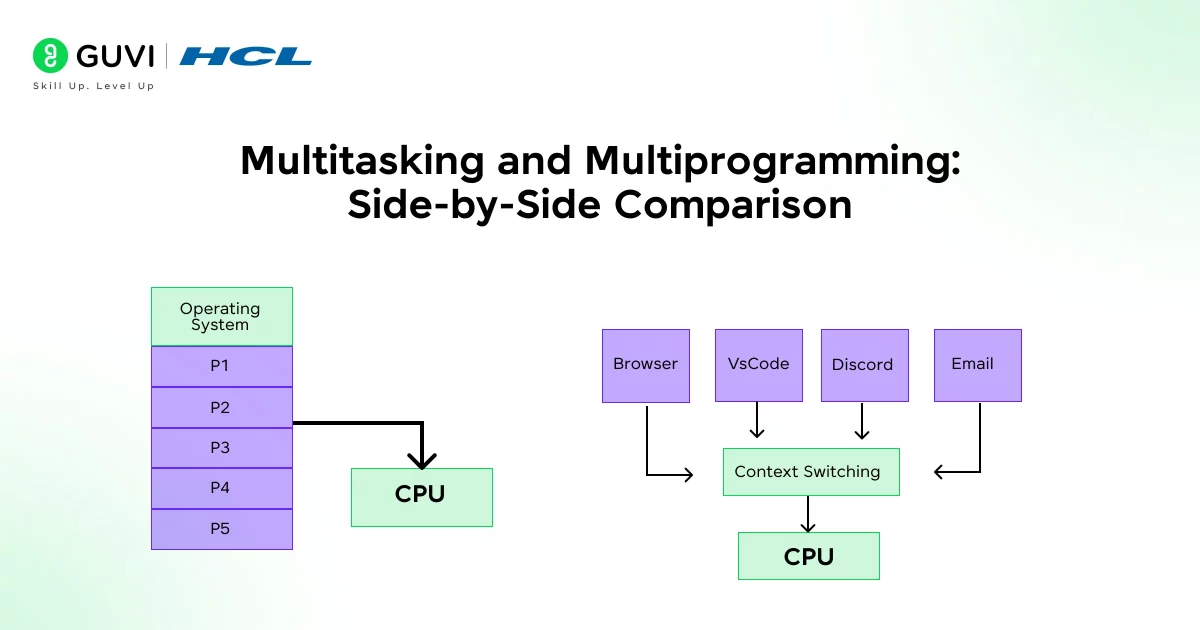
| Core idea | The OS keeps several programs in memory so the CPU always has something to work on when one job is waiting. It’s mainly about improving overall system throughput. | The OS switches between tasks quickly using time slices, giving you the sense that many things run at once. It’s focused on responsiveness. |
| How switching happens | A program gives up the CPU only when it’s blocked, usually waiting for I/O. The OS then picks another job to continue. | Switching is frequent and pre-planned. Each task gets a short window of CPU time before the next one takes over. |
| User experience | You don’t really interact with programs in real time. Jobs run in the background until they finish. | You interact smoothly with multiple apps—typing, browsing, listening to music—all without noticeable delays. |
| Goal | Keep the CPU busy and reduce idle time. Ideal for environments that process long-running jobs. | Share CPU time fairly across tasks so the system feels responsive, especially during interactive work. |
| Type of workloads | Fits batch-oriented workloads where completion matters more than immediate feedback. | Built for everyday computing where quick response and task switching matter. |
| Overhead | Less overhead because switches happen only when a job can’t continue. | More overhead due to frequent context switches, but the payoff is better interactivity. |
| Examples | Early mainframe batch systems or servers running queued jobs. | Modern desktop and mobile operating systems where apps run side by side. |
There are 8 different types of Operating Systems out there, and if you want to know about all of them in detail, read – 8 Different Types of Operating Systems You Should Know
Multiprogramming vs Multitasking: The Subtle Difference Explained
Multiprogramming and multitasking are closely related because both involve managing multiple programs or tasks on a computer. The difference is mainly in what the operating system is trying to optimize.
Multiprogramming focuses on CPU utilization
In multiprogramming, multiple programs are kept in main memory. When the currently running program has to wait for an I/O operation, such as reading from a disk, the operating system can give the CPU to another ready program.
The goal is simple: avoid leaving the CPU idle.
For example:
Program A → CPU → waits for I/O
                    ↓
Program B → CPU → continues execution
                    ↓
Program A → I/O complete → becomes ready again
This approach improves CPU utilization and overall system throughput.
Multitasking focuses on responsiveness
Multitasking extends this idea by allowing the operating system to switch between tasks frequently so that users can interact with several applications without waiting for one application to finish.
A preemptive multitasking OS can assign each task a small amount of CPU time, often called a time slice or time quantum. When that time expires, the scheduler can switch to another task.
For example:
Browser → CPU
   ↓ time slice expires
Music Player → CPU
   ↓ time slice expires
Code Editor → CPU
   ↓ time slice expires
Browser → CPU
The rapid switching makes multiple applications appear to run simultaneously, even when a single CPU core is executing only one instruction stream at a time.
The key difference
| Multiprogramming | Multitasking |
|---|---|
| Primarily aims to maximize CPU utilization | Primarily aims to improve responsiveness |
| Switching traditionally happens when a program waits, especially for I/O | Switching can happen because of time-slice expiration or other scheduling events |
| Commonly associated with batch-oriented systems | Commonly associated with interactive systems |
| Forms an important foundation for modern multitasking | Builds on multiprogramming with scheduling and preemption |
Important: This is a conceptual distinction rather than a strict separation in modern operating systems. Modern systems combine multiprogramming, multitasking, scheduling, memory management, and multiprocessing.
Why Does It Matter to You?
If you’re learning about operating systems or teaching others, understanding the difference between multiprogramming and multitasking helps you in several ways:
- It clarifies how OS scheduling evolved: from simple job-switching to responsive interactive systems.
- It helps in understanding modern OS features: e.g., how your smartphone handles multiple apps, how the OS ensures fairness and responsiveness.
- It matters in performance tuning and OS architecture decisions: for example, if you’re designing a system that must prioritise throughput (many jobs) vs one that emphasises responsiveness (interactive tasks).
Use Cases and Practical Scenarios
Multiprogramming
Multiprogramming usually appears in systems where the goal is to keep the CPU busy rather than keep the user engaged.

- You’ll see it in batch-oriented setups where programs run for long periods and don’t need real-time interaction.
- It works well when tasks spend a lot of time waiting for I/O, because the CPU can instantly switch to another job that’s ready to run.
- Older mainframe systems and some server environments still rely on this model to boost throughput and avoid idle CPU time.
What this really means is that multiprogramming thrives in places where steady progress on many jobs matters more than quick responses to a single user.
Multitasking
Multitasking shows up everywhere you expect fast reactions and smooth switching between activities.
- It powers your everyday experience on desktops, laptops, and mobile devices, letting you jump between apps without thinking twice.
- Background services, downloads, notifications, syncing, run alongside your active tasks without getting in your way.
- Interactive systems like development environments, creative tools, and browsers rely heavily on multitasking to stay responsive.
In short, multitasking is built for the real world you interact with: quick taps, fast switches, and constant movement between tasks.
Did you know that early computers didn’t support multitasking at all? A single program would run from start to finish, and the CPU often sat idle while waiting for slow I/O operations. Multiprogramming was the first big shift that kept the CPU busy, and only later did multitasking evolve to make systems feel interactive. The smooth app-switching you rely on today is built on decades of these foundational ideas.
If you’re serious about mastering software development along with AI and want to apply it in real-world scenarios, don’t miss the chance to enroll in HCL GUVI’s IITM Pravartak and MongoDB Certified Online AI Software Development Course. Endorsed with NSDC certification, this course adds a globally recognized credential to your resume, a powerful edge that sets you apart in the competitive job market.
Real OS Examples That Use Multiprogramming vs Multitasking
The difference becomes easier to understand when you look at real operating systems.
Multiprogramming in operating systems
The underlying idea of multiprogramming is still present in modern general-purpose operating systems. Systems such as Linux, Windows, and macOS can keep multiple processes in memory and schedule another ready process when one process is blocked or waiting for I/O.
Historically, multiprogramming was especially important in batch-oriented and early mainframe systems, where maximizing CPU utilization was the primary objective.
For example, if one process is waiting for data from a storage device, the operating system does not have to leave the CPU unused. It can schedule another ready process instead.
Multitasking in modern operating systems
Modern desktop and mobile operating systems use multitasking extensively.
Examples include:
- Windows: You can edit a document while a browser downloads a file in the background.
- Linux: Multiple applications, services, and background processes can run concurrently.
- macOS: Applications can remain active while background processes perform tasks such as synchronization.
- Android: Apps and system services can perform multiple activities under the operating system’s scheduling and resource-management rules.
- iOS: Multiple application and system activities are managed according to Apple’s multitasking and background-execution policies.
Modern operating systems combine these mechanisms rather than implementing them as completely separate modes. GUVI’s operating-system overview similarly describes modern general-purpose systems as using multiprogramming concepts alongside advanced scheduling and resource management.
How Context Switching Works in Multiprogramming
Context switching is the mechanism that allows the operating system to stop one process and resume another.
Consider three programs in memory:
Program A → Running
Program B → Ready
Program C → Waiting
Suppose Program A starts a disk I/O operation. Because A cannot continue until the I/O operation finishes, the operating system can save A’s current execution state and select another ready program, such as Program B.
The process looks like this:
1. Program A is running
        ↓
2. Program A requests I/O
        ↓
3. OS saves A's context
        ↓
4. OS selects Program B
        ↓
5. Program B starts running
        ↓
6. Program A's I/O completes
        ↓
7. A becomes ready
        ↓
8. OS can later restore A's saved context
The saved context can include information such as the program counter, CPU registers, stack information, and other process-state information required to resume execution.
In simplified pseudocode:
while programs_are_ready:
    process = scheduler.select_ready_process()

    save_context(current_process)

    load_context(process)

    run(process)
The scheduler decides which ready process should run next, while the context switch preserves enough state for the previous process to continue later.
Why context switching matters
Context switching allows the CPU to remain productive when a process is waiting for I/O. However, switching itself requires CPU time, so excessive context switching can create overhead and reduce performance.
Remember: Context switching does not mean that a single CPU core executes multiple processes at exactly the same instant. It means the CPU switches between their saved execution states quickly enough to provide concurrent progress.
Multiprogramming Exam Questions for OS Subjects
If you are preparing for an Operating Systems exam, these are some common questions you should be able to answer.
1. What is multiprogramming in an operating system?
Multiprogramming is an OS technique in which multiple programs are kept in main memory and the CPU switches to another ready program when the currently running program waits, particularly for I/O.
2. What is the main objective of multiprogramming?
The primary objective is to increase CPU utilization and system throughput by reducing the amount of time the CPU remains idle.
3. What is the difference between multiprogramming and multitasking?
Multiprogramming primarily focuses on keeping the CPU busy, while multitasking focuses on allowing multiple tasks to make progress while maintaining system responsiveness.
4. Does multiprogramming mean that programs execute simultaneously?
Not necessarily. On a single CPU core, only one execution stream can execute at a given instant. The OS switches between programs to create concurrent progress.
5. What is context switching?
Context switching is the process of saving the execution state of one process and restoring the saved state of another process so the CPU can switch between them.
6. What happens when a process waits for I/O in a multiprogramming system?
The process enters a waiting or blocked state, and the operating system can assign the CPU to another ready process.
7. What are the advantages of multiprogramming?
Major advantages include:
- Better CPU utilization
- Higher system throughput
- Reduced CPU idle time
- Better utilization of I/O and CPU resources
8. What are the disadvantages of multiprogramming?
Potential disadvantages include:
- More complex memory management
- Scheduling complexity
- Context-switching overhead
- Greater resource-management requirements
9. What is the difference between multiprogramming and multiprocessing?
Multiprogramming can involve multiple programs sharing CPU time, while multiprocessing uses multiple processors or CPU cores to enable processes to execute in parallel.
10. Why is multiprogramming important in modern operating systems?
Multiprogramming introduced the fundamental idea of keeping multiple programs available for execution and switching the CPU between them. Modern operating systems build on this concept with advanced scheduling, multitasking, multiprocessing, and multithreading.
Conclusion
In conclusion, multiprogramming and multitasking represent two stages of how operating systems evolved. One focuses on keeping the CPU productive, the other on keeping you engaged with quick, predictable responses.
Both still matter today because they shape how applications share resources, how performance is managed, and how users experience speed on any device. Once you understand the distinction, concepts like scheduling, parallelism, and system performance start making a lot more sense.
Modern systems blend both ideas, but understanding how they differ helps you see why today’s devices feel so smooth and why earlier systems behaved the way they did. Once you grasp these fundamentals, the rest of the operating-system concepts, like scheduling, concurrency, and performance tuning, start falling into place naturally.
FAQs
1. What is the main difference between multiprogramming and multitasking?
Multiprogramming keeps the CPU busy by switching when a job waits for I/O. Multitasking switches rapidly between tasks to make the system feel responsive. One focuses on throughput, the other on interactivity.
2. Is multitasking faster than multiprogramming?
Not necessarily. Multitasking feels faster because tasks respond quickly, but it has more switching overhead. Multiprogramming can be more efficient for long-running jobs.
3. Can a modern operating system use both?
Yes. Most OSes load several programs into memory (multiprogramming) and use time-sharing to switch between tasks (multitasking). Both concepts work together under the hood.
4. Does multiprogramming mean multiple CPUs are used?
No. It works even on a single CPU by switching between jobs when one is waiting. Multiple CPUs fall under multiprocessing, not multiprogramming.
5. Which is better for user-facing applications?
Multitasking. It’s designed to keep apps responsive and allow users to switch between them smoothly. Multiprogramming is better suited for batch or background workloads.
Success Stories

About the Author
Lukesh S
A professional content writer who has experience in freelancing and now working as a Technical Content Writer at HCL GUVI having sound knowledge in Blog Writing and Creative Writing!
View all posts by Lukesh S
Connect with me @













Did you enjoy this article?