


Artificial Intelligence and Machine Learning Articles
Finance Manager to Data Analytics: Career Growth, Salary and Seniority
How to Evaluate LLM Outputs in Production Deployments
AI/ML Skills Gap 2026: Why Companies Can't Find Job-Ready Talent
20 AI/ML Interview Questions Recruiters Can Use Without a Tech Background - Best Guide


Get In Touch For Details! Request More Information

Multinomial Naive Bayes: A Complete Guide
Aug 19, 2026 8 Min Read 1091 Views
(Last Updated)
Every day, billions of emails are filtered for spam, millions of news articles are automatically categorised, and thousands of customer support messages are routed to the right team — all without a human reading them first. Behind many of these systems sits a surprisingly simple yet remarkably effective algorithm: Naive Bayes.
Of the Naive Bayes family, the multinomial variant is the workhorse of text classification. It is purpose-built for data where features represent counts or frequencies — exactly the kind of data produced when text is converted into a bag-of-words representation.
Multinomial Naive Bayes is fast, interpretable, and competitive with far more complex models on short-text classification tasks. It scales to millions of documents without breaking a sweat, and its probabilistic foundations make its predictions transparent and explainable.
This guide covers everything: from the probabilistic theory underpinning Naive Bayes, through the multinomial model’s mechanics and Laplace smoothing, to practical implementation with sklearn’s MultinomialNB, evaluation, and a comparison of the key Naive Bayes variants.
Table of contents
- TL;DR
- Bayes' Theorem: The Probabilistic Foundation
- The Naive Independence Assumption
- Why Does It Work Despite Being Wrong?
- The Multinomial Model: Feature Counts
- From Text to Feature Counts: Bag of Words
- Computing the Class Likelihood
- Prior Probability Estimation
- Laplace Smoothing: Handling Unseen Words
- The Zero-Probability Problem
- The Smoothing Solution
- Implementing Multinomial Naive Bayes with Sklearn
- Step 1: Text Vectorisation
- Step 2: Model Training
- Step 3: Prediction and Evaluation
- Step 4: Using Pipelines
- Real-World Applications of Multinomial Naive Bayes
- Spam and Ham Detection
- News Article Categorisation
- Sentiment Analysis
- Customer Support and Ticket Routing
- Language Detection
- Naive Bayes Variants: Choosing the Right Model
- Multinomial Naive Bayes
- Bernoulli Naive Bayes
- Gaussian Naive Bayes
- Complement Naive Bayes
- Strengths, Limitations, and Best Practices
- Strengths
- Limitations
- Best Practices
- Conclusion
- FAQs
- Why is it called 'naive' Bayes?
- When should I use Bernoulli instead of Multinomial NB?
- What does Laplace smoothing actually do?
- Can MultinomialNB handle TF-IDF features?
- How does MultinomialNB compare to logistic regression for text?
TL;DR
- Multinomial Naive Bayes classifies documents by combining prior probability with conditional word-count probabilities.
- It assumes feature independence — naive but effective for bag-of-words text classification.
- Laplace smoothing prevents zero-probability failures for unseen vocabulary words.
- sklearn’s MultinomialNB implements the full pipeline in a few lines of Python.
- It is faster and more interpretable than most alternatives, with competitive accuracy on short documents.
What Is Multinomial Naive Bayes?
Multinomial Naive Bayes is a probabilistic text classification algorithm that applies Bayes’ theorem while assuming that features, usually word counts or term frequencies, are conditionally independent given the class label. It represents each document as a multinomial distribution over a vocabulary and estimates the probability of observing specific word frequencies within each class. By combining these likelihoods with prior class probabilities, the algorithm predicts the class with the highest posterior probability. Multinomial Naive Bayes is widely used in document classification, spam filtering, sentiment analysis, and other NLP classification tasks.
Bayes’ Theorem: The Probabilistic Foundation
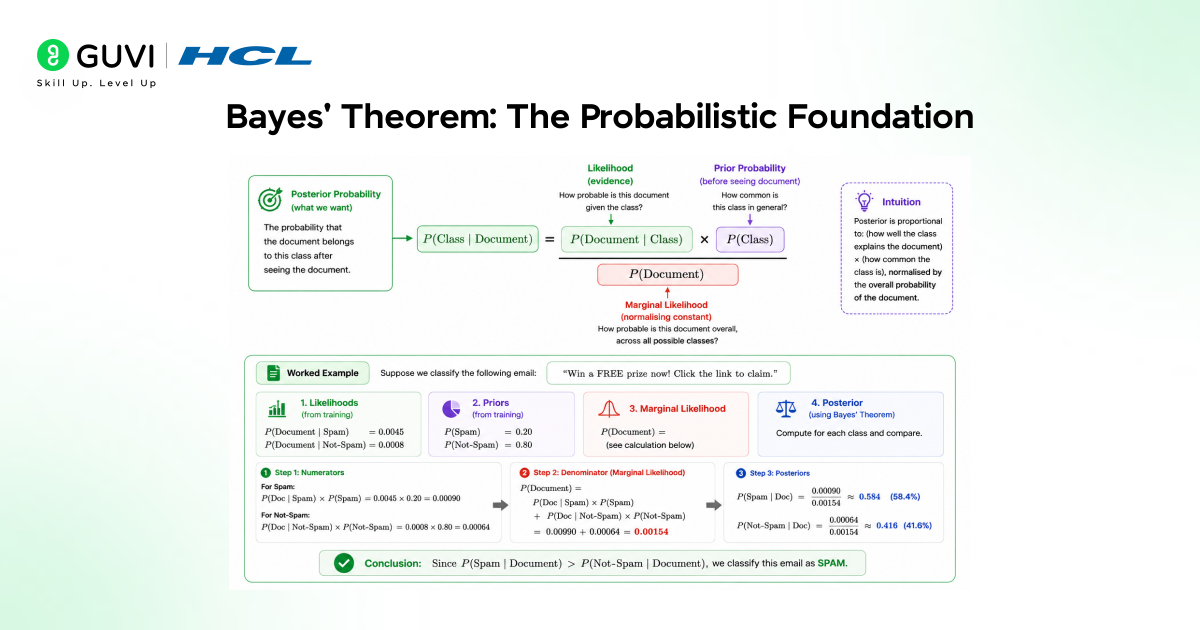
Multinomial Naive Bayes is grounded in Bayes’ theorem, one of the most fundamental results in probability theory. Understanding the theorem is the key to understanding what the algorithm is actually computing.
Bayes’ theorem states:
P(Class | Document) = [P(Document | Class) × P(Class)] / P(Document)
In the context of text classification, each term has a precise meaning:
• P(Class | Document) — Posterior probability: the probability that a document belongs to a given class, given its content. This is what the classifier computes and maximises.
• P(Document | Class) — Likelihood: the probability of observing this document’s word pattern if it truly belongs to the class. This is where word frequencies come in.
• P(Class) — Prior probability: the baseline probability of a class before seeing the document. Estimated from the proportion of training documents in each class.
• P(Document) — Marginal likelihood: the overall probability of this document across all classes. It is constant across all classes for a given document, so it is ignored during classification we simply compare numerators.
The classifier selects the class with the highest posterior probability the class for which the combination of prior probability and document likelihood is greatest.
The Naive Independence Assumption
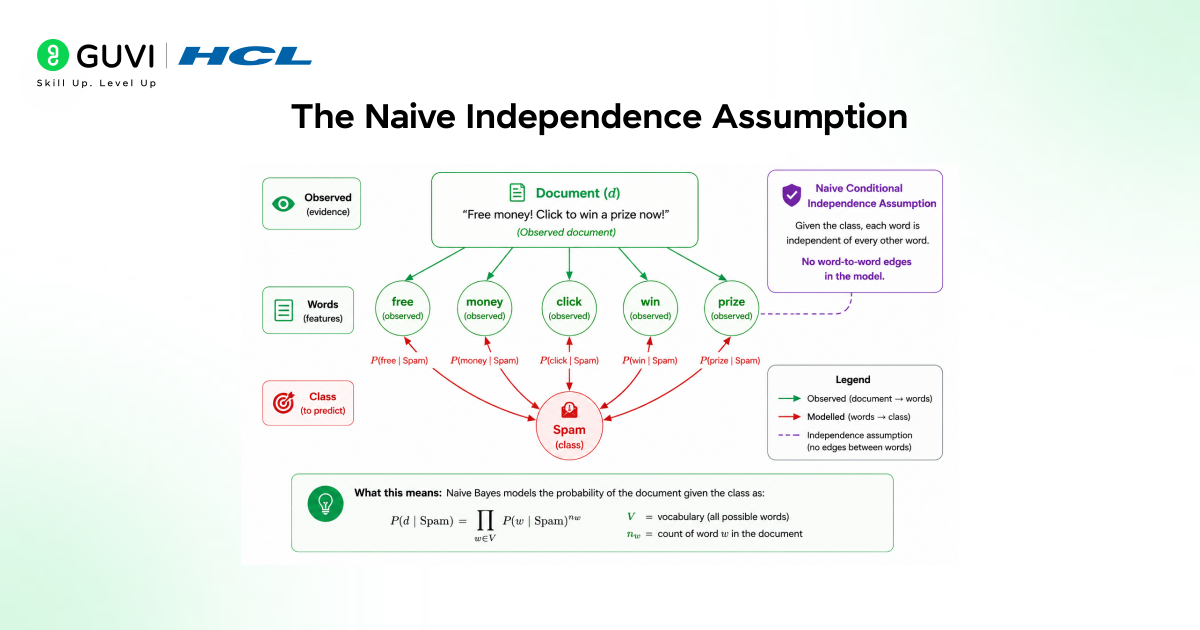
The word “naive” in Naive Bayes refers to a bold simplifying assumption: all features in this case, all words in a document, are assumed to be conditionally independent given the class label.
In plain language, knowing that an email contains the word “free” tells you nothing additional about whether it also contains the word “money”, once you already know the email is spam. Each word is treated as an independent piece of evidence.
This assumption is almost never true in natural language. Words co-occur in patterns “machine” frequently precedes “learning”; “free” often accompanies “offer”. Real documents have rich dependency structures that the naive assumption completely ignores.
Why Does It Work Despite Being Wrong?
Despite its obvious inaccuracy, the naive independence assumption produces surprisingly strong classifiers for several reasons:
• Classification robustness: Naive Bayes only needs to correctly rank classes it does not need calibrated probabilities. Even with correlated features, the ranking is often correct.
• Bias towards the right direction: Correlated features tend to reinforce each other consistently across both classes, so their double-counting errors partially cancel out.
• High-dimensional advantage: In text classification, there are often thousands of features (vocabulary words). The independence assumption makes the parameter estimation tractable; instead of estimating millions of joint probabilities, the model estimates one probability per word per class.
For short documents and moderate vocabulary sizes, exactly the conditions of spam detection, news categorisation, and sentiment analysis, Naive Bayes consistently delivers accuracy that rivals far more complex models.
The Multinomial Model: Feature Counts

The multinomial model is specifically designed for discrete count data, making it the natural choice for text, where documents are commonly represented as word count vectors.
From Text to Feature Counts: Bag of Words
The bag-of-words (BoW) representation converts a document into a fixed-length vector of word counts, discarding word order and grammar. The process is:
• Tokenisation: Split the text into individual tokens (words or subwords).
• Vocabulary construction: Build a vocabulary of all unique tokens across the training corpus.
• Count vectorisation: For each document, count how many times each vocabulary word appears. The result is a vector of feature counts, one dimension per vocabulary word.
A document “free money free offer” with vocabulary {free, money, offer, meeting} becomes the count vector [2, 1, 1, 0]. This vector is the input to the multinomial Naive Bayes classifier.
Computing the Class Likelihood
Given a class label c, the multinomial model estimates the likelihood of observing a document’s word counts as:
P(Document | Class = c) = product of P(word_i | Class = c) raised to the power of count(word_i)
Where P(word_i | Class = c) is the probability of word i appearing in a document of class c, estimated from training data as:
P(word_i | c) = count(word_i in class c documents) / total word count in class c documents
Because multiplying many small probabilities together causes numerical underflow, the computation is performed in log-space the product of probabilities becomes a sum of log-probabilities. This is both numerically stable and computationally efficient.
Prior Probability Estimation
The prior probability P(Class = c) is estimated simply as the proportion of training documents belonging to class c:
P(c) = number of documents in class c / total number of training documents
In a balanced dataset, all class priors are equal. In an imbalanced dataset such as a spam filter where spam is rarer than legitimate mail the prior reflects this imbalance, naturally making the classifier more conservative about assigning rare classes.
Gmail’s original spam filtering system, launched by Google in 2004, heavily relied on Naive Bayes text classification. Despite the simplicity of the algorithm, it achieved remarkably high spam detection accuracy with very low false-positive rates by statistically learning which words and patterns were strongly associated with spam emails. Variants of Naive Bayes and related probabilistic filtering techniques still influence modern production spam detection systems because of their speed, efficiency, and strong performance on large-scale text classification tasks.
Laplace Smoothing: Handling Unseen Words
Laplace smoothing, also called additive smoothing, addresses one of the most critical failure modes in multinomial Naive Bayes: the zero-probability problem.
The Zero-Probability Problem
Consider a word that appears in the test document but never appeared in any training document of a given class. Its estimated conditional probability is zero. Because probabilities are multiplied together (or summed in log-space), a single zero probability makes the entire class likelihood zero regardless of how strong the evidence from all other words is.
This is not a quirk of bad data. It is inevitable: any real-world deployment will encounter vocabulary words not seen in training for every class. Without correction, the classifier becomes brittle and unreliable on novel vocabulary.
The Smoothing Solution
Laplace smoothing adds a small pseudocount (alpha, typically 1) to every word count before computing probabilities:
P(word_i | c) = [count(word_i in class c) + alpha] / [total words in class c + alpha × vocabulary size]
The effect:
• No word ever has a zero probability; every vocabulary word gets at least a pseudocount of alpha.
• Words that genuinely appear frequently in a class still dominate the smoothing effect is small relative to large true counts.
• The alpha parameter controls the strength of smoothing. Alpha = 1 is Laplace smoothing; alpha < 1 is Lidstone smoothing, which applies less aggressive redistribution.
Laplace smoothing is not just a numerical fix it is a form of regularisation. By redistributing a small portion of probability mass to unseen events, it produces a model that is less overconfident and more robust to vocabulary variation between training and test distributions.
Implementing Multinomial Naive Bayes with Sklearn
Python’s scikit-learn provides a clean, efficient implementation of multinomial Naive Bayes through the MultinomialNB class. The full pipeline from raw text to evaluated classifier is concise and readable.
Step 1: Text Vectorisation
MultinomialNB expects non-negative integer or float feature counts not raw text strings. sklearn offers two primary vectorisers:
• CountVectorizer: Converts text to word count matrices. Each row is a document; each column is a vocabulary word; each cell is the word’s count in that document. The direct bag-of-words representation for multinomial Naive Bayes.
• TfidfVectorizer: Converts text to TF-IDF weighted feature matrices, down-weighting words that appear frequently across all documents (like ‘the’, ‘is’). Can improve performance on longer documents but produces float features rather than raw counts.
For multinomial Naive Bayes, CountVectorizer is the most natural choice. Both vectorisers should be fitted only on training data the vocabulary and weighting scheme learned from training is then applied to transform test data, preventing information leakage.
Step 2: Model Training
Instantiating and training MultinomialNB is a single step:
model = MultinomialNB(alpha=1.0)
model.fit(X_train, y_train)
The alpha parameter sets the Laplace smoothing strength. The default of 1.0 is appropriate for most tasks; alpha can be tuned via cross-validation if needed.
Step 3: Prediction and Evaluation
Predictions and probability estimates are available through:

• model.predict(X_test): Returns the predicted class label for each test document, the class with the highest posterior probability.
• model.predict_proba(X_test): Returns the posterior probability for each class for each document, enabling threshold-based classification, confidence scoring, and probability calibration.
Standard sklearn metrics accuracy_score, classification_report, and confusion_matrix provide full evaluation. For imbalanced datasets (common in spam detection), precision, recall, and F1-score per class are more informative than overall accuracy.
Step 4: Using Pipelines
sklearn’s Pipeline class chains vectorisation and classification into a single estimator object. This eliminates data leakage risks during cross-validation, simplifies hyperparameter search with GridSearchCV, and produces a single serialisable object for deployment. A minimal pipeline:
Pipeline([(‘vectoriser’, CountVectorizer()), (‘classifier’, MultinomialNB(alpha=1.0))])
This pipeline can be passed directly to cross_val_score or GridSearchCV, with hyperparameters addressed using the double-underscore syntax (e.g., classifier__alpha).
Real-World Applications of Multinomial Naive Bayes
Spam and Ham Detection
Spam detection is the canonical multinomial Naive Bayes application. Emails are represented as word count vectors; the classifier learns which words are strongly associated with spam (“free”, “win”, “click”, “offer”) versus legitimate mail (“meeting”, “report”, “attached”, “regards”). The model’s probabilistic output supports adjustable decision thresholds trading off false positive rate (legitimate mail classified as spam) against recall (spam that gets through).
News Article Categorisation
News aggregators and content platforms use document classification to assign articles to topic categories: politics, sport, technology, finance, and health. Multinomial Naive Bayes trains efficiently on large news corpora and produces interpretable models. The highest-weight words for each category directly reveal what vocabulary is most discriminative.
Sentiment Analysis
For short-form sentiment classification of product reviews, social media posts, and customer feedback, multinomial Naive Bayes competes effectively with more complex models. Its performance is strong on binary classification (positive/negative) and reasonable on three-class (positive/neutral/negative) tasks, particularly when the training set is large.
Customer Support and Ticket Routing
Enterprise helpdesks deploy NLP classification to automatically route incoming support tickets to the appropriate team. A multinomial Naive Bayes classifier trained on historical ticket-team assignments learns the vocabulary patterns that distinguish billing queries from technical issues from account management requests enabling automated triage at scale.
Language Detection
Character n-gram versions of multinomial Naive Bayes are effective for language detection — identifying the language of a short text snippet. Each language has a distinctive character frequency distribution; the multinomial model captures this concisely and classifies even single sentences with high accuracy.
Naive Bayes Variants: Choosing the Right Model
Naive Bayes is a family of classifiers, not a single model. The multinomial variant is one of three commonly used flavours, each suited to a different feature distribution.
Multinomial Naive Bayes
Models feature counts or frequencies. Each feature represents how many times a term appeared. Best suited for text classification where document length varies and term frequency carries signal. The natural choice for bag-of-words document classification and spam detection.
Bernoulli Naive Bayes
Models binary feature presence/absence rather than counts. For text, each feature indicates whether a word appeared in the document at all — not how many times. Bernoulli NB explicitly penalises the absence of words expected in a class, which can be useful for very short documents. It is generally less accurate than multinomial NB when document length varies, but can outperform it on short texts where frequency provides little additional information.
Gaussian Naive Bayes
Models continuous features as normally distributed within each class. It is not suited for text classification but is the natural choice for numerical feature data medical measurements, sensor readings, and financial metrics. Gaussian NB assumes features follow a Gaussian (bell curve) distribution given the class label, estimating the mean and variance per feature per class from training data.
Complement Naive Bayes
Complement NB is a variant of multinomial NB designed to address class imbalance. Instead of estimating the probability of features given a class, it estimates the probability of features given the complement of the class (all other classes combined). This produces more stable parameter estimates when one class has far fewer training examples making it particularly effective for imbalanced text classification problems.
Strengths, Limitations, and Best Practices
Strengths
• Training speed: Parameter estimation is a single pass over the training data — no iterative optimisation. Training on millions of documents takes seconds.
• Scalability: Linear in both training documents and vocabulary size. Handles high-dimensional feature spaces (large vocabularies) without performance degradation.
• Small data performance: Because the model has few parameters (one probability per word per class), it generalises reasonably even from limited training data.
• Interpretability: The model’s learned probabilities can be inspected directly — the highest conditional probability words per class reveal what the model is actually using to classify.
• Online learning: sklearn’s MultinomialNB supports partial_fit, enabling incremental updates as new labelled data arrives without retraining from scratch.
Limitations
• Independence assumption: Correlated features (common in natural language) violate the model’s assumptions, potentially degrading probability calibration.
• Feature representation sensitivity: The model is only as good as the bag-of-words features it receives. It ignores word order, syntax, and the semantics context matters for meaning but is invisible to the model.
• Probability overconfidence: Posterior probabilities from Naive Bayes tend to be extreme (near 0 or 1) due to the naive assumption. Calibration with CalibratedClassifierCV corrects this if well-calibrated probabilities are needed.
• Long-document degradation: For very long documents, the independence assumption’s violations accumulate, and accuracy can drop relative to models that capture word interactions.
Best Practices
- Preprocessing: Apply lowercasing, punctuation removal, and stopword filtering before vectorisation. These steps consistently improve accuracy by reducing noise in the feature space.
- Alpha tuning: Do not assume alpha = 1 is optimal. Use cross-validation to find the smoothing strength that minimises validation error for your specific dataset.
- Baseline first: Always run MultinomialNB as a baseline before investing in complex models. Its accuracy often approaches that of neural classifiers on short-text tasks, at a fraction of the computational cost.
- Calibration: If downstream systems use the classifier’s probability outputs (not just the label), wrap MultinomialNB in CalibratedClassifierCV for more reliable probability estimates.
If you want practical experience working with activation functions, neural networks, and deep learning models, HCL GUVI’s AI and ML programs can help you understand how concepts like sigmoid, backpropagation, and gradient descent are implemented using frameworks such as TensorFlow and PyTorch through hands-on projects.
Conclusion
Multinomial Naive Bayes is a textbook example of a principle that recurs throughout machine learning: simple models, well-applied, are often more than sufficient and sometimes superior to complex alternatives.
Its probabilistic foundation in Bayes’ theorem is transparent and mathematically sound. Its multinomial distribution over feature counts is a natural fit for bag-of-words text data. Its naive independence assumption is technically wrong, but practically effective for the document classification tasks where it is most commonly deployed. And Laplace smoothing ensures it handles the inevitable vocabulary mismatches between training and production without catastrophic failures.
sklearn’s MultinomialNB makes the full implementation from raw text to evaluated classifier a matter of a dozen lines of Python. For practitioners working on spam detection, NLP classification, document classification, or any short-text categorisation problem, it is the correct first algorithm to reach for: fast, interpretable, surprisingly capable, and a robust baseline against which more complex models must justify their additional complexity.
Master the fundamentals here: prior probability, conditional probability, Laplace smoothing, and the bag-of-words pipeline, and you have a solid foundation for understanding the entire Naive Bayes family and the probabilistic approach to machine learning more broadly.
FAQs
1. Why is it called ‘naive’ Bayes?
The term ‘naive’ refers to the model’s core assumption that all features are conditionally independent given the class label. This assumption simplifies the maths enormously but is almost never true in real data — hence ‘naive’.
2. When should I use Bernoulli instead of Multinomial NB?
Use Bernoulli NB when only the presence or absence of words matters, especially for very short texts. Use Multinomial NB when word frequency carries signal which is the case for most document classification tasks.
3. What does Laplace smoothing actually do?
It adds a small pseudocount to every word before computing probabilities, ensuring no word ever receives a zero probability. This prevents a single unseen word from zeroing out the entire class likelihood for a new document.
4. Can MultinomialNB handle TF-IDF features?
Yes, sklearn’s MultinomialNB accepts TF-IDF float features as long as all values are non-negative. In practice, CountVectorizer features often produce similar or better results for short texts.
5. How does MultinomialNB compare to logistic regression for text?
Multinomial NB trains faster and works better with small datasets. Logistic regression typically achieves higher accuracy on larger datasets because it does not make the naive independence assumption. Start with NB; upgrade to logistic regression if accuracy demands it.
Success Stories

About the Author
Vishalini Devarajan
An Aerospace Engineer turned content writer, I focus on making complex concepts easy to understand through well-structured, reader-friendly blogs. Whether it’s a technical topic or a non-technical one, I love creating content that is clear, engaging, and impactful.
View all posts by Vishalini Devarajan
Connect with me @













Did you enjoy this article?