


Artificial Intelligence and Machine Learning Articles
AI/ML Skills Gap 2026: Why Companies Can't Find Job-Ready Talent
20 AI/ML Interview Questions Recruiters Can Use Without a Tech Background - Best Guide
How Industry-Backed AI/ML Bootcamps Are Changing the AI/ML Hiring Pipeline - Best Guide 2026
From IT Support to AI Engineer: A Realistic Career Switch Guide 2026


Get In Touch For Details! Request More Information
Claude’s Approach to Academic Integrity
Aug 05, 2026 3 Min Read 407 Views
(Last Updated)
Academic integrity is the foundation of meaningful learning and responsible AI use. Claude supports students by explaining concepts, providing feedback, and encouraging independent thinking instead of simply generating answers. This helps learners use AI ethically while maintaining academic standards.
Table of contents
- TL;DR
- Why Does Claude Emphasize Academic Integrity?
- Claude's Approach to Academic Integrity
- Step 1: Learn Before You Write
- Step 2: Use Claude for Guidance
- Step 3: Create Original Work
- Step 4: Follow Institutional AI Policies
- Step 5: Ask Claude for Feedback Instead of Answers
- Step 6: Cite AI Use When Required
- Step 7: Verify Facts and Sources
- Step 8: Reflect and Improve
- What Claude Can Assist With
- Common Academic Integrity Challenges in the AI Era
- What Claude Cannot Replace
- ⚠️ Warning
- Best Practice
- Conclusion
- FAQs
- What is Claude's approach to academic integrity?
- Can students use Claude for assignments?
- Does Claude encourage cheating?
- Should students disclose using Claude?
- Can educators use Claude?
- What are the benefits of using Claude responsibly?
- How can students maintain academic integrity while using Claude?
TL;DR
- Claude promotes academic integrity by supporting learning instead of enabling cheating.
- It encourages students to understand concepts, improve writing, and develop critical thinking.
- Educators can use Claude for feedback, study support, and responsible AI-assisted learning.
- AI should enhance education, while students remain responsible for original work and proper attribution.
HCL GUVI’s AI & ML Course also introduces responsible AI practices and ethical AI applications for modern learners.
📊 Data Point
Anthropic’s analysis of 574,740 academically relevant conversations found that students primarily used Claude to create and improve educational content (39.3%), explain concepts, and solve academic problems, highlighting AI’s growing role in higher education.
Source: Anthropic Education Report: How University Students Use Claude
Why Does Claude Emphasize Academic Integrity?
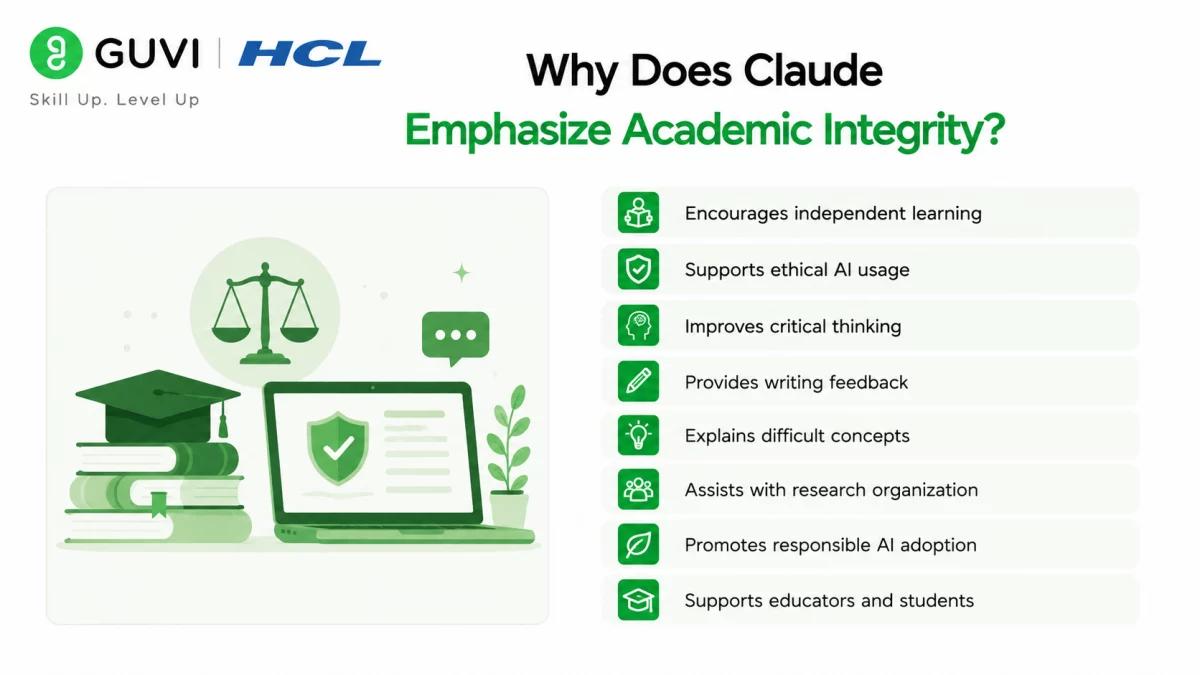
Academic integrity ensures assessments reflect a student’s own knowledge and skills. Claude is designed to act as a learning assistant, helping users understand topics, refine ideas, and improve their work, rather than encouraging academic misconduct. This approach promotes ethical AI use and supports long-term learning outcomes.
Some major benefits include:
- Encourages independent learning
- Supports ethical AI usage
- Improves critical thinking
- Provides writing feedback
- Explains difficult concepts
- Assists with research organization
- Promotes responsible AI adoption
- Supports educators and students
Claude’s Approach to Academic Integrity
Step 1: Learn Before You Write
Use Claude to understand concepts, summarize reading materials, or clarify difficult topics before beginning your assignment. Building your own understanding leads to stronger and more authentic work.
Step 2: Use Claude for Guidance
Ask Claude for explanations, outlines, brainstorming ideas, or writing feedback instead of requesting complete assignments. This keeps AI as a learning partner rather than a shortcut.
Step 3: Create Original Work
Write assignments using your own analysis, reasoning, and conclusions. Claude can help improve clarity and structure, but the final submission should represent your own understanding.
Step 4: Follow Institutional AI Policies
Every school or university may have different rules regarding AI use. Review your institution’s academic integrity policy before using Claude and disclose AI assistance whenever required.
Step 5: Ask Claude for Feedback Instead of Answers
Use Claude to review your draft, explain weak arguments, improve clarity, or suggest better evidence. Feedback helps strengthen your understanding while ensuring the final work remains your own, supporting responsible AI use and academic integrity.
Step 6: Cite AI Use When Required
Many schools and universities now have policies on AI-assisted work. If your institution requires disclosure, acknowledge Claude’s assistance appropriately and follow your academic integrity guidelines before submitting assignments.
Step 7: Verify Facts and Sources
Claude can make mistakes or provide incomplete information. Cross-check important facts, statistics, and references using reliable academic sources before including them in assignments, research papers, or projects.
Step 8: Reflect and Improve
After completing your work, use Claude to identify knowledge gaps, create practice questions, or explain difficult concepts. This reinforces learning while helping you develop stronger critical thinking and problem-solving skills. HCL GUVI’s AI eBook also explores responsible AI usage, prompt engineering, and ethical AI practices for modern learners.
Anthropic introduced Learning Mode for Claude to encourage active learning instead of simply providing answers. It uses guiding questions, step-by-step reasoning, and concept-based explanations to help students build understanding while supporting responsible AI use in education.
What Claude Can Assist With
Claude supports students and educators across many academic tasks.

It can help with:
- Explaining difficult concepts
- Brainstorming ideas
- Creating study guides
- Summarizing research papers
- Improving writing clarity
- Reviewing grammar and structure
- Generating practice questions
- Organizing research notes
- Creating revision plans
- Providing constructive feedback
- Simplifying complex topics
Common Academic Integrity Challenges in the AI Era
The growing use of generative AI has introduced new challenges for students and educators. While AI can improve productivity and learning, using it without clear boundaries may affect originality, critical thinking, and assessment fairness. Understanding these challenges helps learners use Claude more responsibly.
Some common challenges include:
- Distinguishing AI assistance from original work.
- Following different AI policies across institutions.
- Verifying AI-generated facts and references.
- Maintaining critical thinking instead of over-relying on AI.
- Avoiding accidental plagiarism through AI-generated text.
- Using AI ethically during coursework and assessments.
- Balancing productivity with genuine learning outcomes.
What Claude Cannot Replace
While Claude is a valuable learning assistant, some responsibilities must always remain with the student or educator.
Claude should not replace:
- Original thinking
- Independent research
- Final academic judgment
- Proper source evaluation
- Academic honesty
- Examination rules
- Instructor feedback
- Institutional AI policies
Using Claude responsibly helps students learn more effectively while maintaining academic integrity.
Want to build AI systems that are both intelligent and responsible? HCL GUVI’s AI & Machine Learning Course teaches machine learning, deep learning, and ethical AI practices through industry-focused projects and expert mentorship.
⚠️ Warning
Claude should support learning, not replace it. Always submit your own work, verify AI-generated information, and follow your institution’s academic integrity and AI usage policies. Responsible AI use protects both learning outcomes and academic credibility.
Best Practice
To use Claude’s academic integrity effectively:
- Use Claude to learn concepts, not complete assignments.
- Verify facts with reliable academic sources.
- Follow your institution’s AI policy.
- Cite AI assistance when required.
- Write final submissions in your own words.
- Review AI-generated content carefully.
- Combine AI support with independent learning.
Conclusion
Claude’s approach to academic integrity focuses on helping students learn rather than encouraging shortcuts. By providing explanations, feedback, brainstorming support, and guided learning, it promotes responsible AI use while preserving academic honesty. When combined with independent thinking and institutional guidelines, Claude becomes a valuable educational assistant who enhances learning without compromising integrity.
FAQs
1. What is Claude’s approach to academic integrity?
Claude encourages responsible AI use by helping students understand concepts, improve writing, and develop critical thinking instead of completing academic work dishonestly.
2. Can students use Claude for assignments?
Yes. Students can use Claude for explanations, brainstorming, feedback, and study support, provided they follow their institution’s AI and academic integrity policies.
3. Does Claude encourage cheating?
No. Claude is designed to support learning and responsible AI use rather than promote academic misconduct.
4. Should students disclose using Claude?
Many institutions require AI disclosure. Always follow your school’s academic integrity policy and cite AI assistance when required.
5. Can educators use Claude?
Yes. Educators can use Claude to prepare learning materials, generate discussion questions, explain concepts, and provide feedback while maintaining academic standards.
6. What are the benefits of using Claude responsibly?
Responsible use improves understanding, strengthens writing, supports research, encourages critical thinking, and helps students learn more effectively.
7. How can students maintain academic integrity while using Claude?
Use Claude as a learning assistant, verify information, produce original work, acknowledge AI use when required, and always follow institutional policy.
Success Stories

About the Author
Vishalini Devarajan
An Aerospace Engineer turned content writer, I focus on making complex concepts easy to understand through well-structured, reader-friendly blogs. Whether it’s a technical topic or a non-technical one, I love creating content that is clear, engaging, and impactful.
View all posts by Vishalini Devarajan
Connect with me @











Did you enjoy this article?