


Artificial Intelligence and Machine Learning Articles
Google Jules Tutorial: Real Examples & Implementation
Docling AI Explained: A Comprehensive Guide to Parsing
Detecting Hallucinations in Generative AI: Types, Examples, Methods, and Best Practices


Get In Touch For Details! Request More Information
Is AI Making Developers Lazy? The Case for Retaining Core Skill
Mar 10, 2026 5 Min Read 655 Views
(Last Updated)
What happens when machines start writing the very code humans once labored over? Artificial intelligence has entered software development with remarkable speed. It is changing how programs are designed, built, and maintained. Its adoption promises faster delivery, cleaner code, and smoother collaboration across teams. Yet, beneath this progress lies a critical debate, whether AI is empowering developers or quietly diminishing the skills that make them indispensable.
AI is celebrated as a tool that boosts productivity and removes repetitive work, but its growing influence raises concerns about overreliance and skill erosion. Can efficiency and mastery coexist, or will convenience reshape the essence of engineering itself?
This blog explores the question that Is AI making developers lazy? How AI is transforming developer workflows, where it enhances capability, where it risks complacency, and why preserving foundational skills remains essential for the next generation of developers. Let’s learn more:
Table of contents
- How AI Is Transforming the Developer Workflow?
- The Argument: Is AI Making Developers Lazy?
- Reduced Practice of Fundamental Skills
- Overdependence on AI Suggestions
- Shallow Knowledge and Skill Atrophy
- Diminished Problem Ownership
- Ethical and Quality Complacency
- Counterargument: AI as an Enhancer, Not a Replacement
- Leveraging AI for Higher-Level Thinking
- Improved Productivity and Innovation
- AI as a Learning Companion
- Elevation of Collaboration and Team Dynamics
- Reframing the Role of Human Creativity
- Why Retaining Core Skills Still Matters?
- Debugging and Troubleshooting in Real-World Scenarios
- Security, Reliability, and Performance
- Architecture and System Design
- Avoiding the “Black Box Developer” Trap
- Guidelines for Using AI Without Losing Skills
- The Future Developer: Hybrid Human + AI Skillset
- Conclusion
- FAQs
- Does using AI coding tools actually make developers less skilled?
- How can developers balance AI assistance with skill retention?
- Can AI fully replace human creativity in development?
- What are the risks of overdependence on AI in programming?
- Why is it still important to practice core programming fundamentals?
How AI Is Transforming the Developer Workflow?
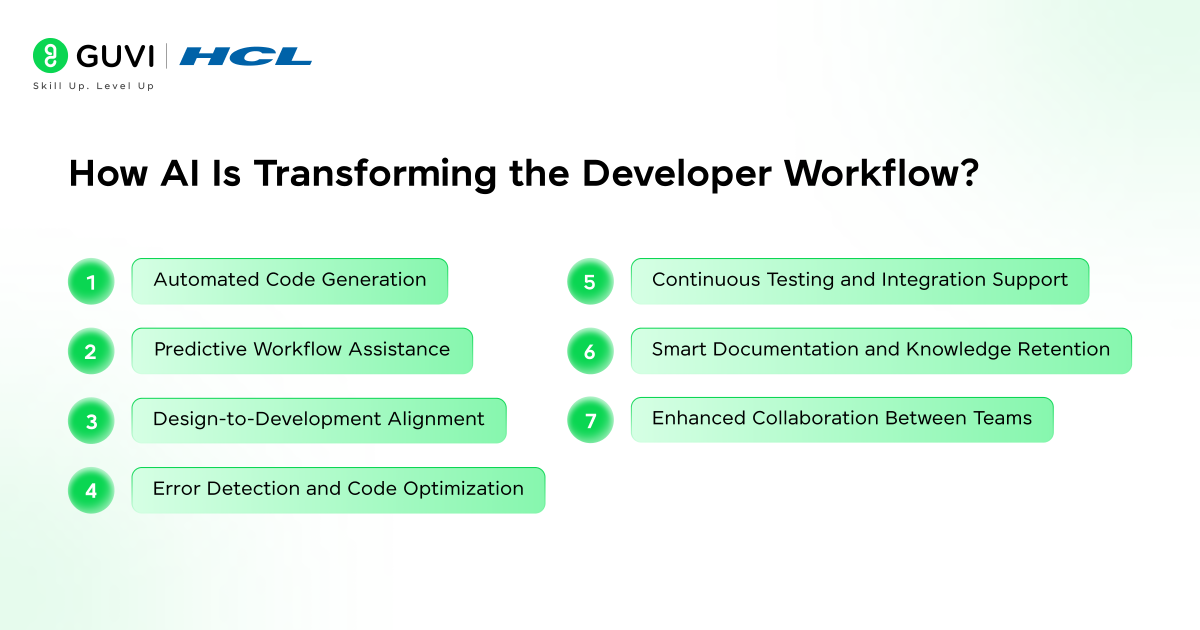
AI is redefining how developers plan, build, and refine digital products. It reduces repetitive work and increases accuracy. It also accelerates collaboration across design and engineering teams. The integration of AI-driven tools creates a more efficient and insight-led workflow that reshapes every stage of development:
- Automated Code Generation: AI in software development converts design elements or written instructions into clean, structured code. This minimizes manual coding effort and shortens the time between prototype and deployment.
- Error Detection and Code Optimization: Machine learning models identify bugs and security gaps before testing begins, ensuring a more robust and secure code. Automated suggestions improve performance and maintain code consistency across modules.
- Design-to-Development Alignment: AI bridges the gap between design outputs and codebases by directly translating design components into reusable UI elements. This alignment eliminates misinterpretation and keeps interfaces faithful to the original design intent.
- Smart Documentation and Knowledge Retention: AI tools generate detailed technical documentation and track development changes automatically. Teams gain consistent and searchable references that simplify onboarding and version control.
- Predictive Workflow Assistance: AI analyzes project data to anticipate bottlenecks, recommend tools, and adjust workloads. This predictive support improves resource planning and accelerates decision-making.
- Continuous Testing and Integration Support: Automated testing frameworks use AI to simulate user scenarios and detect regressions. It also helps validate performance metrics. Continuous feedback ensures reliable releases and stable builds.
- Enhanced Collaboration Between Teams: AI-powered platforms centralize communication among designers, developers, and product managers. This integration maintains context and promotes smoother cross-functional execution.
The Argument: Is AI Making Developers Lazy?
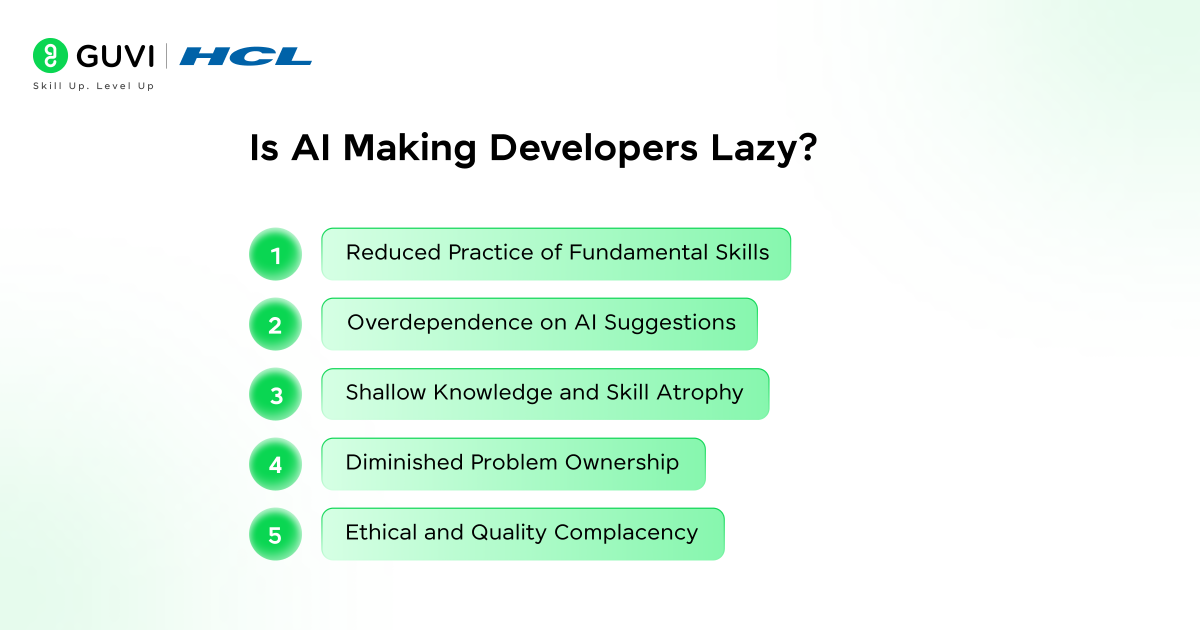
Yes, AI is transforming development like never before by boosting speed and efficiency, but it’s also quietly breeding dependency and reducing hands-on problem-solving. Here are the key reasons why this growing reliance is making developers lazy:
1. Reduced Practice of Fundamental Skills
The foundation of software development rests on problem analysis and algorithmic reasoning. AI reduces exposure to these fundamentals by solving routine coding challenges instantly. Developers who once learned by breaking problems into smaller and logical components now bypass that process.
The absence of consistent engagement with algorithms, data structures, and optimization techniques weakens the cognitive layer that supports technical adaptability. Over time, the difference between those who truly understand systems and those who only assemble them becomes visible in product quality and scalability.

2. Overdependence on AI Suggestions
AI-driven automation tools and recommendations simplify decision-making but can dull analytical awareness. Developers accustomed to autocomplete and AI-assisted code generation risk losing the habit of evaluating why a specific approach works.
This overreliance discourages exploration, leading to passive acceptance of outputs without critical verification. The result is code that functions but lacks conceptual rigor, which makes debugging in software development or optimization difficult when unexpected problems arise.
3. Shallow Knowledge and Skill Atrophy
Programming is a cumulative skill built through repetition and experimentation. As AI fills the gaps, those repetitions fade, and so does the depth of understanding. Developers who depend heavily on automation often struggle to explain or re-create what their tools generate.
For new entrants into the field, this creates a skill vacuum where surface-level proficiency replaces foundational expertise, limiting long-term growth and innovation capacity.
4. Diminished Problem Ownership
Ownership in development is rooted in curiosity and persistence. These are the two qualities that weaken when instant solutions are always available. AI tools provide direction so quickly that developers may detach from the reasoning process that drives architectural or design choices.
The intellectual satisfaction of solving complex problems gives way to passive consumption of ready-made logic. Over time, this erodes confidence in independent thinking and reduces engagement with system-level problem solving.
5. Ethical and Quality Complacency
AI-generated outputs carry hidden biases, inefficiencies, or logic flaws. Blind trust in automation can lead developers to deploy unvetted code without full comprehension of its implications. This complacency undermines accountability, as responsibility for decisions becomes blurred between human and machine.
Ethical reasoning, a cornerstone of responsible software creation, risks being replaced by convenience and speed. It eventually lowers both quality and moral oversight in production environments.
Counterargument: AI as an Enhancer, Not a Replacement
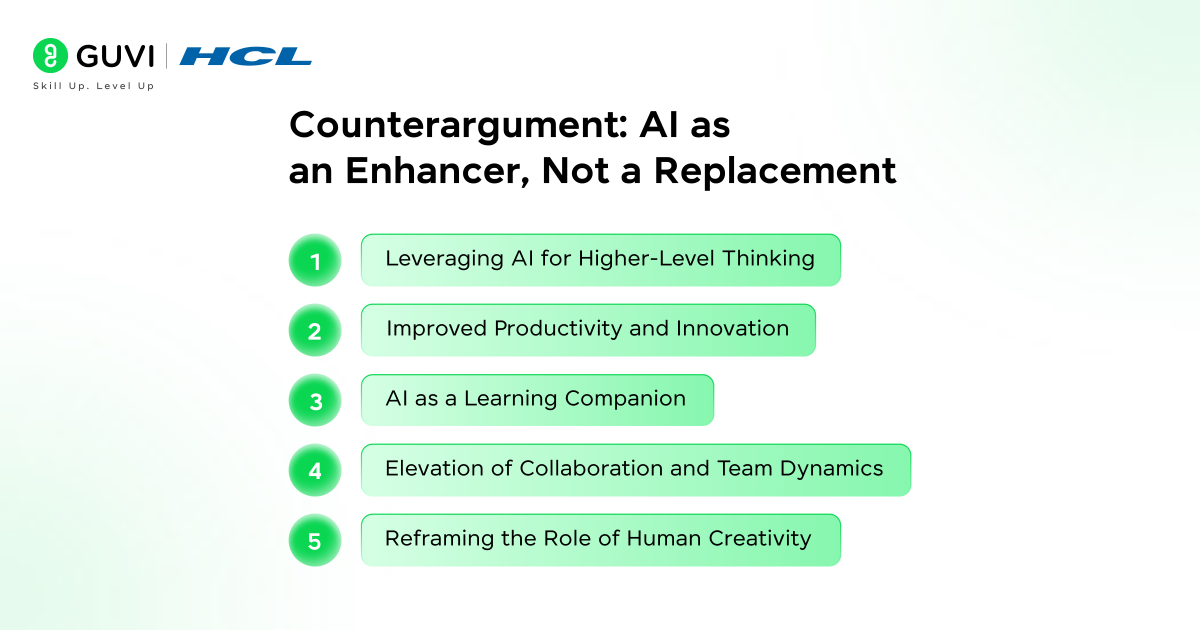
The integration of AI into software development does not inherently weaken skill; in fact, it can also elevate it. AI becomes an amplifier of human capability when used consciously. It expands the boundaries of what developers can achieve. It shifts focus from mechanical repetition to conceptual innovation rather than diminishing expertise. It redefines what technical mastery means in a modern context.
1. Leveraging AI for Higher-Level Thinking
AI and machine learning remove the friction of repetitive coding and configuration, giving developers more time to think strategically. Routine tasks such as syntax correction, boilerplate creation, or documentation can now run in the background. This shift directs human attention toward architectural clarity, scalability, and problem framing.
Developers move from managing syntax to designing systems that solve broader organizational and user challenges. It cultivates a mindset that values reasoning over routine.
2. Improved Productivity and Innovation
Automation allows rapid translation of ideas into functional prototypes, which encourages iterative exploration. AI reduces the delay between concept and implementation and enables teams to test multiple design hypotheses and user flows in a fraction of the time.
This acceleration does not dilute creativity; it expands it. Freed from mechanical constraints, developers experiment more, evaluate more outcomes, and produce better solutions supported by data and insight.
3. AI as a Learning Companion
AI systems can act as mentors rather than mere assistants. They explain logic and point out inefficiencies. They also suggest better practices in real time. Developers gain immediate feedback that strengthens conceptual understanding and technical intuition.
For newcomers, AI serves as an interactive teacher; for experts, it functions as a peer that stimulates refinement and continuous learning. This dynamic nurtures growth instead of dependency.
4. Elevation of Collaboration and Team Dynamics
AI streamlines communication across disciplines by aligning design and documentation. Teams spend less time clarifying handoffs and more time improving structure and usability. Automated insights bring visibility to dependencies and allow collaborative decisions that improve both product quality and workflow coherence.
5. Reframing the Role of Human Creativity
True creativity thrives when repetitive work recedes. AI cannot replace intuition, empathy, or context. These are the superior qualities that shape meaningful digital experiences. Developers equipped with intelligent tools are free to think beyond technical limitations and approach problems from a human-centered perspective. This balance between analytical precision and imaginative thinking transforms AI from a threat to craftsmanship into a catalyst for deeper creative expression.
Why Retaining Core Skills Still Matters?
AI and generative AI can streamline workflow, yet technical depth remains the anchor of true expertise. Developers who preserve core skills retain control over both creative and practical aspects of their work. These foundational proficiencies form the safety net when automation reaches its limits and logic alone must guide problem-solving.
Debugging and Troubleshooting in Real-World Scenarios
AI-generated code may appear functional, but it can hide logic errors or structural flaws. Identifying and resolving these issues requires an understanding of programming fundamentals. When automation fails, developers who grasp the underlying principles of computation and control flow can diagnose problems with accuracy and speed.
Security, Reliability, and Performance
Strong technical foundations remain essential for creating secure and efficient software. AI tools cannot always detect subtle vulnerabilities or resource inefficiencies. Developers must rely on their own expertise to evaluate memory usage. They should know how to handle concurrency and protect against exploits that automated systems overlook.
Architecture and System Design
AI and LLMs can assist with code generation but lack strategic context. Designing systems that balance scalability, modularity, and maintainability demands human insight shaped by years of practice. Foundational knowledge allows developers to see the broader architecture beyond immediate tasks, making informed trade-offs that AI cannot replicate.
Avoiding the “Black Box Developer” Trap
When developers rely on AI without understanding its outputs, they become dependent on opaque logic they cannot fully explain. This creates “black box” professionals, who are capable of executing tasks but unable to reason about how or why something works. Retaining technical literacy preserves autonomy and credibility in every engineering decision.
Strengthen your AI expertise without losing the fundamentals with HCL GUVI’s Artificial Intelligence and Machine Learning Course. Learn to build, train, and deploy intelligent systems while mastering the core logic, algorithms, and problem-solving skills that define true engineering excellence. Gain IIT-M Pravartak certification, hands-on mentorship, and career-focused project experience that blends automation with deep understanding, helping you stay adaptable in an AI-driven world.
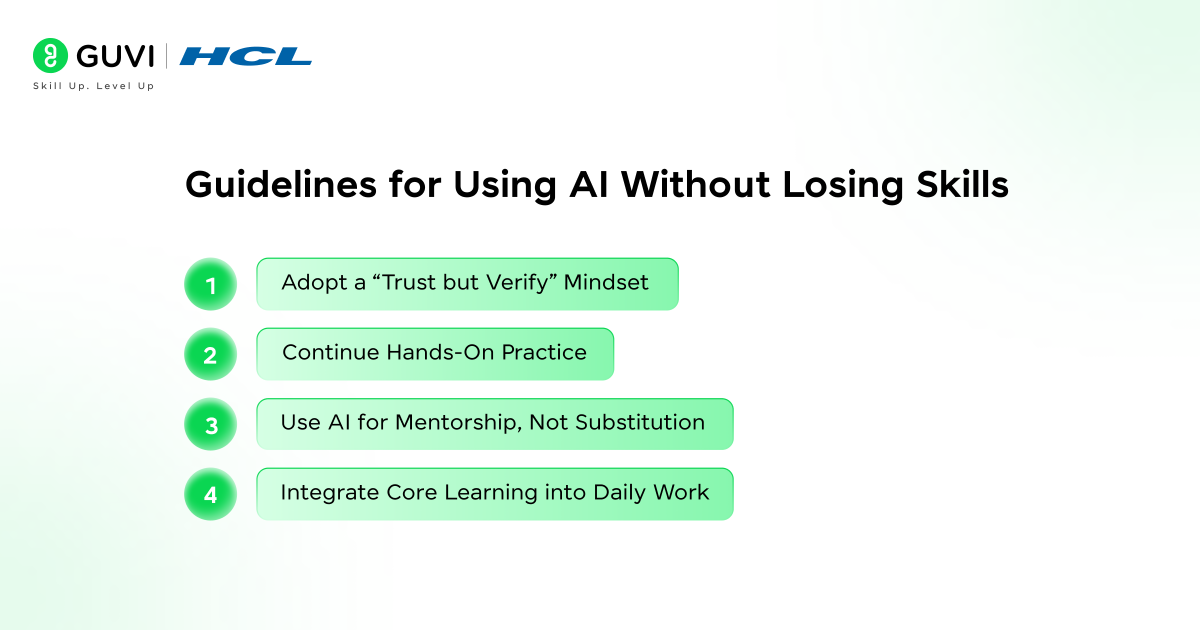
Guidelines for Using AI Without Losing Skills
- Adopt a “Trust but Verify” Mindset
Treat AI-generated code as a draft, not a final version. Review every function and algorithm with the same rigor applied to manual work. Verification strengthens both trust and comprehension.
- Continue Hands-On Practice
Set aside time for manual problem-solving. Participate in coding challenges, build side projects, or reconstruct solutions without AI assistance. Regular practice keeps logic sharp and intuition active.
- Use AI for Mentorship, Not Substitution
Engage with AI to understand reasoning, not merely results. Ask for explanations, compare multiple solutions, and analyze trade-offs. This turns AI into a learning companion that reinforces understanding instead of replacing it.
- Integrate Core Learning into Daily Work
Revisit algorithms, data structures, and design patterns regularly. Apply theoretical concepts to real tasks, reinforcing how foundational knowledge supports applied engineering. Continuous study keeps proficiency aligned with evolving tools.
The Future Developer: Hybrid Human + AI Skillset
The developer of the future will blend analytical precision with adaptive creativity. AI will manage the mechanical aspects of development, while humans will focus on systems thinking, architecture, and ethical design. Success will depend on adaptability, the capacity to learn new technologies without losing core reasoning. Junior engineers will need to master fundamentals before leveraging automation, and senior engineers will guide AI-driven workflows through informed oversight. The strongest professionals will be orchestrators who combine human insight with intelligent tools to build systems that are efficient, secure, and meaningful.
Conclusion
AI and its applications have redefined how software is designed and built, yet lasting expertise still depends on human understanding. The most capable developers will blend automation with analytical depth, using AI as a tool for acceleration rather than substitution. Mastery in this new era comes from balance, where efficiency meets comprehension and technology amplifies, not replaces, the discipline that defines real craftsmanship.
FAQs
1. Does using AI coding tools actually make developers less skilled?
AI can reduce manual problem-solving if used passively. Developers who rely on suggestions without understanding the logic risk losing critical thinking and algorithmic reasoning. Skill is maintained only when AI assists the process, not replaces it.
2. How can developers balance AI assistance with skill retention?
Balance comes from active engagement. Developers should review AI-generated code, experiment manually, and apply core principles regularly. Using AI as a learning partner, asking why a solution works ensures understanding stays intact while productivity improves.
3. Can AI fully replace human creativity in development?
AI can optimize patterns and structure but lacks human intuition, empathy, and contextual awareness. Creative problem-solving, ethical reasoning, and design judgment remain uniquely human and essential for building purposeful, user-centered software.
4. What are the risks of overdependence on AI in programming?
Overreliance can create “black box” developers who execute code they cannot explain. This limits troubleshooting, weakens system design understanding, and leads to poor decisions when AI-generated outputs fail or behave unpredictably.
5. Why is it still important to practice core programming fundamentals?
Core skills in algorithms, data structures, and architecture underpin every system. They allow developers to debug, optimize, and innovate independently. Retaining these fundamentals safeguards adaptability and ensures long-term relevance in an AI-driven landscape.
Success Stories

About the Author
Vaishali
I'm a seasoned writer with four years of experience across technical, non-technical, and just about every genre or niche you can imagine. Adaptable and curious, I enjoy exploring new topics and making information engaging and easy to understand. Fueled by a steady stream of tea, I approach each project with creativity, reliability, and genuine enthusiasm for storytelling.
View all posts by Vaishali
Connect with me @














Did you enjoy this article?