


Career Articles
Accountant vs Data Analyst Salary in India After Switching Careers - Best Guide
Finance Managers: Could Data Science Be Your Next Career Move?
Insurance Claims Executive to Data Analyst: Is It a Good Switch?
Banking Executive (Loans, KYC) to Data Analyst: Skills and Career Path


Get In Touch For Details! Request More Information

How to Prepare for Aptitude Questions: Complete Guide for Students & Job Seekers
Jun 10, 2026 3 Min Read 1121 Views
(Last Updated)
Table of contents
- TL;DR
- What are Aptitude Questions?
- Why are Aptitude Questions Important?
- Types of Aptitude Questions
- Quantitative Aptitude Questions
- Logical Reasoning Questions
- Verbal Ability Questions
- Data Interpretation Questions
- How to Prepare for Aptitude Questions
- Understand the Exam Pattern
- Learn Basic Concepts Clearly
- Practice Aptitude Questions Daily
- Improve Speed & Time Management
- Focus on Weak Areas
- Solve Mock Tests & Previous Papers
- Common Mistakes to Avoid During Aptitude Preparation
- Best Tips to Improve Aptitude Skills
- Effective Aptitude Preparation Tips
- Real-World Importance of Aptitude Skills
- Aptitude Preparation Framework
- Stage 1: Learn Fundamentals
- Stage 2: Practice Topic-Wise Questions
- Stage 3: Improve Speed & Accuracy
- Stage 4: Solve Mock Tests
- Stage 5: Revise & Analyze Mistakes
- Improve Your Analytical & Problem-Solving Skills with HCL GUVI
- Conclusion
TL;DR
Preparing for aptitude questions requires improving logical reasoning, quantitative aptitude, problem-solving, time management, and analytical thinking skills. Aptitude questions are commonly asked in placement tests, competitive exams, and job interviews to evaluate a candidate’s thinking ability and decision-making skills. This guide explains how to effectively prepare for aptitude questions, with strategies, examples, practice techniques, and tips to improve speed and accuracy.
What are Aptitude Questions?
Aptitude questions are problem-solving and reasoning-based questions used to evaluate a person’s logical thinking, numerical ability, analytical skills, and decision-making capability.
These questions are commonly asked in:
- Campus placements
- Competitive exams
- Government exams
- IT company recruitment tests
- Banking exams
- MBA entrance exams
Aptitude questions help companies and institutions assess how efficiently candidates can analyze information and solve problems under time constraints.
According to Business Insider, 76% of companies used skills-based and aptitude assessments in hiring in 2025, compared to 55% in 2022, showing the growing importance of aptitude tests in recruitment.
Why are Aptitude Questions Important?
Aptitude questions are important because they evaluate critical thinking, problem-solving ability, analytical reasoning, and decision-making skills.
Strong aptitude skills help candidates:
- Perform well in placement tests
- Improve logical thinking
- Increase problem-solving speed
- Crack competitive exams
- Improve interview confidence
Companies often use aptitude tests to identify candidates who can think logically and solve real-world problems efficiently.
Types of Aptitude Questions
Different types of aptitude questions evaluate different problem-solving and reasoning abilities.
1. Quantitative Aptitude Questions
Quantitative aptitude questions evaluate mathematical problem-solving and numerical calculation skills. These questions commonly involve arithmetic, percentages, ratios, probability, profit & loss, and time & work concepts.
Common Topics:
- Percentages
- Profit & Loss
- Time & Work
- Probability
- Simple & Compound Interest
2. Logical Reasoning Questions
Logical reasoning questions test analytical thinking, pattern recognition, and logical decision-making abilities. These questions help evaluate how efficiently candidates can analyze situations and solve logical problems.
Common Topics:
- Coding-Decoding
- Blood Relations
- Seating Arrangements
- Number Series
- Puzzle Solving
3. Verbal Ability Questions
Verbal ability questions evaluate English language understanding, grammar, vocabulary, and comprehension skills. These questions help assess communication and language interpretation abilities.
Common Topics:
- Reading Comprehension
- Synonyms & Antonyms
- Error Detection
- Sentence Correction
- Vocabulary
4. Data Interpretation Questions
Data interpretation questions evaluate a candidate’s ability to analyze charts, graphs, tables, and numerical information effectively. These questions test analytical thinking and decision-making skills.
Common Topics:
- Pie Charts
- Bar Graphs
- Tables
- Line Graphs
- Caselet Analysis
TestGorilla reported that its Critical Thinking aptitude assessment was completed more than 100,000 times in Q1 2025, reflecting the rising demand for aptitude and reasoning evaluations in hiring.
How to Prepare for Aptitude Questions
Preparing for aptitude questions requires consistency, structured learning, and regular practice.
1. Understand the Exam Pattern
Start by understanding the aptitude test pattern, syllabus, question types, and time limits. Knowing the structure of the exam helps candidates prepare more strategically and manage time effectively during tests.
Analyze:
- Number of questions
- Difficulty level
- Important topics
- Section-wise timing
2. Learn Basic Concepts Clearly
Strong fundamentals are important for solving aptitude questions quickly and accurately. Focus on understanding concepts instead of memorizing formulas blindly.
Important aptitude concepts include:
- Percentages
- Ratios
- Algebra
- Probability
- Logical reasoning basics
Research shows that companies using aptitude and skills-based hiring assessments reported 82% satisfaction with new hires, compared to 73% average employer satisfaction overall.
3. Practice Aptitude Questions Daily
Daily practice improves speed, accuracy, logical thinking, and confidence. Solving aptitude questions regularly also helps identify weak areas and improve problem-solving efficiency.

Recommended Practice Goal:
Solve at least 20–30 aptitude questions daily across different aptitude topics.
4. Improve Speed & Time Management
Most aptitude tests are time-based, so speed and accuracy are equally important. Candidates should practice solving questions within fixed time limits to improve performance.
Tips to Improve Speed:
- Use shortcut methods
- Learn calculation tricks
- Avoid lengthy calculations
- Practice mock tests regularly
5. Focus on Weak Areas
Identify topics where you frequently make mistakes and spend extra time improving those concepts. Regular revision and targeted practice help strengthen weak areas effectively.
Example:
If logical reasoning is difficult, focus more on:
- Puzzles
- Seating arrangements
- Coding-decoding questions
6. Solve Mock Tests & Previous Papers
Mock tests help candidates understand real exam pressure and improve time management skills. Previous aptitude papers also help identify frequently asked question patterns.
Benefits of mock tests:
- Improve confidence
- Increase speed
- Identify mistakes
- Improve exam strategy
Canditech reported that assessment usage among employers grew by 135% in 2024 and is projected to grow another 242% year-over-year, highlighting the increasing adoption of aptitude-based hiring.
Common Mistakes to Avoid During Aptitude Preparation
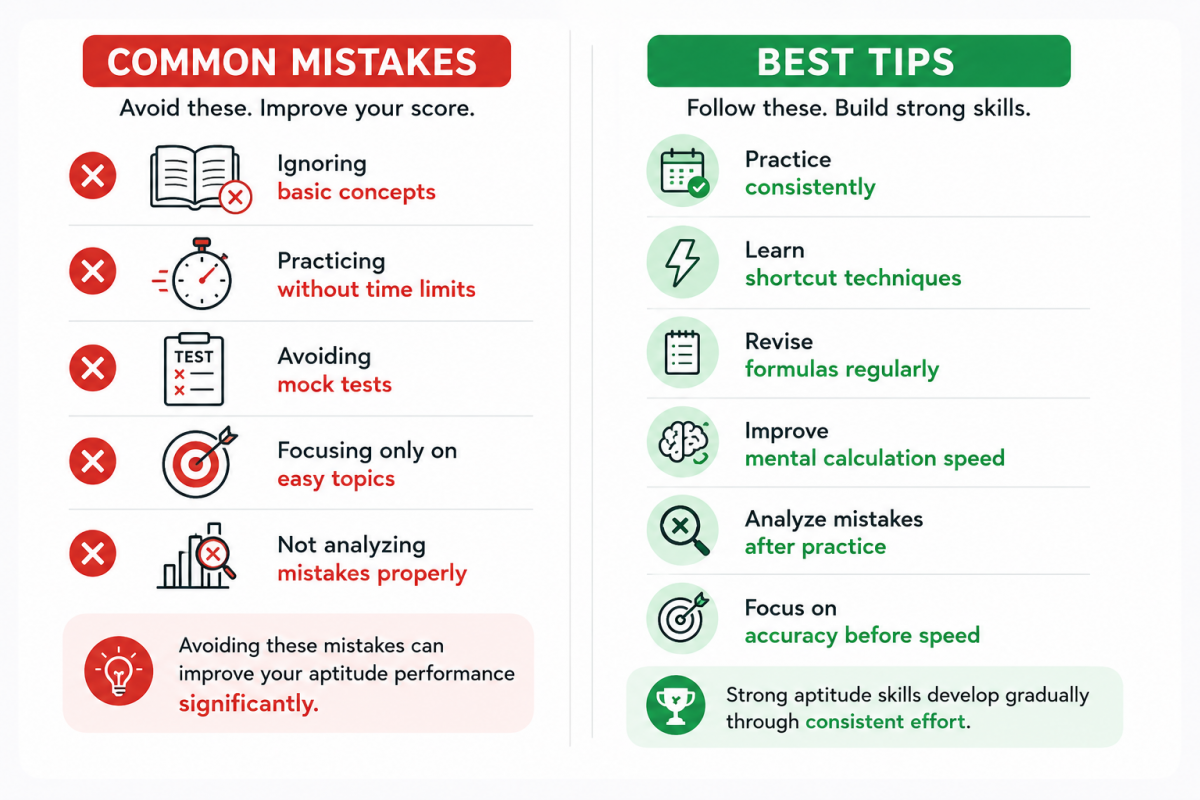
Many students struggle with aptitude preparation because of these common mistakes:
- Ignoring basic concepts
- Practicing without time limits
- Avoiding mock tests
- Focusing only on easy topics
- Not analyzing mistakes properly
Avoiding these mistakes can improve aptitude performance significantly.
Best Tips to Improve Aptitude Skills
Improving aptitude skills requires regular practice and structured learning strategies.
Effective Aptitude Preparation Tips
- Practice consistently
- Learn shortcut techniques
- Revise formulas regularly
- Improve mental calculation speed
- Analyze mistakes after practice
- Focus on accuracy before speed
Strong aptitude skills develop gradually through consistent effort and problem-solving practice.
Real-World Importance of Aptitude Skills
Aptitude skills are useful beyond placement tests and competitive exams.
Strong aptitude abilities help professionals:
- Solve business problems
- Analyze data
- Improve decision-making
- Think logically
- Manage tasks efficiently
Aptitude and reasoning skills are valuable across careers such as:
- Software Development
- Data Analytics
- Banking
- Consulting
- Business Analysis
Aptitude Preparation Framework
Stage 1: Learn Fundamentals
- Arithmetic basics
- Logical reasoning concepts
- Verbal ability fundamentals
Stage 2: Practice Topic-Wise Questions
- Quantitative aptitude
- Logical reasoning
- Verbal ability
- Data interpretation
Stage 3: Improve Speed & Accuracy
- Timed practice sessions
- Shortcut methods
- Calculation techniques
Stage 4: Solve Mock Tests
- Full-length tests
- Previous placement papers
- Performance analysis
Stage 5: Revise & Analyze Mistakes
- Formula revision
- Error analysis
- Weak topic improvement
Improve Your Analytical & Problem-Solving Skills with HCL GUVI
Want to improve your aptitude, reasoning, and problem-solving skills for placements and competitive exams?
Explore HCL GUVI’s Aptitude Preparation Courses to practice aptitude questions, strengthen analytical thinking, and prepare confidently for interviews and placement tests.
Conclusion
Preparing for aptitude questions requires consistent practice, strong fundamentals, logical thinking, and effective time management. Aptitude tests are designed to evaluate problem-solving ability, analytical reasoning, and decision-making skills across different domains.
Candidates who practice regularly, improve speed and accuracy, and solve mock tests consistently can significantly improve aptitude performance and placement success.
As aptitude assessments continue to remain important in placements and competitive exams, strong aptitude skills can provide a major career advantage.
Success Stories
















Did you enjoy this article?