


Interview Articles
Technical Interview Questions Commonly Asked in Startups
Technical Interview vs HR Interview: 7 Key Differences
Advanced DNS Interview Questions for Senior Engineers: What to Expect in 2026
How to Handle a Technical Interview When the HR Interviewer Isn’t Technical


Get In Touch For Details! Request More Information
How to Improve Your Placement Strategy for this Upcoming Placement Season
Feb 05, 2026 8 Min Read 1373 Views
(Last Updated)
All the college hustle from juggling between assignments, seminars, presentations, workshops, exams, internals, and internships led to one ultimate goal: ‘getting placed’ and bagging offers at the end!
Campus placement plays a major role, offering the best way to kickstart your career by connecting you with top recruiters.
And the good news:
“All your hard work is about to pay off!”
But before the placement season begins, it is time to gear up and prepare your placement strategy. If you understand the process and prepare strategically, you’re already ahead of most candidates. This guide breaks down every stage of campus recruitment and gives you the exact tactics to level up your placement game this season.
By the end of this blog, you’ll gain key insights into the 2025 placement landscape, including a clear glimpse into different types of companies and their expectations. You’ll have a comprehensive roadmap to placement success, complete with specific resources and tips to tackle each recruitment round.
Finally, you’ll also uncover the essential strategies on how to effectively manage placement season stress for peak performance. Let’s dive deeper!
Table of contents
- Understanding the 2025 Placement Landscape
- Top Employer Categories in Campus Placement Drives
- Product-Based Companies (Top-tier)
- Service-Based Companies (Mass Recruiters)
- Startups
- Core/Non-Tech Companies
- Fintech & Banking
- Roadmap for Placement Success
- Resume shortlist
- Why this stage matters
- What recruiters look for
- Tips to ace
- Resources
- Aptitude Tests (Mostly Online)
- Coding Rounds (DSA, 100 Codes Challenge)
- Technical Interview (DSA+ Core Subjects)
- HR Interview
- Manage Placement Season Stress
- To wrap up
- Frequently Asked Questions
- What are placement strategies?
- How to master campus placement?
- What is the best time to prepare for placement?
- Do soft skills matter in placement success?
- How to manage placement stress?
Understanding the 2025 Placement Landscape
You may think …” Why should I know the placement landscape?”
It’s a small but crucial step that helps you plan your preparation around what recruiters expect.
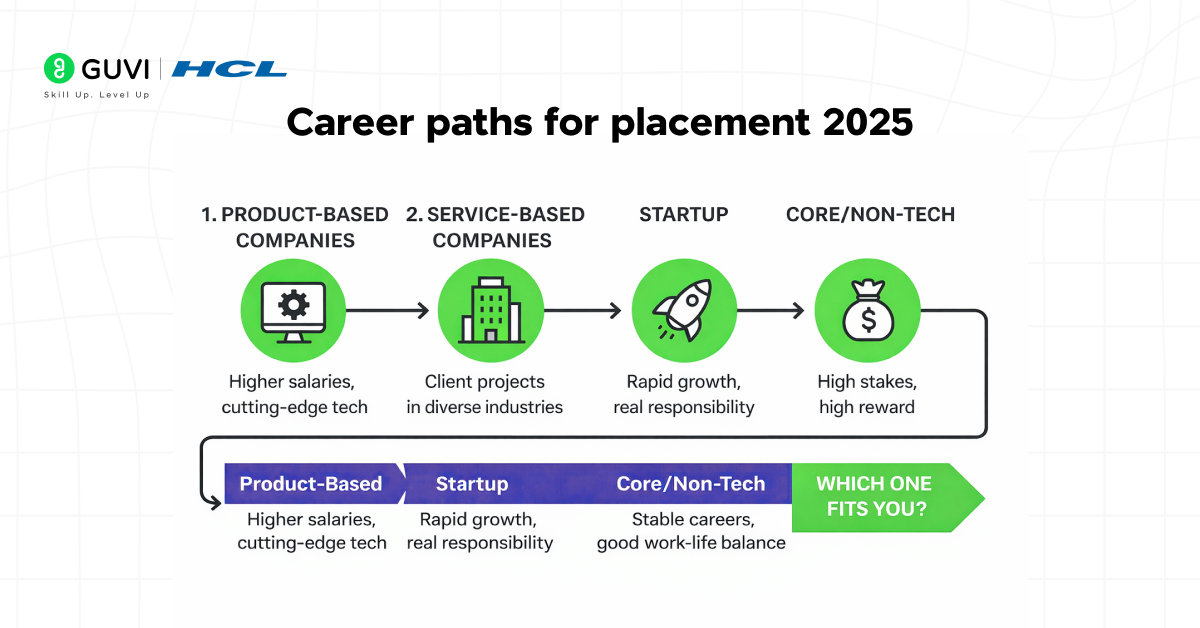
Hybrid Recruitment Models: A Combination of virtual and in-person hiring. Early rounds like aptitude tests and technical screenings are conducted online, while final interviews may be on campus or at selected venues.
Skills and practice knowledge focus: Of course! You must possess the technical skills related to your field, such as programming languages, data structures, and algorithms.
Recruiters value candidates with internship experience and live project portfolios. If you have earned a skill, learning a certification course, it is a great plus.
They are likely to assess your soft skills like communication, leadership qualities, and how easily you work with others.
Off-campus drives: Off-campus drives are a new trend in the student placement ecosystem, offering you a chance to participate and secure placements beyond your campus.
Gives you an exposure to a wide range of companies from startups to multinational corporations.
Explore HCL GUVI’s interview preparation course for complete guidance.
Top Employer Categories in Campus Placement Drives
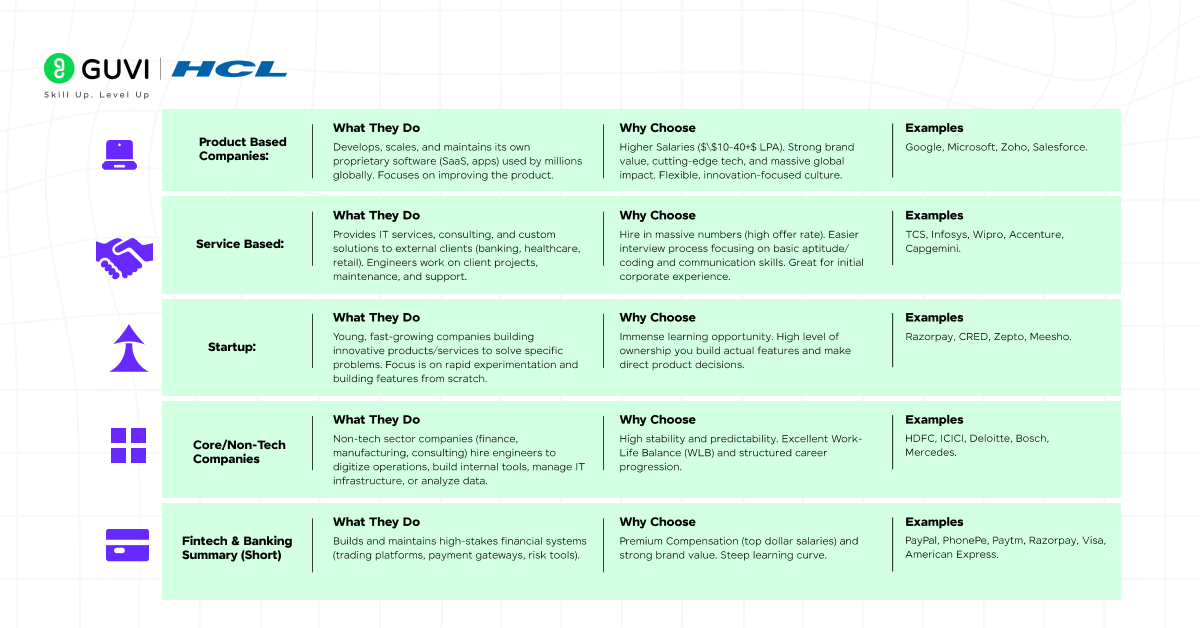
1. Product-Based Companies (Top-tier)
Product-based companies build and sell their own software products, platforms, or services. Instead of working on client projects like service companies, they focus on developing, scaling, and maintaining their own technology.
What they do: They create products used by millions, for example, Google Search, Microsoft Office, Amazon’s e-commerce platform, or Adobe Photoshop. Their engineers work on improving features, fixing bugs, optimizing performance, and building new functionality for their own products. The work is ongoing and evolves with user needs.
The catch: Extremely competitive recruitment. They hire fewer people but expect top-tier problem-solving skills. Interview rounds are tough except for hard DSA questions, system design basics, and multiple technical rounds. They want the best coders who can think independently and scale solutions.
Industry Giants like Google, Microsoft, Zoho, Salesforce, and Oracle.
In short: Product-based roles mean you’re building the product itself, not customizing it for someone else. Higher impact, higher pay, higher bar for entry.

2. Service-Based Companies (Mass Recruiters)
Service-based companies provide IT services, consulting, and solutions to other businesses.
You work on projects for clients across different industries like banking, healthcare, retail, or manufacturing.
What they do: These companies act as tech vendors for other organizations. If a bank needs a new app, a retail chain wants an inventory system, or a hospital needs patient management software, service companies build and maintain it for them. You’re assigned to client projects that can range from a few months to years. The work varies and may involve coding, testing, or maintenance.
Why choose them: Job security and guaranteed placement. They hire in massive numbers (50-200+ students per college), so your chances of getting an offer are high. The interview process is relatively easier, focusing on basic aptitude, simple coding (usually easier than LeetCode medium), and a strong emphasis on communication skills and attitude. They often serve as a safety net if product companies don’t work out.
The reality check: The work can be repetitive or less challenging, as maintenance projects, legacy code, or support roles are common for freshers. Growth can be slower compared to product companies. However, you gain exposure to multiple domains, a professional work environment, and client-handling skills.
Industry giants like: TCS, Infosys, Wipro, Cognizant, Accenture, Capgemini, HCL, Tech Mahindra
In Short: Service companies are volume players that value reliability, communication, and adaptability over cutting-edge coding skills. They are a great starting point if you want a stable income and corporate experience, but the work may feel limiting if you’re looking for high-impact technical challenges.
3. Startups
Startups are young, fast-growing companies (usually under 10 years old) building innovative products or services. They’re smaller teams solving specific problems with technology such as fintech apps, food delivery platforms, SaaS tools, or ed-tech solutions.
What they do: Startups move fast and experiment constantly. You’ll work on building features from scratch, wearing multiple hats (frontend, backend, sometimes even design or product decisions), and seeing your code directly impact users. You’ll have more ownership, and your contributions are visible immediately.
Why you should choose: Real learning and hands-on experience. You’re not just a cog in the machine; you build actual features, make decisions, and grow fast. Startups value hustle, creativity, and problem-solving over pedigree.
The reality check: You’ll work on the environment to drive growth. You’ll get experience in fast-paced projects, tight deadlines, and plenty of opportunities to take ownership and make an impact. The learning curve, exposure, and potential rewards can be greater.
Examples: Razorpay, CRED, Zepto, Meesho, Dunzo, and smaller Y Combinator-backed startups.
In short: Startups are for risk-takers who want rapid growth, real responsibility, and aren’t afraid of uncertainty. You’ll learn more in 6 months here than in 2 years at some larger companies.
4. Core/Non-Tech Companies
These are non-tech sector companies that hire engineers for their IT departments, analytics teams, or technical roles.
What they do: These companies need tech talent to digitize operations, build internal tools, analyze data, or manage IT infrastructure. Work is less cutting-edge but more stable and predictable. Good work-life balance compared to pure tech companies.
Why should you choose: Stable careers. Students who want stability and don’t mind working in less purely technical roles. Good option if you’re interested in finance, consulting, or applying tech to traditional industries. Also great if you want structured career progression and corporate experience.
The reality check: You might develop internal banking applications, build data pipelines for business analytics, automate manufacturing processes, or consult on digital transformation projects. It’s less about innovation and more about reliable, business-focused solutions. Analytics firms focus heavily on data interpretation, client presentations, and business impact.
Examples: HDFC and ICICI, Deloitte, EY, and manufacturing giants like Bosch and Mercedes.
In short: Ideal for those seeking job stability, corporate experience, and steady career growth. Great fit if you are interested in finance, consulting, or applying tech to traditional industries.
5. Fintech & Banking
Financial technology and investment banking firms build and maintain high-stakes systems that handle money, transactions, and sensitive financial data. They create payment gateways, trading platforms, fraud detection algorithms, digital wallets, risk management tools, and banking infrastructure.
What they do: Engineers here work on systems that process millions of transactions daily, requiring bulletproof code, top-tier security, and zero tolerance for bugs since errors can cost millions.
Why should you choose: You work on cutting-edge technology, solving complex, real-world problems at a massive scale. Strong brand value on your resume (opens doors everywhere).
Steep learning curve with exposure to finance domain knowledge, system design, and performance optimization. If you’re interested in how money and technology intersect, this is the sweet spot.
The reality check: The interview process is tedious; they expect multiple rounds of hard DSA problems (LeetCode hard level), system design questions, and quantitative reasoning tests. They hire very selectively, looking for top-tier problem-solvers.
Work can be high-pressure with tight deadlines, especially in investment banking tech roles where markets don’t wait.
Examples: Goldman Sachs, Morgan Stanley, JP Morgan, PayPal, PhonePe, Paytm, Razorpay, Stripe, Visa, American Express.
In short: Fintech and banking firms pay top dollar for engineers who can build rock-solid financial systems under pressure. High reward, high stakes, high expectations. Perfect if you’re a strong coder who wants premium compensation and doesn’t mind the intensity.
Roadmap for Placement Success
Campus placements can feel overwhelming. But if you understand the process and prepare strategically, you’re already ahead of most of the candidates.
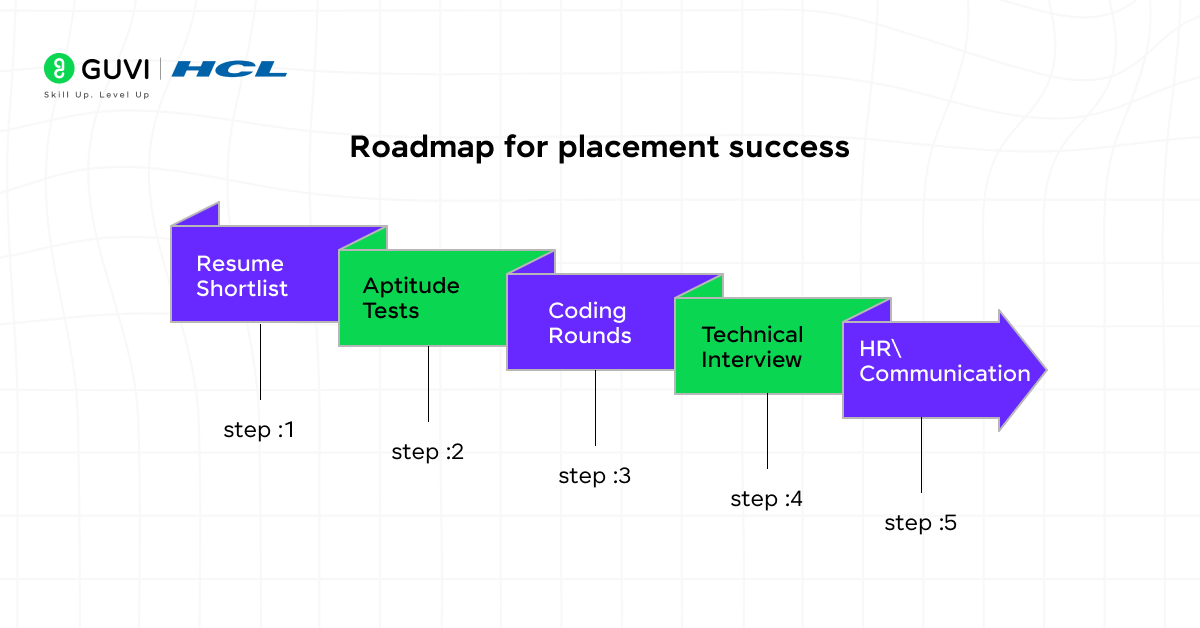
Resume shortlist
Before you even get to test your skills, your resume needs to be cut. Companies receive hundreds of applications and use this stage to filter candidates based on academics, projects, and relevant experience.
Why this stage matters
Your resume is your first impression and your ticket to the actual selection rounds. No matter how good you are, if your resume doesn’t pass, you won’t get a chance to prove yourself.
What recruiters look for
Clean, one-page format with clear sections: Make a clean format resume with clear headings like (Education, Projects, Skills, Experience) maintain consistent spacing and easy-to-read fonts.
Relevant technical skills match job requirements. Your resume should match the job description and highlight relevant technologies; never exaggerate, instead organize your skills strategically.
Internships or practical experience: Internship experience shows you have worked in a professional setting. Although no formal experience? Freelance projects, building solutions for local businesses, count too.
Tips to ace
Keep it ATS-friendly: Use simple fonts, bullet points, and clear headings. Avoid fancy designs or logos.
Proofread: Typos are instant red flags. Proofread multiple times, use spellcheck.
Get feedback from seniors you’ve already placed.
Check out HCL GUVI’s resume-building course to help you get started from scratch.
Resources
Check out HCL GUVI’s Free Resume Builder to create professional, ATS-friendly resumes.
Quick Tip: Ask seniors or professionals for a review.
1. Aptitude Tests (Mostly Online)
The first elimination round after the resume shortlisting. These online assessments test your problem-solving speed, logical thinking, and sometimes basic technical knowledge.
Why this round
Companies use aptitude tests to efficiently filter out candidates quickly. They want to see if you can think logically under time pressure and have the foundational reasoning skills needed for the job.
What recruiters test:
Quantitative Aptitude:
Topics include time and work, profit and loss, percentages, probability, and number series. Focus is on speed and accuracy in solving mathematical problems.
Logical Reasoning:
Tests ability to identify patterns, solve puzzles, understand blood relations, coding-decoding exercises, and seating arrangements.
Verbal Ability:
Includes reading comprehension passages, sentence correction, and a vocabulary test.
Technical MCQs:
This is basically on the company’s domain, but generally covers Basic programming concepts, coding logic, Database management systems, and Computer Networks.
Tips to ace
Speed matters more than perfection. Aim to solve questions quickly and accurately, as spending too much time on one problem can prevent you from attempting easier ones. Practice consistently by taking at least 50–100 practice tests before your first company assessment. Regular mock tests will help you improve your speed, accuracy, and ability to identify weak areas.
Resources
IndiaBix (free, topic-wise practice)
Previous year papers from your placement cell
AMCAT/COCUBES mock tests
Get ready to ace this round with ease by exploring HCL GUVI’s Aptitude Course.
2. Coding Rounds (DSA, 100 Codes Challenge)
This is where tech placements get real. Coding rounds test your ability to write efficient code and solve algorithmic problems under pressure. Most companies have 2-3 coding questions in 60-90 minutes.
Why this round
Your ability to code well is literally the job. Recruiters want to see if you can translate problem statements into working solutions, optimize your approach, and handle edge cases. This round separates casual coders from serious problem-solvers.
What recruiters test
Data Structures: Arrays, strings, linked lists, stacks, queues, trees, graphs, heaps
Algorithms: Searching, sorting, recursion, dynamic programming, greedy algorithms, backtracking
Problem-solving patterns: Two pointers, sliding window, BFS/DFS, divide and conquer
Code quality: Clean syntax, proper variable naming, handling edge cases
Complexity analysis: Time and space complexity of your solution
Tips to ace
Master the fundamentals first. Don’t rush into complex problems without a solid grasp of the basics. Follow the “100 Codes” approach by solving at least 100–150 diverse DSA problems before placements. Focus on recognizing patterns rather than memorizing solutions, and always test your code with edge cases before submitting.
Resources
LeetCode (company-tagged problems)
Codekata, an interactive coding platform by HCL GUVI to enhance your coding skills.
Webkata, a Front-end practice platform by HCL GUVI, which hosts a series of tasks on Web Development skills like HTML, CSS, and JavaScript.
Also, explore HCL GUVI’s free e-books to guide you on your way to success.
3. Technical Interview (DSA+ Core Subjects)
Why this round
In this round, companies want to see how you think under pressure, communicate technical ideas, and handle real-time challenges. This round tests whether you can collaborate with a team, explain your reasoning clearly, and write clean code when someone’s watching. It separates candidates who memorize answers from those who genuinely understand concepts.
What recruiters test
Live DSA coding: Solving array, string, tree, graph, or DP problems on a whiteboard or shared editor while explaining your approach
Core CS subjects: Operating Systems (threads, processes, memory), DBMS (SQL queries, normalization, transactions), Computer Networks (TCP/IP, HTTP), OOP principles
Problem-solving approach: How you break down problems, ask clarifying questions, and optimize solutions
Communication skills: Can you explain complex logic simply? Do you think out loud?
Code quality: Clean syntax, proper naming, handling edge cases even under pressure.
Tips to ace
Begin by asking clarifying questions about inputs, outputs, and constraints before you start coding. Discuss your approach and get the interviewer’s approval before implementing it. Start with a brute-force solution and then work on optimizing it.
Write clean, readable code with meaningful variable names, even on a whiteboard. Always test your solution with edge cases before considering it complete.
When discussing core subjects, focus on explaining the “why” behind each concept rather than just memorizing definitions. Finally, be honest about your projects and be prepared to explain every detail confidently.
Resources
Pramp, Interviewing.io – (free mock technical interviews with real people)
Striver’s A2Z DSA Sheet – Ideal for structured learning.
NeetCode 150 – Perfect for FAANG-style interview preparation.
LeetCode, InterviewBit, and CodeStudio – For consistent problem-solving practice.
Practice daily coding challenges, prepare for your interview, get guidance from industry experts, and choose the right course to upskill, everything in one place.
Download the all-in-one HCL GUVI App
4. HR Interview
The final hurdle. Many candidates bomb here because they underestimate it. HR rounds assess culture fit, communication skills, and whether you’re genuinely interested in the company.
Why this round
Technical skills get you here, but personality and fit determine if you get the offer. Companies want to ensure you’ll work well with teams, align with their values, and genuinely want to be there (not just collect offers).
What recruiters test
Behavioral questions: Tell me about a time you faced conflict, showed leadership, failed, or worked in a team.
Motivation and fit: Why this company? Why this role? Where do you see yourself in 5 years?
Self-awareness: What are your strengths and weaknesses? Situational judgment: How would you handle X scenario?
Salary expectations and negotiation.
Tips to ace
Research the company thoroughly to understand its products, values, and recent developments. Practice common interview questions such as “Tell me about yourself,” “What are your strengths and weaknesses?” and “What are your goals for the next five years?”
Be genuine in your responses, as overly rehearsed answers can sound unnatural and leave a negative impression.
Quick Tip: Prepare two to three thoughtful questions to ask during the interview.
Resources
Glassdoor (company reviews and interview experiences)
Company careers page and LinkedIn (understand culture)
Manage Placement Season Stress
Hey geeks! It is completely understandable to feel anxious during placement season, but it’s important to take care of your mental and emotional well-being while working on your goal.
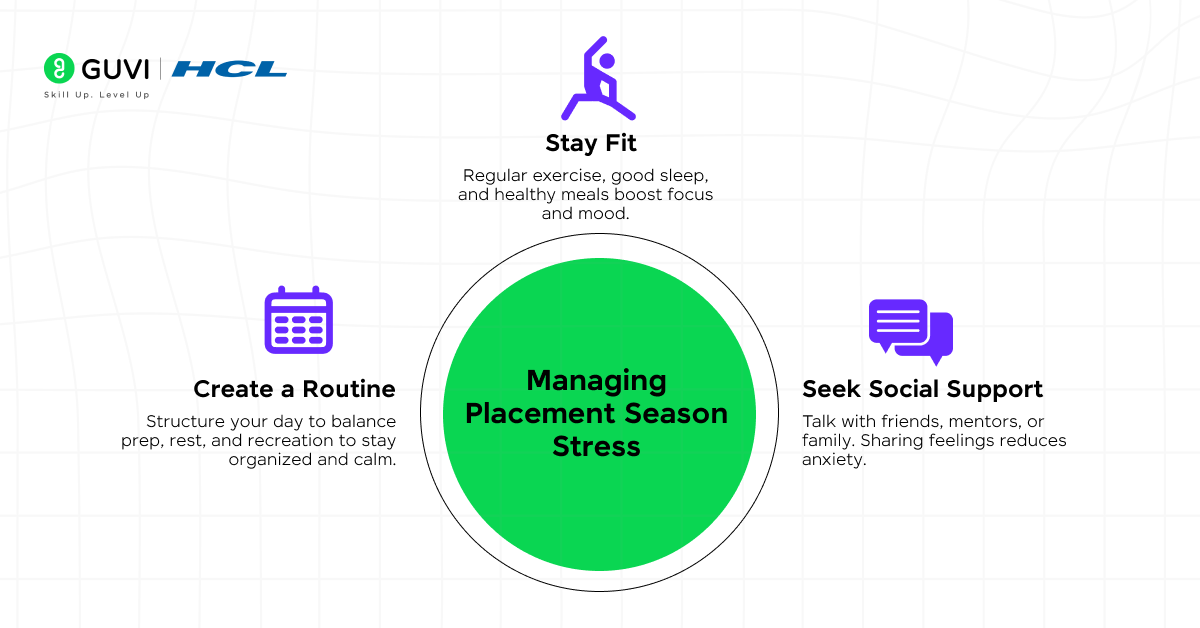
Create a daily routine: Structure your day to take less stress, balance preparation, rest, and recreation.
Stay Fit: Regular exercise, good sleep, and eating healthy will help you focus and balance your mood.
Seek Social Support: Talk to friends, mentors, or family and open up about how you feel to help lighten the stress.
To wrap up
Start early and stay consistent. Preparing in advance will build your confidence and sharpen your problem-solving skills. Understand the hybrid recruitment process so you can prepare effectively for both virtual and in-person interviews.
Keep your resume neat, relevant, and ATS-friendly by highlighting your projects and technical expertise. Practice regularly, work on your aptitude and coding to improve your speed, strengthen logical thinking, and gain clarity. Take mock tests and participate in mock interviews to assess your progress.
On interview days, communicate clearly, show passion, and leave a lasting impression.
Finally, maintain a healthy balance between your mental and physical well-being, and seek support or mentorship from peers and seniors whenever you need it.
It’s not about hearing a hundred “No’s”, it’s about finding that one “Yes.”
Stay consistent. Stay curious. Keep showing up.
Your opportunity is closer than you think.
Frequently Asked Questions
1. What are placement strategies?
It is your personalized roadmap to success. This involves strategic resume building, skill development, rigorous mock interviews, and consistent aptitude practice. Also, investing time in company research and networking.
2. How to master campus placement?
Mastering placement games involves smart and balanced play.. Understand recruitment process, for different company types. Your core focus must be on building strong technical and problem-solving skills (like DSA) alongside regular practice of aptitude and communication tests.
3. What is the best time to prepare for placement?
The best time to start preparing is at least three to six months before the placement season officially kicks off.
4. Do soft skills matter in placement success?
Absolutely, Soft skills are often the deciding factor, especially when technical scores between candidates are very close. Employers seek candidates who have strong communication skills, positive attitude and a problem solving mindset.
5. How to manage placement stress?
Feeling stressed during placements is completely normal, but managing it wisely is key to boosting your performance. Start by creating a clear, balanced daily routine and sticking to it. Make sure you regularly exercise and get enough rest.
Success Stories

About the Author
Salini Balasubramaniam
A curious, information-savvy writer loves to turn deep insights into authentic and engaging content that connects. With experience in writing for brands and driving audience engagement, I believe that words can make a powerful difference.
View all posts by Salini Balasubramaniam
Connect with me @















Did you enjoy this article?