


Career Articles
CA to Data Scientist: Skills, Roadmap and Career Path
Data Analytics vs Data Science for Finance Professionals: Which Path Fits?
Can a Senior Accountant With 2–3 Years of Experience Switch to Data Analytics?


Get In Touch For Details! Request More Information

How to Get a Job at Google & What You Need to Know
Jul 20, 2026 5 Min Read 6817 Views
(Last Updated)
Google is one of the most famous companies in the world. Who wouldn’t dream of working at Google! Getting a job at Google is a dream for many.
A top tech giant and a leading FAANG company? Known for its innovative products, culture, and insane perks! But what makes Google such a great place to work?
It is not just high paychecks, unlimited food, or campus vibes. The real draw is working with some of the smartest people in tech, building products that millions of people use.
A job at Google is undoubtedly awesome! But Google is selective. Over 2 million people apply every year for roughly 10,000 openings.
And the acceptance rate is low, which sounds terrifying, until you understand what that actually means.
Table of contents
- TL;DR Summary
- Skills You Need to Crack Google Based on Your Target Role
- Google Hiring Process in India 2026: A Step-by-Step Guide
- Step 1: Resume Screening
- Step 2: Recruiter Call
- Step 3: Phone Screen
- Step 4: Onsite or Virtual Interviews
- Step 5: Hiring Committee Review
- Step 6: Team Matching
- Step 7: Offer and Salary Negotiation
- Google India Salary Guide: Roles, CTC Ranges, and Interview Difficulty
- How to Prepare for Google Interviews
- Coding Preparation Plan
- Behavioural Interview Prep
- Resources and Platforms Google Employees Recommend for Interview Preparation
- Improve Your Chances of Getting a Job at Google
- Google vs FAANG vs Indian Product Companies: Which Is Harder to Crack?
- Conclusion
- FAQs
- Is it hard to get a Job at Google?
- Can freshers apply for a Job at Google in India?
- What CGPA is required for a Job at Google?
- Does Google hire candidates without a computer science degree?
- How many interview rounds does Google usually have?
- What programming languages does Google prefer?
- How long does it take to get a Job at Google?
TL;DR Summary
- Landing a Job at Google is highly competitive because the company evaluates both technical ability and problem-solving mindset.
- To improve your chances of getting a Job at Google, focus on building role-specific technical and soft skills.
- A strong portfolio, impactful projects, and a well-structured resume can make your job application at Google.
- Understanding the hiring process, interview rounds, and salary expectations helps you prepare better for a Job at Google.
- Consistent practice with coding platforms, mock interviews, and recommended resources can increase your chances of securing a Job at Google.
Google uses the term “Googleyness” to describe qualities such as curiosity, teamwork, problem-solving, adaptability, and a willingness to learn — traits that can matter as much as technical skills during hiring.
Skills You Need to Crack Google Based on Your Target Role
If you’re aiming for a Job at Google, the table below highlights the key technical and soft skills required for some of the company’s most recognized roles:
| Role | Technical Skills | Soft Skills |
|---|---|---|
| Software Engineer | Data Structures, Algorithms, System Design, Java, C++, Python | Problem Solving, Teamwork, Communication, Adaptability |
| Data Scientist | Python, SQL, Statistics, Machine Learning, Data Visualization | Analytical Thinking, Curiosity, Communication, Collaboration |
| Product Manager | Product Strategy, Analytics, SQL Basics, Market Research | Leadership, Decision-Making, Stakeholder Management, Communication |
| UX Designer | User Research, Wireframing, Prototyping, Figma, Usability Testing | Empathy, Creativity, Collaboration, Presentation Skills |
| Site Reliability Engineer (SRE) | Linux, Networking, Python or Go, Automation, Cloud Computing | Problem Solving, Ownership, Communication, Adaptability |
| Cloud Engineer | Cloud Platforms, Kubernetes, Docker, Networking, Security | Collaboration, Troubleshooting, Communication, Continuous Learning |
Looking to build the skills top tech companies value? HCL GUVI’s IITM Pravartak Certified MERN Full Stack Developer Course offers expert mentorship, live classes, 100+ hours of project work, 1500+ coding problems, and career support to help you master MongoDB, Express.js, React, Node.js, Git, and more — all designed to make you job-ready in just 6 months.
Google Hiring Process in India 2026: A Step-by-Step Guide
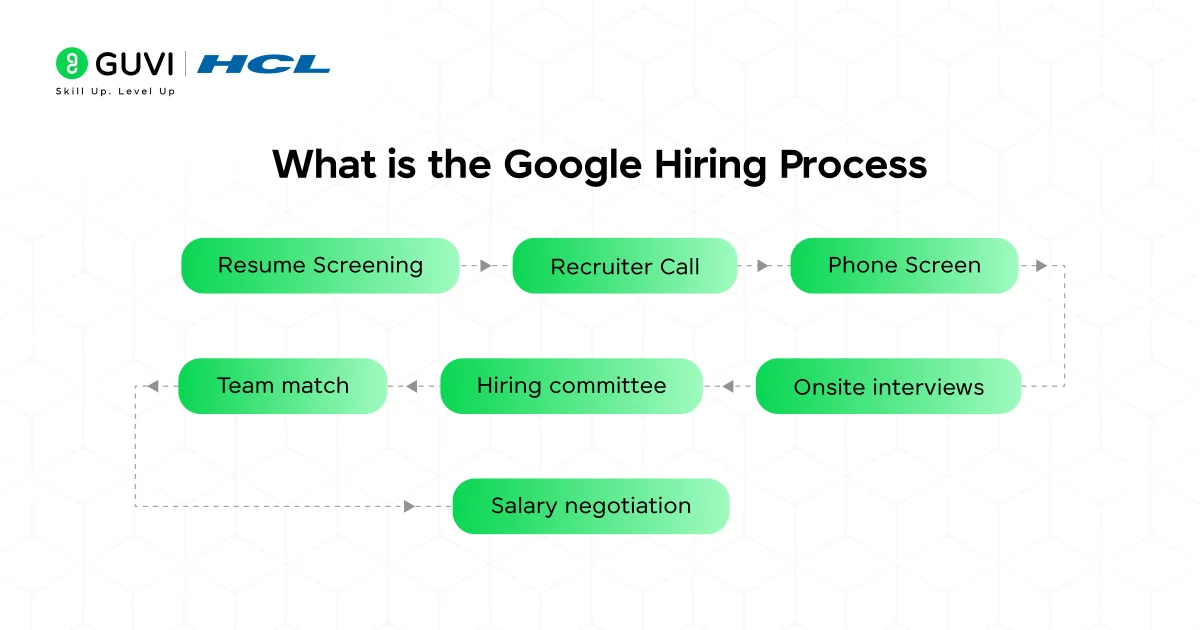
If you’re aiming for a Job at Google, understanding the hiring journey can help you prepare better. Below are the seven main stages of Google’s hiring process in India:
Step 1: Resume Screening
The process begins when you apply through Google’s careers portal. Recruiters review your resume, projects, achievements, and work experience to determine whether your profile matches the role.
A strong resume with measurable results and relevant projects can significantly improve your chances of moving forward.
Step 2: Recruiter Call
If your profile is shortlisted, a recruiter usually schedules a brief conversation to discuss your background, experience, career goals, and interest in the position.
This stage also gives you an opportunity to ask questions about the role, team, and hiring process.
Step 3: Phone Screen
Candidates who pass the recruiter round move to a technical phone interview or role-specific assessment. Depending on the position, this may involve coding problems, technical concepts, case studies, or domain-specific questions.
Interviewers pay close attention to your problem-solving approach and communication skills, not just the final answer.
Step 4: Onsite or Virtual Interviews
This is typically the most challenging stage of the process. Candidates participate in multiple interview rounds covering coding, system design, behavioral questions, leadership, and role-specific scenarios.
The goal is to evaluate both your technical ability and your collaboration, thinking, and decision-making.
Step 5: Hiring Committee Review
After the interviews are completed, an independent hiring committee reviews the feedback from all interviewers. Rather than relying on a single interview, the committee evaluates your overall performance across all rounds before making a decision.
Step 6: Team Matching
Candidates who receive approval from the hiring committee enter the team matching stage. Managers from different teams assess whether your skills and experience align with their requirements.
In some cases, candidates clear the interviews but spend additional time waiting for the right team match.
Step 7: Offer and Salary Negotiation
The final stage involves receiving an offer and discussing compensation, benefits, joining timelines, and other details. Researching market salaries beforehand can help you negotiate confidently and professionally.
Also Read: Google SDE Interview Experience
Google India Salary Guide: Roles, CTC Ranges, and Interview Difficulty
Salary is one of the biggest reasons many professionals aim for a Job at Google, but compensation can vary significantly based on the role, experience level, and interview performance. The table below gives a quick overview of some popular roles in Google India:
| Role | Google India Office Location | CTC Range (India) | Interview Difficulty |
|---|---|---|---|
| Software Engineer | Bengaluru, Hyderabad | ₹40–90+ LPA | Very High |
| Product Manager | Bengaluru, Gurugram | ₹45–100+ LPA | Extremely High |
| Data Scientist | Bengaluru, Hyderabad | ₹35–75+ LPA | Very High |
| Site Reliability Engineer (SRE) | Bengaluru, Hyderabad | ₹40–85+ LPA | Very High |
| UX Designer | Bengaluru, Mumbai | ₹25–60+ LPA | High |
| Cloud Engineer | Hyderabad, Bengaluru | ₹35–70+ LPA | High |
| Research Scientist | Bengaluru | ₹50–120+ LPA | Extremely High |
| Machine Learning Engineer | Bengaluru, Hyderabad | ₹40–90+ LPA | Very High |
| Security Engineer | Bengaluru, Hyderabad | ₹35–80+ LPA | Very High |
| Technical Program Manager (TPM) | Bengaluru, Gurugram | ₹35–75+ LPA | High |
How to Prepare for Google Interviews
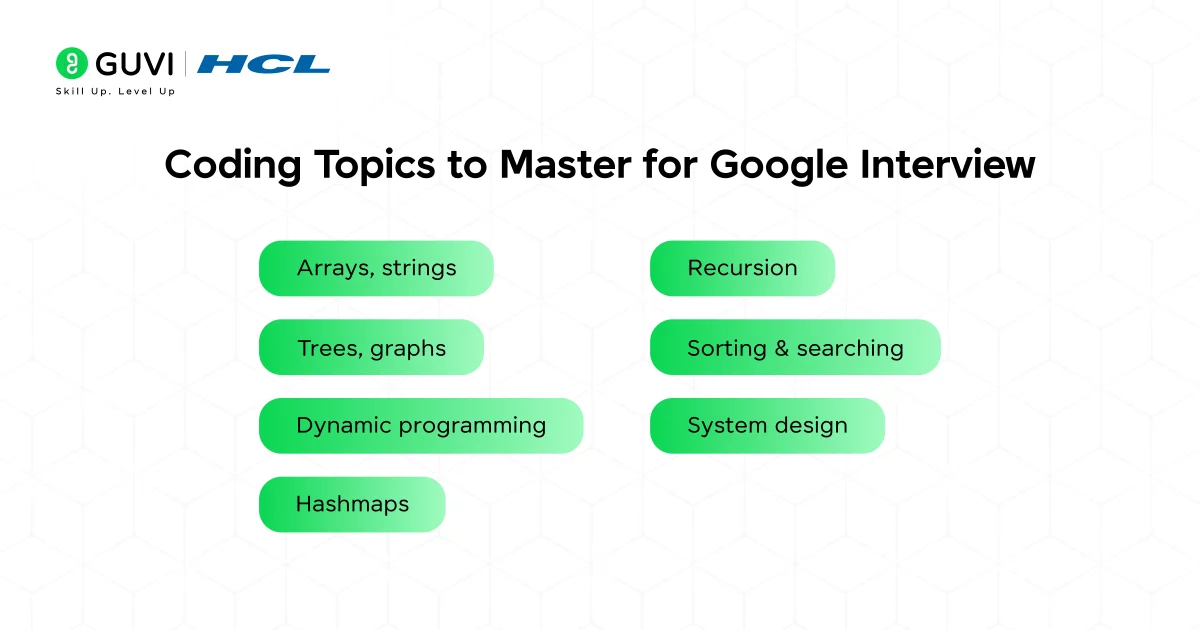
Coding Preparation Plan
If you’re applying for a technical role, coding interviews are coming. Practice on websites like LeetCode and HackerRank.
These platforms have thousands of interview-style problems. Start with easier problems and work your way up.
Mock interviews are invaluable. Practice answering questions out loud and explaining your thinking. Data structures and algorithms are must-knows. You’ll be asked about arrays, trees, graphs, sorting, and searching. Study these topics thoroughly and practice implementing them from scratch.
Behavioural Interview Prep
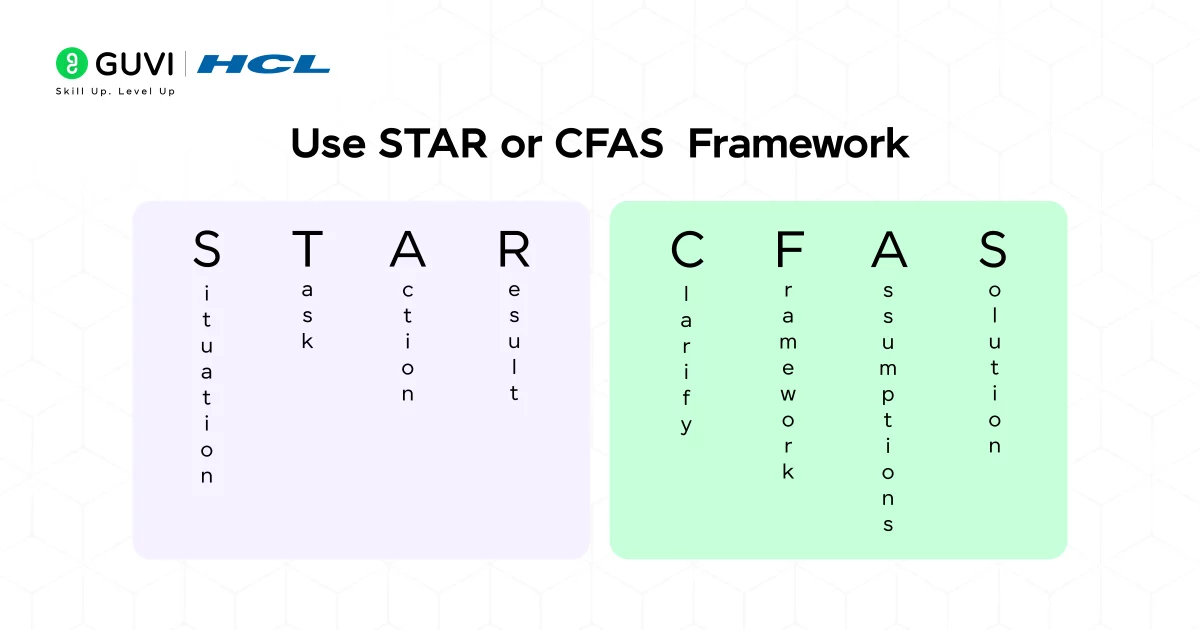
Google also conducts behavioral interviews. These questions explore how you handle situations and work with others.

Common questions include “Tell me about a time you solved a difficult problem” or “Describe a conflict with a teammate.”
Use the STAR method to answer these questions. STAR stands for Situation, Task, Action, and Result. Start by describing the situation, explain the task you faced, describe the action you took, and finish by sharing the result.
In behavioral interviews, show your Googleyness. Demonstrate that you’re collaborative, curious, and humble. Communicate with confidence even if you’re nervous. Speak clearly, avoid filler words like “um,” and be genuine in your responses.
Also Read: How to Get an Internship at Google
Resources and Platforms Google Employees Recommend for Interview Preparation
For a Job at Google, most successful candidates rely on a small set of trusted resources instead of jumping between dozens of platforms. The resources below are frequently recommended by engineers, interview candidates, and hiring communities for building strong coding, system design, and behavioral interview skills.
• Coding Interview Preparation
- LeetCode — The most widely used platform for practicing coding problems and company-tagged questions.
- NeetCode — Provides structured roadmaps such as Blind 75 and NeetCode 150 along with video explanations.
- HackerRank — Useful for strengthening programming fundamentals and timed coding practice.
• System Design Preparation
- System Design Primer GitHub Repository — One of the most recommended free resources for system design preparation.
- ByteByteGo — Excellent for learning distributed systems and architecture concepts.
- Hello Interview System Design Guides — Covers practical system design interview patterns.
• Behavioral and Googleyness Preparation
- Prepare stories using the STAR (Situation, Task, Action, Result) framework.
- Practice questions around leadership, conflict resolution, teamwork, and decision-making, as these are commonly evaluated during Google interviews.
• Mock Interviews
- Pramp — Free peer-to-peer mock interviews for coding and system design.
- Interviewing.io — Anonymous mock interviews with engineers from top tech companies.
Preparing consistently with a few high-quality resources is usually more effective than trying every platform available. If your goal is a Job at Google, depth of preparation matters far more than the number of resources you use.
Improve Your Chances of Getting a Job at Google
Beyond skills and interviews, there are more things you can do to stand out and show that you match Google’s culture.
A. Build a Strong Online Presence
Recruiters often check your LinkedIn, GitHub, Behance, or personal website. A strong online presence showcases your growth, projects, and interests. Write about your work, share your achievements, and stay active. This helps you look professional and confident.
B. Network with Google Employees
You can connect with Google employees on LinkedIn. Ask for advice, learn about their experience, and understand what the company expects. If someone believes in your skills, they might refer to you. A referral increases your chances of getting noticed.
C. Keep Learning and Stay Curious
Google loves people who keep learning. Technology changes quickly, so staying up to date is important. Read blogs, take short courses, join online learning groups, and try new tools. When you show curiosity, you show Google that you fit the company culture.
Google vs FAANG vs Indian Product Companies: Which Is Harder to Crack?
Getting a job at Google is often considered one of the toughest challenges in tech, but it is not the only company with a demanding hiring process. Other FAANG companies and leading Indian product firms are also highly selective.
The difficulty usually depends on factors such as the number of applicants, interview complexity, role expectations, and the level of competition. The table below provides a quick comparison to help put things into perspective.
| Company Category | Hiring Difficulty | Competition Level |
|---|---|---|
| ⭐⭐⭐⭐⭐ Very High | Extremely High | |
| FAANG Companies | ⭐⭐⭐⭐ High to Very High | Very High |
| Indian Product Companies | ⭐⭐⭐ High to Very High | High |
Conclusion
Getting a job at Google is challenging but absolutely possible with the right preparation. Focus on building real skills, creating impressive projects, and understanding what Google values in candidates. Keep learning, stay curious, and don’t be discouraged by rejection. Many successful Google employees faced rejection before getting hired.
Your hard work and dedication will pay off. Apply to Google with confidence, knowing you’ve done everything you can to prepare. Good luck!
FAQs
1. Is it hard to get a Job at Google?
Yes. The competition is very high, but strong skills, projects, and interview preparation can improve your chances.
2. Can freshers apply for a Job at Google in India?
Yes. Google hires fresh graduates through campus placements, internships, and entry-level roles.
3. What CGPA is required for a Job at Google?
There is no official CGPA cutoff. Skills, projects, and interview performance matter more.
4. Does Google hire candidates without a computer science degree?
Yes. Candidates from different educational backgrounds can apply if they have the required skills.
5. How many interview rounds does Google usually have?
Most candidates go through 4 to 6 interview rounds, including technical and behavioural interviews.
6. What programming languages does Google prefer?
Commonly used languages include Python, Java, C++, JavaScript, and Go, depending on the role.
7. How long does it take to get a Job at Google?
The hiring process for a Job at Google typically takes anywhere from a few weeks to a few months, depending on the role, interview schedule, and team matching process.
Success Stories
















Did you enjoy this article?