


Career Articles
Cognizant GenC Elevate Communication Assessment: Test Pattern and Preparation - Best Guide
Cognizant GenC Next and GenC Elevate Interview Experience
Cognizant GenC Elevate Interview Experience (On Campus): Rounds, Questions and Prep - Best Guide
Capgemini Exceller Syllabus 2026: Complete Topics and Exam Pattern - Best Guide


Get In Touch For Details! Request More Information
Cognizant GenC Elevate Interview Questions and Answers for Freshers – Best Guide
Sep 24, 2026 8 Min Read 15 Views
(Last Updated)
Table of contents
- TL;DR
- Why GenC Elevate Interview Questions Still Matter in 2026
- What Should You Know Before Using GenC Elevate Interview Questions?
- Which Topics Were Common in GenC Elevate Interviews?
- GenC Elevate Interview Questions on Resume and Projects
- Tell me about yourself.
- Explain your final year project.
- What challenge did you face in your project?
- GenC Elevate Technical Questions on Java and OOP
- What are the four pillars of OOP?
- What is the difference between method overloading and method overriding?
- Why are strings immutable in Java?
- What is exception handling?
- What is an interface in Java?
- GenC Elevate Interview Questions on SQL and DBMS
- What is the difference between DDL and DML?
- What is a primary key?
- What is a foreign key?
- What is normalisation?
- What are ACID properties?
- Write a query to find the second highest salary.
- GenC Elevate Interview Questions on OS, Networks, and Cloud
- What is the difference between a process and a thread?
- What is a deadlock?
- What is virtual memory?
- What is cloud computing?
- GenC Elevate Coding Questions to Practice
- How would you check whether a string is a palindrome?
- How would you find the second largest distinct number in an array?
- How would you count character frequency in a string?
- GenC Elevate HR Questions and Sample Answers
- Why do you want to join Cognizant?
- Are you willing to relocate?
- Are you comfortable working in shifts?
- What are your strengths and weaknesses?
- Why should we hire you?
- How Should You Prepare for GenC Elevate Interview Questions?
- Step 1: Audit Your Resume
- Step 2: Revise One Programming Language
- Step 3: Practise SQL
- Step 4: Revise Core CS Basics
- Step 5: Practise Small Coding Problems
- Step 6: Prepare Your Project
- Step 7: Practise HR Answers Aloud
- Real World Fresher Example
- Common Mistakes While Preparing GenC Elevate Interview Questions
- Prepare for Cognizant Interviews with HCL GUVI
- Conclusion
- Frequently Asked Questions
- What are the most common GenC Elevate interview questions?
- Is Cognizant GenC Elevate available in 2026?
- Are Java questions asked in GenC Elevate interviews?
- Is SQL important for GenC Elevate interview preparation?
- What coding questions should I practise?
- Are projects asked in the Cognizant technical interview?
- What GenC Elevate HR questions should I prepare?
- How should I answer if I do not know a technical question?
- How many GenC Elevate interview questions should I practise?
TL;DR
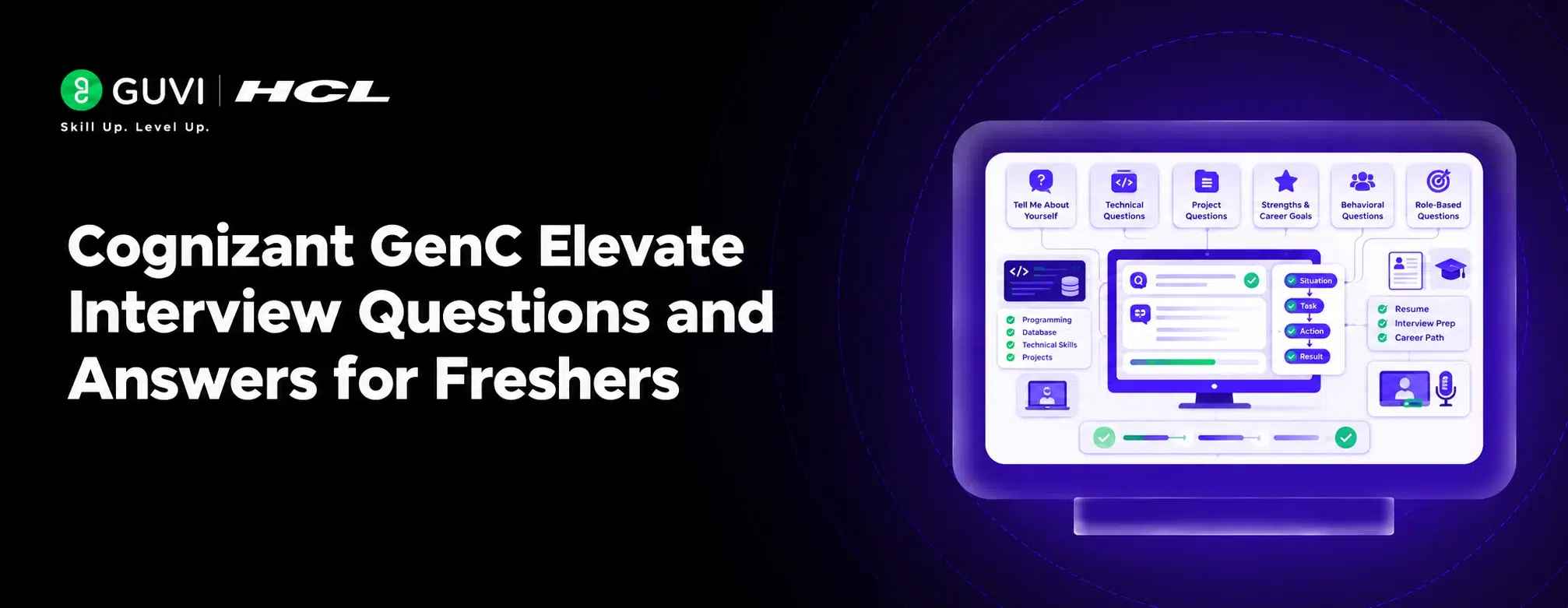
GenC Elevate interview questions from earlier Cognizant campus hiring cycles commonly covered self introduction, projects, Java or another preferred programming language, OOP, coding, SQL, DBMS, operating systems, cloud basics, and HR topics such as relocation and shift flexibility. For 2026, remember that Cognizant’s current engineering campus material lists GenC, GenC Pro, and GenC Next rather than GenC Elevate as a separate category. Use these GenC Elevate interview questions as a historical preparation bank, not as a guaranteed current question paper. For a current drive, follow your Cognizant assessment and interview communication first.
Why GenC Elevate Interview Questions Still Matter in 2026
GenC Elevate interview questions are still searched by freshers because older Cognizant campus experiences contain useful examples of the technical and HR topics the company tested in its Elevate hiring route.
Historical candidate reports repeatedly mention Java, OOP, SQL, DBMS, projects, coding, operating systems, cloud concepts, and workplace questions. However, the exact interview differed by campus, candidate, and panel.
This guide gives original GenC Elevate interview answers and practice questions while keeping one 2026 point clear: GenC Elevate is an older category, so current candidates should check the latest Cognizant hiring notice before assuming the same pattern applies.
What Should You Know Before Using GenC Elevate Interview Questions?
The most important context is that GenC Elevate interview questions mostly come from earlier Cognizant campus hiring cycles.
Cognizant’s current 2026 engineering on campus page lists three hiring categories: GenC Next, GenC Pro, and GenC. It does not list GenC Elevate as a separate current category.
That does not make older GenC Elevate interview questions useless. They remain valuable for practising programming fundamentals, databases, coding logic, project explanation, and HR communication.
Use them as a preparation bank. Do not treat them as an official 2026 interview syllabus.
Historical GenC Elevate interview questions were not limited to coding. Candidate reports also mention OOP, DBMS, SQL, operating systems, project discussion, aptitude, and questions about newer technologies such as cloud and big data.
If you need the current structure first, here is the Cognizant GenC 2026 guide.
Which Topics Were Common in GenC Elevate Interviews?
Historical GenC Elevate interview questions show a stronger pattern in the topics than in the exact wording.
| Area | What to Prepare |
| Resume | Education, skills, certifications, internships |
| Projects | Problem, technology stack, contribution, challenges |
| Programming | Java, C, C++, Python, or the language on your resume |
| OOP | Encapsulation, inheritance, abstraction, polymorphism |
| Coding | Strings, arrays, loops, basic number problems |
| SQL | SELECT, joins, keys, DDL, DML, queries |
| DBMS | Normalisation, ACID properties, indexing, keys |
| OS | Process, thread, deadlock, virtual memory |
| Networks | Basic networking concepts in some interviews |
| Cloud | Cloud computing, IaaS, PaaS, SaaS in some reports |
| HR | Relocation, shifts, learning flexibility, strengths |
A 2021 Code360 candidate report described preparation around DSA, OOP, Core Java, DBMS, and SQL. A later GeeksforGeeks account reported Java, SQL, cloud, coding, and HR questions. This variation is exactly why GenC Elevate interview questions should be used by topic rather than memorised word for word.
GenC Elevate Interview Questions on Resume and Projects
1. Tell me about yourself.
A good answer should cover your education, strongest technical skills, one relevant project or internship, and what you want to learn next.
Sample answer:
“I recently completed my degree in Computer Science. I am comfortable with Java, SQL, and basic data structures. My final year project was a placement management portal where I worked mainly on the backend and database. I enjoy solving programming problems and I am looking for an entry level role where I can strengthen my software development skills.”
Keep the answer around one minute. This question matters because the skills you mention can decide the follow up questions.
2. Explain your final year project.
Use this order:
Problem → Solution → Technology → Your contribution → Challenge → Result
Sample answer:
“My project was a college event management portal. It allowed students to register for events and organisers to manage registrations. We used Java and MySQL. I worked on the backend and database. One issue was duplicate registrations, so I added validation before saving each entry.”
Project based questions can become technical quickly, so be ready to explain every technology you mention.
3. What challenge did you face in your project?
Choose one real technical or teamwork problem. Explain what happened, what you did, and what changed.
Sample answer:
“We noticed duplicate records in our database during testing. I traced the problem to missing validation in the registration flow. I added a check using the student ID before insert operations and tested it with different cases. That removed the duplicate entries.”
This type of GenC Elevate interview answer is stronger than saying your project had no problems.
GenC Elevate Technical Questions on Java and OOP
Historical GenC Elevate interview questions frequently include Java and OOP when Java appears on the candidate’s resume. Candidate reports specifically mention OOP, interfaces, string immutability, exception handling, and related Java fundamentals.
For deeper revision, use Java interview questions for freshers.
4. What are the four pillars of OOP?
The four pillars are:
- Encapsulation: Bundling data and methods together and controlling access to internal state.
- Abstraction: Showing essential behaviour while hiding implementation details.
- Inheritance: Creating a new class from an existing class to reuse or extend behaviour.
- Polymorphism: Allowing the same interface or method name to behave differently in different contexts.
5. What is the difference between method overloading and method overriding?
Overloading means using the same method name with different parameter lists. It is resolved at compile time.
Overriding means a subclass provides its own implementation of a method already defined in its parent class. It supports runtime polymorphism.
6. Why are strings immutable in Java?
A Java String cannot be changed after creation. Operations that appear to modify a String create a new object.
Immutability helps with string pooling, security, thread safety, and predictable hash values. Explain the idea first before discussing memory details.
7. What is exception handling?
Exception handling lets a program deal with runtime problems without ending abruptly.
Java uses try, catch, finally, throw, and throws for exception handling. A good answer should also explain when you would catch an exception rather than only naming the keywords.
8. What is an interface in Java?
An interface defines a contract that implementing classes agree to follow. It can declare abstract methods and can also contain default, static, and private methods in modern Java.
Interfaces are useful when different classes need to expose common behaviour without sharing the same class hierarchy.
GenC Elevate Interview Questions on SQL and DBMS
SQL and DBMS appear repeatedly in historical GenC Elevate interview questions, so this section deserves dedicated practice. Candidate reports mention SQL queries, DDL, DML, keys, normalisation, transactions, and indexing.
For deeper revision, SQL interview questions and answers will help.
9. What is the difference between DDL and DML?
DDL, or Data Definition Language, changes database structures. Common commands include CREATE, ALTER, DROP, and TRUNCATE.
DML, or Data Manipulation Language, works with the data stored inside tables. Common commands include INSERT, UPDATE, and DELETE.
10. What is a primary key?
A primary key is a column or group of columns that uniquely identifies each row in a table. Primary key values must be unique and cannot be NULL.
11. What is a foreign key?
A foreign key is a column or group of columns that refers to a key in another table. It helps maintain relationships and referential integrity between tables.
12. What is normalisation?
Normalisation is the process of organising database tables to reduce unnecessary duplication and improve data consistency.
For fresher level GenC Elevate interview questions, be ready to explain 1NF, 2NF, and 3NF with a simple example rather than only listing their names.
13. What are ACID properties?
ACID describes four properties of reliable database transactions:
- Atomicity: A transaction completes fully or not at all.
- Consistency: A transaction keeps the database valid.
- Isolation: Concurrent transactions should not interfere incorrectly.
- Durability: Committed changes remain saved even after a failure.
14. Write a query to find the second highest salary.
One simple approach is:
SELECT MAX(salary)
FROM employees
WHERE salary < (SELECT MAX(salary) FROM employees);
If duplicate salary values matter, clarify whether the interviewer wants the second highest distinct salary.
SQL based GenC Elevate interview questions often test whether you can explain your query, not just write syntax.
GenC Elevate Interview Questions on OS, Networks, and Cloud
Not every candidate reported the same computer science subjects, but historical GenC Elevate interview questions include OS, networking, and cloud basics often enough to revise them.
15. What is the difference between a process and a thread?
A process is an independent program in execution with its own memory space.
A thread is a smaller execution unit within a process. Threads in the same process share resources such as memory and files.
16. What is a deadlock?
Deadlock is a situation where processes are permanently waiting for resources held by one another.
The four classic conditions are mutual exclusion, hold and wait, no preemption, and circular wait.
17. What is virtual memory?
Virtual memory lets a system use disk space to extend the effective memory available to programs when physical RAM is limited.
It also provides processes with their own logical address spaces, though using disk is much slower than RAM.
18. What is cloud computing?
Cloud computing provides computing resources such as servers, storage, databases, and software over a network on demand.
Among historical GenC Elevate interview questions, cloud questions were usually basic. Be ready to explain IaaS, PaaS, and SaaS with one example each. One historical on campus account specifically reports these cloud service model questions.
GenC Elevate Coding Questions to Practice
Coding based GenC Elevate interview questions were generally reported around beginner to moderate fresher problems rather than advanced system design. Historical reports include Fibonacci, palindrome, methods, arrays, and other basic programming tasks.
Useful areas include strings, arrays, loops, number logic, methods, searching, and basic data structures.
For more practice, use DSA interview questions and answers.

19. How would you check whether a string is a palindrome?
Compare the string with its reverse or use two pointers, one from each end.
For example, level is a palindrome because it reads the same forward and backward.
In an interview, mention how you would handle case differences, spaces, or punctuation if the input rules require it.
20. How would you find the second largest distinct number in an array?
Track the largest and second largest distinct values while scanning the array once.
Before coding, clarify how duplicates should be handled. This shows the interviewer that you think about requirements before implementation.
21. How would you count character frequency in a string?
Use a hash map or dictionary where the character is the key and its count is the value.
Scan the string once and increase the count for each character. This gives linear time complexity with respect to the string length.
These GenC Elevate interview questions are more useful when you practise explaining your logic aloud before typing code.
GenC Elevate HR Questions and Sample Answers
Historical GenC Elevate HR questions include relocation, shift flexibility, strengths, weaknesses, technology flexibility, and motivation. Some candidate reports describe these questions inside the technical discussion rather than as a completely separate round.
22. Why do you want to join Cognizant?
Sample answer:
“I want to start my career in an environment where I can work with different technologies and continue learning. Cognizant’s GenC program is designed for emerging talent and includes role based skilling and project exposure, which matches what I am looking for at the start of my career.”
Cognizant currently describes GenC as its hiring and development program for emerging talent in India and highlights role based skilling and project exposure.
Avoid memorising this answer word for word. Personalise your GenC Elevate interview answers with your own goals.
23. Are you willing to relocate?
Answer honestly.
Sample answer if you are open to relocation:
“Yes. I am comfortable relocating based on the project and business requirement.”
Do not say yes only because you think it is the expected answer if you have a genuine restriction.
24. Are you comfortable working in shifts?
Sample answer:
“Yes, I understand that client projects may require different working hours. I am open to shifts based on the role and project requirements.”
Change the answer if you have a real limitation.
25. What are your strengths and weaknesses?
Choose strengths you can support with examples.
For a weakness, mention something real but manageable and explain what you are doing to improve it.
Sample answer:
“One strength is that I stay patient when debugging problems. One area I am improving is speaking in larger groups, so I have started taking more presentation opportunities in college.”
26. Why should we hire you?
A fresher does not need to claim expert level skills.
Sample answer:
“I have a good foundation in Java, SQL, and problem solving. I can explain the projects I have built, I am comfortable learning new technologies, and I am willing to put in consistent effort during training and project work.”
Good GenC Elevate interview answers should sound like you, not like a script copied from a preparation site.
How Should You Prepare for GenC Elevate Interview Questions?
Use a simple preparation order rather than trying to learn every question online.
Step 1: Audit Your Resume
Read every skill, project, certification, and technology listed on your resume.
If you cannot explain something, revise it or remove it before the interview.
Step 2: Revise One Programming Language
Choose the language you know best.
Prepare syntax, OOP, strings, arrays, functions, exception handling, and common collections or data structures relevant to that language.
Step 3: Practise SQL
Write queries rather than only reading them.
Focus on SELECT, WHERE, JOIN, GROUP BY, aggregate functions, subqueries, and keys.
Step 4: Revise Core CS Basics
Cover OOP, DBMS, operating systems, basic networking, and cloud fundamentals.
Step 5: Practise Small Coding Problems
Solve strings, arrays, number problems, searching, sorting, and simple hash map questions.
Step 6: Prepare Your Project
Use this format:
Problem → Solution → Technology → Your contribution → Challenge → Result
Step 7: Practise HR Answers Aloud
Your Cognizant interview preparation should include speaking, not just reading.
MNC interview preparation guide can help you structure technical, project, and HR preparation.
Real World Fresher Example
Suppose Meera is preparing for a current Cognizant campus drive and finds older GenC Elevate interview questions online.
She does not assume her 2026 role is GenC Elevate. She first checks her official Cognizant communication and sees that her drive follows the current GenC structure.
She still uses historical GenC Elevate interview questions to build a practice checklist: Java, OOP, SQL, DBMS, one project explanation, three coding problems, and common HR questions.
Instead of memorising 100 answers, she practises explaining 25 core concepts in her own words. She also writes SQL and code without looking at solutions.
That approach makes historical material useful without confusing it with the current hiring category.
Common Mistakes While Preparing GenC Elevate Interview Questions
1. Treating Elevate as a current 2026 category: Current Cognizant engineering campus material lists GenC, GenC Pro, and GenC Next. Use older GenC Elevate interview questions for practice, not as proof of the current category structure.
2. Memorising answers word for word: Interviewers can ask follow ups. Understand the concept and practise explaining it naturally.
3. Ignoring your project: Project discussion is common in candidate reports. Know your own contribution, technology choices, database, and one challenge.
4. Reading coding solutions without solving them: GenC Elevate interview questions involving code are useful only if you can reproduce the logic independently.
5. Preparing technical topics but skipping HR: Relocation, shifts, strengths, learning flexibility, and motivation also appear in historical Cognizant interview questions.
Prepare for Cognizant Interviews with HCL GUVI
Preparing for Cognizant GenC Elevate or similar fresher interviews requires more than just revising coding questions. You should also practise technical concepts, aptitude, HR questions, and common interview scenarios. To prepare in a more structured way, explore HCL GUVI’s Interview Preparation resources and practise the topics recruiters commonly assess during technical and HR rounds.
Conclusion
GenC Elevate interview questions from earlier Cognizant campus drives show a clear preparation pattern: know your resume and project, prepare one programming language well, revise OOP, SQL, DBMS, OS and basic cloud concepts, practise simple coding, and prepare honest HR answers.
For 2026, use these GenC Elevate interview questions as historical preparation material because current Cognizant engineering campus hiring lists GenC, GenC Pro, and GenC Next rather than a separate Elevate category. Focus on concepts instead of memorising exact questions, and always follow the latest instructions sent for your own Cognizant interview.
Frequently Asked Questions
1. What are the most common GenC Elevate interview questions?
Common historical GenC Elevate interview questions cover self introduction, projects, Java or another programming language, OOP, SQL, DBMS, coding, operating systems, cloud basics, relocation, and shift flexibility.
2. Is Cognizant GenC Elevate available in 2026?
Cognizant’s current 2026 engineering campus page lists GenC, GenC Pro, and GenC Next. GenC Elevate interview questions should therefore be treated as historical preparation unless your own official Cognizant communication says otherwise.
3. Are Java questions asked in GenC Elevate interviews?
Java appears frequently in older candidate reports, especially when Java was the candidate’s preferred language. Prepare the language listed on your resume rather than assuming Java is mandatory for everyone.
4. Is SQL important for GenC Elevate interview preparation?
Yes. Historical GenC Elevate interview questions repeatedly cover SQL and DBMS concepts such as joins, keys, normalisation, transactions, and simple query writing.
5. What coding questions should I practise?
Practise strings, arrays, loops, palindrome checks, frequency counting, searching, sorting, second largest element, and basic number problems. Explain your approach before writing code.
6. Are projects asked in the Cognizant technical interview?
Yes. Project discussion appears frequently in historical candidate experiences. Be ready to explain the problem, stack, your contribution, database, challenge, and result.
7. What GenC Elevate HR questions should I prepare?
Prepare questions about relocation, shifts, strengths, weaknesses, learning new technologies, teamwork, career goals, and why you want to join Cognizant.
8. How should I answer if I do not know a technical question?
Say that you are not fully sure instead of inventing an answer. You can explain the part you know and, if appropriate, describe how you would find or verify the correct solution.
9. How many GenC Elevate interview questions should I practise?
There is no official number. A focused set covering programming, OOP, SQL, DBMS, coding, projects, CS basics, and HR is more useful than memorising a very large question bank.
Success Stories

About the Author
Reemsha Khan
Always been a storyteller at heart. Now, I turn complex topics into simple, easy-to-understand stories through content. Hope you find it helpful.
View all posts by Reemsha Khan
Connect with me @








Did you enjoy this article?