


Career Articles
Cognizant GenC Elevate Interview Questions and Answers for Freshers - Best Guide
Cognizant GenC Next and GenC Elevate Interview Experience
Cognizant GenC Elevate Interview Experience (On Campus): Rounds, Questions and Prep - Best Guide
Capgemini Exceller Syllabus 2026: Complete Topics and Exam Pattern - Best Guide


Get In Touch For Details! Request More Information
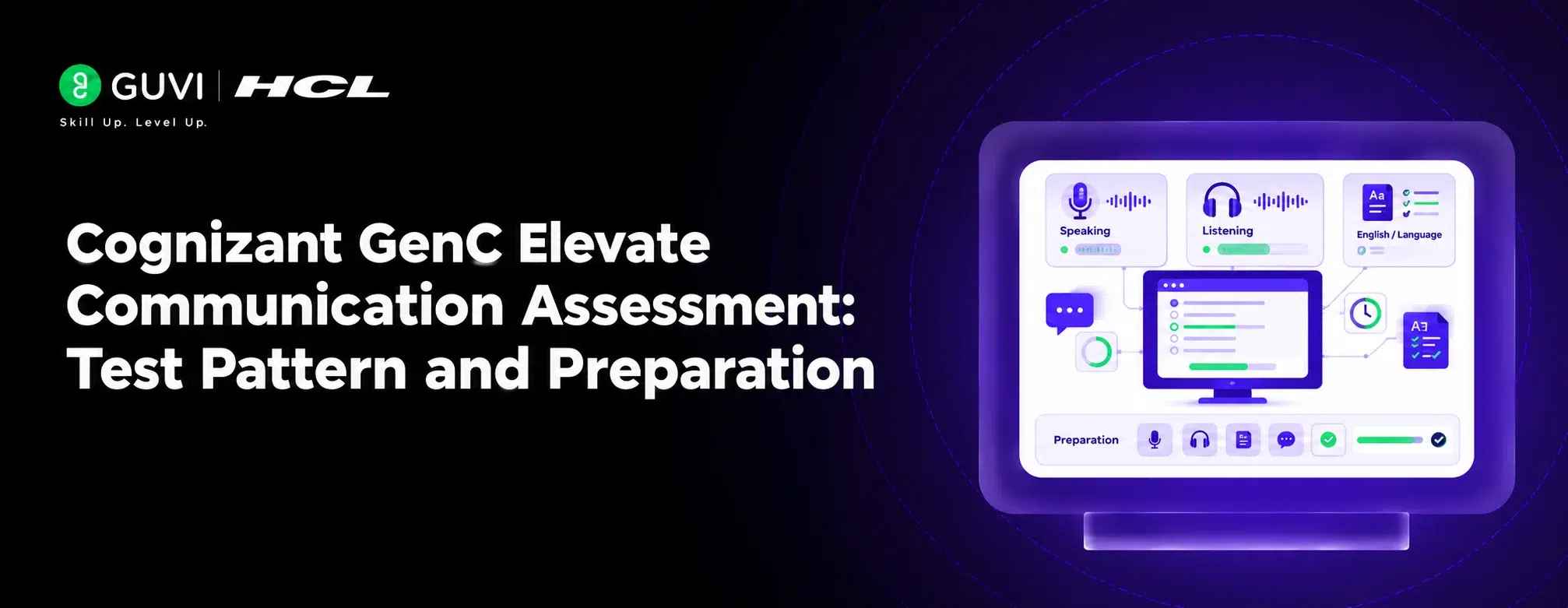
Cognizant GenC Elevate Communication Assessment: Test Pattern and Preparation – Best Guide
Sep 24, 2026 7 Min Read 17 Views
(Last Updated)
Table of contents
- TL;DR
- What Should You Know Before Preparing for the Communication Assessment?
- What Is the GenC Elevate Communication Assessment?
- Is GenC Elevate Still Used in Cognizant 2026 Hiring?
- What Was the Reported GenC Elevate Communication Assessment Pattern?
- Historical GenC Elevate Communication Assessment at a Glance
- Was the GenC Elevate Communication Assessment an Elimination Round?
- What Skills Did the GenC Elevate Communication Assessment Test?
- Fluency
- Pronunciation
- Listening and Comprehension
- Sentence Structure
- How Should You Prepare for Reading and Pronunciation?
- Simple Practice Example
- How Should You Prepare for Listening and Sentence Repetition?
- How Should You Prepare for Grammar and Sentence Formation?
- Practice Example
- How Should You Prepare for Speaking and Storytelling?
- Example Topic: Working in a Team
- Storytelling Structure
- What Is the Current Cognizant Communication Assessment Like in 2026?
- Sample GenC Elevate Communication Assessment Practice Tasks
- Task 1: Read Aloud
- Task 2: Sentence Repetition
- Task 3: Jumbled Sentence
- Task 4: Short Question
- Task 5: Speaking
- Task 6: Storytelling
- 5 Day GenC Elevate Communication Assessment Preparation Plan
- Day 1: Reading and Pronunciation
- Day 2: Listening
- Day 3: Grammar
- Day 4: Speaking and Storytelling
- Day 5: Mock Assessment
- Real World Example: How a Fresher Can Prepare
- Common Mistakes in GenC Elevate Communication Assessment Preparation
- Prepare Your Communication Skills with HCL GUVI
- Frequently Asked Questions
- What is the GenC Elevate communication assessment?
- Is there a GenC Elevate communication assessment in 2026?
- How long was the GenC Elevate communication assessment?
- What sections were included in the GenC Elevate communication assessment?
- Was the GenC Elevate communication assessment an elimination round?
- What should I practice for the Cognizant communication test?
- Is an accent important in the Cognizant communication assessment?
- How can I improve quickly for the GenC Elevate communication assessment?
- What is the difference between the historical Elevate test and current GenC communication assessment?
TL;DR
The GenC Elevate communication assessment was part of Cognizant’s earlier GenC Elevate campus hiring process after the technical assessment. Historical Cognizant material confirms the communication round, while candidate and preparation sources commonly describe reading, listening, grammar, comprehension, speaking, and story based tasks. Exact timings and section formats varied across sources, so they should not be treated as one universal official pattern. In 2026, Cognizant’s current engineering campus structure lists GenC, GenC Pro, and GenC Next rather than GenC Elevate, but communication assessment remains part of current GenC hiring. Follow your own assessment invitation for the exact format.
What Should You Know Before Preparing for the Communication Assessment?
The GenC Elevate communication assessment was used to check whether candidates could understand spoken and written English and communicate their ideas clearly during earlier Cognizant GenC Elevate hiring.
Historical candidate reports repeatedly mention reading, listening, comprehension, grammar, sentence formation, pronunciation, speaking, and storytelling. However, the exact structure was not identical across every available source.
For 2026, you should also know that Cognizant’s current engineering campus structure uses GenC, GenC Pro, and GenC Next rather than a separate GenC Elevate category.
That means this guide uses the historical GenC Elevate communication assessment as preparation context while also explaining what current Cognizant candidates should check before their test.
What Is the GenC Elevate Communication Assessment?
The GenC Elevate communication assessment was a language and communication stage in Cognizant’s earlier GenC Elevate campus hiring process.
Historical Cognizant material shows that candidates who cleared the first assessment moved to a communication assessment before the technical interview. The official historical brochure confirms the stage but does not provide a detailed public breakdown of question numbers or individual communication tasks.
Preparation sites and candidate experiences from that period commonly describe tasks designed to check:
- Reading
- Listening
- Comprehension
- Grammar
- Sentence formation
- Pronunciation
- Fluency
- Speaking
- Storytelling
The main goal of the GenC Elevate communication assessment was therefore broader than checking grammar alone. Candidates needed to understand information and communicate it clearly.
If you want to understand where this round fits into the complete hiring process, Cognizant GenC Elevate exam pattern guide, will be a great help.
Is GenC Elevate Still Used in Cognizant 2026 Hiring?
No separate GenC Elevate category is listed in Cognizant’s current 2026 engineering on campus material.
The current hiring page lists:
- GenC Next
- GenC Pro
- GenC
Cognizant states that candidates across these current categories undergo a communication assessment, aptitude and technical assessment, and a technical or SME interview.
Cognizant’s broader GenC careers page also says assessments can evaluate communication skills, aptitude, and technical skills, with the process varying according to the role.
So, the GenC Elevate communication assessment remains useful for understanding earlier Cognizant communication testing, but you should not assume that an old Elevate test pattern is the official 2026 pattern.
For the current category structure, see the Cognizant GenC 2026 guide.
Cognizant’s current 2026 engineering campus material states that GenC Next, GenC Pro, and GenC candidates all undergo a communication assessment. GenC Elevate appears in older Cognizant campus hiring material rather than the current category structure.
What Was the Reported GenC Elevate Communication Assessment Pattern?
The historical GenC Elevate communication assessment is commonly described as a roughly 45 minute communication round, but that duration comes from candidate and preparation reports rather than the historical Cognizant brochure.
PrepInsta’s 2023 preparation page grouped the GenC Elevate communication assessment into three broad areas:
- Reading and Grammar
- Comprehension and Listening
- Speaking
It also identified fluency, vocabulary, pronunciation, and sentence mastery as important evaluation areas.
Candidate experiences from earlier Cognizant campus drives similarly mention reading, listening, speaking, comprehension, and storytelling.
Historical GenC Elevate Communication Assessment at a Glance
| Area | Commonly Reported Task | What It Checks |
| Reading | Read sentences or short passages aloud | Pronunciation, pace, clarity |
| Listening | Listen to sentences or audio | Attention and comprehension |
| Sentence Repetition | Repeat what you hear | Listening accuracy and memory |
| Grammar | Complete or organise sentences | Grammar and sentence structure |
| Speaking | Speak on a given topic | Fluency and structured thinking |
| Storytelling | Retell or create a short story | Comprehension, vocabulary and coherence |
Do not treat this table as an official fixed 2026 GenC Elevate assessment test syllabus. It summarises recurring historical reports.
Was the GenC Elevate Communication Assessment an Elimination Round?
This is one area where historical sources conflict.
PrepInsta describes the GenC Elevate communication assessment as an elimination round. However, multiple historical candidate experiences on GeeksforGeeks describe their communication round as compulsory but non elimination.
The historical Cognizant hiring brochure confirms that selected candidates appeared for a communication assessment but does not explicitly state on the cited page whether the round was elimination or non elimination.
Therefore, the safest answer is: do not assume the elimination rule from one old candidate experience or preparation website. Follow the instructions provided for your own Cognizant communication assessment.
What Skills Did the GenC Elevate Communication Assessment Test?
The GenC Elevate communication assessment was designed around practical English communication rather than difficult vocabulary.
Four skills deserve most of your preparation.
1. Fluency
Fluency means speaking continuously at a natural pace without too many long pauses or repeated words.
You do not need to speak extremely fast. A controlled pace makes your answer easier to understand.
2. Pronunciation
Pronunciation affects whether the listener can understand the words you say.
Do not try to copy a particular accent. Focus on saying common English words clearly and naturally.
3. Listening and Comprehension
Listening tasks check whether you can understand spoken information and remember the important parts.
The GenC Elevate communication assessment reportedly included listening based activities, so active listening is more useful than simply hearing English in the background.
4. Sentence Structure
Good communication requires sentences that are grammatically clear and logically organised.
Simple sentences are usually safer than long sentences filled with unnecessary words.
For a broader understanding of why communication matters in professional roles; guide on the importance of soft skills.
How Should You Prepare for Reading and Pronunciation?
Reading aloud is one of the simplest ways to prepare for the GenC Elevate communication assessment.
Choose a short English paragraph from a technology, business, or career article and read it aloud every day.
While reading, focus on:
- Speaking every word clearly
- Pausing at punctuation
- Avoiding unnecessary speed
- Maintaining steady volume
- Completing each sentence naturally
Simple Practice Example
Read this aloud:
“Technology teams often work with clients from different industries. Clear communication helps developers understand requirements and explain technical decisions.”
Record yourself once.
Listen again and check whether every word is understandable.
The purpose of GenC Elevate communication assessment practice is not to sound perfect. It is to become clear and consistent.
How Should You Prepare for Listening and Sentence Repetition?
Listening was another commonly reported part of the historical GenC Elevate communication assessment.
Start with short sentences rather than long podcasts.
Listen once and repeat the sentence without reading it.
For example:
Audio sentence:
“The development team will complete the testing phase tomorrow.”
Try to repeat the complete sentence accurately.
Next, move to two or three sentence audio clips and summarise the main idea in your own words.
This builds:
- Listening accuracy
- Short term memory
- Sentence recall
- Comprehension
- Spoken response
Do not panic if you miss one word. Focus on understanding the meaning first.
How Should You Prepare for Grammar and Sentence Formation?
The GenC Elevate communication assessment also included grammar and sentence construction according to historical preparation sources.
Prioritise basic grammar that affects everyday communication:
- Subject verb agreement
- Tenses
- Articles
- Prepositions
- Pronouns
- Conjunctions
- Word order
- Sentence correction
Practice Example
Jumbled words:
project / completed / team / the / successfully
Correct sentence:
The team completed the project successfully.
Another example:
working / I / Java / enjoy / with
Correct sentence:
I enjoy working with Java.
You do not need advanced grammar books for GenC Elevate communication assessment preparation. Strong basics and repeated practice are more useful.
How Should You Prepare for Speaking and Storytelling?
Speaking tasks are where many candidates become nervous because they have only a short time to organise their thoughts.
Historical GenC Elevate communication assessment reports mention candidates speaking on a topic or responding to story based prompts.
Use this simple structure:
Opening → Two Main Points → Example → Closing
Example Topic: Working in a Team
You could say:
“Working in a team helps people combine different skills. It also teaches us how to communicate and solve problems together. During my college project, our team divided the frontend, backend, and documentation work based on our strengths. This helped us complete the project on time. I believe teamwork becomes effective when everyone communicates clearly and takes responsibility.”
That is enough.
You do not need complicated vocabulary.

Storytelling Structure
For storytelling, use:
Situation → Problem → Action → Result
If you receive an image showing a student missing a bus, for example, create a short logical story rather than adding unnecessary details.
This keeps your answer structured during the GenC Elevate communication assessment.
What Is the Current Cognizant Communication Assessment Like in 2026?
This is where you must separate current GenC information from the historical GenC Elevate communication assessment.
Cognizant officially confirms that communication assessment is part of its current 2026 engineering campus hiring process. However, its public hiring page does not publish the detailed task count or timing.
PlacementPreparation.io currently reports a five part 2026 GenC communication format with:
- Reading Sentences
- Repeat Sentences
- Jumbled Sentences
- Question and Answer
- Story Telling
It reports 60 total questions and 58 minutes shared across these sections.
These details relate to the current GenC communication assessment, not an officially published 2026 GenC Elevate communication assessment.
So, if you are taking a Cognizant assessment in 2026, use the format mentioned in your official email or assessment portal first.
Sample GenC Elevate Communication Assessment Practice Tasks
The following questions are original practice exercises. They are not copied from Cognizant or competitor tests.
Task 1: Read Aloud
Read clearly:
“Companies value employees who can solve problems and explain their ideas to different teams.”
Task 2: Sentence Repetition
Listen to someone read this once:
“Customer feedback helped the team improve the application.”
Now repeat it without looking at the sentence.
Task 3: Jumbled Sentence
Arrange:
meeting / attending / tomorrow / we / are / the
Answer:
We are attending the meeting tomorrow.
Task 4: Short Question
Question: Why is teamwork important?
Sample response:
“Teamwork helps people combine different skills and solve problems together. It also improves communication and makes it easier to complete shared goals.”
Task 5: Speaking
Speak for 45 to 60 seconds on:
A skill you recently learned
Task 6: Storytelling
Imagine three pictures showing:
A student preparing for an interview → attending the interview → receiving an offer
Tell a short story connecting all three events.
Practising these formats regularly can make the GenC Elevate communication assessment style feel much more familiar.
5 Day GenC Elevate Communication Assessment Preparation Plan
You do not need weeks of preparation if your English fundamentals are already reasonable.
Day 1: Reading and Pronunciation
Read aloud for 20 minutes.
Record five sentences and check your pace, pronunciation, and clarity.
Day 2: Listening
Practice listening to short sentences and repeating them.
Then listen to a one minute clip and summarise it.
Day 3: Grammar
Revise basic sentence structure, tenses, articles, prepositions, and subject verb agreement.
Solve sentence correction and jumbled sentence questions.
Day 4: Speaking and Storytelling
Choose five simple topics.
Speak for one minute on each topic without writing a full script.
Day 5: Mock Assessment
Combine reading, listening, grammar, short responses, and storytelling in one timed session.
Record the complete session.
Review where you paused too often, spoke too quickly, or lost sentence structure.
This gives you much more useful GenC Elevate communication assessment practice than memorising sample answers.
Real World Example: How a Fresher Can Prepare
Suppose Priya receives an invitation for a current Cognizant campus assessment.
She searches for the GenC Elevate communication assessment and finds several older pages saying the test contains reading, listening, and speaking sections.
Instead of assuming the old Elevate pattern applies exactly, Priya first checks her current assessment email.
She then uses the historical tasks to practise useful communication skills. Every evening, she reads one paragraph aloud, repeats five recorded sentences, answers two short questions, and speaks for one minute on one topic.
She also records herself instead of practising silently.
By the assessment day, Priya is familiar with the main communication task types without depending on one outdated GenC Elevate communication assessment pattern.
Common Mistakes in GenC Elevate Communication Assessment Preparation
1. Treating an old pattern as the current official pattern: The historical GenC Elevate communication assessment is useful for practice, but Cognizant’s current 2026 engineering categories are GenC, GenC Pro, and GenC Next. Check your latest assessment instructions.
2. Trying to speak too fast: Speed does not automatically mean fluency. Speak at a steady pace so your words remain clear.
3. Using difficult vocabulary unnecessarily: Simple and correct English is better than forcing unfamiliar words into your response.
4. Practising only grammar: The GenC Elevate communication assessment also involved listening and speaking. Your preparation should include all three skills.
5. Memorising speaking answers: A memorised answer can break down when the topic changes. Practise organising new ideas quickly instead.
Prepare Your Communication Skills with HCL GUVI
The skills needed for the GenC Elevate communication assessment also matter in interviews, group discussions, project presentations, and workplace conversations.
HCL GUVI’s Interview Preparation course covers interview strategy, communication, personal presentation, and practical preparation for different interview stages.
Use assessment specific practice for the Cognizant communication test, then build broader interview communication so you are prepared for the rounds that follow.
Conclusion
The GenC Elevate communication assessment historically focused on whether candidates could read, listen, understand, structure sentences, and speak clearly. Older candidate and preparation sources commonly describe reading, grammar, listening, comprehension, speaking, and storytelling, although exact formats differed.
For 2026, remember that Cognizant currently lists GenC, GenC Pro, and GenC Next rather than a separate GenC Elevate category. Communication assessment is still part of current engineering campus hiring.
Use historical GenC Elevate communication assessment material to practise core communication skills, but always follow the exact instructions in your current Cognizant assessment invitation.
Frequently Asked Questions
1. What is the GenC Elevate communication assessment?
The GenC Elevate communication assessment was a communication testing stage in earlier Cognizant GenC Elevate campus hiring. It assessed areas such as reading, listening, comprehension, grammar, fluency, and speaking.
2. Is there a GenC Elevate communication assessment in 2026?
Cognizant’s current 2026 engineering campus material does not list GenC Elevate as a separate category. It lists GenC, GenC Pro, and GenC Next, all of which currently include a communication assessment.
3. How long was the GenC Elevate communication assessment?
Historical third party and candidate reports commonly describe a roughly 45 minute GenC Elevate communication assessment. The historical Cognizant brochure reviewed here does not publish an official duration, so treat 45 minutes as a reported historical pattern.
4. What sections were included in the GenC Elevate communication assessment?
Historical reports commonly mention reading and grammar, comprehension and listening, and speaking. Some candidate accounts also describe sentence repetition and storytelling.
5. Was the GenC Elevate communication assessment an elimination round?
Sources conflict on this point. Some preparation material describes it as eliminative, while multiple candidate experiences describe it as compulsory but non elimination, so follow the instructions for your own drive.
6. What should I practice for the Cognizant communication test?
Practice reading aloud, listening and repetition, grammar, sentence formation, short answers, pronunciation, fluency, and one minute speaking tasks.
7. Is an accent important in the Cognizant communication assessment?
You do not need to copy a particular accent. Focus on understandable pronunciation, clear sentences, steady pace, and relevant answers.
8. How can I improve quickly for the GenC Elevate communication assessment?
For GenC Elevate communication assessment preparation, record yourself reading and speaking daily, practise sentence repetition, revise basic grammar, and complete at least one timed mock session before the test.
9. What is the difference between the historical Elevate test and current GenC communication assessment?
The historical GenC Elevate communication assessment is linked to an older hiring category. Current 2026 GenC communication assessment information applies to GenC, GenC Pro, and GenC Next, so do not mix the two patterns without checking your assessment notice.
Success Stories

About the Author
Reemsha Khan
Always been a storyteller at heart. Now, I turn complex topics into simple, easy-to-understand stories through content. Hope you find it helpful.
View all posts by Reemsha Khan
Connect with me @










Did you enjoy this article?