


Data Science Articles
Back Office Process Executive to Data Analyst: Where to Start
Data Analytics vs CFO Track: Which Path Should Senior Finance Leaders Choose?
Finance Manager to Head of Finance Data and Analytics: Career Path


Get In Touch For Details! Request More Information
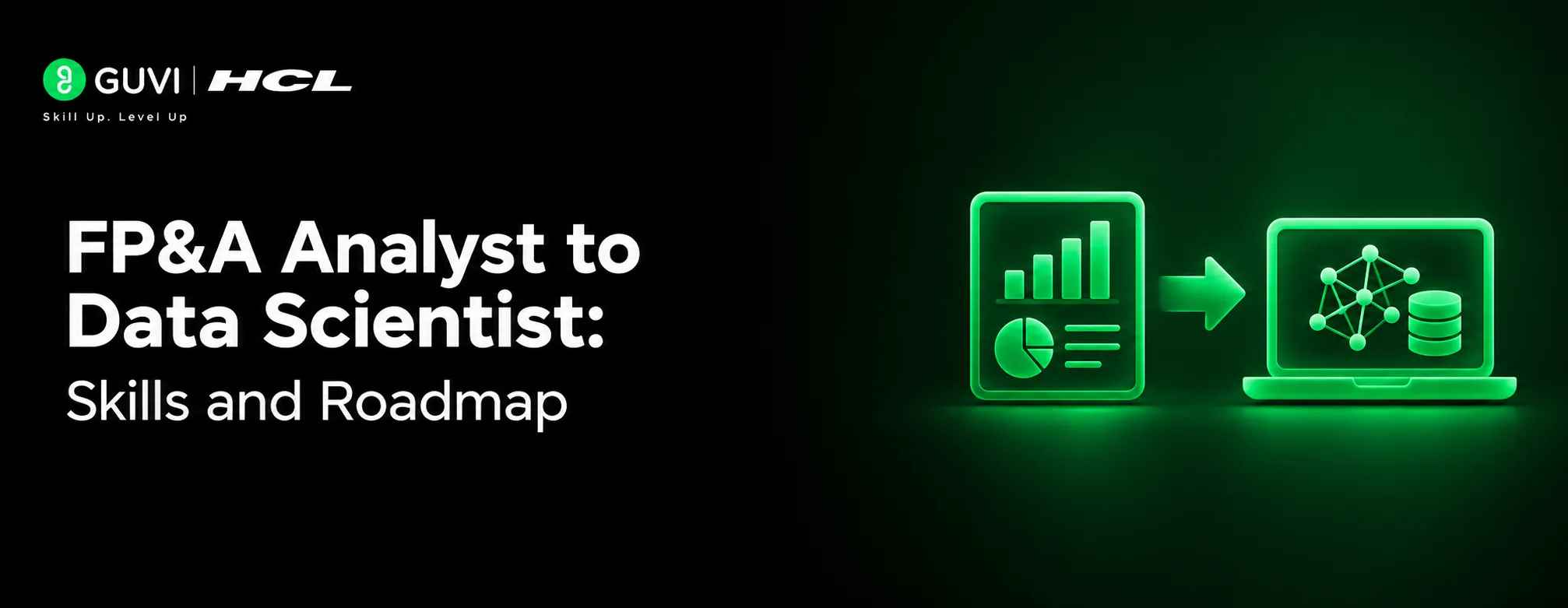
FP&A Analyst to Data Scientist: Skills and Roadmap
Nov 02, 2026 5 Min Read 17 Views
(Last Updated)
The transition from FPA Analyst to Data Scientist shifts the focus from financial reporting, budgeting, and forecasting to programming, large datasets, and predictive models. Professionals who understand this shift early can plan their learning path with far more clarity.
This guide covers the required skills, a step-by-step roadmap, the best starting courses, and common mistakes to avoid during the career switch.
Table of contents
- TL;DR Summary
- Can an FP&A Analyst Become a Data Scientist?
- FPA Analyst to Data Scientist: Skills You Need
- Programming
- SQL and Database Management
- Statistics and Probability
- Machine Learning
- Data Visualization and Storytelling
- Data Cleaning and Preparation
- FP&A Analyst to Data Scientist Roadmap: Step by Step
- Best Courses to Switch from FP&A to Data Science
- Common Mistakes to Avoid During the Career Switch
- FAQs
- Can an FP&A analyst become a data scientist without a technical degree?
- How long does it take to move from FP&A to data science?
- Do I need to learn coding to switch from FP&A to data science?
- What is the best first job for an FP&A Analyst transitioning to Data Scientist?
- Is an FP&A background useful for data science?
TL;DR Summary
- This blog explains the FP&A Analyst to Data Scientist transition and whether finance professionals can make the move.
- It lists the core skills to build, including programming, SQL, statistics, machine learning, and data visualization, along with the tools used for each.
- It guides you through a nine-step roadmap, from setting a target role to building projects and preparing for interviews.
- It also helps you compare the best courses, with direct links to each one.
- Finally, it highlights common mistakes to avoid, such as skipping statistics and building generic portfolio projects.
Can an FP&A Analyst Become a Data Scientist?
Yes, an FP&A analyst can become a data scientist. The move requires learning programming, statistics, and machine learning, while the financial and business knowledge already gained remains useful in the new role.
Why You Should Move from FP&A to Data Science
Data science roles are available across banking, technology, consulting, and healthcare, and finance professionals are often preferred for positions that involve business data. Employers value candidates who can build models and also explain the results to decision-makers.
Key Reasons to Switch from FP&A to Data Science
- Strong demand: Companies in most industries hire data scientists to guide planning and strategy.
- Business context: Experience with budgets, forecasts, and variance analysis helps in building relevant models.
- Wider scope of work: The role moves beyond reporting into prediction, automation, and advanced analysis.
- Career growth: Data science opens paths into senior analytics, machine learning, and leadership roles.
Also Read: What Data Roles Suit a Finance Manager With FP&A Experience?
Every great data career begins with one decisive step. HCL GUVI’s Advanced Data Science & Generative AI Program offers 6 months of live, mentor-led classes, 1:1 doubt sessions, 10+ real-world projects, IIT-M Pravartak certification, and placement assistance with mock interviews. No prior coding experience is needed. Enroll today and build an AI-ready career!
FPA Analyst to Data Scientist: Skills You Need
An FP&A analyst planning to become a data scientist needs technical skills beyond spreadsheets and financial models.
1. Programming
Programming is the ability to write instructions that a computer can run to clean, process, and analyze data. It replaces many manual spreadsheet tasks and lets you work with datasets too large for Excel.
Tools Used
- Python: A general-purpose language widely used for data analysis and machine learning.
- R: A language built for statistical analysis and data visualization.
- Jupyter Notebook: An environment for writing code and viewing results in one place.
2. SQL and Database Management
SQL is the language used to retrieve and organize data stored in databases. Most company data lives in databases, so this skill lets you pull the exact data you need without relying on others.
Tools Used
- MySQL: An open-source database system used for storing and querying data.
- PostgreSQL: A database system known for handling complex queries.
- BigQuery: A cloud data warehouse used to query large datasets.
3. Statistics and Probability
Statistics provides the methods for testing assumptions, measuring uncertainty, and drawing reliable conclusions from data. It builds on the variance and trend analysis already done in FP&A and forms the base of every predictive model.
Tools Used
- SciPy: A Python library for statistical tests and calculations.
- Statsmodels: A Python library for regression and time series analysis.
- SPSS: A software package used for statistical analysis.
4. Machine Learning
Machine learning involves training models to find patterns in data and make predictions. It extends forecasting by letting models learn from historical data to predict revenue, churn, or credit risk.
Tools Used
- Scikit-learn: A Python library for standard machine learning algorithms.
- TensorFlow: A framework used to build deep learning models.
- XGBoost: A library used for high-accuracy predictive models on structured data.
5. Data Visualization and Storytelling
Data visualization is the practice of presenting findings through charts and dashboards so that decision-makers can understand them quickly. FP&A professionals already report to leadership, and this skill helps in presenting model results clearly.
Tools Used
- Tableau: A tool for building interactive dashboards.
- Power BI: A Microsoft tool for creating reports and dashboards.
- Matplotlib: A Python library for creating charts and plots.
6. Data Cleaning and Preparation
Data cleaning fixes errors, handles missing values, and structures raw data for analysis. Data scientists spend much of their time on this step, and it directly affects the final model’s accuracy.
Tools Used
- Pandas: A Python library for cleaning and transforming tabular data.
- NumPy: A Python library for numerical operations on large arrays.
- Power Query: A tool for cleaning and reshaping data before analysis.
FP&A Analyst to Data Scientist Roadmap: Step by Step
Moving from FP&A Analyst to Data Scientist requires adding programming, statistics, and machine learning to the financial and business knowledge you already have. The nine steps below are arranged in the order in which these skills are usually learned and put to use.
Step 1: Assess Your Current Strengths and Set a Target Role
Begin by listing what you already do well, such as forecasting, financial modeling, reporting, and working with stakeholders. Then decide which type of data science role you want, because the requirements differ.
A data scientist on a finance team, a product analytics role, and a machine learning role each require a different mix of skills. A clear target keeps the learning plan focused.
Step 2: Learn Python and SQL
Start with Python for data work and SQL for database queries. In Python, focus on variables, loops, functions, and the Pandas library for handling tables of data. In SQL, learn joins, filtering, grouping, and window functions.
]Practice on real datasets rather than just watching lessons, since these two tools show up in almost every data science job.

Step 3: Build a Foundation in Statistics and Mathematics
Study descriptive statistics, probability, hypothesis testing, and regression. Add basic linear algebra and a working understanding of calculus concepts used in model training. This knowledge lets you judge whether a model’s results are reliable, so learn it before moving to advanced algorithms.
Step 4: Learn Machine Learning Fundamentals
Begin with supervised learning methods such as linear regression, logistic regression, decision trees, and random forests. Then move to unsupervised methods such as clustering.
Learn how to split data into training and test sets, how to measure model performance, and how to avoid overfitting. Scikit-learn is a suitable library for practicing these methods.
Step 5: Practice with Finance-Based Projects
Apply what you have learned to problems you already understand. Examples include forecasting revenue with time series models, predicting customer churn, detecting unusual transactions, or scoring credit risk.
Projects built on familiar business problems show employers that you can connect modeling work to real decisions.
Step 6: Create a Portfolio and Publish Your Work
Place two to four well-documented projects on GitHub. Each project should state the problem, the data source, the method used, and the result. Add a short, plain-language explanation, since data scientists are expected to communicate findings to non-technical audiences.
Step 7: Gain Practical Experience Inside or Outside Your Job
Look for chances to use data science methods in your current FP&A role, such as automating a report with Python or building a simple forecasting model.
If that is not possible, consider internships, freelance projects, or competitions on platforms such as Kaggle. Practical exposure matters because many employers look for evidence of applied work.
Step 8: Update Your Resume and Apply for Roles
Rewrite your resume to highlight technical skills, projects, and measurable results from your finance work. Apply for roles that match your background, such as data analyst, business analyst, or junior data scientist positions in finance-related teams.
Entering through a closely related role is a common and realistic way to move into a full data scientist position.
Step 9: Prepare for Interviews
Practice SQL queries, Python exercises, statistics questions, and case-based problems. Be ready to explain your projects in detail, including why you chose a particular method and what the results meant for the business. Data science interviews usually test both technical ability and clear communication.
Best Courses to Switch from FP&A to Data Science
Refer to the table below for the best courses to support an FP&A Analyst to Data Scientist transition, along with what each covers.
| Course | Platform | Best For | Key Topics Covered | Course Link |
|---|---|---|---|---|
| Advanced Data Science & Generative AI Program (Recommended) | HCL GUVI | Career switchers who want live mentor-led training with placement support | Python, machine learning, deep learning, NLP, MLOps, Generative AI, 10+ projects | Link |
| IBM Data Science Professional Certificate | Coursera | Complete beginners who want one structured program | Python, SQL, data visualization, basic machine learning | Link |
| Machine Learning Specialization (Andrew Ng) | Coursera / DeepLearning.AI | Learning machine learning fundamentals | Supervised learning, unsupervised learning, model evaluation | Link |
| Statistics with Python Specialization (University of Michigan) | Coursera | Building the statistics foundation | Statistical inference, regression, hypothesis testing in Python | Link |
| Mathematics for Machine Learning (Imperial College London) | Coursera | Strengthening the math behind models | Linear algebra, calculus, principal component analysis | Link |
| Kaggle Learn Micro-Courses | Kaggle | Free practice with real datasets | Python, Pandas, SQL, machine learning basics | Link |
Common Mistakes to Avoid During the Career Switch
These common mistakes slow the FP&A Analyst to Data Scientist transition:
- Skipping statistics before machine learning: Running algorithms without understanding their assumptions leads to models that fail on new data and to weak answers in interviews.
- Treating courses as the goal: Certificates alone do not prove skill. Employers look for projects where you handled the data, built the model, and explained the result.
- Building generic portfolio projects: Common datasets like Titanic or Iris are used by thousands of candidates. Finance-based projects, such as forecasting or fraud detection, can leverage your background.
- Ignoring SQL and data cleaning: Most real work involves querying databases and preparing messy data, and SQL is tested in most interviews.
- Aiming straight for a senior role: Without hands-on modeling experience, applying to analyst or junior data scientist roles first is a more realistic entry point.
FAQs
1. Can an FP&A analyst become a data scientist without a technical degree?
Yes, an FP&A analyst can become a data scientist by learning Python, SQL, statistics, and machine learning; a technical degree isn’t strictly required.
2. How long does it take to move from FP&A to data science?
It depends on your starting point and study pace, but most people need several months of consistent learning plus project work.
3. Do I need to learn coding to switch from FP&A to data science?
Yes, Python and SQL are the basic requirements for almost every data science role.
4. What is the best first job for an FP&A Analyst transitioning to Data Scientist?
Data analyst, business analyst, or junior data scientist roles in finance-related teams are the most realistic starting points.
5. Is an FP&A background useful for data science?
Yes, experience in forecasting, budgeting, and financial analysis helps in building models for finance and business problems.
Success Stories






Did you enjoy this article?