


Data Science Articles
Back Office Process Executive to Data Analyst: Where to Start
Data Analytics vs CFO Track: Which Path Should Senior Finance Leaders Choose?
Finance Manager to Head of Finance Data and Analytics: Career Path


Get In Touch For Details! Request More Information
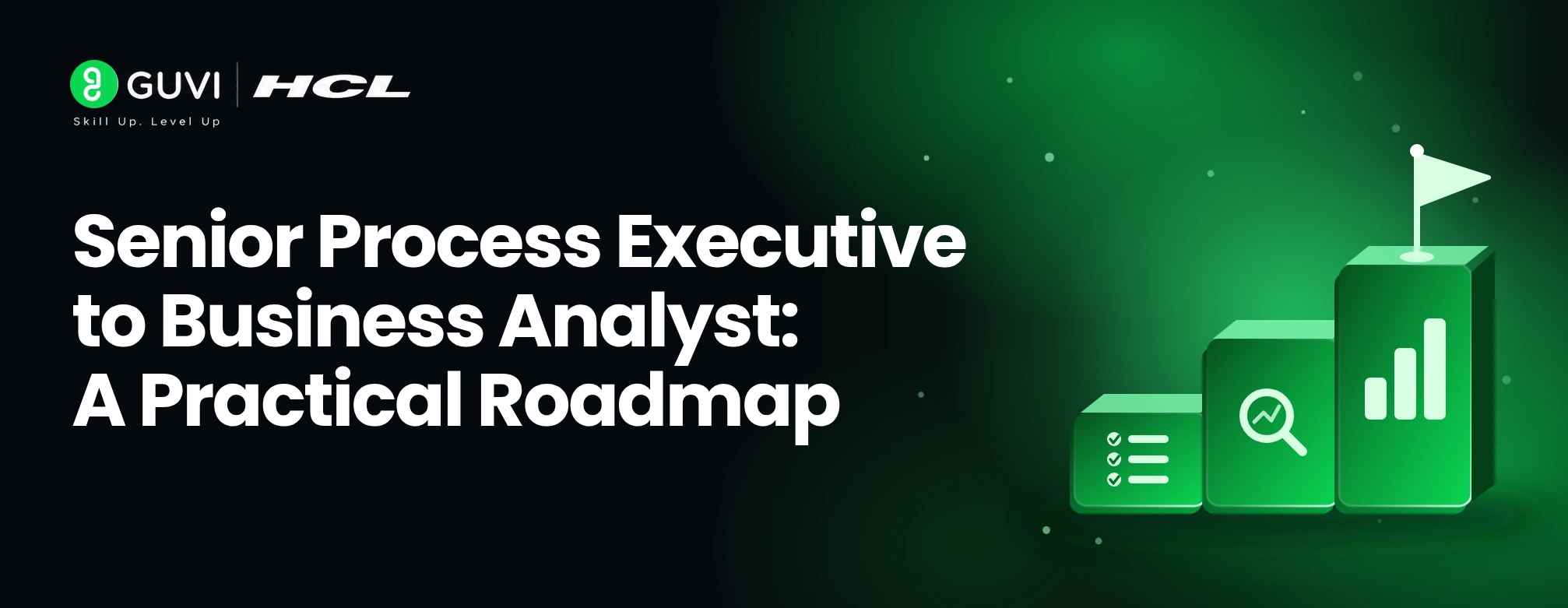
Senior Process Executive to Business Analyst: A Practical Roadmap
Nov 02, 2026 4 Min Read 16 Views
(Last Updated)
It is month-end, the dashboard is red, and you are the person everyone turns to. As a Senior Process Executive, you know why turnaround times slipped, which error keeps repeating, and what the client really wants. Yet your job title says execution, not analysis.
That gap is smaller than it looks. Moving from senior process executive to business analyst is one of the most practical career switches for BPO professionals, because you already work with the processes a BA is hired to improve. This guide covers the skills you already have, the ones to add, a six-step roadmap, beginner projects and salary ranges in India.
Table of contents
- TL;DR
- Can a Senior Process Executive Become a Business Analyst?
- Transferable Skills: What BPO Professionals Already Bring to Business Analysis
- Business Analyst Skills for BPO Professionals
- Senior Process Executive to Business Analyst: Step-by-Step Career Roadmap
- Business Analyst Projects BPO Professionals Can Work On
- BPO to BA Career Path: Job Opportunities and Salary
- Common Challenges and How to Overcome Them
- Conclusion
- Frequently Asked Questions (FAQs)
- Can a Senior Process Executive become a Business Analyst?
- Can a BPO professional become a Business Analyst without coding?
- What skills are required to switch from a Process Executive to a Business Analyst?
- How long does it take to transition from BPO to Business Analyst?
- What is the salary of a Business Analyst with BPO experience?
TL;DR
- Career switch: Yes, a Senior Process Executive can become a Business Analyst. Your process knowledge is the foundation.
- Transferable skills: Workflow understanding, reporting, problem-solving, stakeholder communication and documentation already count.
- Skills to add: Advanced Excel, SQL, Power BI or Tableau, requirements gathering, BRD/FRD writing and basic Agile.
- Roadmap: Learn BA basics, map your skills, build data skills, practise documentation, complete projects, then refine your resume.
- Jobs: Start as a Process Analyst, Operations Analyst or Junior BA. Entry-level BA roles typically pay ₹4–7 LPA.
Can a Senior Process Executive Become a Business Analyst?
Yes. Hiring managers value people who understand how work actually flows, and BPO professionals see that every day. Your experience in SLA tracking, quality checks, MIS reporting, escalation handling and SOP documentation maps directly to BA work. The gap is mostly tools and vocabulary, not ability.
The main difference is scope. A Senior Process Executive runs a process; a Business Analyst decides how it should change.
| Area | Senior Process Executive | Business Analyst |
| Responsibilities | Executes and monitors daily process work, meets SLAs | Studies processes, gathers requirements, recommends improvements |
| Skills | Process knowledge, quality checks, customer handling | Analysis, documentation, stakeholder management |
| Tools | CRM, ticketing tools, Excel, MIS reports | SQL, Power BI or Tableau, Jira, Visio, Excel |
| Career focus | Operational delivery and team targets | Business outcomes and solution design |
Transferable Skills: What BPO Professionals Already Bring to Business Analysis
- Process understanding and workflow management: You know where handoffs break. A BA maps these steps and finds bottlenecks, so your floor-level view is an advantage.
- Data handling and reporting: Daily MIS and SLA reports mean you already read numbers. BAs use the same habit to back recommendations with data.
- Problem-solving and analytical thinking: Finding the root cause of repeated errors or rising handling time is core BA work.
- Communication and stakeholder management: Handling clients, team leads and escalations prepares you for requirement workshops and status meetings.
- Documentation and attention to detail: SOPs, audit notes and quality checklists translate into requirement documents and test scenarios.
If you are a working or BPO professional aiming for analytical, data-driven roles, structured learning can speed up the process. The HCL GUVI Data Science Zen Class covers Python, SQL, data analysis and visualisation, the skills behind many analyst roles. It is a learning opportunity, not a placement guarantee, so pair it with real projects. Explore the course and take your first step.
Business Analyst Skills for BPO Professionals
These are the gaps to fill, roughly in priority order:
- Advanced Excel: Pivot tables, XLOOKUP and conditional logic are used daily to clean and summarise project data.
- SQL fundamentals: Pull data yourself with SELECT, JOIN and GROUP BY instead of waiting for a developer.
- Power BI or Tableau: Turn raw data into dashboards that managers can read in minutes.
- Business requirements gathering: Use interviews, workshops and questionnaires to find out what stakeholders actually need.
- BRD and FRD documentation: A Business Requirement Document records what the business needs. A Functional Requirement Document explains how the system should behave.
- Process mapping and workflow analysis: Flowcharts and BPMN diagrams show the current and improved process.
- Basic Agile and Scrum concepts: Learn user stories, sprints and backlogs, since most BAs work in Agile teams.
- Communication and presentation skills: You will explain findings to senior stakeholders, often in a single slide.
Senior Process Executive to Business Analyst: Step-by-Step Career Roadmap
Step 1: Understand business analysis. Learn what a BA does across a project: requirements, analysis, solution support and testing. Read three or four real BA job descriptions and note the repeated requirements.
Step 2: Identify your transferable BPO skills. Rewrite your achievements in BA language. “Reduced rework by 12% by redesigning the quality checklist” is stronger than “handled quality checks.”
Step 3: Learn Excel, SQL and a visualisation tool. Spend the first month on Excel, the next on SQL, then move to Power BI or Tableau. Practise on public datasets before using work-style data.
Step 4: Develop documentation and requirement-gathering skills. Write a sample BRD for a small change, such as automating a manual daily report. Draw the as-is and to-be process maps.

Step 5: Work on practical Business Analyst projects. Complete two or three projects (see below) and publish them on GitHub or LinkedIn.
Step 6: Build a BA resume and prepare for interviews. Lead with process-improvement results, tools and projects. Practise questions on requirement gathering, stakeholder conflict, SQL queries and case studies. Try an internal move first, since a switch within your own company is often the quickest route.
You can also check out: A Complete Business Analyst Career Roadmap
Business Analyst Projects BPO Professionals Can Work On
Use public or mock data. Never share confidential client information.
1. Customer Complaint Analysis
- Objective: Find the top complaint categories and their root causes.
- Tools: Excel, SQL, Power BI.
- Outcome: A dashboard and a short recommendation report.
2. Process Performance and SLA Dashboard
- Objective: Track SLA compliance, turnaround time and error rates.
- Tools: Excel, Power BI or Tableau.
- Outcome: A monitoring dashboard that shows where targets are missed.
3. Customer Service Efficiency Analysis
- Objective: Compare handling time, first-contact resolution and repeat calls.
- Tools: SQL, Excel, Tableau.
- Outcome: Findings on what slows down resolution, with suggested fixes.
BPO to BA Career Path: Job Opportunities and Salary
Common entry points are Process Analyst, Operations Analyst, Junior Business Analyst and Business Analyst. With experience, you can move into Senior BA, Product Analyst or Functional Consultant roles, often in domains you already know, such as banking, insurance or healthcare.
| Role and experience | Typical annual pay (India, 2026) |
| Operations Analyst (average base) | About ₹4.8 LPA |
| Business Analyst, 0–2 years | ₹4–7 LPA |
| Business Analyst, 2–4 years | ₹7–10 LPA |
| Business Analyst, 4–6 years | ₹10–14 LPA |
| Senior Business Analyst | ₹7–15 LPA (Glassdoor data via Weekday) |
Salaries vary by company, location, industry and skill set. Treat these as ranges, not offers. You can refer to Glassdoor or Ambitionbox for the salary range.
Common Challenges and How to Overcome Them
- Lack of technical knowledge: Learn one tool at a time: Excel, then SQL, then Power BI. Five to six hours a week is enough to start.
- Limited Business Analyst experience: Volunteer for report automation, process documentation or user acceptance testing in your current team.
- Difficulty building a project portfolio: Build three case studies on public datasets and document your approach step by step.
- Interview preparation: Practise explaining a BRD, an as-is versus to-be flow and a SQL query out loud.
- Confidence from a non-IT background: BAs are hired for business understanding. Present your BPO years as domain knowledge, backed by numbers.
Conclusion
Moving from senior process executive to business analyst is achievable because you already understand how a business runs day to day. What you need is a structured set of tools, documentation skills and proof of work. Start small, build projects, and aim for an internal move or a junior analyst role. It takes consistent effort, but the path is realistic.
Frequently Asked Questions (FAQs)
1. Can a Senior Process Executive become a Business Analyst?
Yes. Your process, reporting and stakeholder experience transfers well. Add Excel, SQL, a BI tool and documentation skills, then back them with projects.
2. Can a BPO professional become a Business Analyst without coding?
Yes. Core BA work relies on analysis and communication, not programming. SQL is the one technical skill most roles expect, and it is for querying data, not building software.
3. What skills are required to switch from a Process Executive to a Business Analyst?
Advanced Excel, SQL, Power BI or Tableau, requirements gathering, BRD/FRD writing, process mapping and Agile basics, along with the communication skills you already use.
4. How long does it take to transition from BPO to Business Analyst?
Roughly 6–9 months of steady learning and project work for most working professionals. An internal move can be faster; an external switch usually takes longer.
5. What is the salary of a Business Analyst with BPO experience?
Entry-level BA roles typically pay ₹4–7 LPA, rising to ₹7–10 LPA at 2–4 years. Your BPO tenure strengthens your case, but pay depends on skills, company and city.
Success Stories

About the Author
Vishalini Devarajan
An Aerospace Engineer turned content writer, I focus on making complex concepts easy to understand through well-structured, reader-friendly blogs. Whether it’s a technical topic or a non-technical one, I love creating content that is clear, engaging, and impactful.
View all posts by Vishalini Devarajan
Connect with me @











Did you enjoy this article?