


Forward Deployed Engineer Articles
Debugging Latency Issues in Customer-Deployed AI Systems
Go vs Python for Forward Deployed Engineering Workloads
Forward Deployed Engineering in Government and Public Sector
Forward Deployed Engineering in Fintech: Lessons From Ramp and Brex


Get In Touch For Details! Request More Information
Forward Deployed Engineering in Manufacturing and Industrial AI
Sep 25, 2026 4 Min Read 22 Views
(Last Updated)
Forward deployed engineering in manufacturing brings software engineering, artificial intelligence, data, and industrial operations together to solve real-world production challenges. As manufacturers adopt connected machines, automation, and industrial AI, they need engineers who can integrate these technologies into existing factory environments.
FDEs can work on problems such as predictive maintenance, quality inspection, production optimization, and supply chain analytics. Unlike traditional software projects, manufacturing deployments often involve physical equipment, sensor data, legacy systems, and strict operational requirements.
This article explores how forward deployed engineering is being applied in manufacturing, where industrial AI creates opportunities for FDEs, the technical skills required, and the challenges engineers must overcome when deploying solutions in real production environments.
Table of contents
- TL;DR Summary
- What Is Forward Deployed Engineering in Manufacturing?
- Why Does Manufacturing Need Forward Deployed Engineers?
- How Is Industrial AI Creating Opportunities for FDEs?
- What Manufacturing Problems Can FDEs Solve?
- Predictive Maintenance
- Quality Inspection
- Production Optimization
- Inventory and Supply Chain
- Worker and Process Assistance
- Which Skills Do Manufacturing FDEs Need?
- Software and Data Skills
- AI Skills
- Industrial Technology
- What Challenges Do FDEs Face in Manufacturing?
- Legacy Infrastructure
- Data Quality
- Real-Time Requirements
- Operational Disruption
- Security
- Physical Environment
- How Should FDEs Approach a Manufacturing Deployment?
- Step 1: Understand the Production Workflow
- Step 2: Identify Available Data
- Step 3: Define the Business Problem
- Step 4: Build a Small Proof of Concept
- Step 5: Test Under Realistic Conditions
- Step 6: Integrate With Existing Systems
- Step 7: Deploy and Monitor
- Step 8: Scale Gradually
- Start Your Learning Journey with HCL GUVI
- Conclusion
- FAQs
- What is forward deployed engineering in manufacturing?
- What does a manufacturing FDE work on?
- What skills should a manufacturing FDE learn?
- Why is industrial AI important for FDEs?
- What challenges do FDEs face in manufacturing?
- How can I prepare for a manufacturing FDE role?
TL;DR Summary
- Forward deployed engineering manufacturing combines software engineering, industrial technology, and customer-focused problem-solving.
- FDEs help manufacturers deploy AI, automation, analytics, and connected systems in real production environments.
- Common applications include predictive maintenance, quality inspection, production optimization, and supply chain analytics.
- FDEs need skills in APIs, Python, databases, cloud, AI, IoT, data pipelines, and troubleshooting.
- Manufacturing deployments must account for machines, legacy systems, operational constraints, safety, and unreliable data.
- Successful industrial AI projects require engineers to understand both the technology and the customer’s physical operations.
What Is Forward Deployed Engineering in Manufacturing?
Forward deployed engineering in manufacturing involves working directly with manufacturers to design, integrate, deploy, and improve technology solutions within real industrial environments.
Unlike traditional software development, where engineers may work primarily with digital systems, manufacturing FDEs often work with a combination of software, machines, sensors, databases, industrial control systems, and production workflows.
For example, a manufacturer may want to use AI to identify defects on a production line. An FDE may need to connect camera feeds, collect production data, integrate an AI model, build a monitoring interface, and deploy the system without disrupting factory operations.
This makes manufacturing FDE work highly practical and environment-specific.
Explore the skills needed to build real-world AI solutions with HCL GUVI’s Artificial Intelligence & Machine Learning Course. Gain practical experience in AI, machine learning, and application development through hands-on projects.
Why Does Manufacturing Need Forward Deployed Engineers?
Modern factories generate large amounts of operational data from machines, sensors, production systems, and enterprise applications.
However, collecting data is only part of the challenge.
Manufacturers also need to:
- Connect systems that were built separately.
- Understand machine and production data.
- Automate repetitive workflows.
- Detect equipment problems.
- Improve product quality.
- Reduce downtime.
- Optimize production processes.
Many factories also operate with a mixture of modern cloud systems and older industrial technology.
FDEs help bridge these environments by connecting modern software and AI capabilities with existing manufacturing infrastructure.
A manufacturing environment can contain both highly automated machinery and decades-old software systems. This makes integration and deployment skills particularly valuable for engineers working on industrial AI.
How Is Industrial AI Creating Opportunities for FDEs?
Industrial AI applies artificial intelligence and machine learning to manufacturing operations.
FDEs can help customers move AI from an experimental model to a working production solution.
A typical industrial AI workflow may look like:
Data Collection → Data Processing → Model Development → Testing → Integration → Deployment → MonitoringThe FDE’s role can span several of these stages.
For example, a machine learning model may perform well in a development environment but fail when exposed to noisy sensor data from an actual factory. The FDE needs to identify the problem, work with the customer, improve the pipeline, and deploy a reliable solution.
This combination of AI and deployment makes industrial environments a natural fit for forward deployed engineering.
What Manufacturing Problems Can FDEs Solve?
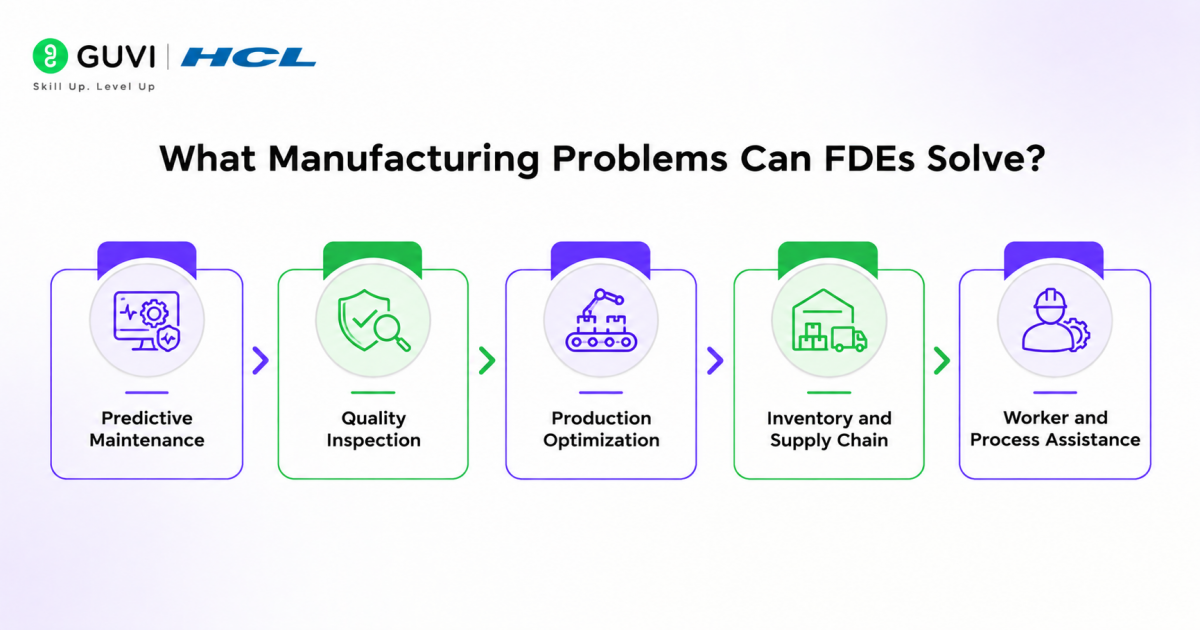
1. Predictive Maintenance
FDEs can help manufacturers use machine and sensor data to identify patterns associated with equipment failures.
Instead of waiting for a machine to fail, predictive systems can help maintenance teams identify potential issues earlier.
2. Quality Inspection
Computer vision models can analyze images or video from production lines to identify defects.
An FDE may integrate cameras, inference systems, production databases, and alerting workflows.
3. Production Optimization
Manufacturers can use operational data to identify bottlenecks and improve production processes.
FDEs can build dashboards, analytics pipelines, or AI systems that help teams understand production performance.
4. Inventory and Supply Chain
Data integration can connect production information with inventory, procurement, and supply chain systems.
This can help organizations improve visibility into materials and production requirements.
5. Worker and Process Assistance
AI assistants can help employees access equipment documentation, troubleshooting procedures, maintenance information, or operational instructions.
An FDE can connect these AI systems to approved internal knowledge sources.
Which Skills Do Manufacturing FDEs Need?
Manufacturing FDEs need a broad technical foundation.
1. Software and Data Skills
Important areas include:
2. AI Skills
Depending on the role, FDEs may work with:
- Machine learning
- Computer vision
- Time-series analysis
- Generative AI
- Model evaluation
- Edge AI
3. Industrial Technology
Understanding industrial environments is also useful.
Relevant concepts include:
- IoT
- Sensors
- Machine data
- Industrial networks
- Manufacturing execution systems
- Production workflows
- Operational technology
An FDE does not need to be an industrial engineer in every role, but understanding how factories operate makes technical problem-solving much more effective.
Pro Tip: When preparing for a manufacturing FDE role, build a project using simulated machine or sensor data. Add anomaly detection, a dashboard, and an alerting workflow to demonstrate both AI and deployment skills.

What Challenges Do FDEs Face in Manufacturing?
Manufacturing deployments come with unique constraints.
1. Legacy Infrastructure
Factories may depend on older machines, databases, and industrial systems that were not designed for modern cloud applications.
2. Data Quality
Sensor data can contain missing values, noise, inconsistent timestamps, or unexpected readings.
3. Real-Time Requirements
Some production applications need extremely fast responses. Sending every operation to a distant cloud service may not be practical.
4. Operational Disruption
Engineers cannot treat a production line like a normal development environment. Changes may need to be tested carefully to avoid disrupting operations.
5. Security
Connecting operational technology to networks and modern applications creates additional security considerations.
6. Physical Environment
Temperature, connectivity, equipment limitations, and physical production conditions can affect technical solutions.
Warning: A model that performs well on clean historical data may not work reliably on real factory data. Test solutions with realistic production conditions before relying on them for operational decisions.
How Should FDEs Approach a Manufacturing Deployment?
A structured deployment process can reduce risk.
Step 1: Understand the Production Workflow
Learn how machines, operators, software systems, and business processes interact.
Step 2: Identify Available Data
Determine where machine, sensor, production, quality, and inventory data is stored.
Step 3: Define the Business Problem
Focus on measurable outcomes such as reduced downtime, improved quality, lower waste, or faster production.
Step 4: Build a Small Proof of Concept
Start with a limited production line, machine, dataset, or workflow.
Step 5: Test Under Realistic Conditions
Evaluate performance using realistic data and operational constraints.
Step 6: Integrate With Existing Systems
Connect the solution with dashboards, databases, alerts, or production workflows.
Step 7: Deploy and Monitor
Track model performance, system health, data quality, and business outcomes after deployment.
Step 8: Scale Gradually
Once the solution proves its value, expand it to additional machines, production lines, or facilities.
Best Practice: In manufacturing, prioritize measurable operational improvements over technically impressive prototypes. A simple system that reliably reduces downtime can be more valuable than a complex AI model that never reaches production.
Start Your Learning Journey with HCL GUVI
Explore the skills needed to build real-world AI solutions with HCL GUVI’s Artificial Intelligence & Machine Learning Course. Gain practical experience in AI, machine learning, and application development through hands-on projects.
Conclusion
Forward deployed engineering in manufacturing sits at the intersection of software engineering, AI, data, and industrial operations. As manufacturers adopt connected machines, analytics, automation, and industrial AI, they need engineers who can move beyond prototypes and make these technologies work in real production environments.
For aspiring FDEs, manufacturing offers opportunities to solve practical problems such as equipment failures, quality issues, production bottlenecks, and disconnected data. The strongest engineers combine technical skills with an understanding of factory workflows, operational constraints, and measurable business outcomes. That combination can make forward deployed engineering an important part of the future of industrial AI.
FAQs
What is forward deployed engineering in manufacturing?
Forward deployed engineering in manufacturing involves designing, integrating, deploying, and improving software and AI solutions directly within manufacturing environments.
What does a manufacturing FDE work on?
Manufacturing FDEs can work on predictive maintenance, computer vision, quality inspection, production analytics, supply chain systems, automation, and industrial AI applications.
What skills should a manufacturing FDE learn?
Useful skills include Python, APIs, SQL, databases, cloud platforms, machine learning, computer vision, IoT, data pipelines, monitoring, and troubleshooting.
Why is industrial AI important for FDEs?
Industrial AI allows manufacturers to use machine and operational data for tasks such as predictive maintenance, defect detection, process optimization, and automated decision support.
What challenges do FDEs face in manufacturing?
Common challenges include legacy systems, poor-quality sensor data, real-time requirements, production constraints, cybersecurity concerns, and the need to avoid disrupting factory operations.
How can I prepare for a manufacturing FDE role?
Build projects involving sensor data, machine learning, computer vision, APIs, dashboards, and monitoring. Also learn basic manufacturing workflows and practice explaining technical solutions in terms of measurable operational outcomes.
Success Stories

About the Author
HCL GUVI
This article was selected and published as part of the HCL GUVI AI Blogathon 2026, an initiative designed to encourage students, AI enthusiasts, and aspiring tech writers to simplify complex AI concepts through impactful technical content. The contest recognized high-quality, original, and insightful AI-focused blogs, with selected authors receiving publication opportunities on the HCL GUVI blog platform along with official author credits and recognition.
View all posts by HCL GUVI
Connect with me @











Did you enjoy this article?