


Forward Deployed Engineer Articles
Debugging Latency Issues in Customer-Deployed AI Systems
Go vs Python for Forward Deployed Engineering Workloads
Forward Deployed Engineering in Government and Public Sector
Forward Deployed Engineering in Manufacturing and Industrial AI


Get In Touch For Details! Request More Information
Forward Deployed Engineering in Fintech: Lessons From Ramp and Brex
Sep 25, 2026 4 Min Read 21 Views
(Last Updated)
Forward deployed engineering in fintech combines software engineering, system integration, and customer-focused problem-solving to address complex financial technology challenges. Companies such as Ramp and Brex operate in environments where fintech platforms need to work seamlessly with accounting systems, expense workflows, payment infrastructure, and other business applications.
For Forward Deployed Engineers, this creates opportunities to solve problems that go beyond traditional product development. They may integrate APIs, automate financial workflows, troubleshoot customer systems, and adapt technology to different business requirements.
This article explores how forward deployed engineering works in fintech, the lessons FDEs can learn from Ramp and Brex, the skills required for these roles, and the challenges engineers may encounter when deploying solutions in financial environments.
Table of contents
- TL;DR Summary
- What Is Forward Deployed Engineering in Fintech?
- Why Does Fintech Need Forward Deployed Engineers?
- What Can FDEs Learn From Ramp?
- Integrate With Existing Systems
- Automate Repetitive Financial Workflows
- Understand the Business Workflow
- What Can FDEs Learn From Brex?
- Customer Requirements Can Vary
- Data Integration Matters
- Reliability Is Critical
- Which Skills Do Fintech FDEs Need?
- Technical Skills
- Fintech Knowledge
- What Challenges Do Fintech FDEs Face?
- Security
- Compliance
- Data Quality
- Legacy Systems
- Complex Integrations
- Customer-Specific Requirements
- What Are the Biggest Lessons From Ramp and Brex?
- Start Your Learning Journey with HCL GUVI
- Conclusion
- FAQs
- What is forward deployed engineering in fintech?
- Why is forward deployed engineering important for fintech companies?
- What can FDEs learn from Ramp?
- What can FDEs learn from Brex?
- What skills are needed for a fintech FDE role?
- Does a fintech FDE need finance experience?
TL;DR Summary
- Forward deployed engineering fintech combines software engineering with customer-facing problem-solving in financial technology environments.
- Companies such as Ramp and Brex operate in complex fintech ecosystems where integrations, data, security, and automation are critical.
- FDEs help connect fintech platforms with customer systems, workflows, APIs, and internal data.
- Strong fintech FDEs need technical skills alongside an understanding of financial workflows and customer requirements.
- Successful deployments require careful attention to security, compliance, reliability, and data quality.
- The biggest lesson is to build practical solutions around real customer workflows rather than treating every problem as a traditional software development project.
What Is Forward Deployed Engineering in Fintech?
Forward deployed engineering in fintech combines software development, system integration, technical problem-solving, and direct customer collaboration to solve financial technology challenges.
Traditional product engineering often focuses on building features for a broad user base. FDEs work closer to individual customers and help adapt technology to specific business workflows.
In fintech, this can involve connecting payment systems, expense platforms, accounting software, financial data, identity systems, or internal business applications.
For example, a customer using a fintech platform may need its expense data synchronized with an existing accounting system. An FDE can understand the workflow, design the integration, build the required solution, and help deploy it.
Build practical skills for AI-driven industries with HCL GUVI’s Artificial Intelligence & Machine Learning Course. Learn AI, machine learning, and real-world application development through hands-on projects and industry-focused training.
Why Does Fintech Need Forward Deployed Engineers?
Financial workflows are rarely isolated. Companies often use multiple systems for accounting, payments, expenses, procurement, payroll, reporting, and compliance.
Customers may also have different:
- Data structures
- Approval workflows
- Accounting rules
- Enterprise systems
- Security requirements
- Compliance constraints
A standard product configuration may not cover every requirement.
FDEs help bridge that gap by connecting the fintech platform with the customer’s existing technology environment.
Fintech integrations can involve both technical and operational requirements. A successful solution may need to match how a finance team actually approves, categorizes, reconciles, and reports transactions.
What Can FDEs Learn From Ramp?
Ramp provides financial technology products focused on areas such as corporate cards, expense management, and financial operations.
From an FDE perspective, platforms like Ramp demonstrate why integrations and workflow automation are important in fintech.
1. Integrate With Existing Systems
Customers rarely want to replace every system they already use.
An FDE may need to connect a fintech platform with accounting, ERP, HR, or other business systems.
The lesson is simple: integration can be as important as the product itself.
2. Automate Repetitive Financial Workflows
Fintech customers often deal with repetitive tasks such as expense categorization, approvals, reconciliation, and reporting.
FDEs can identify where automation can remove manual work and reduce errors.
3. Understand the Business Workflow
An engineer cannot design an effective financial integration by looking only at APIs.
They need to understand what happens before and after the data moves.
For example:
Transaction → Approval → Categorization → Accounting → Reconciliation → ReportingUnderstanding this workflow helps an FDE build a solution that fits the customer’s actual process.
What Can FDEs Learn From Brex?
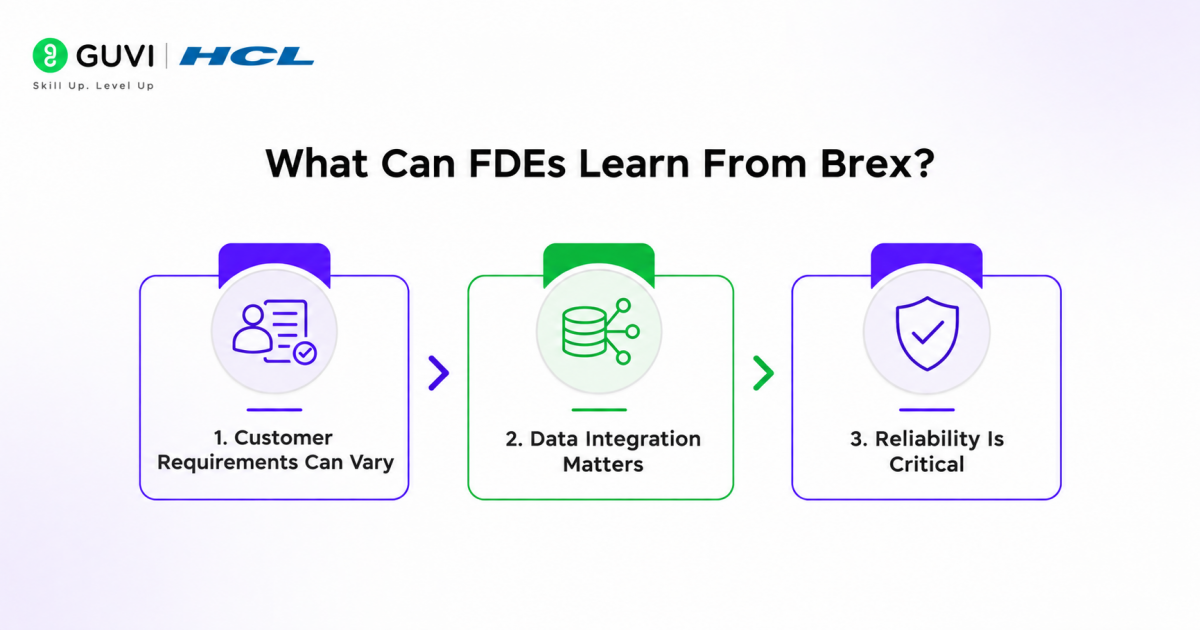
Brex provides financial technology products for businesses, including corporate spending and financial management capabilities.
Brex provides another useful example of the challenges involved in building technology for organizations with complex financial workflows.
1. Customer Requirements Can Vary
Different businesses may have different approval structures, spending policies, accounting configurations, and reporting requirements.
FDEs need to design solutions that accommodate these differences without creating unnecessary complexity.
2. Data Integration Matters
Financial platforms often need to exchange information with other systems.
FDEs should be comfortable working with:
3. Reliability Is Critical
Financial systems handle sensitive and business-critical information.
An integration that loses transactions or produces incorrect financial data can create serious operational problems.
FDEs therefore need strong validation, logging, monitoring, and error-handling practices.
Which Skills Do Fintech FDEs Need?
A fintech FDE needs a combination of engineering knowledge and business understanding.

1. Technical Skills
Important technical areas include:
- APIs and integrations
- Python or another programming language
- SQL and databases
- Cloud platforms
- Data pipelines
- Authentication and authorization
- Monitoring and debugging
- Automation
- AI and machine learning where relevant
2. Fintech Knowledge
Technical skills become more useful when combined with an understanding of:
- Payments
- Expense management
- Accounting workflows
- Financial reporting
- Procurement
- Reconciliation
- Compliance
- Data security
An FDE does not necessarily need to become a finance expert, but understanding the customer’s workflow helps them design better technical solutions.
Pro Tip: When preparing for a fintech FDE role, practice explaining technical solutions in terms of business outcomes. Instead of saying “I built an API integration,” explain how it reduced manual data entry or improved reconciliation.
What Challenges Do Fintech FDEs Face?
Fintech deployments introduce several challenges that FDEs need to consider.
1. Security
Financial data requires careful access control, authentication, encryption, and secure data handling.
2. Compliance
Financial products can operate within complex regulatory environments. FDEs need to understand the customer’s compliance requirements and avoid treating security or compliance as an afterthought.
3. Data Quality
Incorrect or inconsistent financial data can lead to incorrect reports and downstream problems.
4. Legacy Systems
Customers may rely on older accounting or enterprise systems that lack modern APIs.
5. Complex Integrations
A single deployment may involve several third-party applications and internal systems.
6. Customer-Specific Requirements
A solution that works for one organization may not work for another because their workflows, policies, and systems differ.
Best Practice: Design fintech integrations with failure handling from the beginning. Consider retries, validation, duplicate detection, logging, and rollback strategies before deploying the solution.
What Are the Biggest Lessons From Ramp and Brex?
The examples of Ramp and Brex highlight several broader lessons for forward deployed engineering.
- Start with the workflow: Understand how customers actually operate before designing the technical solution.
- Integration is essential: Fintech products often need to work with existing enterprise systems.
- Automation creates value: Removing repetitive financial processes can produce measurable business benefits.
- Reliability matters: Financial workflows require accurate and dependable systems.
- Security must be built in: Sensitive financial information requires careful handling.
- FDEs need business context: Understanding finance workflows makes technical problem-solving more effective.
- Build for the customer’s environment: Practical solutions should account for existing technology, constraints, and processes.
Start Your Learning Journey with HCL GUVI
Build practical skills for AI-driven industries with HCL GUVI’s Artificial Intelligence & Machine Learning Course. Learn AI, machine learning, and real-world application development through hands-on projects and industry-focused training.
Conclusion
Forward deployed engineering in fintech demonstrates how modern engineering roles are moving closer to real customer problems. Companies such as Ramp and Brex operate in environments where products must connect with existing systems, automate financial workflows, and handle sensitive business data reliably.
For aspiring FDEs, the biggest lesson is to look beyond coding. Strong fintech engineers understand customer workflows, work across APIs and data systems, troubleshoot complex environments, and communicate technical decisions clearly. Combining these skills can help you build solutions that are not only technically sound but also deliver measurable value to financial technology customers.
FAQs
What is forward deployed engineering in fintech?
Forward deployed engineering in fintech involves building, integrating, and deploying technical solutions directly around customer financial workflows and technology environments.
Why is forward deployed engineering important for fintech companies?
Fintech customers often have complex systems, integrations, security requirements, and financial workflows. FDEs help adapt products and integrations to these real-world requirements.
What can FDEs learn from Ramp?
FDEs can learn the importance of integrations, financial workflow automation, and understanding how customers use financial products within their existing technology environments.
What can FDEs learn from Brex?
Brex highlights the importance of customer-specific workflows, data integration, reliability, security, and connecting financial technology with existing business systems.
What skills are needed for a fintech FDE role?
Fintech FDEs benefit from programming, APIs, SQL, databases, cloud, automation, debugging, data integration, security knowledge, and customer-facing communication.
Does a fintech FDE need finance experience?
Not necessarily. However, understanding concepts such as payments, expenses, accounting, reconciliation, and financial reporting can help an FDE solve customer problems more effectively.
Success Stories

About the Author
HCL GUVI
This article was selected and published as part of the HCL GUVI AI Blogathon 2026, an initiative designed to encourage students, AI enthusiasts, and aspiring tech writers to simplify complex AI concepts through impactful technical content. The contest recognized high-quality, original, and insightful AI-focused blogs, with selected authors receiving publication opportunities on the HCL GUVI blog platform along with official author credits and recognition.
View all posts by HCL GUVI
Connect with me @










Did you enjoy this article?