


Forward Deployed Engineer Articles
Debugging Latency Issues in Customer-Deployed AI Systems
Go vs Python for Forward Deployed Engineering Workloads
Forward Deployed Engineering in Government and Public Sector
Forward Deployed Engineering in Manufacturing and Industrial AI


Get In Touch For Details! Request More Information

Forward Deployed Engineering in Insurance: An Emerging Niche
Sep 25, 2026 4 Min Read 19 Views
(Last Updated)
Forward deployed engineering in insurance is emerging as a specialized area where engineers combine software development, data, AI, and customer-focused problem-solving to improve complex insurance workflows. Insurers often work with large datasets, legacy systems, document-heavy processes, and multiple applications that need to communicate reliably.
For FDEs, this creates opportunities to build solutions for claims processing, document automation, risk analysis, customer service, and data integration. Instead of simply developing software in isolation, engineers work directly with insurance teams to understand their workflows and deploy solutions within existing technology environments.
This article explores why insurance could become an emerging niche for forward deployed engineers, the problems they can solve, the skills they need, and the challenges involved in deploying modern technology in insurance environments.
Table of contents
- TL;DR Summary
- What Is Forward Deployed Engineering in Insurance?
- Why Does Insurance Need Forward Deployed Engineers?
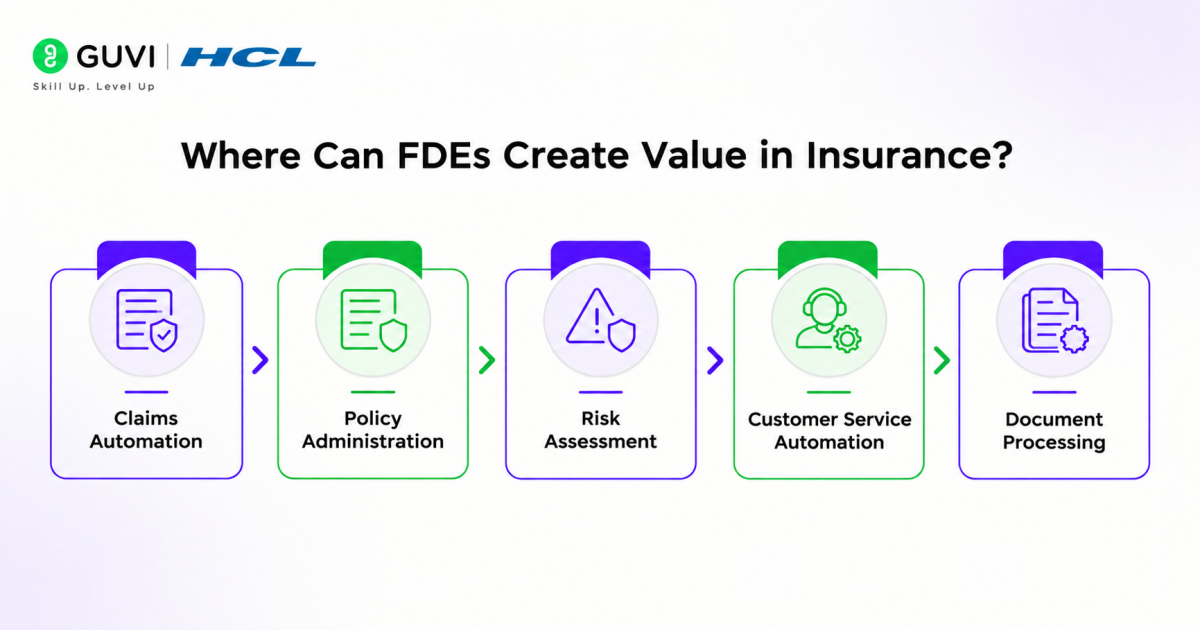
- Where Can FDEs Create Value in Insurance?
- Claims Automation
- Policy Administration
- Risk Assessment
- Customer Service Automation
- Document Processing
- Which Skills Do Insurance FDEs Need?
- Technical Skills
- Insurance Knowledge
- What Challenges Do FDEs Face in Insurance?
- Legacy Technology
- Data Privacy
- Complex Integrations
- Data Quality
- Regulatory Requirements
- Reliability
- How Can FDEs Approach Insurance Deployments?
- Step 1: Understand the Workflow
- Step 2: Map the Technology
- Step 3: Identify the Bottleneck
- Step 4: Build a Small Prototype
- Step 5: Validate With Realistic Data
- Step 6: Deploy and Monitor
- Step 7: Improve Iteratively
- Why Could Insurance Become an Emerging FDE Niche?
- Start Your Learning Journey with HCL GUVI
- Conclusion
- FAQs
- What is forward deployed engineering in insurance?
- Why does insurance need forward deployed engineers?
- What can an FDE do in insurance?
- What skills are needed for an insurance FDE role?
- Do insurance FDEs need insurance industry experience?
- Is insurance a good niche for forward deployed engineers?
TL;DR Summary
- Forward deployed engineering insurance combines software engineering with customer-focused problem-solving across complex insurance workflows.
- FDEs can help insurers integrate legacy systems, automate processes, deploy AI solutions, and improve data workflows.
- Insurance companies often operate with large amounts of structured and unstructured data across multiple systems.
- FDEs need technical skills in APIs, cloud, databases, AI, automation, and debugging alongside an understanding of insurance workflows.
- Successful insurance deployments require strong attention to data security, compliance, reliability, and integration.
- As insurers adopt AI and modern technology, forward deployed engineering can become an increasingly useful model for delivering practical solutions.
What Is Forward Deployed Engineering in Insurance?
Forward deployed engineering in insurance combines software development, system integration, data engineering, automation, and customer-focused problem-solving to address the specific technology needs of insurance organizations.
Insurance companies often rely on complex technology environments containing policy administration systems, claims platforms, customer databases, document repositories, analytics tools, and legacy applications.
An FDE works closely with insurance teams to understand these environments and build practical solutions around them.
For example, an insurer may want to use AI to help classify incoming claims documents. An FDE could integrate the AI system with existing document management and claims platforms, build the required workflow, test it with realistic data, and help deploy it.
Prepare for emerging AI engineering opportunities with HCL GUVI’s Artificial Intelligence & Machine Learning Course. Develop practical skills in AI and machine learning through hands-on projects and industry-focused learning.
Why Does Insurance Need Forward Deployed Engineers?
Insurance is a data-heavy industry with workflows that can involve multiple departments and systems.
A single insurance process may involve:
- Customer information
- Policy data
- Claims
- Documents
- Payments
- Risk information
- External data sources
- Regulatory requirements
These systems do not always communicate seamlessly.
A standard software product may provide the core functionality, but customers often need additional integrations or customization to fit their existing workflows.
This is where FDEs can provide value.
Insurance workflows often involve both structured data, such as policy records, and unstructured information, such as emails, PDFs, images, and claim documents. This creates opportunities for both data integration and AI-based automation.
Where Can FDEs Create Value in Insurance?
1. Claims Automation
Claims processing can involve collecting documents, reviewing information, validating records, and routing cases.
FDEs can build integrations and automation workflows that reduce repetitive manual work.
For example:
Claim submission → Document processing → Data extraction → Validation → Review → DecisionAI can potentially assist with document classification or information extraction, while the FDE ensures the solution integrates correctly with existing systems.
2. Policy Administration
Insurance organizations manage large amounts of policy information.
FDEs can help connect policy administration platforms with customer portals, analytics systems, CRM platforms, and other applications.
3. Risk Assessment
Insurance companies increasingly use data to evaluate risk.
FDEs can help integrate internal and external datasets into analytical workflows and build applications that make relevant information easier to access.
4. Customer Service Automation
AI assistants and automated workflows can help insurance organizations handle common customer questions.
An FDE may integrate an AI system with policy databases and internal knowledge sources so responses can be grounded in relevant information.
5. Document Processing
Insurance generates large volumes of documents, including applications, policies, claims forms, invoices, and reports.
AI-powered document processing can help extract relevant information and route documents to the appropriate workflows.
Which Skills Do Insurance FDEs Need?
An insurance FDE needs a broad technical foundation combined with an understanding of insurance operations.
1. Technical Skills
Important areas include:
- APIs and system integration
- Python or another programming language
- SQL and databases
- Cloud platforms
- Data pipelines
- AI and machine learning
- Automation
- Authentication
- Monitoring and debugging
2. Insurance Knowledge
FDEs should also understand basic concepts such as:
- Policies
- Premiums
- Claims
- Underwriting
- Risk assessment
- Renewals
- Fraud detection
- Customer servicing
You do not need to become an insurance specialist before entering the field. However, understanding how insurance workflows operate can make technical discussions with customers much more productive.
Pro Tip: When building an insurance FDE project, focus on a real workflow rather than simply creating an AI demo. For example, build a claims-document processing pipeline that connects document extraction, validation, and a simple claims workflow.
What Challenges Do FDEs Face in Insurance?
Insurance environments present several challenges that FDEs must consider.
1. Legacy Technology
Many insurers depend on systems that have been running for years. These systems may have limited APIs or outdated interfaces.

2. Data Privacy
Insurance applications can involve sensitive personal and financial information. Data access and storage must therefore be handled carefully.
3. Complex Integrations
An FDE may need to connect several internal and external systems during one deployment.
4. Data Quality
Incorrect or incomplete data can affect downstream workflows and analytical results.
5. Regulatory Requirements
Insurance is highly regulated in many markets. Technical solutions may need to account for applicable regulatory and compliance requirements.
6. Reliability
Insurance systems often support important customer and business processes. Unexpected failures can disrupt claims, policy servicing, or customer communication.
Warning: Avoid treating insurance data like ordinary application data. Before building an AI or integration solution, understand the customer’s security, privacy, access-control, and compliance requirements.
How Can FDEs Approach Insurance Deployments?
A structured approach can reduce deployment risks.
Step 1: Understand the Workflow
Start by learning how the customer’s process works from beginning to end.
Step 2: Map the Technology
Identify databases, APIs, legacy applications, document systems, cloud infrastructure, and existing integrations.
Step 3: Identify the Bottleneck
Look for repetitive manual tasks, slow data transfers, disconnected systems, or processes where employees spend significant time.
Step 4: Build a Small Prototype
Test the solution on a limited workflow before expanding it across the organization.
Step 5: Validate With Realistic Data
Use representative test cases to identify data quality issues, edge cases, and integration failures.
Step 6: Deploy and Monitor
Track system performance, errors, data quality, and operational outcomes after deployment.
Step 7: Improve Iteratively
Use customer feedback and production observations to improve the solution rather than attempting to solve every problem in the first deployment.
Best Practice: In insurance deployments, prioritize reliability and explainability alongside technical performance. A solution that works in a demo but cannot be trusted by operational teams will struggle to deliver long-term value.
Why Could Insurance Become an Emerging FDE Niche?
The combination of legacy infrastructure, large datasets, AI adoption, automation, and complex customer workflows creates a strong need for engineers who can bridge technology and business requirements.
Insurance organizations may need help connecting modern AI and cloud technologies with existing systems rather than replacing everything at once.
This creates an opportunity for FDEs who can:
- Understand ambiguous requirements
- Work across different technology stacks
- Integrate modern and legacy systems
- Build AI-powered workflows
- Automate repetitive processes
- Communicate with business stakeholders
- Deploy and troubleshoot solutions in real environments
For engineers interested in customer-facing technical roles, insurance can therefore offer a specialized path within forward deployed engineering.
Start Your Learning Journey with HCL GUVI
Prepare for emerging AI engineering opportunities with HCL GUVI’s Artificial Intelligence & Machine Learning Course. Develop practical skills in AI and machine learning through hands-on projects and industry-focused learning.
Conclusion
Forward deployed engineering in insurance represents an emerging niche where engineers can apply modern software, cloud, data, and AI technologies to complex industry workflows. Insurance companies often have valuable data and established systems but need practical ways to connect them with newer technologies.
For aspiring FDEs, the opportunity lies in learning how to solve these problems without treating every customer environment like a greenfield project. By combining integration skills, AI knowledge, debugging ability, domain understanding, and strong communication, engineers can help insurers modernize workflows while delivering measurable business value.
FAQs
What is forward deployed engineering in insurance?
Forward deployed engineering in insurance involves building and deploying technical solutions that address specific insurance workflows, integrations, data challenges, and customer requirements.
Why does insurance need forward deployed engineers?
Insurance companies often have complex workflows, legacy systems, large datasets, and multiple applications that need to work together. FDEs help connect these systems and implement practical technical solutions.
What can an FDE do in insurance?
An FDE can work on claims automation, policy integrations, document processing, customer service automation, risk analytics, data pipelines, and AI-powered workflows.
What skills are needed for an insurance FDE role?
Useful skills include programming, APIs, SQL, databases, cloud platforms, AI, automation, debugging, system integration, and customer communication.
Do insurance FDEs need insurance industry experience?
Not always. However, understanding concepts such as claims, policies, premiums, underwriting, and risk assessment can help engineers understand customer requirements more effectively.
Is insurance a good niche for forward deployed engineers?
Insurance can be a promising niche because organizations are adopting AI and modern technology while continuing to operate complex legacy systems and workflows. This creates opportunities for engineers who can bridge business requirements and technical implementation.
Success Stories

About the Author
HCL GUVI
This article was selected and published as part of the HCL GUVI AI Blogathon 2026, an initiative designed to encourage students, AI enthusiasts, and aspiring tech writers to simplify complex AI concepts through impactful technical content. The contest recognized high-quality, original, and insightful AI-focused blogs, with selected authors receiving publication opportunities on the HCL GUVI blog platform along with official author credits and recognition.
View all posts by HCL GUVI
Connect with me @











Did you enjoy this article?