


Data Structure Articles
Sliding Window Technique: Explained with Examples
Two Pointer Technique: Problems and Applications


Get In Touch For Details! Request More Information
Ultimate Guide 2026: Difference Between Data Structures and Algorithms Explained
Feb 12, 2026 6 Min Read 3118 Views
(Last Updated)
If you are an enthusiastic developer, you probably have heard of Data Structures and algorithms. But what exactly do they mean, and more importantly, what’s the difference between them?
Understanding the difference between Data Structures and Algorithms is very important for anyone willing to join the tech field, whether you’re a beginner learning to code, a software developer looking to sharpen your skills, or a student preparing for technical interviews. These two concepts work hand in hand to make programs efficient, scalable, and reliable.
In this blog post, we will discuss: What Data Structures and Algorithms are, the main differences between them, why they are always taught together in computer science, Real-world applications in software development, and lastly, how you can learn both Data Structures and Algorithms to enhance your programming skills. After reading this blog, you will have a crystal clear understanding of what the two core concepts are, why we care about them, and how learning them can help you think like a true programmer.
Table of contents
- What Are Data Structures?
- What Are Algorithms?
- Key Difference Between Data Structures and Algorithms
- Why Are They Taught Together?
- Common Types of Data Structures
- Arrays
- Linked Lists
- Stacks
- Queues
- Trees
- Graphs
- Hash Tables
- Common Types of Algorithms
- Searching Algorithms
- Sorting Algorithms
- Recursion Algorithms
- Dynamic Programming
- Greedy Algorithms
- Divide and Conquer
- Graph Algorithms
- Data Structures vs Algorithms: Which Should You Learn First?
- 💡 Did You Know?
- How to Master Data Structures and Algorithms
- Step 1: Understand the Basics
- Step 2: Learn a Programming Language
- Step 3: Practice Problem-Solving
- Step 4: Analyze Complexity
- Step 5: Build Real Projects
- Step 6: Learn Through Visualization Tools
- Step 7: Stay Consistent and Reflect
- Bonus Step: Prepare for Interviews
- Applications in Programming and Software Development
- Wrapping it up…
- FAQs
- What is the primary difference between data structures and algorithms?
- Why do we teach data structures and algorithms together?
- Which should I learn first, data structures or algorithms?
- Are data structures or algorithms important for coding interviews?
What Are Data Structures?
A data structure is a way of organizing, storing, and managing data so it can be used efficiently.
Think of it as a container that holds your data and determines how that data can be accessed or modified.
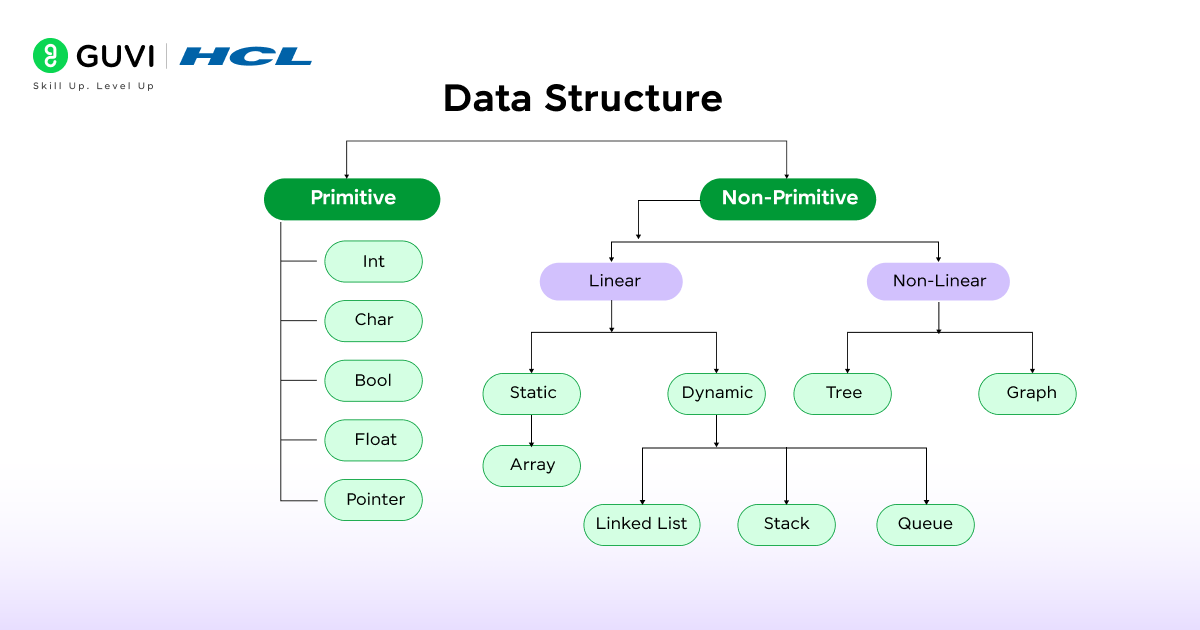
In programming, data structures help you:
- Store information in memory
- Retrieve data quickly
- Perform operations like insertion, deletion, or sorting efficiently
What Are Algorithms?
An algorithm is a step-by-step procedure or formula for solving a problem or performing a task.
It’s not about what data you have, but how you manipulate it.
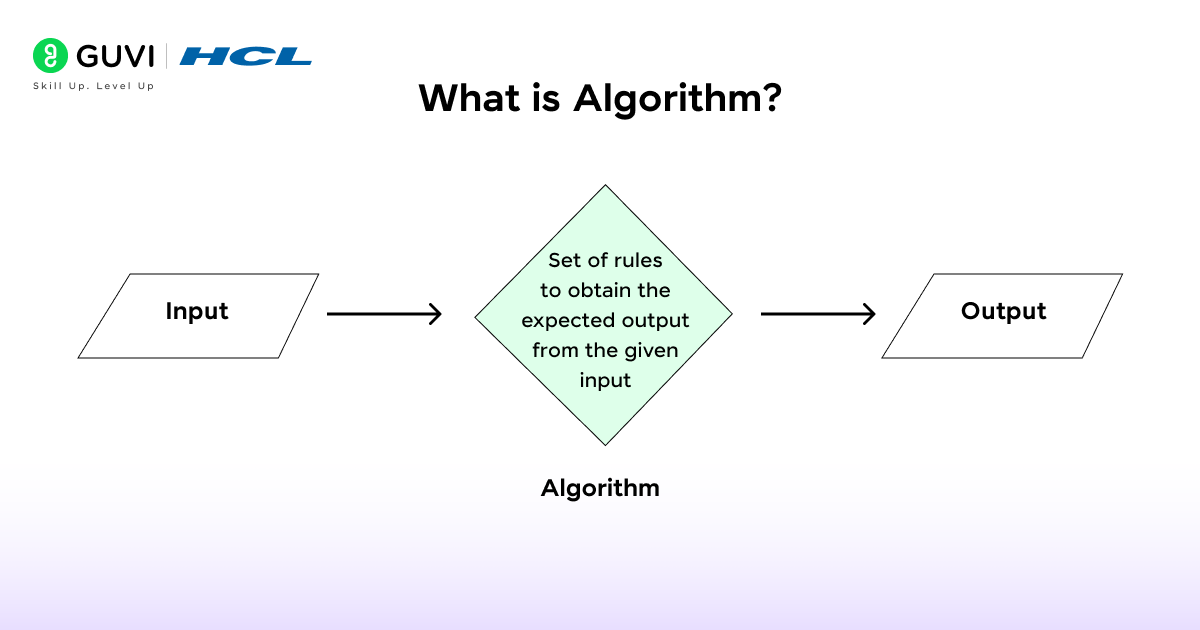
Algorithms define logic and flow a sequence of operations applied to data to get a desired result.
Key Difference Between Data Structures and Algorithms
| Aspect | Data Structures | Algorithms |
| Definition | A method to store and organize data | A step-by-step process to solve a problem |
| Purpose | Efficient data storage and management | Efficient problem-solving and computation |
| Focus | Structure and organization | Logic and flow of operations |
| Example | Array, Stack, Queue, Tree | Sorting, Searching, Recursion |
| Role | Defines how data is stored | Defines how data is processed |
| Dependency | Algorithms depend on data structures to function efficiently | Data structures are useless without algorithms |
| Analogy | A container that holds ingredients | The recipe that tells how to cook those ingredients |
Why Are They Taught Together?
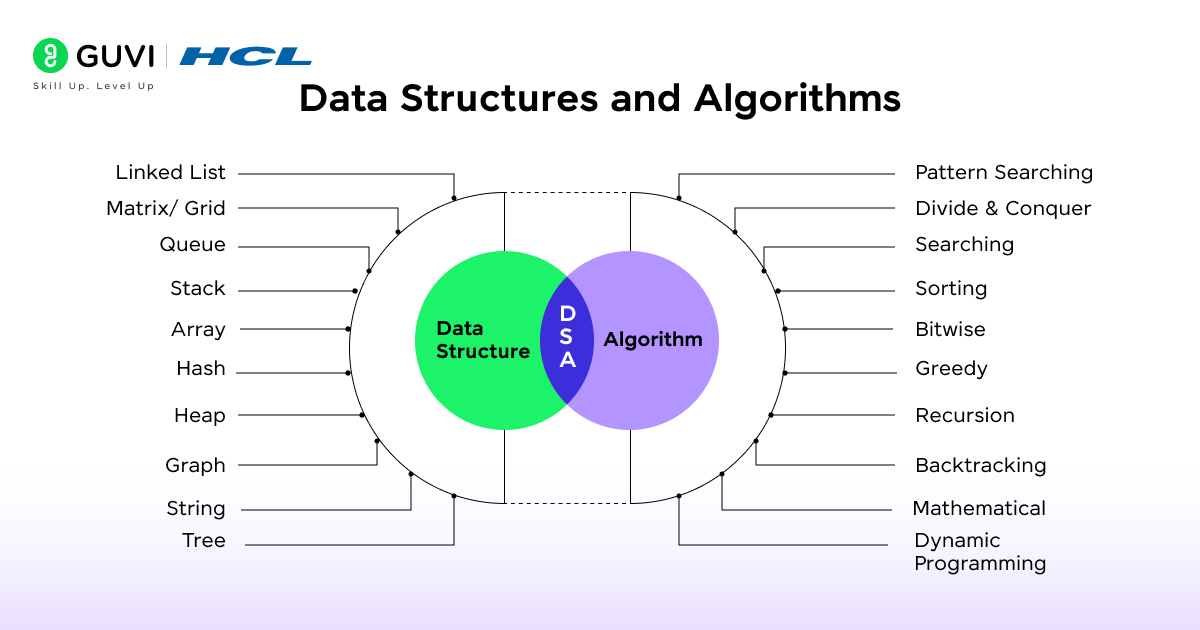
You will often see both subjects together within courses or books titled “Data Structures and Algorithms (DSA),” and there is a solid reason for this. They go hand-in-hand. Without data structures, algorithms have nothing to act on, and without algorithms, data structures are mere passive storage.
For example, a binary search algorithm can only function effectively on a sorted data structure such as an array. A graph traversal algorithm needs a graph data structure to determine various relationships.
In the end, data structures are the building blocks, while algorithms are the logic that stimulates the data structures.
Common Types of Data Structures
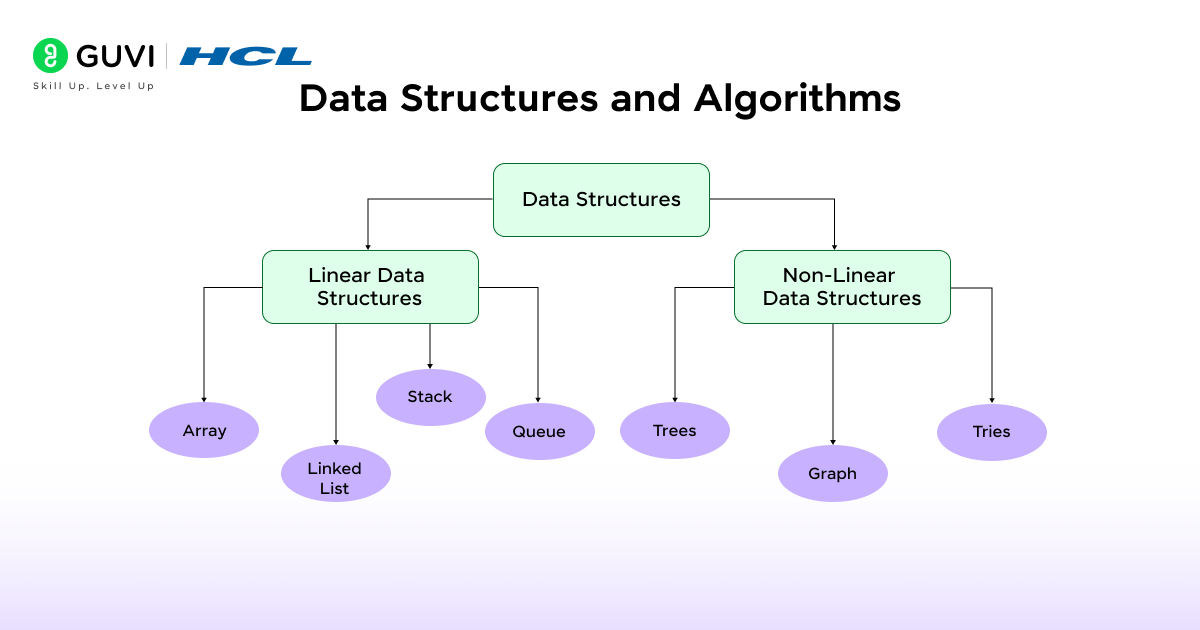
1. Arrays
- Store elements of the same type.
- Accessing elements is fast (O(1)), but insertion/deletion is costly (O(n)).
2. Linked Lists
- Elements (nodes) are connected via pointers.
- Dynamic in size but slower in accessing specific elements.
3. Stacks
- LIFO structure.
- Used in undo/redo operations, recursion, and expression evaluation.
4. Queues
- FIFO structure.
- Used in scheduling, printing tasks, and data buffering.
5. Trees
- Hierarchical structure with a root and branches.
- Variants: Binary Tree, AVL Tree, Binary Search Tree, etc.
- Used in databases, file systems, and hierarchical storage.
6. Graphs
- Represent relationships or networks.
- Used in maps, social media, and web link structures.
7. Hash Tables
- Store key-value pairs for fast lookup.
- Used in dictionaries, caches, and databases.
Common Types of Algorithms
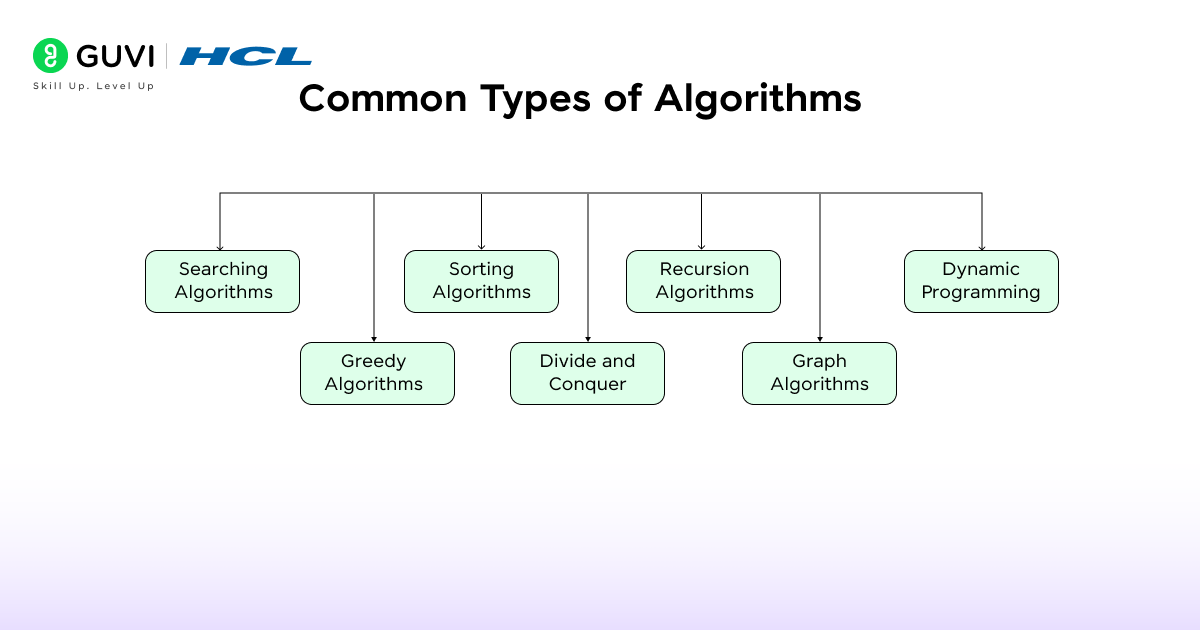
1. Searching Algorithms
Used to locate data within a structure.
- Linear Search
- Binary Search
2. Sorting Algorithms
Used to arrange data systematically.
- Bubble Sort
- Merge Sort
- Quick Sort
3. Recursion Algorithms
A function that calls itself to solve subproblems.
- Used in tree traversals, factorial calculation, etc.
4. Dynamic Programming
Solves complex problems by breaking them into smaller overlapping subproblems.
- Examples: Fibonacci Series, Knapsack Problem
5. Greedy Algorithms
Choose the best solution at each step for optimal results.
- Example: Huffman Coding, Dijkstra’s Algorithm
6. Divide and Conquer
Divide a problem into smaller parts, solve, and combine.
- Example: Merge Sort, Quick Sort
7. Graph Algorithms
Used to navigate and analyze networks.
- BFS, DFS, and Kruskal’s Algorithm.
Data Structures vs Algorithms: Which Should You Learn First?
If you are a beginner, you likely have the same question.
As a general rule, they recommend starting with Data Structures.
But why?
Algorithms are about changing data so it is very important, if not crucial, for you to first understand how data is stored.
Learning Order Example
- Learn Arrays, Linked Lists, Stacks, Queues, and Trees
- Then practice it in a programming language like Python or C++.
- After that, you can move on to searching algorithms, sorting algorithms, and optimization algorithms.
- Finally, you can get into more complicated algorithms like dynamic programming or graph algorithms.
The idea is that by learning this way, this will help you understand that each algorithm has a reason why it is built that way and not just how it was built.
💡 Did You Know?
- The concept of Data Structures dates back to the 1950s — around the same time as the first computers!
- Algorithms were named after the Persian mathematician Al-Khwarizmi, whose name literally gave birth to the term “algorithm.”
- Google’s search engine uses advanced algorithms that process billions of data structures every second to deliver results in milliseconds.
- Mastering Data Structures and Algorithms (DSA) is often the key skill that top tech companies test during coding interviews.
How to Master Data Structures and Algorithms
Learning Data Structures and Algorithms (DSA) is similar to working out, you cannot get good at it quickly, but once you do it, it will pay off much more than you would think. Coding interviews, making applications, or just learning to think logically, DSA provides you with a solid background in all areas of computer science.
Here’s a detailed roadmap to help you learn effectively and with purpose:
Step 1: Understand the Basics
Before you start coding complex problems, it’s essential to understand what each data structure does and why it exists.
- Understand the use and practical examples of data structures such as arrays, stacks, queues, linked lists, trees, and graphs.
- Learn how data is stored in the memory, e.g., arrays save the items in the same blocks, whereas the ones in a linked list store nodes scattered across memory.
- Don’t rush. Take time to visualize how operations (such as insertion, deletion or traversal) occur in each structure.
- Read basic analogies. Think of stacks as a pile of dishes or queues as people waiting in line.
Step 2: Learn a Programming Language
You cannot understand DSA, really, without putting it into practice. Select one programming language, and follow it throughout your learning period.
- Python is easy to learn, as it is simple and easy to understand.
- In competitive programming and interviews, C++ and Java are more preferred as they are more direct in memory and performance.
- Write your own data structure code such as stacks, queues and trees even when libraries are available.
Download HCL GUVI’s free Data Structures & Algorithms eBook and start mastering problem-solving skills that every top developer needs!

Step 3: Practice Problem-Solving
After getting the fundamentals, put them into practice. Problem-solving is the core of mastering DSA.
- Take small steps. Work on easy problems with arrays and strings.
- Advance towards intermediate and advanced concepts such as recursion, sorting, and dynamic programming gradually.
- Platforms like HCL Guvi CodeKata, LeetCode, HackerRank, GeeksforGeeks, and Codeforces are goldmines for structured DSA practice.
Step 4: Analyze Complexity
Each algorithm is associated with a time complexity (length of time it requires) and space complexity (amount of memory it requires). The combination of them determines the scalability of your solution.
Learn Big O notation, the language used to express efficiency:
- O(1): Constant time
- O(n): Linear time
- O(log n): Logarithmic time
- O(n²): Quadratic time
Example:
- Linear search → O(n)
- Binary search → O(log n)
- Bubble sort → O(n²)
- Merge sort → O(n log n)
Understanding these helps you write faster, smarter code and make better design choices.
Step 5: Build Real Projects
The most effective method of building your knowledge is by creating something that is practical. Practical application of DSA concepts in projects helps in eliminating the gap between theory and practice.
- Chat Application: Process your messages using queues and store your messages using linked lists.
- Search Engine Prototype: Use a hash table-based simple text search algorithm.
- Game Logic: Use graphs or trees to manage player navigation or game maps.
- File Compression Tool: Use greedy algorithms (such as Huffman encoding).
These projects make you know not only how DSA works – but why they are important in real-world systems.
Step 6: Learn Through Visualization Tools
Visualization helps you to make your abstract reasoning a reality. The ability to visualize data movement and shifting when an algorithm is being run will make learning much quicker.
The visualization tools and platforms that are popular:
- VisuAlgo.net: It is good with animations of sorting, searching, and graph algorithms.
- Algorithm Visualizer: Allows you to step through code and logic flow.
- CS50 Visualizer: It is recommended when a person who wants to know C-based data structures and is a beginner.
Use them to both strengthen your knowledge after coding, it enhance your intuition and recollection of algorithm behavior.
Step 7: Stay Consistent and Reflect
The thing is, people do not become masters in one session of a marathon, but the result is achieved through daily practice.
- Set achievable goals. For example, 1 new topic or problem a day.
- Use a coding journal or GitHub repository to remind yourself of what you have done.
- Do not omit reconsideration of old issues. The ability to re-solve them a few weeks later is an indication of how well you have understood them.
Pro Tip: Participate in online communities or study groups such as Reddit, Discord or LinkedIn. Sharing the issues with others improves retention and presents new perspectives.
Bonus Step: Prepare for Interviews
Now is the time to practice DSA interview questions, to bag your dream job in your dream company.
- Read some of the most popular questions of the best tech firms.
- Problem-solve in whiteboard style- be able to explain how you got your answer in a simple and precise way.
- Pay attention to standard interview questions: arrays, strings, recursion, binary trees, hash maps, and dynamic programming.
Applications in Programming and Software Development
Knowing the difference between Data Structures and Algorithms isn’t just about success in academia; it also has real-world implications regarding how software should be developed or used.
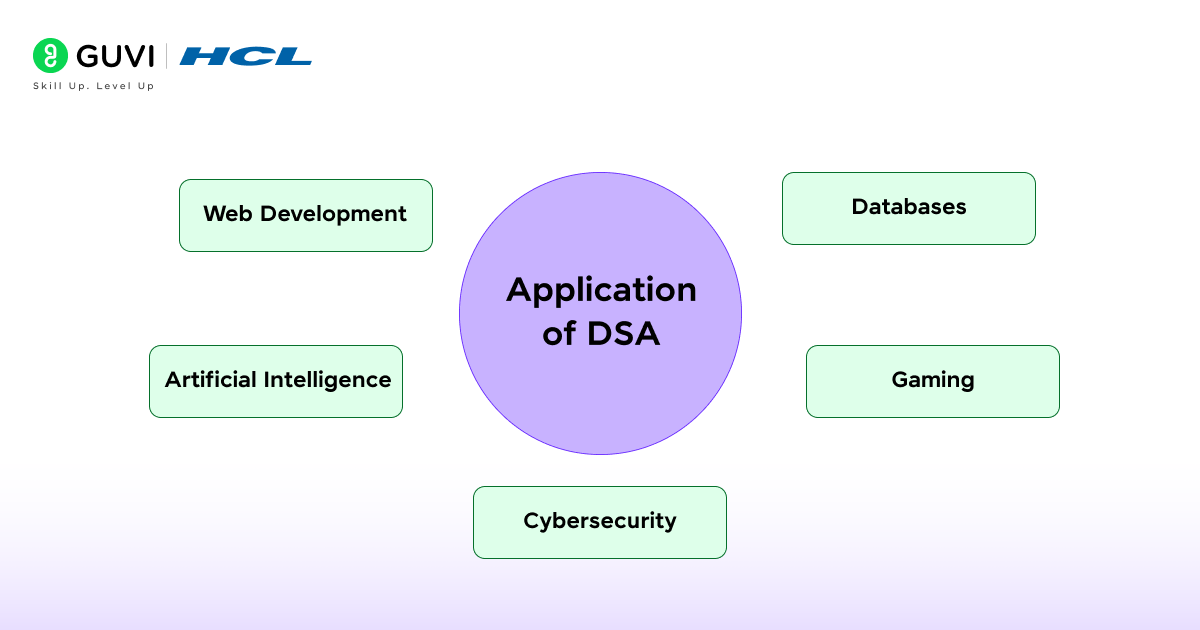
- In Web Development:
- Data structures are used to manage sessions, make sense of stored cookies, or switch between user profiles.
- Algorithms are used for searching for input data or retrieving data sources.
- In Artificial Intelligence:
- Data structures like graphs or matrices are used to represent decision-making models.
- Algorithms such as backpropagation or decision trees are used for learning and predicting future states.
- In Cybersecurity:
- Data structures like hash functions are used to protect sensitive data.
- Algorithms are used for encryption/decryption for secure communications.
- In Gaming:
- Trees and graphs represent game maps.
- Pathfinding algorithms determine player movement.
- In Databases:
- Data structures such as B-trees and hash tables serve to index, then quickly query datasets.
- Algorithms are used for sorting input data and for searching for data within potentially massive datasets.
Every discipline from finance to healthcare to logistics to social networking is turning a blind eye to the relevance of discrete principles, on a daily basis.
You’ve just learned the difference between Data Structures and Algorithms, now it’s time to put that knowledge into action! Join HCL GUVI’s AI & Software Development Course with Python IIT-M Pravartak Certified and gain real-world coding experience, expert mentorship, and job-ready skills that top companies are looking for.
Wrapping it up…
In short, the difference between Data Structures and Algorithms lies in their roles. Data structures focus on how data is stored, while algorithms focus on how that data is used to solve problems.
Both are important to write logical code that is efficient and high-performance. The proper data structure will make the algorithm run faster, and the proper algorithm will make the data structure useful. The two work symbiotically and are core to every software system, from mobile applications to sophisticated AI models.
Learning both Data Structures and Algorithms will improve coding efficiency as well as logical thinking and problem-solving skills.
I hope this blog has given you a better sense of the difference between Data Structures and Algorithms and how learning both will help you become a better programmer.
FAQs
1. What is the primary difference between data structures and algorithms?
Data structures are used to store and organize data, while algorithms are used to manipulate and process data efficiently.
2. Why do we teach data structures and algorithms together?
They complement one another; algorithms need data structures to perform work on, and data structures need algorithms to be efficient.
3. Which should I learn first, data structures or algorithms?
Begin with data structures as they provide the foundation. Once you know how to store data, algorithms are much easier to learn.
4. Are data structures or algorithms important for coding interviews?
Absolutely! Most technical interviews put a heavy emphasis on data structures and algorithms as these concepts test your coding efficiency and problem-solving.
Success Stories

About the Author
Vishalini Devarajan
An Aerospace Engineer turned content writer, I focus on making complex concepts easy to understand through well-structured, reader-friendly blogs. Whether it’s a technical topic or a non-technical one, I love creating content that is clear, engaging, and impactful.
View all posts by Vishalini Devarajan
Connect with me @











Did you enjoy this article?