


Python Articles
Excel SQL Python for BPO Professionals Best Guide to Move Into Data Science
Go vs Python for Forward Deployed Engineering Workloads
Python for Forward Deployed Engineers: What You Actually Need to Know
Freelancing as a Python Developer: Getting Your First Client


Get In Touch For Details! Request More Information

Constructor in Python: Types, Syntax, Advantages & Real-World Examples
Sep 02, 2026 4 Min Read 887 Views
(Last Updated)
More than 80% of modern software applications today are built using object-oriented programming principles, making constructors one of the most frequently used concepts in Python development. From authentication systems and e-commerce platforms to AI pipelines and enterprise software, constructors help initialise objects automatically and maintain structured application design.
In this guide, explore what constructors are in Python, their syntax, types, advantages, and real-world applications. You will also learn how constructors simplify object creation and improve code scalability in modern software development.
Quick Answer:
A constructor in Python is a special __init__() method that automatically runs during object creation to initialise attributes and configure object states. Constructors improve code organisation, scalability, and reusability while simplifying real-world workflows like user authentication, database connections, API setup, e-commerce product management, and enterprise application development.
- Python moved from rank 26 in 2001 to rank 1 globally by 2026, showing one of the fastest long-term growth trends among programming languages.
- Python recently overtook JavaScript as the most-used language on GitHub, highlighting its dominance across AI, automation, data science, and enterprise software development.
- According to the Python Developer Survey covering nearly 30,000 developers, around 72% use Python professionally, while 86% prefer Python over other programming languages.
Table of contents
- What Is a Constructor in Python?
- Core Concepts of Constructors in Python
- Types of Constructors in Python
- Default Constructor
- Parameterized Constructor
- Constructor With Default Arguments
- Constructor vs Normal Method
- Advantages of Constructors in Python
- Real-World Examples of Constructors in Python
- Database Connection Setup in Enterprise Applications
- Product Object Creation in E-Commerce Platforms
- Common Errors in Python Constructors
- Conclusion
- FAQs
- Can a Python class have multiple constructors?
- What happens if a constructor is not defined in Python?
- Can constructors call other methods inside a class?
- Why is constructor design important in large applications?
What Is a Constructor in Python?
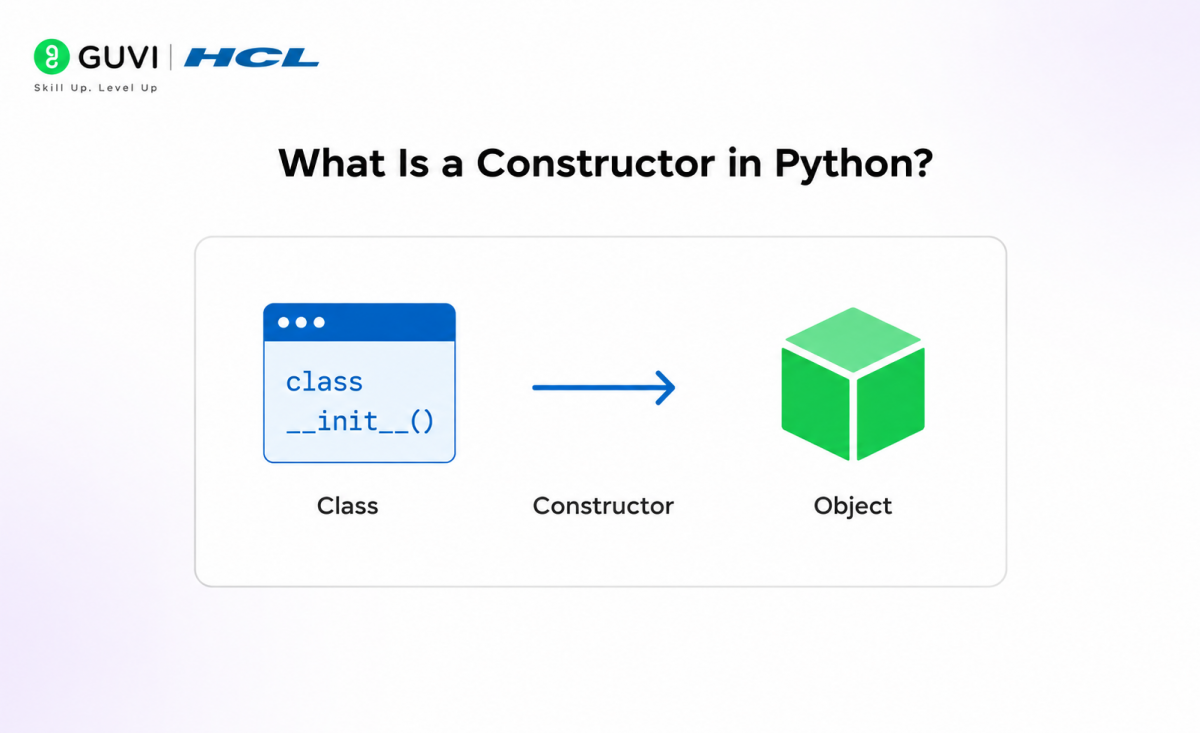
A constructor in Python is a special class method that automatically executes when an object is created. It is primarily used to initialise object attributes, assign default values, and prepare the object’s internal state before other methods interact with it. Python constructors are implemented using the __init__() method.
Core Concepts of Constructors in Python
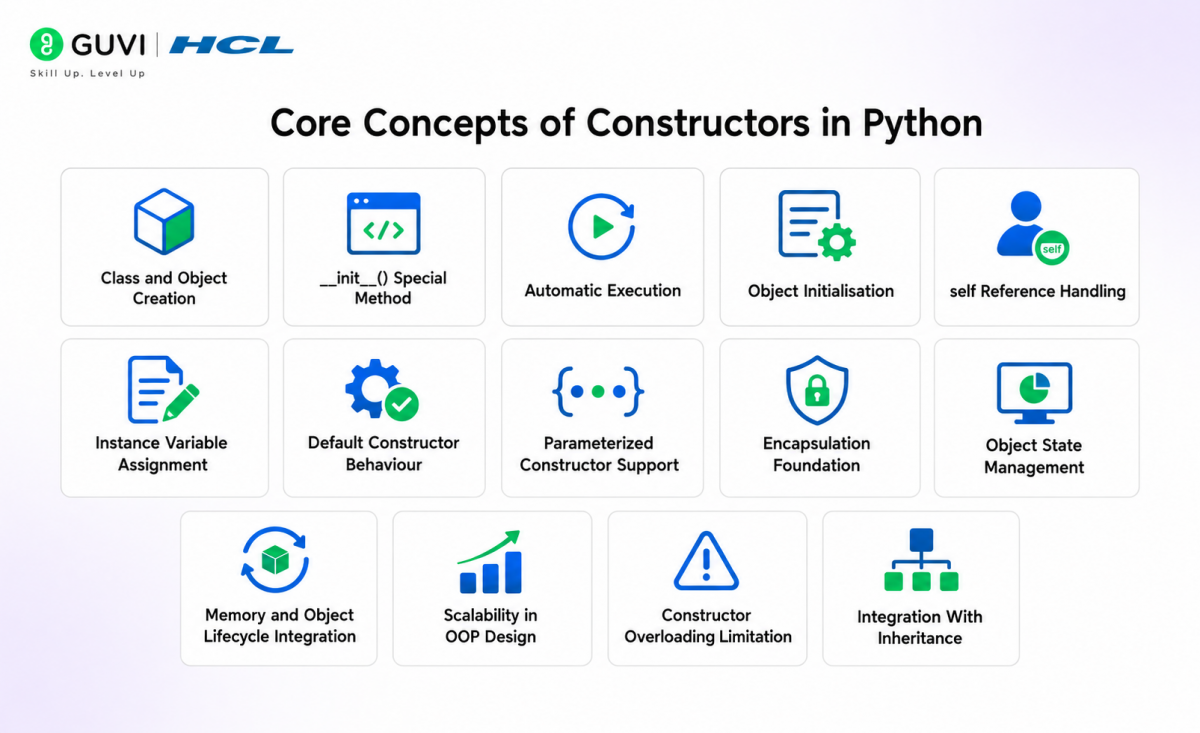
- Class and Object Creation: A constructor executes automatically whenever a new object is created from a class, helping initialise the object’s internal state immediately.
- __init__() Special Method: Python constructors are implemented using the __init__() method, which acts as the primary object initialisation mechanism inside a class.
- Automatic Execution: Unlike normal methods, constructors do not require explicit method calls. They run automatically during object instantiation.
- Object Initialisation: Constructors are mainly responsible for assigning initial values to object attributes such as names, IDs, balances, configurations, or settings.
- self Reference Handling: The self keyword inside constructors refers to the current object instance and allows instance-specific data storage.
- Instance Variable Assignment: Constructors commonly create and initialise instance variables using the self.variable_name syntax.
- Default Constructor Behaviour: A constructor without additional parameters apart from self is called a default constructor and is used for fixed initialisation workflows.
- Parameterized Constructor Support: Constructors can accept multiple input arguments, allowing dynamic object creation with different attribute values.
- Encapsulation Foundation: Constructors help establish encapsulated object design by controlling how object data gets initialised internally.
- Object State Management: Constructors ensure objects begin in a valid and predictable state before other methods interact with them.
- Memory and Object Lifecycle Integration: Constructors participate in Python’s object lifecycle management by preparing objects immediately after memory allocation.
- Scalability in OOP Design: In larger applications, constructors simplify the management of complex entities like users, APIs, databases, configurations, and service objects.
- Constructor Overloading Limitation: Python does not support traditional constructor overloading directly, but similar behaviour can be achieved using default arguments or variable-length parameters.
- Integration With Inheritance: Constructors can be inherited and extended using super().__init__() to initialise parent class attributes within child classes.
Strengthen your Python fundamentals and explore real-world programming concepts with HCL GUVI’s free Python eBook. Learn core Python concepts, practical coding techniques, and beginner-friendly examples designed for aspiring developers and AI learners.
Types of Constructors in Python
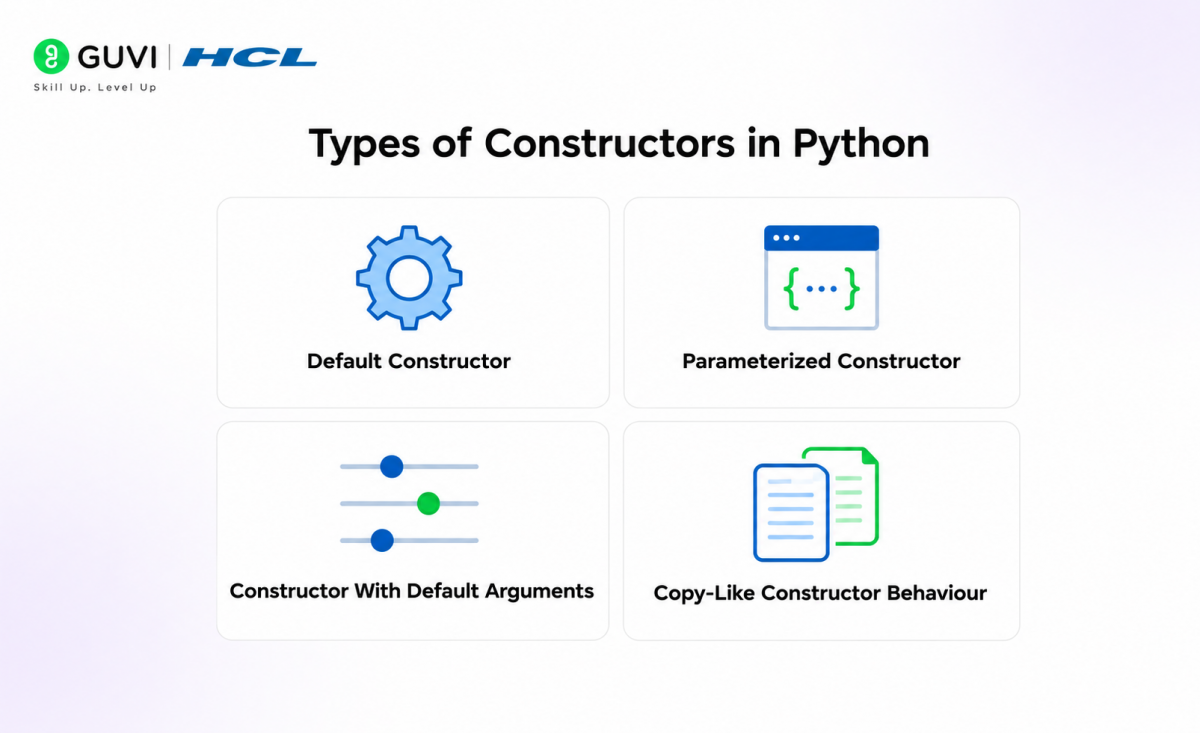
1. Default Constructor
A default constructor does not accept additional parameters apart from self. It is mainly used for fixed object initialisation, assigning default values, and executing predefined setup logic automatically during object creation. Default constructors are commonly used when all objects require similar initial configurations.
Key Characteristics
- Accepts only the self parameter
- Automatically executes during object creation
- Useful for static or predefined initialisation workflows
- Simplifies basic object setup operations
2. Parameterized Constructor
A parameterized constructor accepts arguments during object creation. It allows developers to initialise objects with dynamic values such as names, IDs, prices, configurations, credentials, or user-specific data. This provides greater flexibility and scalability in object-oriented programming.
Key Characteristics
- Accepts multiple input parameters
- Supports dynamic object initialisation
- Improves flexibility in application design
- Commonly used in real-world systems and enterprise applications
3. Constructor With Default Arguments
Python constructors can also use default argument values, allowing developers to create flexible constructors that support both optional and user-defined inputs.
Example Use Cases
- Default user roles
- Predefined API configurations
- Optional application settings
- Default pricing or inventory values
- Copy-Like Constructor Behaviour
Although Python does not support traditional copy constructors like C++, developers can create similar behaviour by passing existing objects into constructors and duplicating attribute values manually.
Common Applications
- Cloning configurations
- Duplicating datasets
- Copying object states
- Creating backup object instances
Constructor vs Normal Method
Both constructors and normal methods are important components of object-oriented programming in Python. However, they serve completely different purposes inside a class. Constructors primarily handle object initialisation during object creation, while normal methods are used to perform operations, process logic, or manipulate object data after the object already exists.
| Feature | Constructor | Normal Method |
| Execution | Runs automatically | Called manually |
| Purpose | Initialise objects | Perform operations |
| Method Name | __init__() | Any valid name |
Master Python from fundamentals to real-world application development with GUVI’s Python Course. Learn core concepts like OOP, constructors, functions, automation, and backend programming through hands-on projects and industry-focused training.

Advantages of Constructors in Python
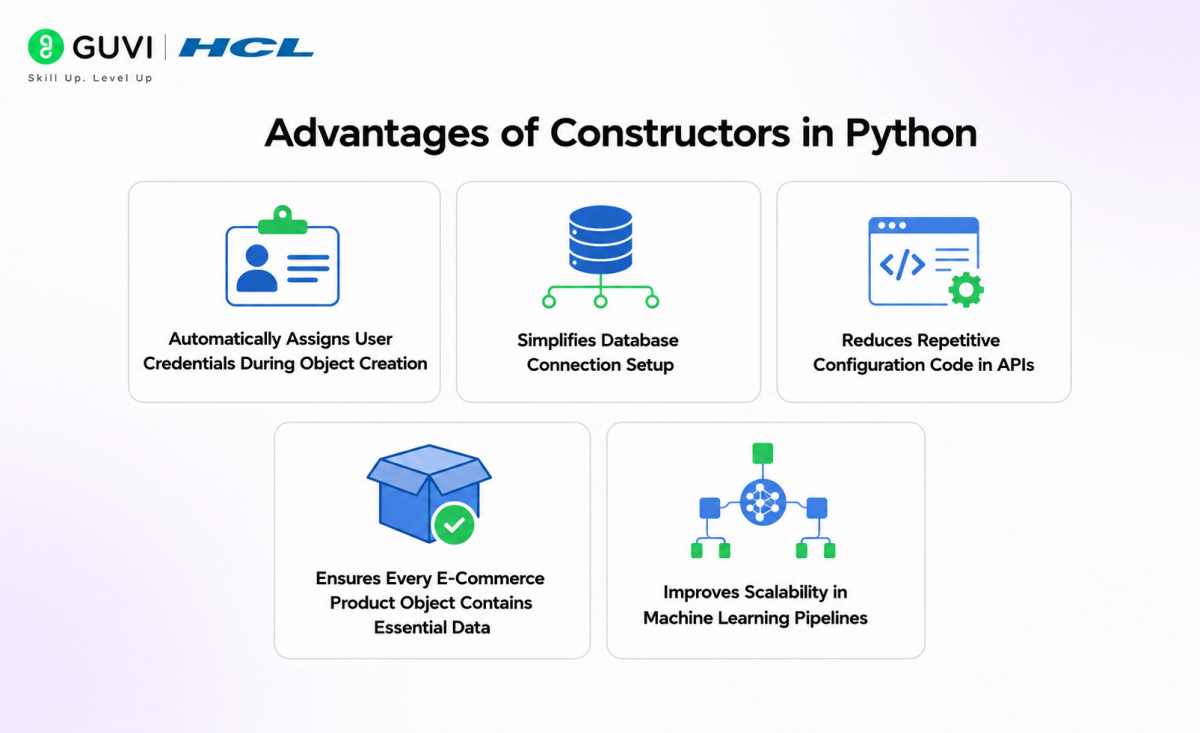
- Automatically Assigns User Credentials During Object Creation: Constructors can instantly initialise attributes like username, email, and password when creating user account objects in authentication systems.
- Simplifies Database Connection Setup: Constructors help initialise database host names, ports, credentials, and connection states automatically inside database management classes.
- Reduces Repetitive Configuration Code in APIs: API client objects can automatically store tokens, endpoints, and request headers during object creation instead of configuring them repeatedly.
- Ensures Every E-Commerce Product Object Contains Essential Data: Constructors help guarantee that product objects always start with valid attributes such as product ID, price, stock quantity, and category.
- Improves Scalability in Machine Learning Pipelines: Constructors can initialise datasets, model parameters, preprocessing settings, and training configurations automatically when ML pipeline objects are created.
Real-World Examples of Constructors in Python
- User Account Initialisation in Authentication Systems
Constructors are commonly used in authentication platforms to initialise user-related information automatically during account creation. When a new user object is created, the constructor can assign attributes such as username, email, password hash, account type, and login status instantly.
class User:

    def __init__(self, username, email):

        self.username = username

        self.email = email

        self.is_logged_in = False

user1 = User("Rahul", "[email protected]")
In large applications, this approach ensures every user object starts with a consistent structure and default account state.
2. Database Connection Setup in Enterprise Applications
Enterprise applications often use constructors to establish database configuration details automatically when database manager objects are created. This avoids repetitive connection setup code across multiple modules.
class DatabaseConnection:

    def __init__(self, host, port):

        self.host = host

        self.port = port

        print("Database connection configured")

db = DatabaseConnection("localhost", 3306)
This design improves maintainability because all connection-related setup logic remains centralised inside the constructor.
3. Product Object Creation in E-Commerce Platforms
E-commerce systems frequently use constructors to initialise product objects with essential inventory and pricing information during creation.
class Product:

    def __init__(self, name, price, stock):

        self.name = name

        self.price = price

        self.stock = stock

product1 = Product("Laptop", 75000, 20)
Using constructors here ensures every product object always contains valid core attributes such as pricing, inventory quantity, and product identity before business operations begin.
Common Errors in Python Constructors
- Forgetting the self Parameter: Beginners often forget to include self inside the constructor definition, causing argument-related errors during object creation.
- Incorrect Constructor Name: Writing init() instead of __init__() prevents Python from recognising the method as a constructor.
- Passing Incorrect Arguments During Object Creation: Creating objects with missing or extra parameters compared to the constructor definition results in TypeError exceptions.
- Accessing Uninitialised Attributes: Attempting to use object attributes before assigning them inside the constructor can cause AttributeError issues.
- Overwriting Instance Variables Accidentally: Using incorrect variable assignments inside constructors may unintentionally replace existing object data.
- Ignoring Parent Class Constructors in Inheritance: Failing to call super().__init__() in child classes can prevent parent attributes from initialising properly.
Conclusion
Constructors play a foundational role in Python’s object-oriented programming model by automating object initialisation and simplifying class-based development. They help developers create cleaner, more scalable, and maintainable applications by ensuring objects always start with properly configured states. Whether building simple beginner projects or enterprise-grade systems, understanding constructors is essential for writing efficient and structured Python code.
FAQs
Can a Python class have multiple constructors?
Python does not support traditional multiple constructors directly. Developers usually achieve similar behaviour using default arguments or variable-length parameters.
What happens if a constructor is not defined in Python?
If no constructor is defined, Python automatically provides a default constructor that creates the object without initialising custom attributes.
Can constructors call other methods inside a class?
Yes, constructors can call other class methods to perform validations, calculations, or additional setup operations during object creation.
Why is constructor design important in large applications?
Well-structured constructors improve maintainability, reduce configuration errors, and simplify object management across complex software systems.
Success Stories

About the Author
Vaishali
I'm a seasoned writer with four years of experience across technical, non-technical, and just about every genre or niche you can imagine. Adaptable and curious, I enjoy exploring new topics and making information engaging and easy to understand. Fueled by a steady stream of tea, I approach each project with creativity, reliability, and genuine enthusiasm for storytelling.
View all posts by Vaishali
Connect with me @
















Did you enjoy this article?