TL;DR
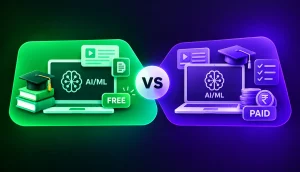
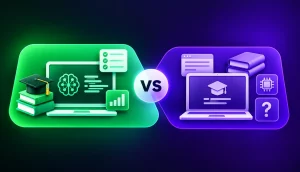
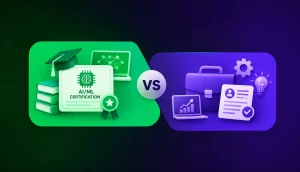
They are not really competitors — AI is a tool, and human coders are the professionals who direct that tool. But if you’re choosing what to learn and build a career around in 2026, the honest verdict is this: learn to code first, then learn to work with AI as a force-multiplier. Coding skill is what makes you employable and lets you actually use AI tools well; AI/ML skills (prompt engineering, building AI systems, working with LLMs) are what make you future-proof and higher-paid once you already know how to code.
- Choose Human Coding skills if: you’re a beginner, want a stable entry-level job, or want to build software, apps, and websites.
- Choose AI/ML skills if: you already know programming basics and want to specialize in a high-growth, high-paying field.
- Best for beginners: Start with core programming (Python, Java, or JavaScript) — you cannot skip this even to “work with AI.”
- Best for freshers: Full Stack Development or Software Development roles, since they have the most entry-level openings in India right now.
- Best for long-term growth: AI/ML specialization, once you have solid coding fundamentals.
- Best for working professionals switching careers: Full Stack or Backend Development first — faster to become job-ready, then add AI skills later.
Who this comparison is for: Beginners deciding what to learn first, college students planning their tech career, freshers preparing for placements, and working professionals wondering if AI will replace developer jobs or if they should pivot into AI instead of traditional coding.
What are AI (in the context of coding) and Human Coder?
AI, in this comparison, refers to AI coding tools and the broader AI/ML career path — including AI code assistants, machine learning models, and generative AI systems that can write, debug, and suggest code. It is used by developers to speed up repetitive coding tasks, and by AI/ML engineers who build the models and systems themselves. Main applications include code generation and autocomplete, chatbots and virtual assistants, recommendation systems, computer vision, and automation of business workflows.
A human coder (software developer/programmer) is a professional who writes, tests, and maintains code to build websites, apps, and software systems. Human coders are employed across every industry — from startups to enterprises — as full stack developers, backend engineers, mobile developers, and QA engineers. Main applications include building websites and web apps, mobile apps, enterprise software, APIs, and internal business tools.
AI vs Human Coders — Side-by-Side Comparison
| Criteria | AI (Tools/AI-ML Career) | Human Coders (Software Dev) | Winner |
|---|---|---|---|
| Learning Difficulty | Higher (needs math, statistics, ML concepts) | Moderate (logic-based, more forgiving for beginners) | Human Coders |
| Programming Requirement | Yes — Python is mandatory | Yes — Python/Java/JS depending on stack | Tie |
| Technical Knowledge Needed | ML algorithms, statistics, data handling | DSA, OOP, databases, web/app frameworks | Tie |
| Job Market in India | Growing fast, but fewer entry-level openings | Very large volume of entry-level openings | Human Coders |
| Time to Learn Job-Ready Basics | 6–9 months (after programming basics) | 4–6 months | Human Coders |
| Career Opportunities | ML Engineer, Data Scientist, AI Engineer, GenAI Developer | Full Stack Dev, Backend Dev, Mobile Dev, QA, DevOps | Tie |
| Remote Work Availability | High, especially for AI/GenAI roles | High, especially for web/app development | Tie |
| Freelancing Demand | Growing, mostly AI automation and GenAI app projects | Very high, especially web/app development | Human Coders |
| Future Growth Potential | Very high — one of the fastest-growing fields | Steady and consistent, evolving with AI-assisted workflows | AI |
| Best For | Learners who want to specialize after core coding skills | Beginners and freshers wanting fast job entry | — |
| HCL GUVI Course Available | Yes — AI & Machine Learning Programme | Yes — Full Stack Development Course | Tie |
Find Your Coding Style
Answer 3 quick questions to discover whether AI Coding or Human Coding better matches your skills, goals, and working style.
What do you enjoy most about coding?
Think about what motivates you when building software.
How do you prefer to learn?
Choose the learning style that suits you best.
What matters most when building a project?
Think about your biggest priority.
The Key Difference Between AI and Human Coders
The biggest difference is simple: AI/ML focuses on building systems that learn patterns from data, while human coding focuses on building software that follows explicit logic written by a developer.
- Core purpose: AI/ML predicts, classifies, or generates outputs from data; traditional coding builds functional applications and systems.
- Skills required: AI/ML needs statistics, linear algebra, and ML frameworks; coding needs data structures, algorithms, and framework-specific skills (React, Spring Boot, Django, etc.).
- Tools/technologies: AI/ML uses Python, TensorFlow, PyTorch, and LLM APIs; coding uses languages like Java, JavaScript, and frameworks tied to web, mobile, or backend development.
- Type of work: AI/ML work is often research-and-experimentation heavy; software development work is typically feature-building, debugging, and shipping products.
- Career environment: AI/ML roles are concentrated in product companies, research teams, and specialized startups; coding roles exist across almost every company in every industry.
In Practical Terms
Think of building a food delivery app. A human coder builds the app itself — the login screen, the ordering system, the payment integration, and the delivery tracking map. An AI/ML specialist would work on the “smart” part of that app — for example, the feature that predicts delivery time or recommends dishes based on past orders. You need the coder to build the app at all; you need the AI specialist to make specific parts of it “intelligent.” One typically can’t exist without the other.
AI vs Human Coders for Getting a Job as a Fresher in India
For freshers, traditional software development roles offer far more entry-level opportunities. Companies hire large batches of freshers into full stack, backend, and QA roles every year, and these roles typically require solid programming fundamentals plus one or two frameworks — a learning curve most freshers can complete in a few months of focused study.
AI/ML roles, by contrast, often expect candidates to already have strong Python skills, some exposure to statistics, and ideally a project portfolio (even at fresher level). This makes pure AI/ML a harder entry point unless you already have programming fundamentals in place.
For a fresher trying to become job-ready fastest, mastering core programming, data structures and algorithms, and a full stack framework is usually the more reliable path. AI/ML skills can then be added as a specialization once you have your first offer or during your final year of college.
Artificial Intelligence and Machine Learning Programme
AI vs Human Coders for Building Software Products
Building an actual product — a website, mobile app, SaaS tool, or enterprise system — is fundamentally a software development task. You need to understand architecture, databases, APIs, and user interfaces. AI tools can accelerate parts of this (writing boilerplate code, suggesting fixes, generating test cases), but a human coder still has to design the system, make architectural decisions, and ensure the product actually works reliably. AI is a productivity layer on top of coding, not a replacement for it.
AI vs Human Coders for Working Professionals Switching Careers
For a working professional making a career switch, time and risk matter a lot. Full stack or backend development has a shorter, more predictable learning curve, clearer entry-level job openings, and lots of transferable logic if you’re coming from any technical background (even non-CS). Portfolio requirements are also more standardized — a few solid projects (an e-commerce app, a booking system) are usually enough to start applying.
Switching directly into AI/ML as a first career pivot is riskier: it demands stronger math/stats grounding, takes longer to become job-ready, and hiring bars are often higher since companies expect some specialization. The safer, faster path for most working professionals is: learn core coding, land a developer role, then transition into AI-adjacent work (like MLOps or AI-powered features) once you have industry experience.
AI vs Human Coders for Freelancing
Freelance demand for web development, app development, and general programming work is significantly higher and more consistent than freelance demand for pure AI/ML work. Clients on freelance platforms commonly need websites, e-commerce stores, mobile apps, and automation scripts — all coding-heavy work. AI-related freelance work does exist and is growing (building chatbots, automating workflows with AI APIs, fine-tuning models for specific business use cases), but it’s a smaller, more specialized market with a higher entry barrier. If you’re freelancing to earn while you learn, coding skills give you a bigger, easier-to-enter market.
AI/ML for GenAI and Automation Careers
Where AI clearly wins is in the fastest-growing niche of the market: Generative AI. Roles focused on building GenAI applications, LLM-based tools, AI agents, and automation systems are newer, less saturated, and often better paid than equivalent traditional roles at similar experience levels. If your goal is specifically to work on cutting-edge AI products — not just use AI tools as a developer — this is the space to specialize in, but it still requires programming fundamentals as the base.
AI vs Human Coders Salary in India (2026)
| Experience Level | Human Coder (Software Dev) | AI/ML Engineer |
|---|---|---|
| Fresher (0–1 year) | ₹3.5–6 LPA | ₹4–7 LPA |
| Junior (1–3 years) | ₹6–10 LPA | ₹7–12 LPA |
| Mid-Level (3–5 years) | ₹10–18 LPA | ₹12–22 LPA |
| Senior (5+ years) | ₹18–35+ LPA | ₹22–45+ LPA |
These figures are broad, commonly reported industry ranges and will vary significantly by company, city, specific skill set, and specialization. Treat them as indicative starting points for planning, not guarantees — always check current listings on platforms like Naukri, LinkedIn, Glassdoor, and AmbitionBox for the most accurate, role-specific numbers before making a decision.
Professional Certificate in AI Software Development – IITM Pravartak & MongoDB
Which Has Better Long-Term Earning Potential?
AI/ML generally has a higher salary ceiling at senior levels, especially in specializations like GenAI, computer vision, and applied research, where demand currently outpaces supply of experienced talent. Leadership roles like AI Architect or Head of AI/ML can command a significant premium.
However, human coding roles offer a more stable and widely available earning path — senior software engineers, tech leads, architects, and engineering managers are needed at nearly every company, not just AI-focused ones. The most reliable way to maximize earning potential in either path is the same: move from generalist to specialist, take on system design and leadership responsibility, and keep your skills current with emerging tools (including AI) as the industry evolves.
Recommendation — Here Is the Honest Answer
Choose Human Coding (start here) if:
- You are a complete beginner with no programming background
- You want the fastest, most predictable path to your first tech job
- You enjoy building visible things — apps, websites, products
- You want the widest range of entry-level job openings in India
- You’re switching careers and need to minimize risk and time
Choose AI/ML specialization if:
- You already have solid programming fundamentals (or are willing to build them first)
- You enjoy math, statistics, and data-driven problem solving
- You want to work in one of the highest-growth, highest-ceiling fields in tech
- You’re aiming for roles like ML Engineer, Data Scientist, or GenAI Developer
- You want to future-proof your career by specializing early
Should You Learn Both?
Yes — but not at the same time. Start with core programming and build strong fundamentals through real projects. Once you’re comfortable writing and debugging code confidently, add AI/ML skills on top — either as a specialization or simply to become fluent in using AI tools as a developer. Almost every strong tech career in 2026 combines both: solid coding ability, plus the ability to work effectively with AI tools and, increasingly, AI systems themselves.
Conclusion
AI and human coders aren’t really rivals — they’re two layers of the same career stack. Human coding is the better choice if you’re a beginner, a fresher, or a working professional who needs a fast, stable, well-trodden path into tech with strong entry-level hiring. AI/ML is the better choice if you already have programming fundamentals and want to specialize in a high-growth, higher-ceiling field like machine learning or generative AI.
For most learners in 2026, the smartest sequence is programming fundamentals first, then AI/ML as a specialization — not a replacement. Don’t choose based on which one sounds more “future-proof” in isolation. Choose based on your current skill level, your career timeline, and the type of work that genuinely interests you. That decision will serve you far better than chasing whichever technology is trending this year.
Find Your Coding Style
Answer 3 quick questions to discover whether AI Coding or Human Coding better matches your skills, goals, and working style.
What do you enjoy most about coding?
Think about what motivates you when building software.
How do you prefer to learn?
Choose the learning style that suits you best.
What matters most when building a project?
Think about your biggest priority.
Frequently Asked Questions
Which is better, AI or human coders?
Neither is universally “better” — they serve different purposes. Human coding builds the software and systems businesses run on; AI/ML adds intelligent capabilities on top. For most learners, coding is the essential first skill, and AI/ML is a valuable specialization built on top of it.
Which is easier for beginners: AI or coding?
Traditional coding is generally easier for absolute beginners because it’s logic-based and doesn’t require statistics or machine learning theory upfront. AI/ML has a steeper initial learning curve since it needs programming plus math and data concepts.
Which has more job opportunities in India: AI or coding?
Human coding roles (full stack, backend, QA, mobile) currently have a much larger volume of job openings, especially at entry level. AI/ML job postings are growing quickly but remain a smaller, more specialized slice of the overall tech job market.
Which is better for freshers, AI or coding?
Coding is generally better for freshers because it offers faster job readiness and far more entry-level openings. AI/ML roles often expect stronger existing programming and math skills, making them harder to break into as a first job.
Which has a higher salary, AI or human coding?
AI/ML roles tend to have a higher salary ceiling at senior and specialized levels, particularly in GenAI and applied research. At fresher and junior levels, the gap is smaller, and both paths offer solid earning potential that grows significantly with experience.
Can I learn both AI and human coding?
Yes, and most strong tech careers eventually combine both. Start with core programming to build a solid foundation, then add AI/ML skills once you’re comfortable coding — trying to learn both from scratch at once usually slows down progress in both.
Which is better for freelancing, AI or coding?
Coding is better for freelancing right now because demand for websites, apps, and general software work is much higher and more consistent. AI-related freelance work exists and is growing but remains a smaller, more specialized market.
Which has better long-term career growth, AI or coding?
AI/ML offers a higher long-term ceiling in specialized, high-demand niches like GenAI. Human coding offers steadier, more widely available long-term growth through senior engineering, architecture, and leadership roles across virtually every industry.