


Artificial Intelligence and Machine Learning Articles
AI/ML Skills Gap 2026: Why Companies Can't Find Job-Ready Talent
20 AI/ML Interview Questions Recruiters Can Use Without a Tech Background - Best Guide
How Industry-Backed AI/ML Bootcamps Are Changing the AI/ML Hiring Pipeline - Best Guide 2026
From IT Support to AI Engineer: A Realistic Career Switch Guide 2026


Get In Touch For Details! Request More Information
Claude vs Character.AI for Roleplay and Creative Writing
Aug 17, 2026 4 Min Read 328 Views
(Last Updated)
Choosing between Claude and Character.AI for creative work is not a question of which tool is more capable in general but which architecture fits what you are actually trying to create. Character.AI was designed from the ground up for character immersion and social roleplay. Claude was designed as a thinking and writing partner that happens to be exceptionally good at collaborative fiction and creative development. Both serve real creative needs, and understanding where each one excels will save you hours of frustration trying to use the wrong tool for your creative project.
Table of contents
- Quick TL;DR
- What Each Tool Is Actually Built For
- Character.AI
- Claude
- Head-to-Head Comparison: Claude vs Character.AI
- When Character.AI Wins
- Scenario 1: Fan fiction roleplay with existing characters
- Scenario 2: Ongoing social roleplay with persistent personas
- Scenario 3: Exploring a large character library quickly
- When Claude Wins
- Scenario 1: Writing a novel or long-form fiction
- Scenario 2: Developing original characters with psychological depth
- Scenario 3: Collaborative worldbuilding
- Scenario 4: Improving your own creative writing
- The Hybrid Creative Workflow
- An Honest Look at Content and Safety Differences
- Conclusion
- FAQs
- What is the main difference between Claude and Character.AI for creative writing?
- Which is better for fan fiction roleplay?
- Can Claude play characters in roleplay?
- Which tool is better for writing a novel?
- Does Character.AI remember previous conversations?
- Which tool handles mature creative themes better?
Quick TL;DR
Claude vs Character.AI is a comparison between two AI tools that both support roleplay and creative writing but serve fundamentally different purposes. Character.AI is built specifically for character-based roleplay, offering persistent personas, community-created characters, and immersive conversational fiction. Claude is a general-purpose AI with strong creative writing capability that excels at collaborative storytelling, worldbuilding, fiction drafting, and character development with greater narrative depth and writing quality.
What Each Tool Is Actually Built For
1. Character.AI
It was founded in 2021 by former Google Brain researchers and launched publicly in 2022. Its core design is around persistent, community-created AI characters that users can interact with in ongoing conversational roleplay. The platform has millions of user-created characters spanning fictional universes, historical figures, original personas, and fan fiction. The experience is social, immersive, and character-first, meaning the interaction model prioritizes staying in character over analytical or creative meta-discussion.
2. Claude
It was built by Anthropic as a general-purpose AI assistant with strong reasoning, writing, and creative capabilities. Its creative strength comes from its ability to hold narrative context across long conversations, produce high-quality prose, develop complex characters with psychological depth, and collaborate on story structure at a meta level. Claude can play characters, but it can also step out of character to discuss craft, adjust tone, restructure a plot, or build a worldbuilding document alongside the fiction itself.
Read More: How to Build AI Apps with Claude and Share Them Easily
Head-to-Head Comparison: Claude vs Character.AI
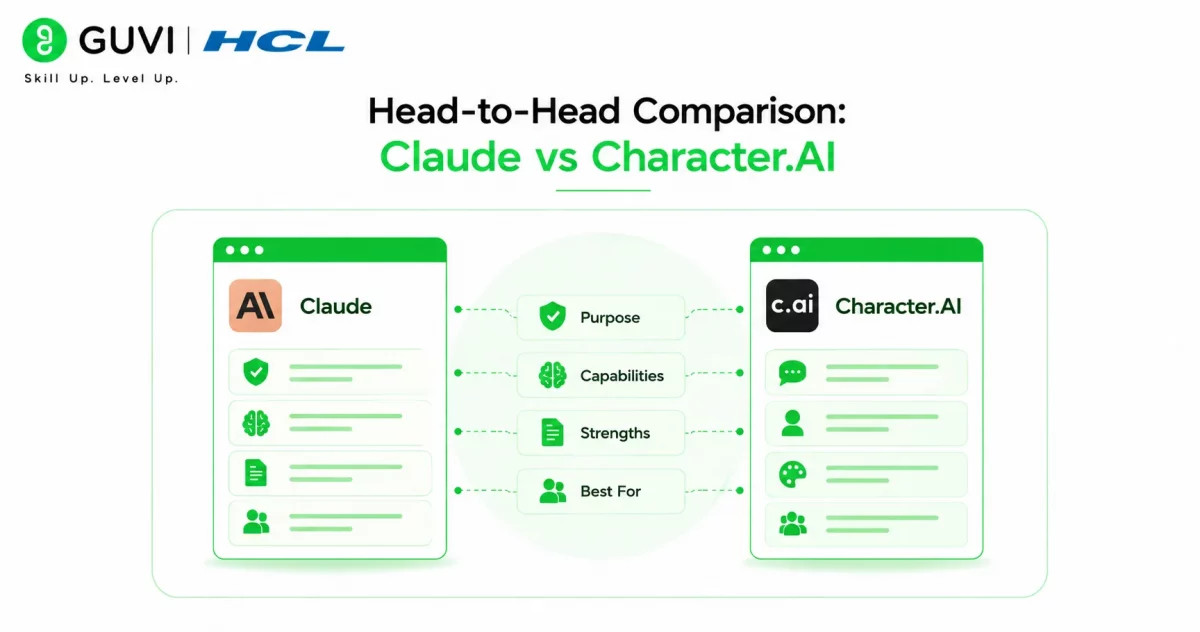
| Capability | Claude | Character.AI |
| Persistent community characters | No | Yes, millions available |
| Character immersion and staying in persona | Strong | Excellent |
| Prose quality and narrative depth | Excellent | Moderate |
| Worldbuilding and lore development | Excellent | Limited |
| Plot structure and story architecture | Excellent | Limited |
| Character psychology and backstory development | Excellent | Moderate |
| Fan fiction and existing IP characters | Limited | Extensive |
| Meta creative discussion (craft, structure) | Yes | Rarely breaks character |
| Long-form fiction drafting | Excellent | Not designed for it |
| Mobile social experience | Basic | Excellent |
| Content moderation strictness | Moderate | Strict on some platforms |
When Character.AI Wins
Character.AI excels when the goal is immersive character interaction rather than creative output production.
Scenario 1: Fan fiction roleplay with existing characters
A reader wants to roleplay with characters from their favourite fantasy series, stepping into scenes with established personas from books or games. Character.AI has community-created versions of thousands of existing fictional characters, making this experience immediately accessible without needing to describe the character’s personality and voice from scratch. Claude can play these characters but requires detailed briefing on each one.
Scenario 2: Ongoing social roleplay with persistent personas
A user wants an ongoing roleplay relationship with a consistent AI character across many sessions, where the character remembers the shared history and maintains a stable persona. Character.AI’s persistent character architecture is designed for exactly this experience. Claude does not retain memory between separate conversations by default.
Scenario 3: Exploring a large character library quickly
A creative user wants to experiment across many different character types and voices without building each one from scratch. Character.AI’s community library of millions of characters makes exploration fast and social, with the ability to see what other users have created and adapt from there.
Claude’s context window is large enough to hold the equivalent of a short novel in a single conversation, giving long-form fiction writers a structural advantage for maintaining character consistency, plot continuity, and worldbuilding details across tens of thousands of words in a single session.
When Claude Wins
Claude is the stronger choice when the goal is producing creative work with depth, structure, and quality rather than immersive character interaction.
Scenario 1: Writing a novel or long-form fiction
A writer is developing a fantasy novel and needs help building the world, developing character arcs, structuring plot points, writing scene drafts, and revising prose. Claude handles all of these at publication-adjacent quality because it can operate at the meta level of craft alongside the immersive level of scene writing. Character.AI stays in character and does not engage with structural story questions effectively.
Scenario 2: Developing original characters with psychological depth
A game designer needs to develop ten original NPCs with distinct personalities, backstories, contradictions, and speech patterns for a narrative RPG. Claude builds detailed character profiles, identifies psychological consistency, generates dialogue samples for each character, and flags where character motivations are unclear. This analytical-creative combination is where Claude significantly outperforms Character.AI.
Scenario 3: Collaborative worldbuilding
A creative team is building a shared universe for a comic series and needs consistent lore, faction histories, geography, magic systems, and cultural details that do not contradict each other. Claude maintains complex worldbuilding context across long sessions, flags contradictions, and produces structured lore documents alongside the collaborative fiction. Character.AI is not designed for this type of creative infrastructure work.
Scenario 4: Improving your own creative writing
A writer wants to use AI to develop their craft, getting feedback on their prose style, learning how to write better dialogue, understanding how to structure scenes, and practicing specific narrative techniques. Claude engages with writing at the craft level. It can explain why a scene does not land, demonstrate alternative approaches, and discuss the structural principles behind narrative choices. Character.AI stays in the fiction.

The Hybrid Creative Workflow
The strongest creative workflow combines both tools at different stages rather than committing to one exclusively.
- Use Character.AI for: Initial character voice exploration, testing how a character sounds in live dialogue, exploring existing fictional universes for inspiration, and the immersive social roleplay experience that is genuinely fun and generative for creative ideation.
- Use Claude for: Translating those character explorations into structured profiles, developing plot and story architecture, writing and revising actual scenes and chapters, building worldbuilding documents, and getting craft-level feedback on your creative work.
Many fiction writers and game designers describe using Character.AI to find a character’s voice through improvised dialogue and then bringing that character into Claude to develop their backstory, motivation structure, and narrative arc in depth.
Character.AI reached one million users within five days of its 2022 launch, faster than ChatGPT’s early growth rate, driven almost entirely by fan fiction and roleplay communities. This rapid adoption revealed an enormous unmet demand for character-first AI interaction that general-purpose assistants were not designed to serve.
An Honest Look at Content and Safety Differences
Both platforms have content moderation but approach it differently, which matters for creative writers working with mature themes.
Character.AI has faced significant public scrutiny over content safety, particularly regarding its default experience for younger users and the emotional intensity of some roleplay interactions. The platform has introduced stricter controls in response to user safety concerns.
Claude maintains content guidelines that restrict certain types of explicit or harmful content while allowing mature themes to be explored in literary fiction contexts where they serve narrative purpose. Claude’s guidelines are designed to support serious creative writing including dark, complex, and morally ambiguous content without crossing into content that could cause real-world harm.
Want to build the AI research skills and tool literacy to work confidently with large language models and knowledge systems? Explore HCL GUVI’s Artificial Intelligence & Machine Learning Course, designed to help you develop the analytical foundations and AI fluency modern research and data roles demand.
Conclusion
Claude and Character.AI are not competing for the same creative use case. Character.AI is the better tool when you want to live inside a character interaction, explore a vast library of existing personas, or enjoy the social and immersive experience of ongoing roleplay. Claude is the better tool when you want to produce creative work, develop your craft, build narrative architecture, or create original characters and worlds with depth and consistency.
The writers and creators getting the most from both tools use Character.AI for immersive exploration and inspiration, and Claude for structured development and production of actual creative output. Recognizing which mode your current creative task requires is the decision that matters most when choosing between them.
FAQs
What is the main difference between Claude and Character.AI for creative writing?
Character.AI is built for immersive character roleplay with persistent community personas. Claude is built for creative writing quality, narrative depth, worldbuilding, and craft-level collaboration on original fiction.
Which is better for fan fiction roleplay?
Character.AI, because it has millions of community-created characters from existing fictional universes ready to interact with immediately without detailed setup prompts.
Can Claude play characters in roleplay?
Yes. Claude can adopt character personas and maintain them through extended roleplay, but it can also step outside the character to discuss craft, structure, and narrative decisions, which Character.AI rarely does.
Which tool is better for writing a novel?
Claude significantly outperforms Character.AI for long-form fiction because it produces higher-quality prose, engages with plot and structure at a meta level, maintains narrative consistency across long sessions, and provides craft-level feedback.
Does Character.AI remember previous conversations?
Character.AI’s persistent character design maintains some continuity within the platform’s character framework. Claude does not retain memory between separate conversations by default unless using Claude Projects.
Which tool handles mature creative themes better?
Both have content guidelines. Claude allows mature literary themes in serious fiction contexts. Character.AI’s policies have evolved significantly following public safety concerns. Review each platform’s current content policy before starting a creative project involving mature themes.
Success Stories

About the Author
HCL GUVI
This article was selected and published as part of the HCL GUVI AI Blogathon 2026, an initiative designed to encourage students, AI enthusiasts, and aspiring tech writers to simplify complex AI concepts through impactful technical content. The contest recognized high-quality, original, and insightful AI-focused blogs, with selected authors receiving publication opportunities on the HCL GUVI blog platform along with official author credits and recognition.
View all posts by HCL GUVI
Connect with me @











Did you enjoy this article?