


Artificial Intelligence and Machine Learning Articles
AI/ML Skills Gap 2026: Why Companies Can't Find Job-Ready Talent
20 AI/ML Interview Questions Recruiters Can Use Without a Tech Background - Best Guide
How Industry-Backed AI/ML Bootcamps Are Changing the AI/ML Hiring Pipeline - Best Guide 2026
From IT Support to AI Engineer: A Realistic Career Switch Guide 2026


Get In Touch For Details! Request More Information
Claude for SEO: Writing Articles That Rank
Aug 13, 2026 4 Min Read 194 Views
(Last Updated)
Writing SEO-friendly content involves considering search intent, content quality, readability, and user experience. Claude for seo can support writers with content research, structuring articles, creating outlines, incorporating keywords naturally, improving readability, and elevating content quality.
Table of contents
- TL;DR
- Direct Answer Box
- Benefits of Using Claude for SEO Writing
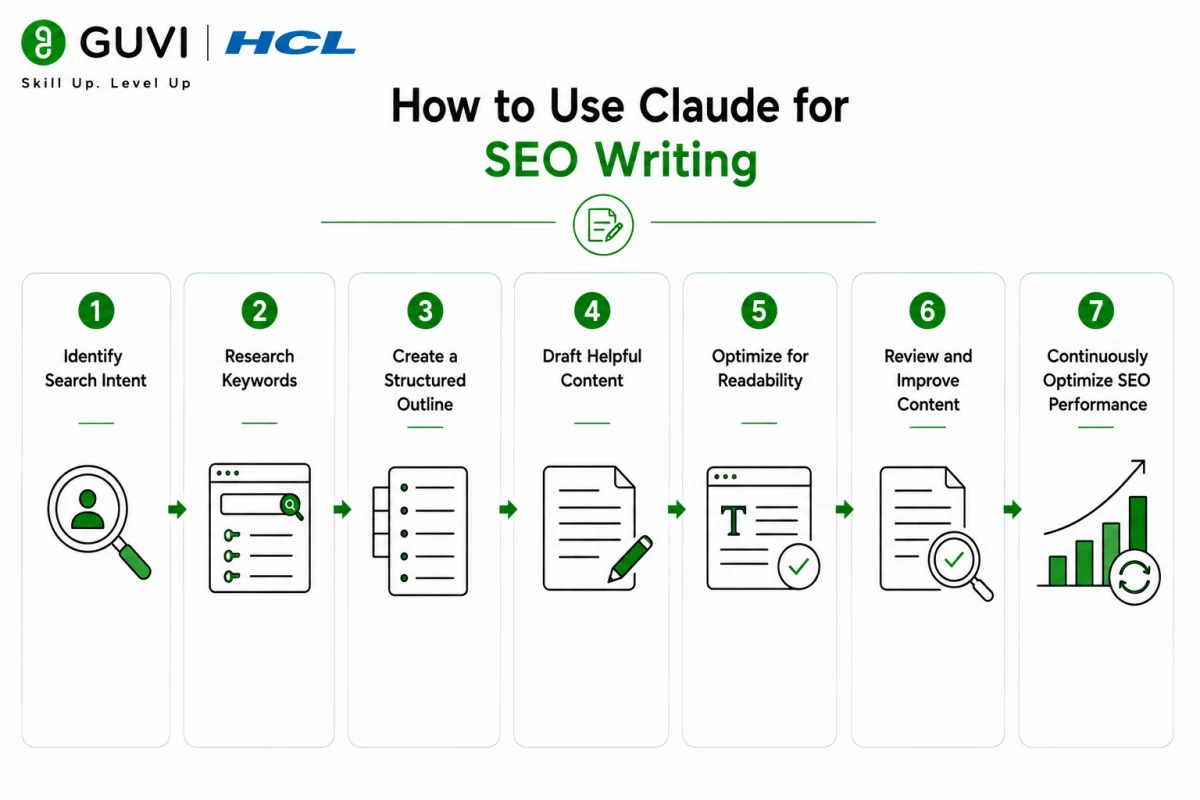
- How to Use Claude for SEO Writing
- Step 1: Identify Search Intent
- Step 2: Research Keywords
- Step 3: Create a Structured Outline
- Step 4: Draft Helpful Content
- Step 5: Optimize for Readability
- Step 6: Review and Improve Content
- Step 7: Continuously Optimize SEO Performance
- Claude Prompts for SEO Writing
- Create an SEO-Friendly Outline
- Research Search Intent
- Generate Keyword Ideas
- Improve Readability
- Optimize Existing Content
- Generate SEO FAQs
- Write Meta Tags
- Find Content Gaps
- Refresh Outdated Content
- Review Before Publishing
- SEO Tasks You Can Automate with Claude
- Tasks Claude Should Not Replace
- Best Practices for Using Claude for SEO
- Conclusion
- FAQs
- How can Claude help with SEO writing?
- Can Claude write articles that rank on Google?
- Should I review AI-generated SEO content?
- Can Claude help with keyword optimization?
- What are the benefits of using Claude for SEO?
- Can Claude replace SEO professionals?
- What are the best practices for using Claude for SEO?
TL;DR
- Claude can help create SEO-friendly content that matches search intent.
- AI can assist with keyword integration, content organization, and readability improvements.
- Focus on high-quality, helpful, people-first content for sustainable rankings.
- Human review is still needed for factual accuracy, originality, and brand consistency.
- SEO is an ongoing process that can be optimized and measured for performance improvement.
📚 Data Point: Google’s current Search Essentials highlight creating helpful, people-first content that is easy to read and meets user intent rather than content written primarily for search.
Source: Google Search Essentials
Direct Answer Box
| Claude can support creating SEO-optimized articles by helping with research, content outline creation, keyword optimization, readability improvements, and content refinement. Claude can elevate content quality and search visibility when combined with human expertise and SEO best practices. |
Benefits of Using Claude for SEO Writing
Articles that rank require identifying user intent, structuring content effectively, and producing helpful content. Claude can help with faster content creation and support best practices for SEO content.
Key benefits include:
- Faster content creation and generation
- Improved article structure and organization
- Keyword optimization assistance
- Readability improvements
- Alignment with search intent
- Content consistency
- Higher productivity
- Easier content updates
How to Use Claude for SEO Writing
Step 1: Identify Search Intent
Understand what your users are searching for and why. Align the article with search intent to better match user expectations.
Research:
- Primary search intent
- Target audience
- Potential user questions
- Search goals
- Desired search outcome
Step 2: Research Keywords
Collect primary and secondary keywords to support the article before creating the initial outline. Keywords should be relevant rather than numerous.
Research:
- Primary keyword
- Secondary keywords
- Long-tail keywords
- Related topics
- Potential user questions
- Search trends
Step 3: Create a Structured Outline
Create a logical article outline before starting the article. This makes it easier to produce and improves content organization.
Ask Claude to help you create an article outline that includes the following elements:
- Introduction
- Main article sections
- Subheadings
- Examples
- FAQs
- Conclusion
Step 4: Draft Helpful Content
Claude can help you create useful content that provides value to the reader and answers user questions. Content should be accurate, easy to read, and naturally incorporate keywords.
Focus on these elements:
- Accuracy
- Readability
- Clear explanations
- Practical, relatable examples
- Natural keyword placement
- Value for users
Step 5: Optimize for Readability
Review the article to improve readability, provide a better user experience, and create engaging content. This includes short paragraphs, descriptive headings, and simpler language.
Review:
- Heading structure
- Paragraph length
- Sentence readability
- Keyword placement
- Internal consistency
- Grammar
Step 6: Review and Improve Content
Verify facts, improve originality and readability, refine keyword use, and ensure the article meets user needs and SEO best practices before publishing.
Verify or improve:
- Factual accuracy
- Originality
- Search intent
- Content completeness
- Brand voice
- SEO quality
Step 7: Continuously Optimize SEO Performance
SEO is an ongoing process. Monitor your rankings and user engagement metrics, update and improve content, and refine your SEO strategy based on data and performance.
Optimize performance:
- Monitor keyword rankings
- Measure user engagement
- Update content regularly
- Optimize based on data
Search engines don’t rank articles based on keywords alone. They also consider factors like search intent, content quality, relevance, readability, and how well an article answers the reader’s query. A well-optimized SEO article combines these elements to improve visibility and attract the right audience.
Claude Prompts for SEO Writing
Writing effective prompts helps Claude generate more relevant, search-friendly, and high-quality content. By providing clear instructions, target keywords, and the desired output, you can improve content quality while reducing the need for extensive revisions.
Here are some practical prompts you can use:
Create an SEO-Friendly Outline
“Create a detailed SEO-friendly outline for a blog on [topic] targeting the keyword [primary keyword]. Include H2 and H3 headings, FAQs, and a logical content flow that satisfies search intent.”
Research Search Intent
“Analyze the search intent behind [keyword] and explain whether users are looking for information, comparisons, or solutions. Recommend the ideal article structure.”
Generate Keyword Ideas
“Suggest primary, secondary, long-tail, and semantic keywords related to [topic]. Group them by search intent and relevance.”
Improve Readability
“Rewrite this content to improve readability using shorter paragraphs, simpler language, and better flow without changing its meaning.”

Optimize Existing Content
“Review this article and recommend improvements for keyword placement, heading structure, search intent, readability, and on-page SEO.”
Generate SEO FAQs
“Create seven SEO-friendly FAQs for [topic] based on common user search queries. Keep the answers concise and informative.”
Write Meta Tags
“Generate an SEO-optimized meta title (under 60 characters) and meta description (under 160 characters) for this article.”
Find Content Gaps
“Review this article and identify missing topics, user questions, or sections that would improve topical coverage and search value.”
Refresh Outdated Content
“Update this article with the latest information while improving readability, SEO, and user experience without changing its core message.”
Review Before Publishing
“Act as an SEO editor and review this article for search intent, factual accuracy, keyword optimization, E-E-A-T, readability, and overall content quality before publication.
As you refine your SEO workflows with Claude, understanding how to analyze search performance and content metrics becomes equally important. HCL GUVI’s Business Analytics Course helps professionals build practical analytical skills for data-driven SEO, marketing, and business decision-making.
SEO Tasks You Can Automate with Claude
Claude can support most SEO and content marketing tasks.
Claude can assist you with:
- Keyword research support
- Content outline creation
- Blog article drafting
- Meta title generation
- Meta description writing
- FAQs
- Content optimization
- Readability improvements
- Internal linking suggestions
- Content refreshing and updating
- Topic clustering support
- Content summaries
Gain important Artificial Intelligence fundamentals, learn prompt engineering, and discover practical use cases in business automation by enrolling in The HCL GUVI’s Artificial Intelligence eBook. The eBook explains how artificial intelligence improves productivity across content, SEO, marketing, customer service, and enterprise workflows.
Tasks Claude Should Not Replace
Claude is an effective SEO writing tool, but some important editorial and strategic decisions should remain with human experts.
Claude should not replace:
- Editorial decisions
- Content strategy
- Brand positioning
- Final content fact-checking
- Original research
- Legal reviews
- SEO strategy
- Publishing approvals
- Human expertise
Claude can help accelerate content creation, but human experts and high-quality content are needed for long-term SEO success.
⚠️ Warning: Claude can generate SEO-friendly articles, but all AI-generated content should be reviewed for factual accuracy, originality, search intent alignment, and adherence to search engine guidelines before publishing.
Best Practices for Using Claude for SEO
SEO content can be improved by following these best practices:
- Understand search intent first.
- Research relevant keywords.
- Create structured content outlines.
- Write people-first, helpful content.
- Use keywords naturally.
- Review content accuracy.
- Update content regularly.
- Monitor and optimize SEO performance.
Conclusion
Claude can support SEO content creation by assisting with research, creating structured article outlines, keyword optimization, and readability improvements. Claude can support content generation and human expertise combined with ongoing performance analysis to produce better user-focused content.
FAQs
1. How can Claude help with SEO writing?
Claude can help with keyword research, article outlines, writing, readability improvements, FAQs, and SEO content optimization while supporting high-quality content.
2. Can Claude write articles that rank on Google?
Claude can help create SEO-friendly content, but actual rankings are based on multiple factors, including search intent, content quality, originality, backlinks, technical SEO, and user experience.
3. Should I review AI-generated SEO content?
Yes, always review AI-generated content for factual accuracy, originality, keyword use, and alignment with brand and SEO strategy.
4. Can Claude help with keyword optimization?
Claude can incorporate primary and secondary keywords naturally without affecting readability and help avoid keyword stuffing.
5. What are the benefits of using Claude for SEO?
Faster content generation, improved structure, readability, keyword optimization assistance, and higher productivity are among the key benefits.
6. Can Claude replace SEO professionals?
No, Claude can support content creation and optimization, but SEO strategy, technical SEO, editorial decisions, and performance analysis require human experts.
7. What are the best practices for using Claude for SEO?
Understand search intent, research keywords, write helpful, people-first content, optimize naturally, verify facts, update content, monitor performance, and use Claude to support, not replace, SEO expertise.
Success Stories

About the Author
HCL GUVI
This article was selected and published as part of the HCL GUVI AI Blogathon 2026, an initiative designed to encourage students, AI enthusiasts, and aspiring tech writers to simplify complex AI concepts through impactful technical content. The contest recognized high-quality, original, and insightful AI-focused blogs, with selected authors receiving publication opportunities on the HCL GUVI blog platform along with official author credits and recognition.
View all posts by HCL GUVI
Connect with me @













Did you enjoy this article?