


Career Articles
Accountant vs Data Analyst Salary in India After Switching Careers - Best Guide
Finance Managers: Could Data Science Be Your Next Career Move?
Insurance Claims Executive to Data Analyst: Is It a Good Switch?
Banking Executive (Loans, KYC) to Data Analyst: Skills and Career Path


Get In Touch For Details! Request More Information
Campus Placement Preparation Roadmap: 60-Day Plan
Sep 02, 2026 5 Min Read 816 Views
(Last Updated)
Campus placements can feel confusing because students have to manage aptitude tests, coding rounds, interviews, resumes, and communication all at once. Starting without a plan often leads to stress and wasted time.
A 60-day campus placement roadmap helps students build basics, stay consistent, improve their resume, prepare interview answers, and feel more confident before final placement rounds. This plan is useful for students from engineering, arts, science, commerce, management, and computer applications backgrounds.
Table of contents
- TL;DR
- Why Do You Need a 60-Day Campus Placement Preparation Roadmap?
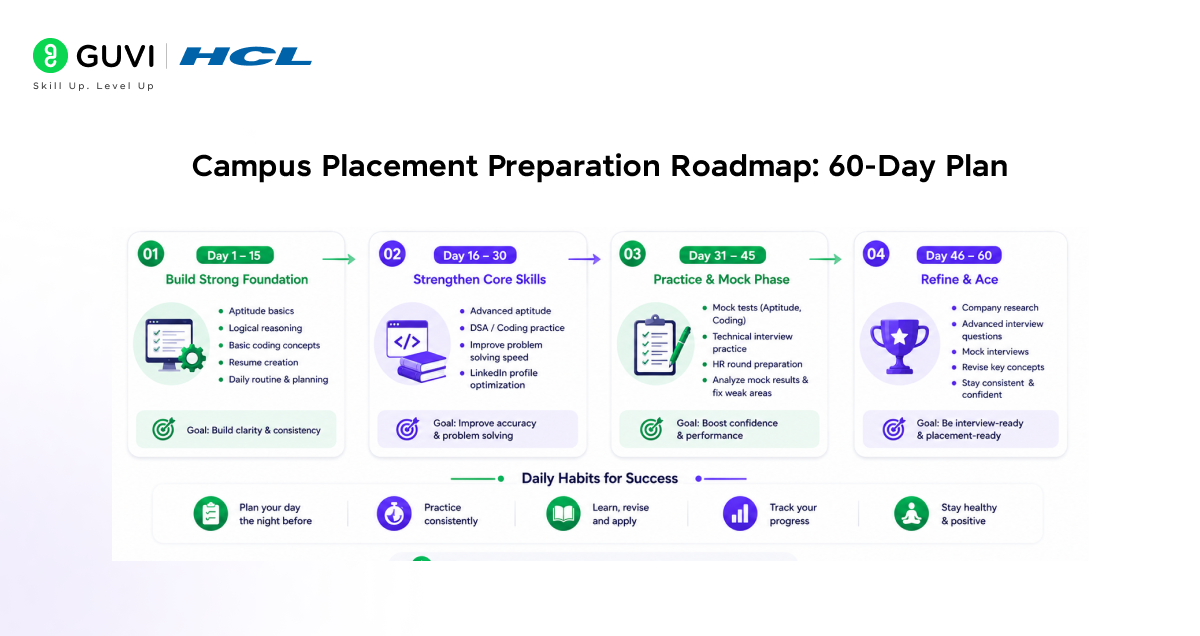
- Campus Placement Preparation Roadmap: 60-Day Plan
- Days 1-7: Understand the Placement Process and Set Your Goal
- Days 8-15: Build Aptitude and Reasoning Basics
- Days 16-23: Improve Verbal Ability and Communication
- Days 24-31: Strengthen Technical and Role-Specific Skills
- Days 32-38: Build a Strong Placement Resume
- Days 39-45: Practice Group Discussion and Personal Interview Questions
- Days 46-52: Take Mock Tests and Mock Interviews
- Days 53-60: Revise, Apply, and Prepare Company-Wise
- Common Campus Placement Mistakes to Avoid
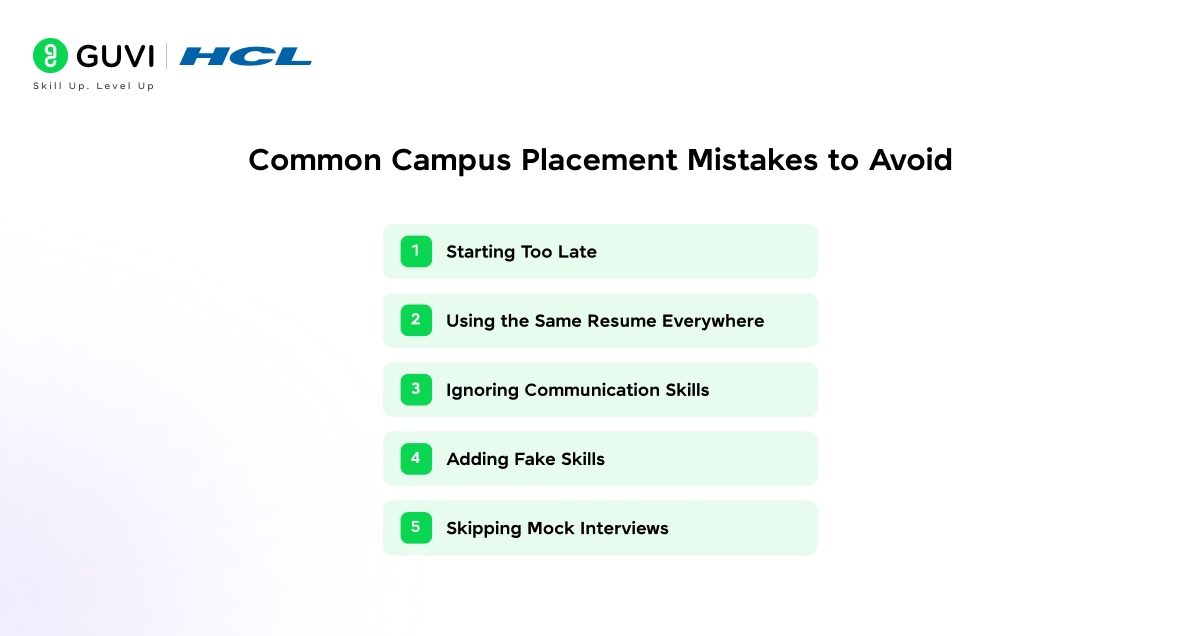
- Starting Too Late
- Using the Same Resume Everywhere
- Ignoring Communication Skills
- Adding Fake Skills
- Skipping Mock Interviews
- 60-Day Campus Placement Preparation Timetable
- Conclusion
- FAQs
- How many days are enough for campus placement preparation?
- What should I study first for campus placements?
- How do I prepare for campus placements without coding?
- What is the best way to prepare for HR interviews?
- How can I improve my resume for campus placements?
TL;DR
- Start campus placement preparation at least 60 days before placement season.
- Focus on aptitude, reasoning, communication, resume, and interview preparation.
- Technical students should practice coding, DBMS, OOPs, OS, CN, and project explanations.
- Non-technical students should focus on Excel, communication, domain basics, case questions, and role-specific skills.
- Prepare a one-page resume with clear projects, internships, achievements, and skills.
- Practice mock interviews every week.
- Revise company-specific questions before every recruitment drive.
Why Do You Need a 60-Day Campus Placement Preparation Roadmap?
Campus placements are competitive because many students apply for the same roles. Recruiters usually spend limited time reviewing each candidate. A structured 60-day placement preparation plan helps you use your time wisely and avoid last-minute panic.
A roadmap helps you:
- Build preparation discipline.
- Cover aptitude, coding, and interview topics in order.
- Identify weak areas early.
- Improve resume and LinkedIn profile..
- Prepare confident answers for HR and technical rounds.
- Track progress every week.
Campus Placement Preparation Roadmap: 60-Day Plan
Days 1-7: Understand the Placement Process and Set Your Goal
Begin with clarity. Do not start solving random questions before knowing which companies may visit your campus, what roles they offer, and how their selection process works.
Check your college’s previous placement records, company lists, eligibility rules, test patterns, and interview rounds. This will help you prepare with a clear direction.
What to Do in Week 1
- List companies likely to visit your campus.
- Note their eligibility criteria and job roles.
- Collect previous placement questions.
- Review your current resume.
- Identify weak areas in aptitude, coding, communication, or domain knowledge.
Goal for Week 1
Create a simple placement tracker with company names, roles, required skills, test patterns, and your preparation status.
Days 8-15: Build Aptitude and Reasoning Basics
Aptitude and reasoning appear in most campus placement tests. Focus on building speed, accuracy, and confidence with the basics.
You do not need advanced mathematics for most entry-level roles. You need regular practice and a clear understanding of common question types.
Key Topics to Cover
- Percentages, profit and loss, averages, ratios, time and work
- Time, speed, distance, number system, and probability
- Blood relations, coding-decoding, seating arrangement, series, and puzzles
- Syllogism, direction sense, and data interpretation
What to Do in Week 2
Practice 25 to 30 questions daily. Start with concept-based questions, then move to timed tests. Keep an error notebook so you can track mistakes and avoid repeating them.
Goal for Week 2
Complete the aptitude basics and become more comfortable solving questions under time pressure.
The first aptitude test in most campus drives is typically a filter that cuts the candidate pool by 70 to 90%, which is why early, steady practice matters more than last-minute cramming.
Days 16-23: Improve Verbal Ability and Communication
Verbal ability matters in written tests, emails, group discussions, and interviews. Many students know the answer but struggle to explain it clearly.
Work on speaking in a simple, confident, and structured way. Recruiters notice students who can express ideas without sounding memorized.
Key Topics to Cover
- Reading comprehension
- Grammar and sentence correction
- Para jumbles
- Vocabulary
- Email writing
- Business communication
Communication Skills to Build
- Clear introduction
- Structured answers
- Active listening
- Confident body language
- Professional tone
What to Do in Week 3
Read one career, business, or technology article daily and summarize it in five lines. Practice speaking for one minute on topics like teamwork, internships, career goals, and strengths.
Goal for Week 3
Speak clearly and naturally, without trying to memorize every answer word for word.
Days 24-31: Strengthen Technical and Role-Specific Skills
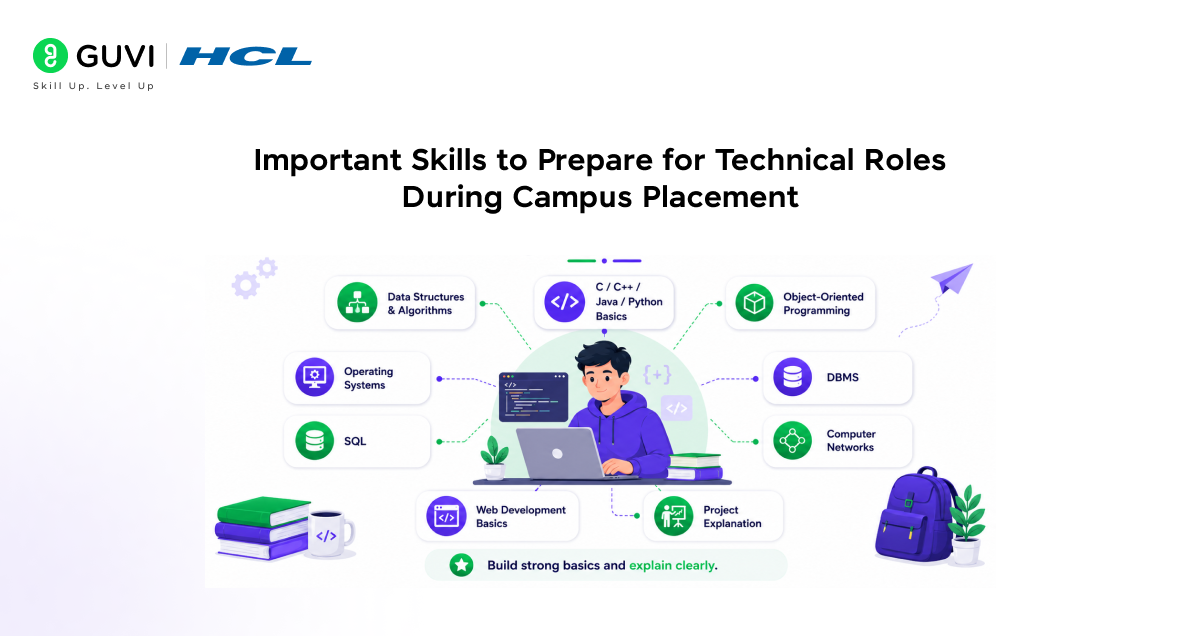
This week depends on your target role. Engineering and computer science students should focus on coding, computer fundamentals, and projects. Management, commerce, arts, and science students should focus on role-based skills and domain knowledge.
For Technical Roles
Focus on:
- C, C++, Java, or Python basics
- Data structures and algorithms
- Object-oriented programming
- DBMS
- Operating systems
- Computer networks
- SQL
- Web development basics
- Project explanation
Prepare for campus placements with confidence through HCL GUVI’s Programming Courses. Build strong programming fundamentals, improve problem-solving skills, and master coding concepts through 100% online, self-paced courses designed to help students become placement-ready and industry-ready.
For Non-Technical Roles
Focus on:
- Excel basics
- PowerPoint presentation skills
- Business communication
- Sales and marketing basics
- Finance basics
- HR concepts
- Market research
- Data interpretation
- Case study practice
For Digital Marketing Roles
Focus on:
- SEO basics
- Social media marketing
- Google Ads basics
- Email marketing
- Content marketing
- Lead generation
- Analytics basics
- Campaign planning
What to Do in Week 4
Pick your top two target job roles and study the skills required for them. Prepare short notes for each topic. Technical students should solve coding problems daily. Non-technical students should practice case questions, role-based scenarios, and Excel tasks.
Goal for Week 4
Build enough role-specific knowledge to answer basic interview questions confidently.
Days 32-38: Build a Strong Placement Resume
Your resume is the first impression before the interview. A weak resume can reduce your chances even when you have good skills. A strong placement resume should be short, clear, and relevant to the role.
What to Include in Your Resume
- Name and contact details
- Career objective or profile summary
- Education
- Technical skills or role-specific skills
- Projects
- Internships
- Certifications
- Achievements
- Leadership or volunteering experience
- LinkedIn and portfolio links
Resume Writing Tips for Campus Placements
- Keep the resume to one page.
- Use clear section headings.
- Add measurable results wherever possible.
- Mention tools, technologies, and skills relevant to the role.
- Avoid long paragraphs.
- Remove spelling and formatting errors.
- Keep the design simple and readable.
Example Resume Bullet
Instead of writing:
“Worked on a website project.”
Write:
“Built a responsive college event website using HTML, CSS, and JavaScript to manage event registrations and updates.”
What to Do in Week 5
Create one master resume and customize it for different roles. Share it with seniors, mentors, or placement coordinators for feedback.

Goal for Week 5
Prepare a clean, one-page resume that clearly shows your skills, projects, and achievements.
Recruiters spend just 6 to 10 seconds scanning a fresher resume before deciding whether to read further, scanning first for branch, CGPA, and role-matching keywords.
Days 39-45: Practice Group Discussion and Personal Interview Questions
Group discussion and personal interview rounds test how you think, speak, listen, and respond. Good communication does not mean speaking the most. It means speaking with clarity and adding value to the discussion.
Common Group Discussion Topics
- Artificial intelligence and jobs
- Work from home vs office work
- Social media and youth
- Digital India
- Startup culture
- Climate change
- Online education
- Women in leadership
- Electric vehicles
- Data privacy
GD Preparation Tips
- Start with a clear point.
- Listen before responding.
- Avoid interrupting others.
- Support your point with examples.
- Speak in a calm and respectful tone.
- Summarize the discussion when possible.
Common HR Interview Questions
- Tell me about yourself.
- Why should we hire you?
- What are your strengths and weaknesses?
- Why do you want this role?
- Why do you want to join this company?
- Tell me about your project.
- Where do you see yourself in five years?
- Are you comfortable relocating?
- Do you prefer working alone or in a team?
- Do you have any questions for us?
What to Do in Week 6
Prepare answers for at least 20 common HR questions. Practice with a friend or record yourself. Focus on clarity, confidence, and natural delivery.
Goal for Week 6
Prepare interview answers that sound personal, honest, and role-specific.
Days 46-52: Take Mock Tests and Mock Interviews
Mock tests show your real preparation level. Mock interviews show how you perform under pressure. This week should focus on practice, feedback, and improvement.
What to Practice
- Full-length aptitude tests
- Coding tests
- Verbal ability tests
- Resume-based interview questions
- HR interviews
- Technical interviews
- Group discussions
Mock Interview Checklist
| Area | Check |
| Introduction | Clear and confident |
| Resume Explanation | Matches resume details |
| Project Explanation | Simple and structured |
| Technical Answers | Conceptually correct |
| Communication | Calm and professional |
| Body Language | Positive and attentive |
| Closing | Polite and confident |
What to Do in Week 7
Take at least three mock tests and two mock interviews. Review your mistakes after every test. Update your notes and revise weak areas.
Goal for Week 7
Reduce mistakes, improve speed, and become comfortable with interview pressure.
Days 53-60: Revise, Apply, and Prepare Company-Wise
The final week should focus on revision and company-specific preparation. Do not start too many new topics at this stage. Strengthen what you already know and prepare for upcoming drives.
Final 7-Day Revision Plan
| Day | Focus Area |
| Day 53 | Revise aptitude formulas |
| Day 54 | Practice reasoning and verbal tests |
| Day 55 | Revise technical or domain topics |
| Day 56 | Prepare project explanation |
| Day 57 | Practice HR questions |
| Day 58 | Take one full mock test |
| Day 59 | Review resume and LinkedIn |
| Day 60 | Light revision and confidence building |
Goal for Week 8
Enter the placement process with clarity, confidence, and a prepared strategy.
Common Campus Placement Mistakes to Avoid
1. Starting Too Late
Many students begin preparation only after companies announce their visit. This creates stress and weakens performance. Start early and revise regularly.
2. Using the Same Resume Everywhere
Every role needs a slightly different resume. A software role, marketing role, and analyst role should highlight different skills.
3. Ignoring Communication Skills
Good technical knowledge is valuable, but poor communication can reduce your chances. Practice speaking clearly and explaining your work.
4. Adding Fake Skills
Recruiters often ask questions about your resume. Fake skills can damage your confidence and credibility during interviews.
5. Skipping Mock Interviews
Mock interviews help you find weak answers before the real interview. They also reduce nervousness.
60-Day Campus Placement Preparation Timetable
| Week | Main Focus | Outcome |
| Week 1 | Placement process and planning | Clear target roles and preparation tracker |
| Week 2 | Aptitude and reasoning | Strong basic problem-solving |
| Week 3 | Verbal ability and communication | Better speaking and writing confidence |
| Week 4 | Technical or role-specific skills | Improved subject and job-role knowledge |
| Week 5 | Resume and LinkedIn | Strong placement profile |
| Week 6 | GD and HR interview | Better interview readiness |
| Week 7 | Mock tests and mock interviews | Faster and more confident performance |
| Week 8 | Company-wise revision | Final placement readiness |
Conclusion
Campus placement preparation feels much easier when you know what to do next. A clear 60-day roadmap helps you prepare for aptitude, coding, communication, resume building, GDs, and interviews without feeling lost.
Start small, practice every day, note your mistakes, and keep improving your resume before placement season begins. With steady preparation and regular mock practice, you can walk into campus placements with more clarity and confidence.
FAQs
How many days are enough for campus placement preparation?
A 60-day preparation plan is enough for many students if they study consistently. Students with weak aptitude, coding, or communication skills may need more time, but 60 days can create a strong foundation.
What should I study first for campus placements?
Start with aptitude, reasoning, and verbal ability because these are common in many placement tests. After that, focus on technical skills, resume preparation, and interview practice.
How do I prepare for campus placements without coding?
Students applying for non-coding roles should focus on aptitude, communication, Excel, domain basics, case questions, resume building, and interview preparation. Coding is important mainly for technical and software roles.
What is the best way to prepare for HR interviews?
Prepare answers for common HR questions, work on your introduction, and connect your skills with the job role. Keep your answers honest, short, and example-based.
How can I improve my resume for campus placements?
Keep your resume to one page, add relevant projects, mention internships, include measurable achievements, and remove unnecessary details. Customize your resume according to the role before applying.
Success Stories

About the Author
Vaishali
I'm a seasoned writer with four years of experience across technical, non-technical, and just about every genre or niche you can imagine. Adaptable and curious, I enjoy exploring new topics and making information engaging and easy to understand. Fueled by a steady stream of tea, I approach each project with creativity, reliability, and genuine enthusiasm for storytelling.
View all posts by Vaishali
Connect with me @













Did you enjoy this article?