


Artificial Intelligence and Machine Learning Articles
What is AI Model Auditing: How It Works
What is Responsible AI Frameworks: A Beginner's Guide


Get In Touch For Details! Request More Information
Building AI Agents: A Developer’s Guide
Aug 18, 2026 6 Min Read 650 Views
(Last Updated)
Most AI interactions follow a simple pattern: a user asks something, the model responds, and the conversation ends. It is useful, but it is passive. The model waits. It does not act.
AI agents break that pattern entirely.
An AI agent does not just answer questions; it pursues goals. It plans a sequence of steps, selects and uses tools, observes the results of its actions, and adjusts its approach until a task is complete. It operates with a degree of autonomy that transforms AI from a conversational tool into a system capable of getting things done.
Building AI agents is one of the most exciting and fast-moving areas in applied AI development today. This guide explains what agents are, how they work, what frameworks and tools are available, and what it takes to build them reliably.
Table of contents
- TL;DR
- What Makes an AI Agent Different from a Chatbot
- Chatbots
- AI Agents
- The Core Architecture of AI Agent Development
- The LLM Brain
- Tools
- Memory
- The Planning Loop
- The ReAct Pattern: Reasoning and Acting in LLM Agents
- How ReAct Works
- Agent Frameworks: LangChain, LlamaIndex, and AutoGen
- LangChain
- LlamaIndex
- AutoGen
- Choosing the Right Framework
- Multi-Step Reasoning: How Agents Handle Complex Tasks
- AI Programming: Building Your First Agent
- Reliability and Safety in Autonomous Agent Systems
- Common Failure Modes
- Conclusion
- FAQs
- What programming language is best for building AI agents?
- Do I need to train a custom model to build an AI agent?
- What is the difference between a single agent and a multi-agent system?
- How do I prevent an AI agent from taking unintended actions?
- How long does it take to build a production-ready AI agent?
TL;DR
- AI agents combine LLMs with tools, memory, and reasoning loops to complete multi-step tasks autonomously.
- The ReAct pattern, Reasoning and Acting, is the most widely used architecture for LLM agents.
- Tool use is the core capability that separates agents from standard chatbots.
- Frameworks like LangChain, LlamaIndex, and AutoGen accelerate agent development.
- Reliability, safety, and observability are the hardest problems in production agent systems.
What Is an AI Agent?
An AI agent is an autonomous system built on a large language model that can perceive its environment, reason about goals, choose and use tools or APIs, and execute actions to complete tasks. Unlike traditional software that follows fixed instructions, an AI agent continuously observes results, adapts its plan, and makes decisions independently until the objective is achieved without requiring step-by-step human guidance.
What Makes an AI Agent Different from a Chatbot
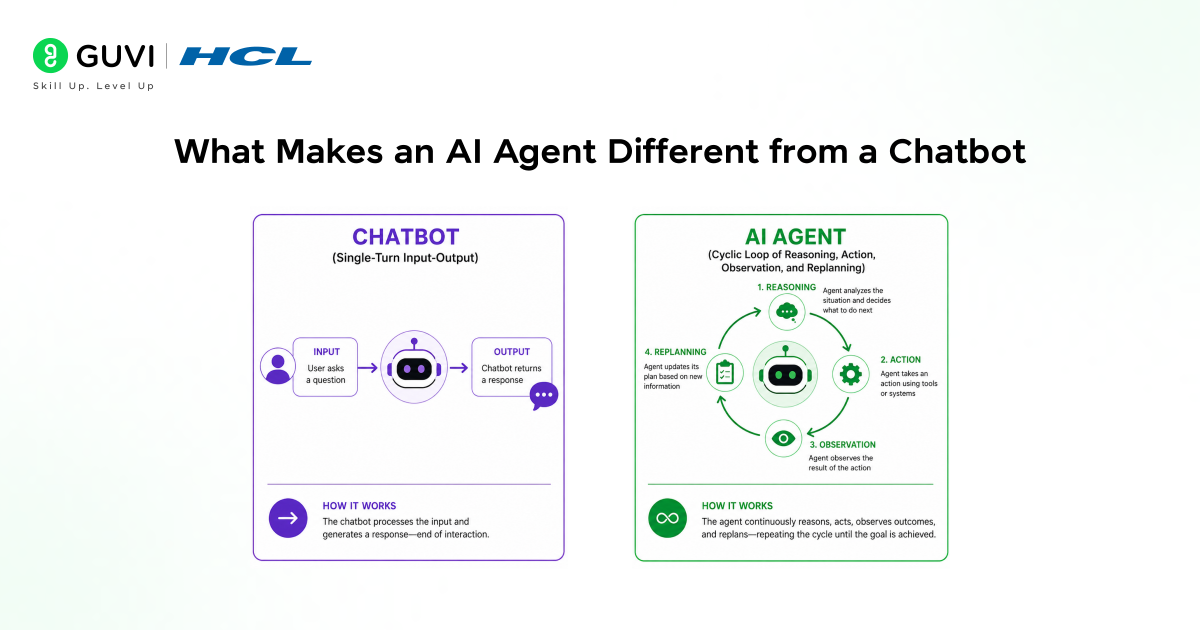
The distinction between a chatbot and an AI agent comes down to agency, the ability to take actions in pursuit of a goal, rather than simply responding to a prompt.
Chatbots
A chatbot receives a message and generates a response. Its scope is bounded by a single turn. Even in multi-turn conversations, each response is generated independently based on the conversation history. The chatbot does not plan, does not use external tools, and does not take actions that affect the world beyond the text it produces.
AI Agents
An AI agent receives a goal and figures out how to achieve it. It may decompose the goal into sub-tasks, call external APIs, search the web, write and execute code, read files, send emails, or interact with databases, all without being told exactly what to do at each step. It observes the results of each action and decides what to do next.
This shift from responding to reasoning and acting is what defines agentic AI.
- Chatbot: Responds to a single prompt. No tools. No memory beyond the conversation. No autonomous action.
- AI Agent: Pursues a goal across multiple steps. Uses tools. Maintains state. Acts autonomously until the task is complete.
The Core Architecture of AI Agent Development
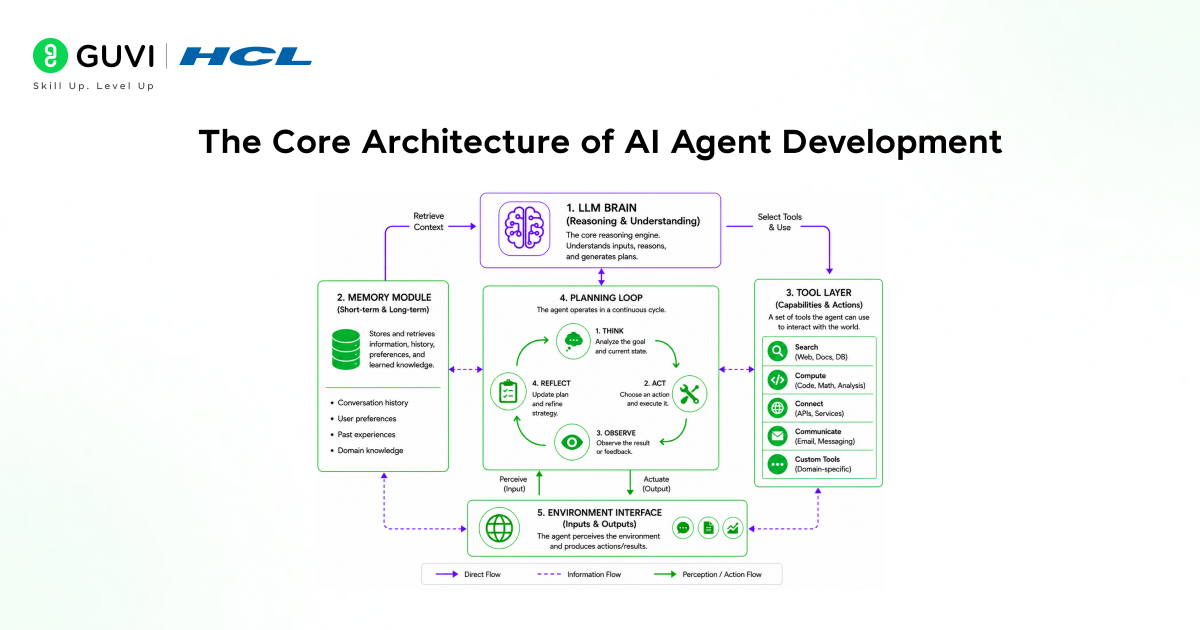
Every AI agent,t regardless of the framework or use case,se is built from the same core components. Understanding each one is essential before writing a single line of agent code.
1. The LLM Brain
The large language model is the reasoning engine at the centre of every agent. It interprets the goal, plans the next action, processes tool results, and decides when the task is complete. The quality of the LLM directly determines the quality of the agent’s reasoning. More capable models handle complex multi-step tasks more reliably and fail less often on ambiguous instructions.
2. Tools
Tools are the capabilities that allow an agent to interact with the world beyond its training data. Without tools, an agent can only reason that it cannot act. Common tools include:
• Web search: Retrieves current information from the internet.
• Code interpreter: Writes and executes Python or other code to perform calculations, data processing, or file operations.
• API calls: Connects to external services databases, CRMs, calendars, and payment systems to read or write data.
• File operations: Reads, writes, and manages documents and structured data files.
• Browser automation: Navigates websites, fills forms, and extracts content from web pages.
Tool use in AI is the capability that makes agents genuinely useful. Designing the right tool set for a given task is one of the most important decisions in agent development.
3. Memory
Memory allows an agent to maintain context and state across multiple steps and sessions. There are two primary types:
• Short-term memory: The contents of the context window — the active conversation, tool results, and intermediate reasoning steps.
• Long-term memory: An external store — a vector database or key-value store — that persists information across sessions and can be retrieved selectively.
Without memory, every agent run starts from scratch. With well-designed memory, agents can build on prior work, remember user preferences, and maintain continuity over time.
4. The Planning Loop
The planning loop is the cycle by which an agent reasons, acts, and observes. At each iteration, the agent receives the current state (goal, history, tool results) and decides: should I take another action, or is the task complete? This loop continues until the agent determines the goal has been achieved or until it reaches a defined stopping condition.
The ReAct Pattern: Reasoning and Acting in LLM Agents
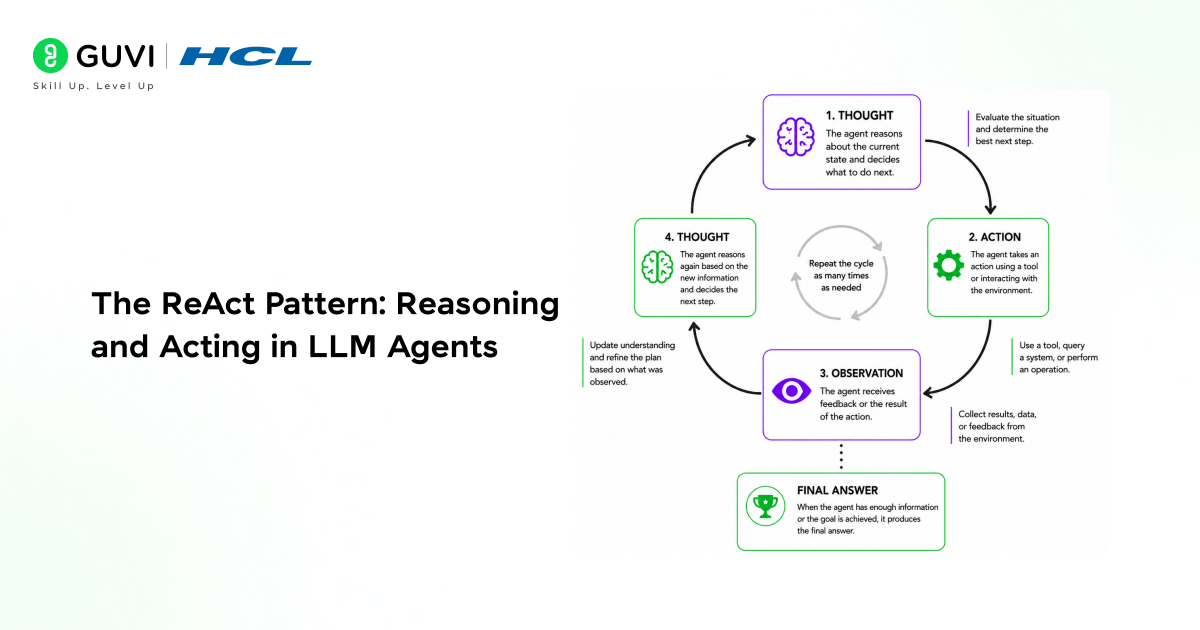
The most widely adopted architecture for building LLM agents is the ReAct pattern — short for Reasoning and Acting. It was introduced in a 2022 research paper and has since become the foundation for most agent frameworks in use today.
How ReAct Works
At each step of the planning loop, the agent produces three things in sequence:
1. Thought: The agent reasons about the current state of the task. What do I know? What do I need to find out? What should I do next?
2. Action: The agent selects a tool and specifies the input. For example: search the web for “current interest rate UK 2025”.
3. Observation: The result of the action is returned to the agent. The agent reads the result and incorporates it into its next thought.
This Thought-Action-Observation cycle repeats until the agent determines it has enough information to produce a final answer or until it completes the task.
The power of ReAct is that the reasoning is explicit and traceable. Each thought is visible, each action is logged, and each observation feeds directly into the next step. This makes agent behaviour far easier to debug than black-box approaches.
The ReAct pattern was introduced in the influential 2022 paper “ReAct: Synergizing Reasoning and Acting in Language Models” by Yao et al. The research demonstrated that combining chain-of-thought reasoning with action-taking capabilities enabled language models to outperform approaches based only on reasoning or only on actions across multiple benchmarks. This hybrid reasoning-and-tool-use framework went on to heavily influence the architecture of modern LLM agents and autonomous AI systems.
Agent Frameworks: LangChain, LlamaIndex, and AutoGen
Building an AI agent from scratch, managing the planning loop, tool calls, memory, and error handling manually, is possible but time-consuming. Agent frameworks accelerate development by providing pre-built components for the most common agent patterns.
LangChain
LangChain is the most widely used agent framework. It provides abstractions for tool definition, agent executors, memory management, and chain composition. Its ecosystem includes a large library of pre-built tool integrations from web search and SQL databases to vector stores and custom APIs.
LangChain is best suited for developers who want flexibility and a large community of existing examples and integrations. Its LangGraph extension adds support for stateful, multi-actor agent workflows with explicit control flow.
LlamaIndex
LlamaIndex focuses on data-intensive agent applications. Its strength is retrieval — connecting agents to structured and unstructured data sources, building knowledge graphs, and enabling agents to reason over large document collections. It is the preferred framework when the agent’s primary task involves reading, understanding, and synthesizing information from complex data.
AutoGen
AutoGen, developed by Microsoft Research, introduces a multi-agent conversation architecture. Instead of a single agent, AutoGen enables multiple specialized agents to collaborate: a planner agent, a coder agent, and a critic agent, each contributing to a shared goal through structured dialogue. This makes it particularly well-suited for complex tasks that benefit from role separation and agent-to-agent feedback.

Choosing the Right Framework
• LangChain: General-purpose agents with broad tool integration needs.
• LlamaIndex: Data-heavy applications requiring sophisticated retrieval and document reasoning.
• AutoGen: Complex tasks where multiple specialized agents working in concert outperform a single general agent.
Multi-Step Reasoning: How Agents Handle Complex Tasks
The ability to break a complex goal into a sequence of manageable sub-tasks and execute those sub-tasks reliably is what makes agentic AI genuinely powerful.
Consider a goal like: “Research the top three competitors in our market, summarise their pricing models, and draft a competitive positioning memo.”
A single LLM prompt cannot complete this task. But an agent can:
- Search the web for competitor information.
- Visit each competitor’s pricing page and extract relevant data.
- Organize the data into a structured comparison.
- Draft the memo based on the structured data.
- Review the draft for completeness and accuracy.
Each step uses a different tool, produces an intermediate result, and feeds into the next. The agent manages the entire sequence without requiring a human to orchestrate each transition.
This multi-step reasoning capability is what separates agents from simple automation scripts. The agent adapts when a step fails, takes a different path when a tool returns unexpected results, and reaches the goal through flexible problem-solving rather than rigid rule-following.
AI Programming: Building Your First Agent
Building a functional AI agent involves a series of deliberate design decisions. Here is the standard development sequence:
- Define the goal and scope: What task should the agent complete? What are the boundaries of its operation? A clear scope prevents agents from taking unintended actions.
- Choose the LLM: Select a model capable of the reasoning complexity required. More capable models (GPT-4, Claude 3, Gemini 1.5) handle nuanced multi-step tasks better than smaller models.
- Define the tool set: Identify which tools the agent needs. Define each tool with a clear name, description, and input schema. The quality of tool descriptions directly affects how reliably the agent selects the right tool.
- Configure memory: Decide what the agent needs to remember between steps and across sessions. Implement a short-term buffer and, if needed, a vector store for long-term retrieval.
- Implement the planning loop: Use a framework like LangChain or build the ReAct loop manually. Define the stopping conditions when the agent decides the task is done?
- Add guardrails: Implement input validation, output filtering, action confirmation for high-risk operations, and rate limiting for external API calls.
- Test systematically: Run the agent against diverse inputs. Test failure mode: What happens when a tool returns an error? When is the goal ambiguous? When the context window fills up?
Reliability and Safety in Autonomous Agent Systems
The hardest part of building AI agents is not making them work; it is making them work reliably. Agents that function well in development often fail in unexpected ways in production. Understanding the failure modes is essential.
Common Failure Modes
- Hallucinated tool calls: The agent invokes a tool with incorrect parameters or invents a tool that does not exist. Robust tool schemas with clear descriptions and input validation reduce this significantly.
- Infinite loops: The agent keeps taking actions without making progress toward the goal. Implement explicit step limits and goal-completion checks.
- Scope creep: The agent takes actions beyond its intended scope — accessing systems it should not, or pursuing sub-goals that were not sanctioned. Clear system prompts and action whitelists are the primary defence.
- Context window overflow: Long agent runs fill the context window, causing the agent to lose track of earlier steps. Summarisation strategies and external memory help manage this.
- Poor error handling: When a tool fails, the agent must recover gracefully. Without explicit error-handling logic, agents often get stuck or hallucinate tool results.
If you want to learn more about building skills for Claude Code and automating your procedural knowledge, do not miss the chance to enroll in HCL GUVI’s Intel & IITM Pravartak Certified Artificial Intelligence & Machine Learning courses. Endorsed with Intel certification, this course adds a globally recognized credential to your resume, a powerful edge that sets you apart in the competitive AI job market.
Conclusion
Building AI agents is one of the most consequential skills in software development today. Agents represent a fundamental shift in how AI is applied from a tool that answers questions to a system that completes tasks, manages workflows, and operates with genuine autonomy.
The foundations are accessible: a capable LLM, a well-defined tool set, a reasoning loop, and a framework to hold it together. But building agents that work reliably in production that handle edge cases gracefully, stay within their intended scope, and produce trustworthy results requires careful design, systematic testing, and a clear-eyed understanding of the failure modes.
The field is moving fast. Frameworks are maturing, models are improving, and the range of tasks that agents can handle autonomously is expanding rapidly. The developers who invest in understanding agentic AI now will be the ones building the systems that define the next generation of software.
FAQs
1. What programming language is best for building AI agents?
Python is the dominant language for AI agent development. The major frameworks LangChain, LlamaIndex, and AutoGen are all Python-first, and the broader AI and machine learning ecosystem is centred on Python. JavaScript/TypeScript versions of LangChain also exist for web-native applications.
2. Do I need to train a custom model to build an AI agent?
No. Most AI agents are built on top of pre-trained models accessed via API, such as GPT-4, Claude, or Gemini. Custom model training is rarely necessary for agent development. The agent’s behaviour is shaped through prompt engineering, tool design, and system configuration rather than model training.
3. What is the difference between a single agent and a multi-agent system?
A single agent handles all reasoning and tool use within one planning loop. A multi-agent system distributes work across multiple specialized agents a planner, a researcher, a coder, a reviewer that communicate and collaborate to complete complex tasks. Multi-agent systems are more powerful for complex goals but significantly harder to design and debug.
4. How do I prevent an AI agent from taking unintended actions?
The primary controls are: a precise system prompt that clearly defines the agent’s scope and prohibited actions; a whitelist of permitted tools and APIs; human-in-the-loop confirmation for high-risk operations such as sending emails, making purchases, or deleting data; and output validation before any action is executed in a production environment.
5. How long does it take to build a production-ready AI agent?
A simple agent with one or two tools can be functional in hours using a framework like LangChain. A production-ready agent with robust error handling, memory management, observability, safety guardrails, and systematic testing typically takes weeks to months,s depending on the complexity of the task and the reliability standards required.
Success Stories

About the Author
Vishalini Devarajan
An Aerospace Engineer turned content writer, I focus on making complex concepts easy to understand through well-structured, reader-friendly blogs. Whether it’s a technical topic or a non-technical one, I love creating content that is clear, engaging, and impactful.
View all posts by Vishalini Devarajan
Connect with me @







Did you enjoy this article?