


Artificial Intelligence and Machine Learning Articles
Finance Manager to Data Analytics: Career Growth, Salary and Seniority
How to Evaluate LLM Outputs in Production Deployments
AI/ML Skills Gap 2026: Why Companies Can't Find Job-Ready Talent
20 AI/ML Interview Questions Recruiters Can Use Without a Tech Background - Best Guide

Get In Touch For Details! Request More Information
AI in Gaming: NPC Behavior and Procedural Generation
Aug 27, 2026 4 Min Read 414 Views
(Last Updated)
Artificial intelligence has become an important part of modern game development, helping create more responsive characters, dynamic environments, and varied gameplay experiences. AI in Gaming is commonly used for NPC behavior, procedural content generation, pathfinding, difficulty adjustment, and player interaction. This guide explains how AI can make non-player characters more intelligent and how procedural generation can create game content efficiently.
Table of contents
- TL;DR
- Quick Answer
- Why AI Matters in Gaming
- AI for NPC Behavior
- Common Techniques for NPC Behavior
- Finite State Machines
- Behavior Trees
- Pathfinding
- Decision-Making Systems
- What Is Procedural Generation?
- How Procedural Generation Works
- Step 1: Define Rules
- Step 2: Provide a Seed or Input
- Step 3: Generate Content
- Step 4: Validate the Result
- Step 5: Integrate Into the Game
- AI and Procedural Generation Together
- Common Applications
- Open-World Games
- Roguelike Games
- Strategy Games
- Simulation Games
- Benefits of AI in Gaming
- More Dynamic NPCs
- Greater Replayability
- Efficient Content Creation
- More Immersive Gameplay
- When Should You Use AI in Gaming?
- Dynamic NPC Behavior
- Open-World Games
- Procedurally Generated Worlds
- Replayable Games
- Strategy and Simulation Games
- Key Concepts to Remember
- A Practical AI Gaming Workflow
- Define NPC Goals
- Identify Game Conditions
- Build Decision Logic
- Add Navigation
- Define Procedural Rules
- Generate and Validate Content
- Test Player Experience
- Real-World Applications
- Open-World Games
- Roguelike Games
- Strategy Games
- Simulation Games
- Best Practices
- Conclusion
- FAQs
- What is AI in Gaming?
- How does AI control NPCs?
- What is procedural generation?
- Is procedural generation the same as random generation?
- What is a finite state machine in gaming?
- What are behavior trees used for?
- How does AI improve gaming?
TL;DR
- AI can make NPCs more responsive and adaptive.
- NPCs can use AI for navigation, decision-making, and interaction.
- Procedural generation creates game content automatically.
- AI can increase gameplay variety and replayability.
- Developers can combine AI techniques to create dynamic game worlds.
Quick Answer
| AI in Gaming uses artificial intelligence techniques to control NPC behavior, generate game content, and create more dynamic player experiences. NPCs can use decision-making systems to respond to players and their surroundings, while procedural generation can automatically create levels, environments, items, or other content. Together, these techniques can improve gameplay variety, immersion, and replayability. |
Why AI Matters in Gaming
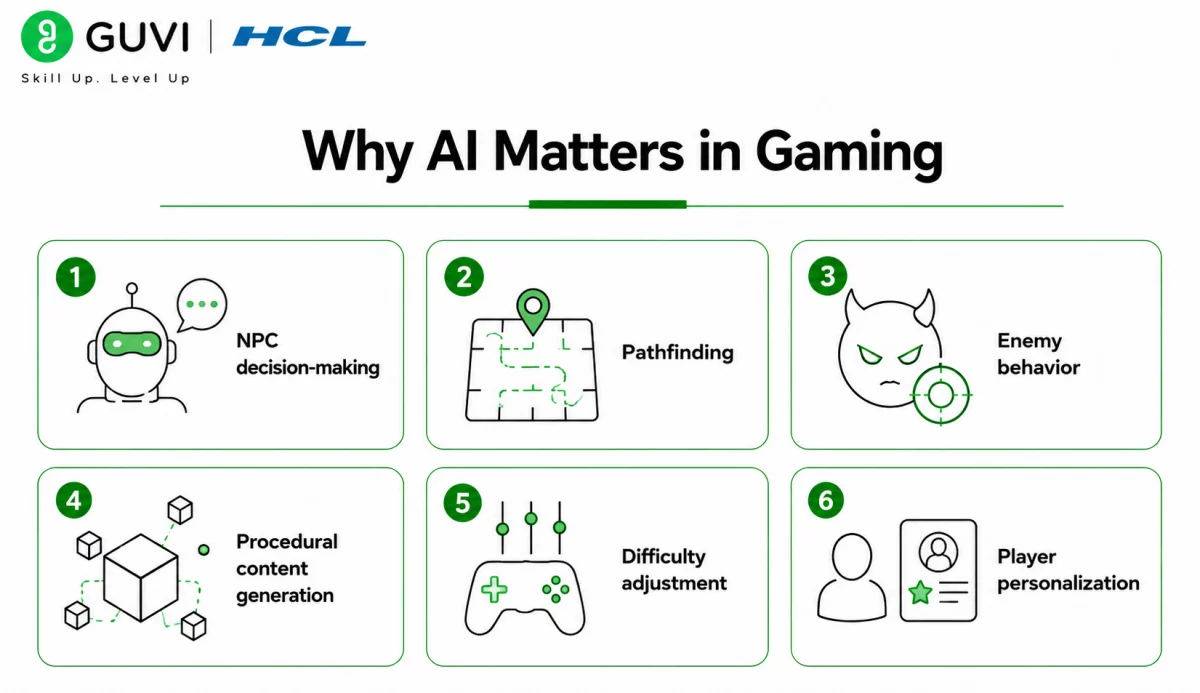
Traditional game systems often rely on predefined rules and scripted behaviors. AI techniques allow developers to create systems that can respond to changing game conditions.
AI can help with:
- NPC decision-making
- Pathfinding
- Enemy behavior
- Procedural content generation
- Difficulty adjustment
- Player personalization
AI for NPC Behavior
NPCs (non-player characters) are characters controlled by the game rather than directly by players.
AI can help NPCs determine what to do based on their environment, objectives, and interactions with players.
For example, an enemy NPC might:
- Detect the player.
- Determine whether the player is a threat.
- Select an appropriate action.
- Move toward a strategic position.
- Attack, defend, or retreat based on the situation.
This creates behavior that can feel more dynamic than simple predetermined actions.
Common Techniques for NPC Behavior
Finite State Machines
A finite state machine represents NPC behavior through defined states.
For example:
Patrol → Detect Player → Chase → Attack → Retreat
The NPC transitions between states when specific conditions occur.
Behavior Trees
Behavior trees organize decisions into a hierarchical structure, allowing NPCs to select actions based on different conditions.
They are useful for managing more complex NPC behavior.
Pathfinding
Pathfinding algorithms help NPCs navigate game environments and find routes between locations.
Decision-Making Systems
AI can evaluate game conditions and choose actions based on objectives, priorities, or available options.
What Is Procedural Generation?
Procedural generation is the automated creation of game content using algorithms and defined rules.
Instead of manually designing every element, developers can create systems that generate content dynamically.
Examples include:
- Game levels
- Maps
- Terrain
- Buildings
- Items
- Environments
- Quests
How Procedural Generation Works
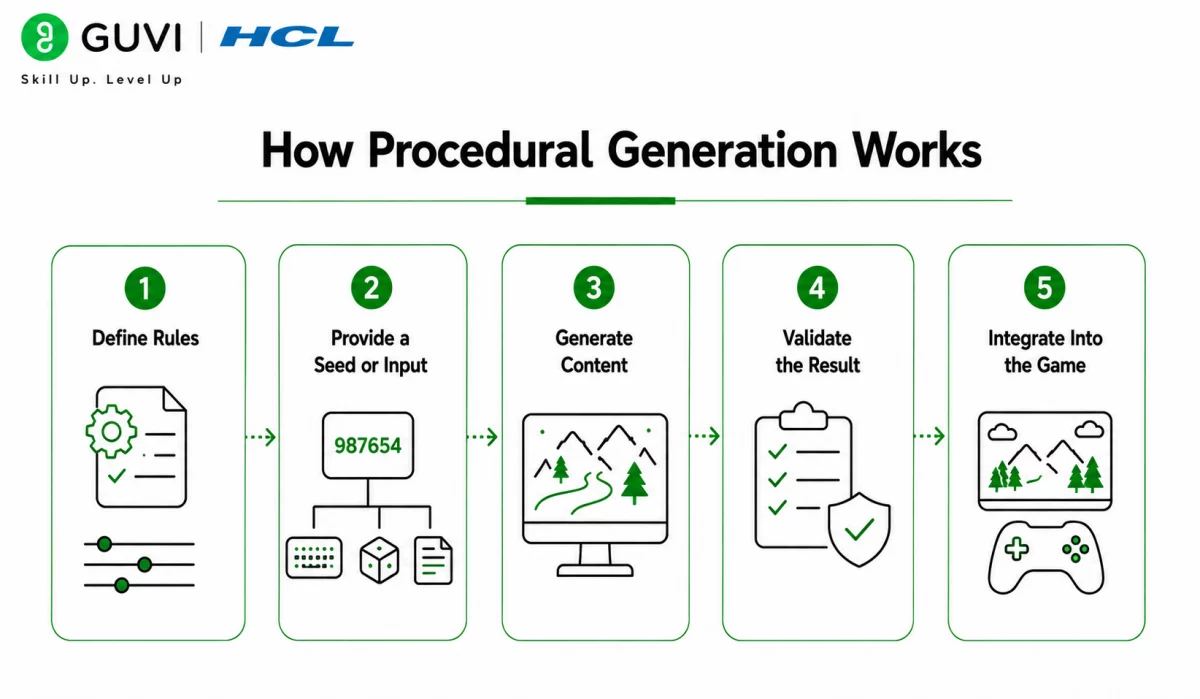
A typical process involves several stages.
Step 1: Define Rules
Developers establish constraints and parameters that determine what can be generated.
Step 2: Provide a Seed or Input
A seed or other input can determine the starting conditions for generation.
Step 3: Generate Content
The system uses algorithms to create game elements according to the defined rules.
Step 4: Validate the Result
Generated content can be checked to ensure it is playable and meets design requirements.
Step 5: Integrate Into the Game
The generated content becomes part of the player’s game environment or experience.
AI and Procedural Generation Together
AI-driven NPC behavior and procedural generation can work together to create dynamic game worlds.
For example:
Procedurally Generated Environment → NPC Perception → Decision-Making → NPC Action → Dynamic Gameplay
An NPC may need to adapt its behavior when the game environment changes, while procedurally generated environments can provide new situations for NPCs to respond to.
Common Applications
Open-World Games
Generate large environments and populate them with dynamic NPCs.
Roguelike Games
Create different maps, encounters, and item combinations for repeated playthroughs.
Strategy Games
Use AI to control opponents and procedural systems to generate maps or scenarios.
Simulation Games
Model dynamic environments and behaviors based on changing game conditions.
Procedural generation should not mean random generation. Good procedural systems use carefully designed rules and constraints so generated content remains playable, balanced, and consistent with the game’s design.
Procedural generation should not mean random generation. Good procedural systems use carefully designed rules and constraints so generated content remains playable, balanced, and consistent with the game’s design.
Benefits of AI in Gaming
More Dynamic NPCs
AI can create characters that react to changing game situations.
Greater Replayability
Procedurally generated content can provide different experiences across playthroughs.
Efficient Content Creation
Procedural systems can generate large amounts of content without requiring every element to be manually designed.
More Immersive Gameplay
Responsive NPCs and dynamic environments can make game worlds feel more alive.
When Should You Use AI in Gaming?
AI in Gaming is especially useful when developers want game worlds, characters, or gameplay systems to respond dynamically to player actions.

Dynamic NPC Behavior
Use AI when NPCs need to react to players, environments, threats, or changing game conditions.
Open-World Games
AI can support NPC navigation and decision-making across large, changing environments.
Procedurally Generated Worlds
Use procedural generation when developers need to create large or varied environments, maps, levels, or items efficiently.
Replayable Games
Procedural systems can generate different content across playthroughs, increasing gameplay variety.
Strategy and Simulation Games
AI can control opponents, manage simulated characters, and respond to changing game conditions.
Professionals interested in artificial intelligence, machine learning, game development, and intelligent systems can strengthen their expertise through HCL GUVI’s Artificial Intelligence and Machine Learning Course.
Key Concepts to Remember
- NPC AI controls the behavior of non-player characters.
- Finite state machines organize behavior into defined states.
- Behavior trees structure more complex decisions.
- Pathfinding helps NPCs navigate game environments.
- Procedural generation creates content using algorithms and rules.
- Good procedural generation uses constraints rather than pure randomness.
A Practical AI Gaming Workflow
1. Define NPC Goals
Determine what each NPC needs to accomplish, such as patrolling, defending, attacking, or escaping.
2. Identify Game Conditions
Define the information NPCs can respond to, such as player location, threats, health, or nearby objects.
3. Build Decision Logic
Use techniques such as state machines or behavior trees to determine appropriate NPC actions.
4. Add Navigation
Use pathfinding so NPCs can move effectively through the game environment.
5. Define Procedural Rules
For generated content, establish constraints controlling elements such as terrain, maps, items, or environments.
6. Generate and Validate Content
Create content automatically and verify that it remains playable and consistent with the game’s design.
7. Test Player Experience
Evaluate whether NPC behavior and generated content feel responsive, balanced, and enjoyable.
Real-World Applications
Open-World Games
AI can support dynamic NPC behavior while procedural systems help create large environments.
Roguelike Games
Procedural generation can create different maps, encounters, and item combinations across playthroughs.
Strategy Games
AI can control opponents while procedural systems generate maps and scenarios.
Simulation Games
AI can model character behavior and changing environments based on game conditions.
The HCL GUVI’s Artificial Intelligence eBook introduces artificial intelligence, machine learning, generative AI, and intelligent automation concepts, helping learners understand modern AI technologies and their practical applications.
Best Practices
- Give NPCs clear goals and behavioral rules.
- Use appropriate decision-making techniques for the complexity of the game.
- Design reliable navigation systems.
- Use constraints when generating procedural content.
- Test generated content for playability.
- Balance NPC difficulty against the intended player experience.
- Continuously test AI behavior in different game situations.
Conclusion
AI in Gaming can make game worlds more dynamic by combining responsive NPC behavior with automated content generation. Techniques such as finite state machines, behavior trees, pathfinding, and procedural generation help developers create characters and environments that react to changing conditions. When carefully designed and tested, these systems can improve gameplay variety, immersion, and replayability.
FAQs
1. What is AI in Gaming?
AI in Gaming refers to the use of artificial intelligence techniques to control NPC behavior, support decision-making, generate content, and create dynamic gameplay experiences.
2. How does AI control NPCs?
AI can use decision-making systems such as finite state machines and behavior trees to determine how NPCs respond to players and their environment.
3. What is procedural generation?
Procedural generation uses algorithms and predefined rules to automatically create game content such as maps, levels, terrain, items, and environments.
4. Is procedural generation the same as random generation?
No. Effective procedural generation uses rules and constraints to create content that remains playable and consistent with the game’s design.
5. What is a finite state machine in gaming?
A finite state machine organizes NPC behavior into defined states, such as patrol, chase, attack, and retreat, with transitions triggered by specific conditions.
6. What are behavior trees used for?
Behavior trees organize complex NPC decisions hierarchically, allowing characters to select actions based on different game conditions.
7. How does AI improve gaming?
AI can create more responsive NPCs, dynamic environments, varied content, and more replayable experiences, making game worlds feel more interactive and immersive.
Success Stories

About the Author
HCL GUVI
This article was selected and published as part of the HCL GUVI AI Blogathon 2026, an initiative designed to encourage students, AI enthusiasts, and aspiring tech writers to simplify complex AI concepts through impactful technical content. The contest recognized high-quality, original, and insightful AI-focused blogs, with selected authors receiving publication opportunities on the HCL GUVI blog platform along with official author credits and recognition.
View all posts by HCL GUVI
Connect with me @









Did you enjoy this article?