


Artificial Intelligence and Machine Learning Articles
Getting Started with LangChain Prompt Templates in 2026
Cursor 2.0: Trending AI Model Explained In-Depth
Creating Custom Swag Merchandise Using Generative AI
Create a Recipe with ChatGPT: A Guide to AI-Assisted Cooking


Get In Touch For Details! Request More Information
Agentic AI Developer Explained: Skills, Salary, and Career Path for 2026
Mar 03, 2026 6 Min Read 5076 Views
(Last Updated)
Imagine a world where your software is capable of thinking for itself, rather than waiting for commands as it would normally do now. It wakes up in the morning, opens your calendar, prioritizes your day’s activities, conducts research for you on what is related to your tasks, books meetings on your behalf, troubleshoots errors it made, and then notifies you of its actions. This is not something from a movie; it’s the reality that we are creating today with a new class of technological professionals: the Agentic AI Developer.
The first question you probably have is “Who is an Agentic AI Developer?” If you are interested in the future of AI and the people who are creating that future, you are in the right place. This Blog is meant to be your friendly guide to understanding this revolutionary role, what it means to be an Agentic AI Developer, the skills that are required, the tools they use, and why this may be the most important job of our decade.
Let’s not delay and plan to explore the architects of autonomous intelligence today, shall we?
Table of contents
- Understanding the Term “Agentic AI”
- Who is an Agentic AI Developer?
- Key Skills of an Agentic AI Developer
- Basic Knowledge in Programming
- Mastery of Large Language Models (LLMs)
- The Frameworks of Agency
- Tool Integration and Function Calling
- Safety, Security, and Ethics
- Why is the Role of an Agentic AI Developer Important?
- Agentic AI Developer Salary in India
- Career Path to Becoming an Agentic AI Developer
- Common Mistakes Students Must Avoid
- The Future is Agentic: What Lies Ahead?
- Wrapping It Up…
- FAQs
- Is a Computer Science degree a requirement to be an Agentic AI Developer?
- What's the difference between an AI Engineer and an Agentic AI Developer?
- Do I need advanced math skills?
- What beginner projects can I work on?
Understanding the Term “Agentic AI”
Before we define the role, it’s important to understand the term agentic. In psychology, “Agency” refers to the capacity of an individual to make choices, formulate a solution, and act independently. However, in AI terms, “agentic” relates to design systems or models that can act independently, make choices, and achieve their goals with little to no human engagement.
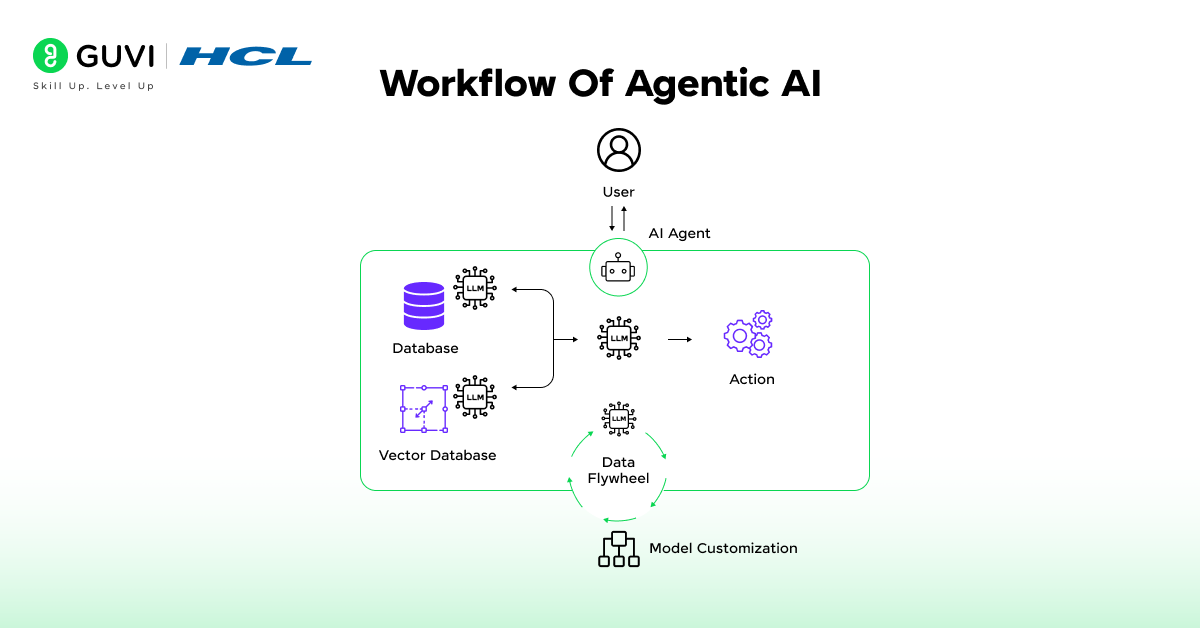
In summary, Agentic AI is not simply a system that can process data and provide response prompts; Agentic AI incorporates the idea of building intelligent agents that can plan, reason, and carry out tasks like a digital teammate.
Who is an Agentic AI Developer?
An Agentic AI Developer is a professional who designs, builds, and optimizes AI agents that can think and act autonomously, but in defined confines. The key difference with a traditional AI developer is that a traditional AI developer focuses on designing and creating AI models, while an agentic AI developer is focused on creating autonomous systems that can:
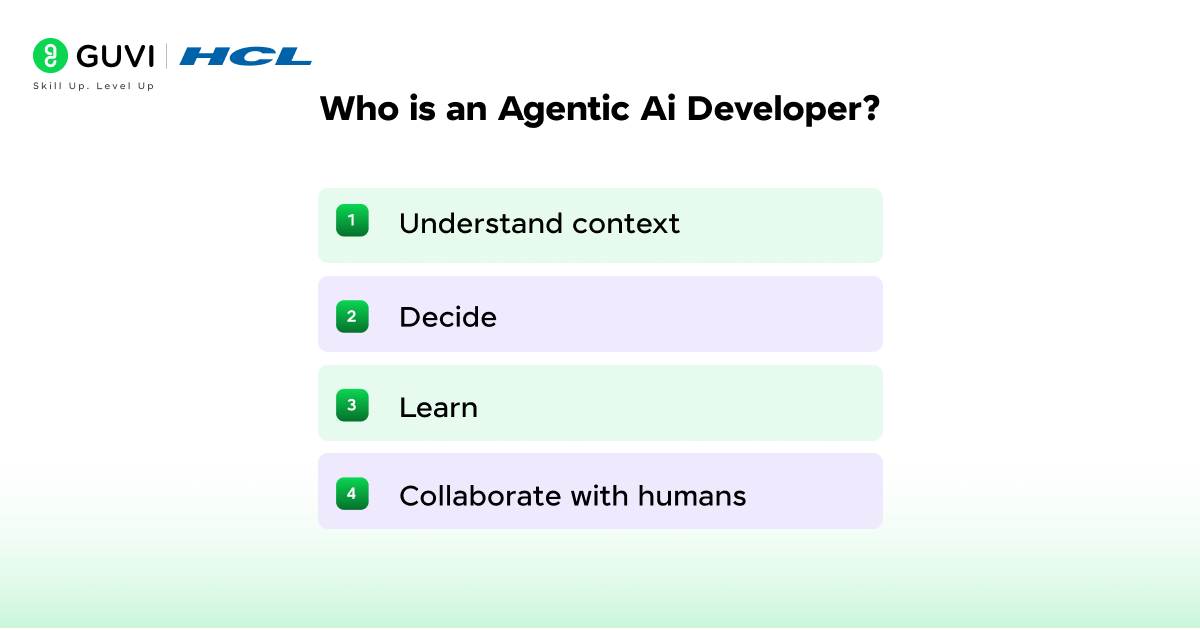
- Understand context: Not just follow instructions, decisions are made based on situations.
- Decide: Choose the best actions to accomplish a goal.
- Learn: With each interaction and more data, performance gets better.
- Collaborate with humans: Work as a digital assistant, partner, or co-worker.
So, an Agentic AI Developer is building the kind of AI that doesn’t just answer your questions, but helps you build plans, take actions, and get stuff done.
Curious about how AI agents really work? Start your journey with HCL GUVI’s Free 5-Day AI & ML Email Course and get practical lessons straight in your inbox.
Key Skills of an Agentic AI Developer
To succeed in this role, one needs a blend of technical expertise, creativity, and problem-solving skills. Here are some of the must-have skills:
1. Basic Knowledge in Programming
You cannot get away with the basics. Python is practically necessary in this field and is the lifeblood of modern AI. However, it is more than just writing a few scripts to be an Agentic AI Developer. You’ll need to:
- Master data structures (lists, dictionaries, queues, trees, graphs).
- Know APIs and how various systems are talking to one another.
- Learn to use software architecture well so that your projects can achieve scalability.
- Work with Git and version control and become a pro at collaborating and controlling codebases.
Think of this as the foundation of your “AI house.” Without strong basics, the advanced skills won’t hold up.

2. Mastery of Large Language Models (LLMs)
This is were is where agentic AI is developed. Smart agents are powered by LLMs and thus, you will require a good understanding of:
- The mechanism of LLMs: What they are capable of doing and what they cannot do, their biases and their hallucinations.
- The LLM Ecosystem: Try to get hands-on experiences with APIs to OpenAI (GPT), Anthropic (Claude), and Google (Gemini) and open-source models such as LLaMA (Meta) or Mistral.
- Context Management: Since LLMs have token limits, you need to understand how to feed the model appropriate data and at the appropriate time without exhausting it.
Example: Consider you are creating a study helper to remember what you have to do during your semester. If you don’t manage context windows properly, the model might “forget” older information and mess up your deadlines.
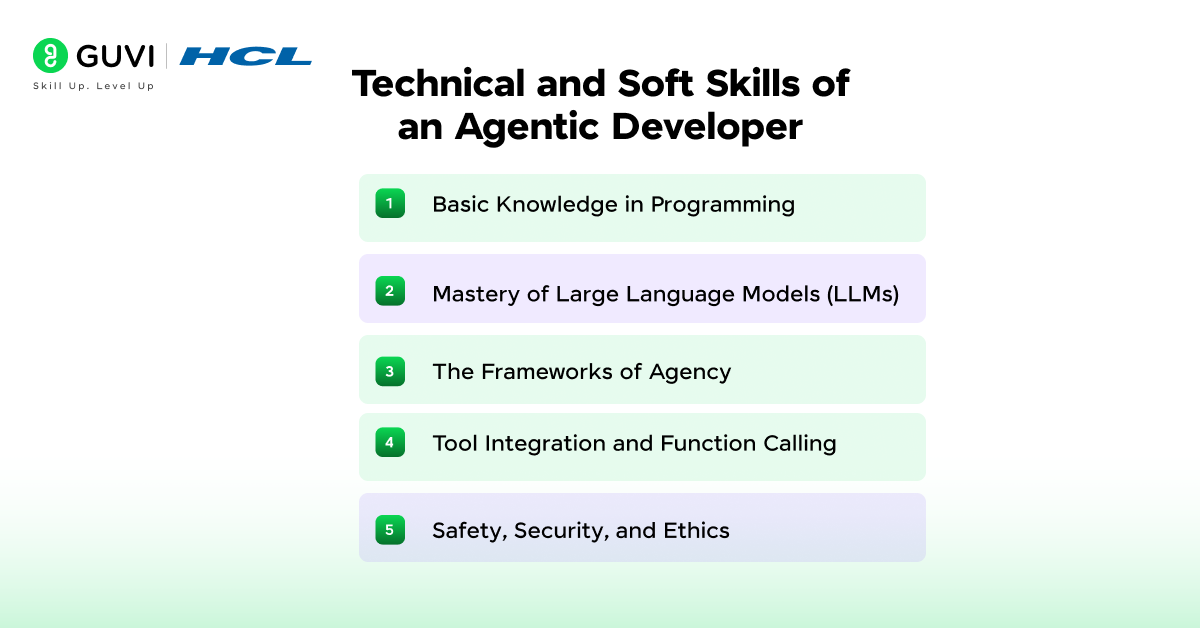
3. The Frameworks of Agency
As an Agentic AI Developer, you don’t have to reinvent the wheel. There are emerging frameworks built specifically for creating AI agents:
- LangChain / LangGraph: The go-to for chaining tasks, creating conversational applications, and creating multi-agent workflows that have state.
- AutoGen(Microsoft): A framework in which multi-agent communication and orchestration are simplified.Great for when you want multiple agents to collaborate.
- CrewAI: Ideal in role-playing agents, such as giving one AI the role of a “Researcher,” another the role of a writer, and the third the role of an editor, and collaborating as a team.
These structures resemble your Lego blocks. They assist you to put complex systems together in a short time.
4. Tool Integration and Function Calling
An AI agent’s intelligence is multiplied by the tools it can use. Imagine an agent that can not only generate text but also:
- Send emails
- Check your calendar
- Run code
- Query databases
This magic occurs in the form of function calling and API integration.
- Function Calling: Teach the agent to call specific functions like send_email() or execute_code() when needed.
- API Integration: API can be used to integrate with tools such as Slack, Google Calendar, weather information, or even cloud infrastructure.
Example: A student might create an agent that would automatically book study time with friends and check the availability of everyone on Google Calendar and send invitations.
5. Safety, Security, and Ethics
With great power comes great responsibility.The agentic AI is both immensely powerful and dangerous at the same time.That’s why safety is non-negotiable:
- Safety: Construct guardrails so your AI does not make harmful, unethical or irreversible choices.
- Security: Defend against prompt injection attacks where bad actors try to manipulate your AI’s behavior
- Cost Control: APIs may be costly to operate long workflows and you will require monitoring and optimization measures.
Being a good Agentic AI Developer does not merely mean being technical, they’re responsible architects of safe, useful systems.
Why is the Role of an Agentic AI Developer Important?
The tech world is shifting from reactive AI (like chatbots that just answer queries) to proactive AI (agents that can anticipate needs and act independently). For example:
- In business, agentic AI can automate workflows, schedule meetings, or respond to customer queries without human involvement.
- In health, agentic AI can support doctors by continuously monitoring patient data and recommending actionable interventions whenever needed.
- In software development, agentic AI can assist developers by debugging code, writing documentation, or automatically deploying updates.
An Agentic AI Developer is at the heart of building these next-generation systems, making them one of the most in-demand roles of the future.
Agentic AI Developer Salary in India
Since Agentic AI Development is a new role in India, exact numbers vary depending on company size, industry, and your skill set. But based on current AI/ML job trends, here’s an estimated salary breakdown:
| Experience Level | Years of Experience | Average Salary Range (₹ LPA) | What Employers Expect |
| Fresher / Entry-Level | 0 – 2 years | ₹3 LPA – ₹12 LPA | Strong Python skills, basic knowledge of LLMs, some project or internship experience. |
| Intermediate / Mid-Level | 2 – 5 years | ₹12 LPA – ₹25 LPA | Hands-on experience with frameworks like LangChain, AutoGen, CrewAI, ability to build and deploy AI agents. |
| Experienced / Senior | 5+ years | ₹25 LPA – ₹45+ LPA | Deep expertise in AI/ML, proven track record in deploying scalable agentic systems, leadership in AI-driven projects. |
Career Path to Becoming an Agentic AI Developer
If you’re inspired by this role, the good news is you can absolutely learn and grow into it. Becoming an Agentic AI Developer doesn’t happen overnight, but with consistent effort and the right learning path, you can build the expertise step by step.
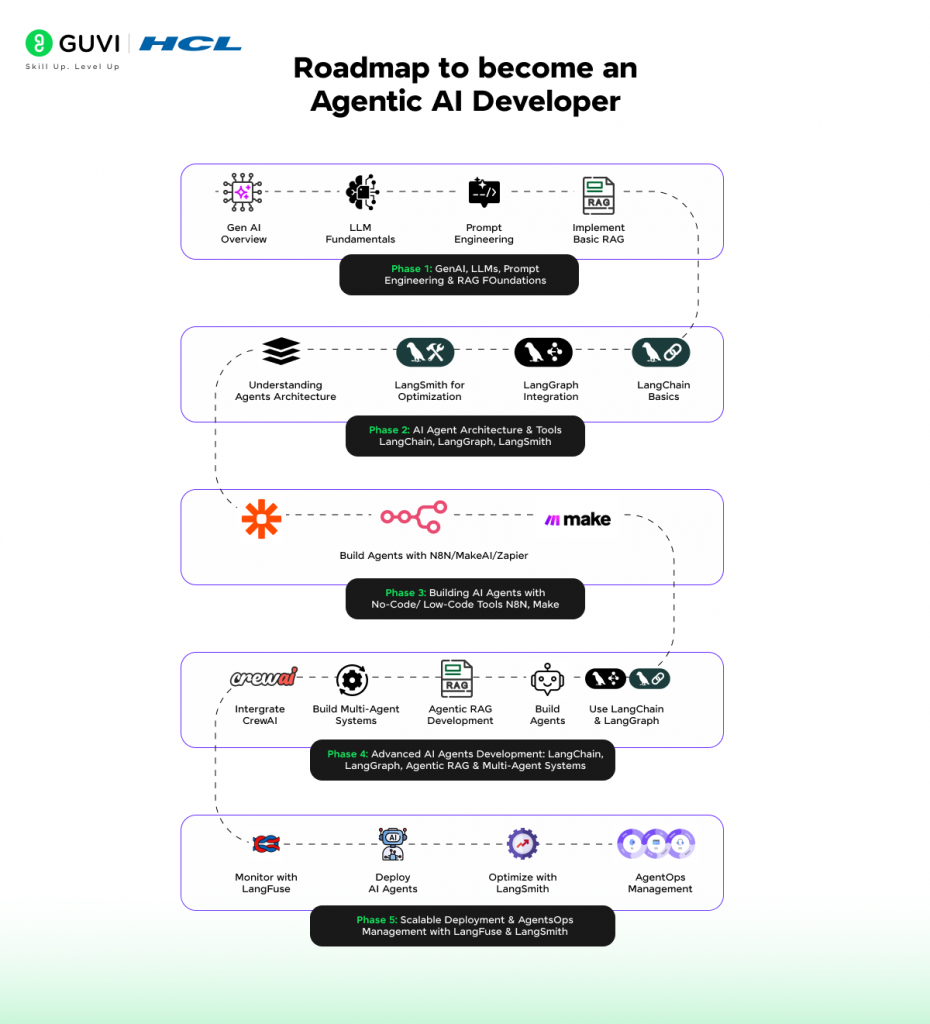
- Learn AI Basics
Begin by strengthening your knowledge of Python since this is the most used language for AI programming. After that, study the basics of machine learning and deep learning so you can develop an understanding of how algorithms learn from the data you provide. Subsequently, practice with some of the most popular platforms, TensorFlow and PyTorch - Explore Large Language Models (LLMs)
Since nearly all agentic systems are based on LLMs, you will also need to become familiar with LLMs (such as GPT + any derivative, LLaMA, Hugging Face’s transformers, etc.) and experiment with text generation tasks, summarisation and text reasoning to observe how LLMs react in particular contexts. - Work on Hands-On Projects
Theory is well and good, yet the greatest learning comes from projects. Start with smaller AI agents (for example a smart personal assistant, an automated research agent, etc.) working with a framework like LangChain, AutoGPT, or ReAct. Progressively tackle larger more challenging projects (for example, agents that can take multiple numerical steps, agents that make decisions, and agents that can complete tasks with minimal direction). - Understand Human-AI Interaction
A great AI agent is not just intelligence; it is also usability. Observe how people interact with AI systems and design and develop workflows that make interaction easy. Skills related to UX design for AI and a natural conversation flow will be an advantage to you. - Stay Ethical and Responsible
Agentic AI is powerful, but with great power comes responsibility. As a developer, you’ll need to ensure your systems are safe, unbiased, and transparent. This means learning about AI ethics, privacy, and responsible deployment practices so the AI you build is trustworthy and beneficial.
By following this path, you’ll not only learn how to build autonomous systems but also develop the mindset to create AI that is practical, safe, and impactful. And since agentic AI is still new, every project you work on helps you stand out as a pioneer in this exciting field.
Common Mistakes Students Must Avoid
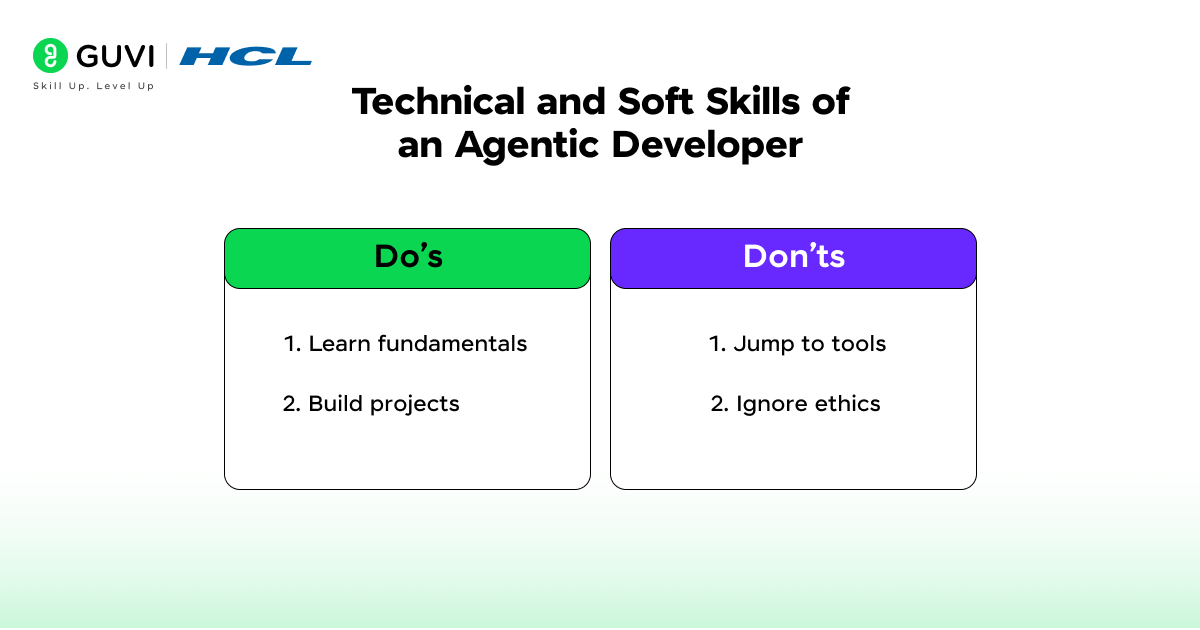
- Neglecting fundamentals: Jumping into LangChain before you understand some of the Machine Learning basics.
- Lack of practice: Reading tutorials instead of actually working on your own projects.
- Skipping ethics: Considering data privacy, bias, and a sense of responsible usage.
- Focusing on tools only: Lots of tools change, but problem-solving will last forever.
The Future is Agentic: What Lies Ahead?
The field is moving at lightning speed. The Agentic AI Developer of tomorrow will be working on even more exciting frontiers:
- Agent-Swarms: Coordinating hundreds or thousands of agents, which may be simple, to solve large-scale problems such as simulating economic markets or optimizing a global logistics network.
- Embodied Agents: Moving from the digital domain to the physical one, developing AI that can direct robots, autonomous vehicles, and smart homes with high fidelity and autonomy.
- Self-Improving Systems: Building agents whose primary purpose is to improve their own code, prompts and architecture, thus accelerating the pace of AI development itself.
- Governance and Ethics: As agents become more para-social or bonded to people, the new role will be to design AI constitution, democratic voting systems for agent swarms, and auditing all agent activity with transparency.
If you are enthusiastic about the future of AI and want to cultivate the skills to develop intelligent, autonomous agents, now is your chance. HCL GUVI’s AI & ML Course co-certified by IITM Pravartak), will help you learn everything from Python and Machine Learning to advanced LLM frameworks, in a comprehensive way, with practical projects and mentorship from trained experts.
Wrapping It Up…
So, who is an Agentic AI Developer?
They are a systems architect, a prompt whisperer, a tool-wielder, and an ethical steward. They are the intermediary, from the unbridled potential of Large Language Models to the commencement of an operational AI agent that can change the world. They are not just writing software, but rather creating intelligent, proactive co-agents to enhance human capability in manners we are beginning to see.
If you are a developer excited by the possibilities of AI, the Agentic AI Developer path is one of the most fulfilling paths you can pursue. It is a combination of technical capabilities, creativity, and a big dose of responsibility. It begins simply with a change in thinking: stop thinking about what your code should be doing, and start thinking about what you want your AI agent to be.
The future is not going to be written line-by-line, it will be conducted goal-by-goal by the agentic AI developer of vision. That future is being built today.
FAQs
1. Is a Computer Science degree a requirement to be an Agentic AI Developer?
No, you only need strong coding experience and an interest in AI. Many people come from non-CS backgrounds and learn through doing projects and courses.
2. What’s the difference between an AI Engineer and an Agentic AI Developer?
AI Engineers build and train models, while Agentic AI Developers turn those models into autonomous agents.
3. Do I need advanced math skills?
The only math skills needed for each project are the basics (probability, statistics, linear algebra). The math becomes somewhat complex, but most frameworks will handle that for you.
4. What beginner projects can I work on?
Beginners should work on small projects like a simple bot that automates tasks, an email assistant, or a chatbot to help students study.
Success Stories

About the Author
Vishalini Devarajan
An Aerospace Engineer turned content writer, I focus on making complex concepts easy to understand through well-structured, reader-friendly blogs. Whether it’s a technical topic or a non-technical one, I love creating content that is clear, engaging, and impactful.
View all posts by Vishalini Devarajan
Connect with me @












Did you enjoy this article?