


Artificial Intelligence and Machine Learning Articles
Finance Manager to Data Analytics: Career Growth, Salary and Seniority
How to Evaluate LLM Outputs in Production Deployments
AI/ML Skills Gap 2026: Why Companies Can't Find Job-Ready Talent
20 AI/ML Interview Questions Recruiters Can Use Without a Tech Background - Best Guide


Get In Touch For Details! Request More Information
Agent Memory Systems: Short-Term vs Long-Term
Sep 07, 2026 3 Min Read 208 Views
(Last Updated)
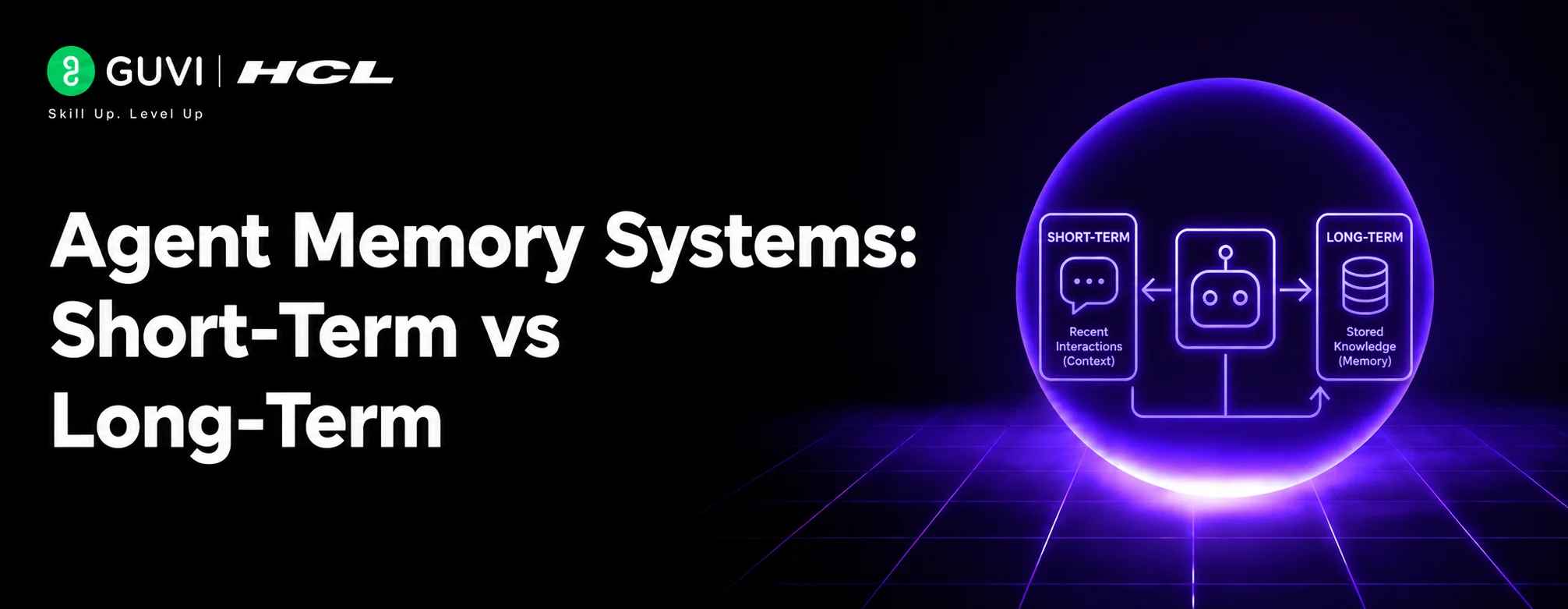
AI agents often need memory to maintain context, remember previous interactions, and make better decisions over time. AI Agent Memory Systems help agents store and retrieve information during and across conversations. Short-term memory supports immediate context, while long-term memory allows useful information to persist beyond a single interaction. This guide explains how both types work and how they support intelligent AI agents.
Table of contents
- TL;DR
- Direct Answer
- Why Memory Matters for AI Agents
- What Is Short-Term Memory?
- What Is Long-Term Memory?
- Short-Term vs Long-Term Memory
- Short-Term Memory
- Long-Term Memory
- How AI Agent Memory Works
- Step 1: Receive Information
- Step 2: Determine What Matters
- Step 3: Store the Information
- Step 4: Retrieve Relevant Memory
- Step 5: Use the Retrieved Context
- Common Applications
- Personal AI Assistants
- Customer Support
- Autonomous Agents
- Recommendation Systems
- Benefits of AI Agent Memory Systems
- Better Context
- Personalization
- Task Continuity
- Improved Efficiency
- When Should You Use Short-Term and Long-Term Memory?
- Short-Term Memory
- Long-Term Memory
- Combined Memory
- Key Concepts to Remember
- A Practical Agent Memory Workflow
- Capture Information
- Classify the Information
- Store Memory
- Retrieve Relevant Memories
- Add Context
- Update Memory
- Real-World Applications
- Personal Assistants
- Customer Support
- Autonomous Agents
- Recommendation Systems
- Best Practices
- Conclusion
- FAQs
- What are AI Agent Memory Systems?
- What is short-term memory in AI agents?
- What is long-term memory?
- Why do AI agents need memory?
- Can an AI agent use both memory types?
- Should agents store everything?
- How can AI agent memory be improved?
TL;DR
- AI agents use memory to maintain useful context.
- Short-term memory handles current interactions.
- Long-term memory stores information for future use.
- Different memory types serve different purposes.
- Effective memory improves agent continuity and personalization.
Direct Answer
| AI Agent Memory Systems allow AI agents to retain and retrieve information needed for their tasks. Short-term memory maintains context within an active interaction, while long-term memory stores useful information that can be retrieved later. Combining both allows agents to understand ongoing conversations while also retaining relevant knowledge, preferences, and past experiences across interactions. |
Why Memory Matters for AI Agents
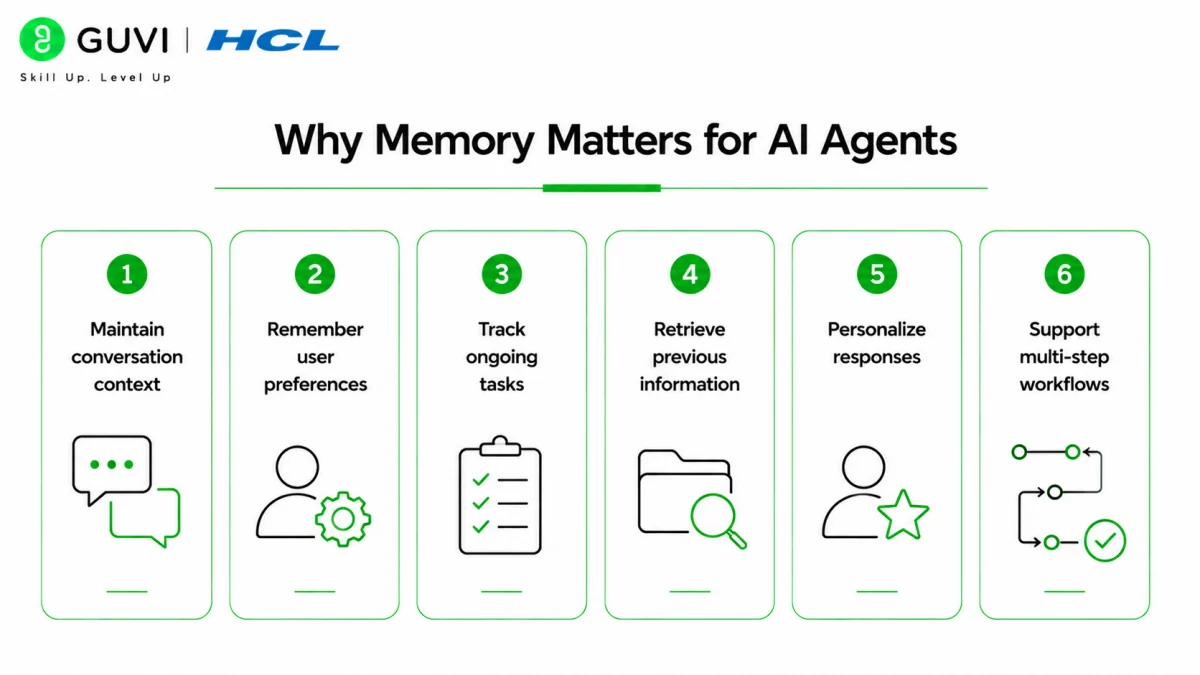
Without memory, an AI agent may treat every interaction as an isolated event. Memory allows an agent to use relevant information from previous steps or interactions.
Memory can help agents:
- Maintain conversation context
- Remember user preferences
- Track ongoing tasks
- Retrieve previous information
- Personalize responses
- Support multi-step workflows
What Is Short-Term Memory?
Short-term memory stores information needed during the agent’s current task or conversation.
It can include:
- Recent user messages
- Current task details
- Previous tool results
- Intermediate reasoning context
- Recent actions
For example, while helping a user plan a trip, an agent may temporarily retain the destination, dates, and preferences discussed earlier in the conversation.
What Is Long-Term Memory?
Long-term memory stores information that may remain useful beyond the current interaction.
Examples include:
- User preferences
- Important past interactions
- Persistent facts
- Previous task outcomes
- Frequently used information
Long-term memory is typically stored outside the immediate conversation context and retrieved when relevant.
Short-Term vs Long-Term Memory
Short-Term Memory
Short-term memory focuses on what the agent needs right now.
It is useful for:
- Maintaining conversational context
- Completing multi-step tasks
- Tracking temporary information
- Coordinating immediate actions
Long-Term Memory
Long-term memory focuses on information that may be useful later.
It is useful for:
- Personalization
- Persistent preferences
- Historical context
- Repeated workflows
- Cross-session continuity
How AI Agent Memory Works
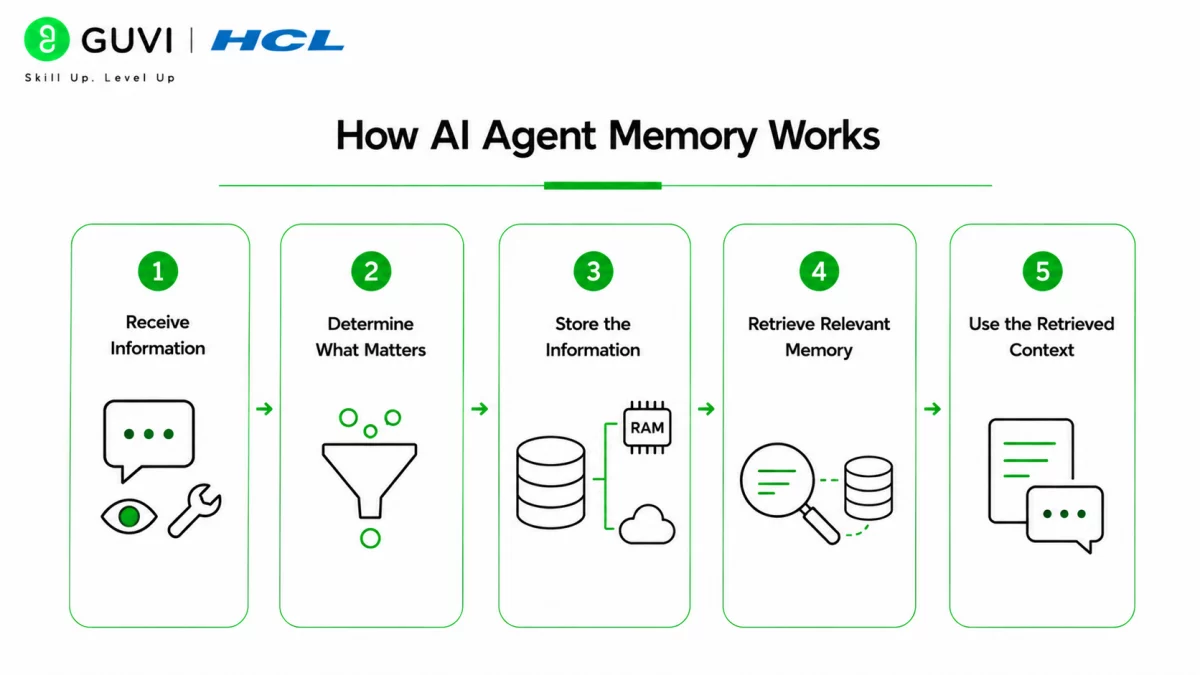
A basic memory workflow can follow these steps.
Step 1: Receive Information
The agent receives messages, observations, tool results, or other relevant information.
Step 2: Determine What Matters
The system identifies information that should remain available for the current task or future interactions.
Step 3: Store the Information
Temporary information can remain in the active context, while persistent information can be stored in an external memory system.
Step 4: Retrieve Relevant Memory
When needed, the agent searches its stored memory for information related to the current task.
Step 5: Use the Retrieved Context
Relevant memories are added to the agent’s working context so it can make informed decisions or responses.
Common Applications
Personal AI Assistants
Remember useful preferences and recurring tasks across interactions.
Customer Support
Retrieve previous customer interactions to provide more consistent assistance.
Autonomous Agents
Maintain task history and relevant information while completing multi-step workflows.
Recommendation Systems
Use previous interactions and preferences to personalize recommendations.
More memory does not automatically make an agent better. Relevant memory is more useful than excessive memory. Poorly selected or outdated memories can introduce irrelevant information and negatively affect an agent’s responses.
Benefits of AI Agent Memory Systems
Better Context
Agents can maintain relevant information across multi-step interactions.
Personalization
Long-term memory can help agents tailor interactions based on useful historical information.
Task Continuity
Agents can resume workflows without starting from scratch.
Improved Efficiency
Retrieving relevant previous information can reduce repeated questions and actions.
When Should You Use Short-Term and Long-Term Memory?
AI Agent Memory Systems should use different memory types depending on how long information needs to remain available and how relevant it is to the agent’s task.
Short-Term Memory
Use short-term memory when the agent needs information during an active task.
Examples include:
- Current conversation context
- Temporary task details
- Recent tool results
- Intermediate workflow information
Long-Term Memory
Use long-term memory when information may be useful across future interactions.

Examples include:
- User preferences
- Persistent facts
- Previous task outcomes
- Frequently used information
Combined Memory
Many AI agents can use both types together. Short-term memory handles the current interaction, while long-term memory provides relevant historical context when needed.
Professionals interested in AI agents, generative AI, and intelligent automation can strengthen their expertise through HCL GUVI’s Artificial Intelligence and Machine Learning Course.
Key Concepts to Remember
- Short-term memory maintains immediate context.
- Long-term memory stores information for future retrieval.
- Memory should contain relevant information rather than everything an agent encounters.
- Retrieval allows agents to access stored information when needed.
- Memory can improve personalization and task continuity.
- Outdated or irrelevant memories can reduce response quality.
A Practical Agent Memory Workflow
A basic memory system can follow these steps:
1. Capture Information
Collect relevant messages, observations, tool results, and task information.
2. Classify the Information
Determine whether information is temporary or likely to remain useful.
3. Store Memory
Keep temporary information in the active context and persistent information in an appropriate long-term storage system.
4. Retrieve Relevant Memories
When a new task begins, search stored memories for information relevant to the current request.
5. Add Context
Provide useful retrieved memories to the agent alongside the current task.
6. Update Memory
Add important new information and update or remove memories when they become outdated.
Real-World Applications
Personal Assistants
Remember useful preferences and recurring information across conversations.
Customer Support
Retrieve previous customer interactions to provide more consistent assistance.
Autonomous Agents
Maintain task history while completing complex, multi-step workflows.
Recommendation Systems
Use previous interactions and preferences to personalize recommendations.
The HCL GUVI’s Artificial Intelligence eBook introduces artificial intelligence, machine learning, generative AI, and intelligent automation concepts, helping learners understand modern AI technologies and intelligent systems.
Best Practices
- Store only information that has future value.
- Keep short-term context focused on the current task.
- Retrieve long-term memories only when relevant.
- Update outdated information.
- Avoid storing unnecessary sensitive information.
- Test whether retrieved memories actually improve the agent’s task.
- Monitor memory quality as the agent evolves.
Conclusion
AI Agent Memory Systems help agents maintain context and use relevant information beyond individual interactions. Short-term memory supports immediate tasks, while long-term memory provides persistent context across sessions. Combining both can improve continuity, personalization, and task completion. However, effective memory depends on selecting relevant information, retrieving it appropriately, and keeping stored memories accurate and useful.
FAQs
1. What are AI Agent Memory Systems?
AI Agent Memory Systems allow agents to store and retrieve information that helps them maintain context, complete tasks, and personalize future interactions.
2. What is short-term memory in AI agents?
Short-term memory stores information needed during the agent’s current conversation or task, such as recent messages, temporary details, and tool results.
3. What is long-term memory?
Long-term memory stores information that can remain useful across future interactions, such as preferences, persistent facts, and previous task outcomes.
4. Why do AI agents need memory?
Memory helps agents maintain context, avoid repeatedly requesting the same information, personalize interactions, and continue multi-step tasks more effectively.
5. Can an AI agent use both memory types?
Yes. Short-term memory can manage immediate context while long-term memory provides relevant historical information when needed.
6. Should agents store everything?
No. Storing excessive or irrelevant information can make retrieval less useful. Memory systems should prioritize information that is relevant and likely to provide future value.
7. How can AI agent memory be improved?
Memory quality can be improved by storing relevant information, using effective retrieval, updating outdated memories, removing unnecessary information, and evaluating whether retrieved memories actually help the agent.
Success Stories

About the Author
HCL GUVI
This article was selected and published as part of the HCL GUVI AI Blogathon 2026, an initiative designed to encourage students, AI enthusiasts, and aspiring tech writers to simplify complex AI concepts through impactful technical content. The contest recognized high-quality, original, and insightful AI-focused blogs, with selected authors receiving publication opportunities on the HCL GUVI blog platform along with official author credits and recognition.
View all posts by HCL GUVI
Connect with me @








Did you enjoy this article?