


Full Stack Development Articles
Claude for Architecture and Engineering Documentation
Freelancing as a Python Developer: Getting Your First Client


Get In Touch For Details! Request More Information
Modern PHP Architecture: How Developers Are Building Scalable Apps in 2026
Jan 30, 2026 3 Min Read 1840 Views
(Last Updated)
Modern PHP architecture has undergone significant changes as web applications increasingly demand better scalability, performance, and long-term stability. In 2026, developers are no longer writing simple PHP scripts; instead, they are designing structured systems that can grow with users and traffic.
This blog explains how modern PHP architecture works today, the patterns developers follow, and how scalable PHP applications are built in real projects. It is written for beginners, backend developers, and anyone exploring PHP’s role in modern web development.
Quick Answer
Modern PHP architecture focuses on clean code structure, scalable design patterns, and framework-driven development. Developers rely on layered architecture, APIs, and cloud-friendly workflows to build scalable PHP applications. This approach helps PHP remain relevant and reliable in 2026.
Table of contents
- What Is PHP Architecture?
- How Modern PHP Architecture Has Evolved
- From Monolithic Files To Modular Structure
- Adoption Of MVC And Layered Architecture
- Standardization And Clean Code Practices
- Core Building Blocks Of Modern PHP Architecture In 2026
- Framework-Driven Development
- API-First Application Design
- Performance And Caching Strategies
- How Developers Are Building Scalable Apps Using Modern PHP In 2026
- Using Frameworks As The Foundation
- Applying Layered And Modular Architecture
- Building API-Driven PHP Backends
- Optimizing Performance With Caching And Background Processing
- Deploying PHP Applications In Scalable Environments
- 💡 Did You Know?
- Conclusion
- FAQs
- Is modern PHP architecture suitable for large applications?
- Which frameworks support modern PHP architecture best?
- Can PHP applications scale in cloud environments?
- Does modern PHP architecture support APIs?
- Should beginners learn architecture concepts early?
What Is PHP Architecture?
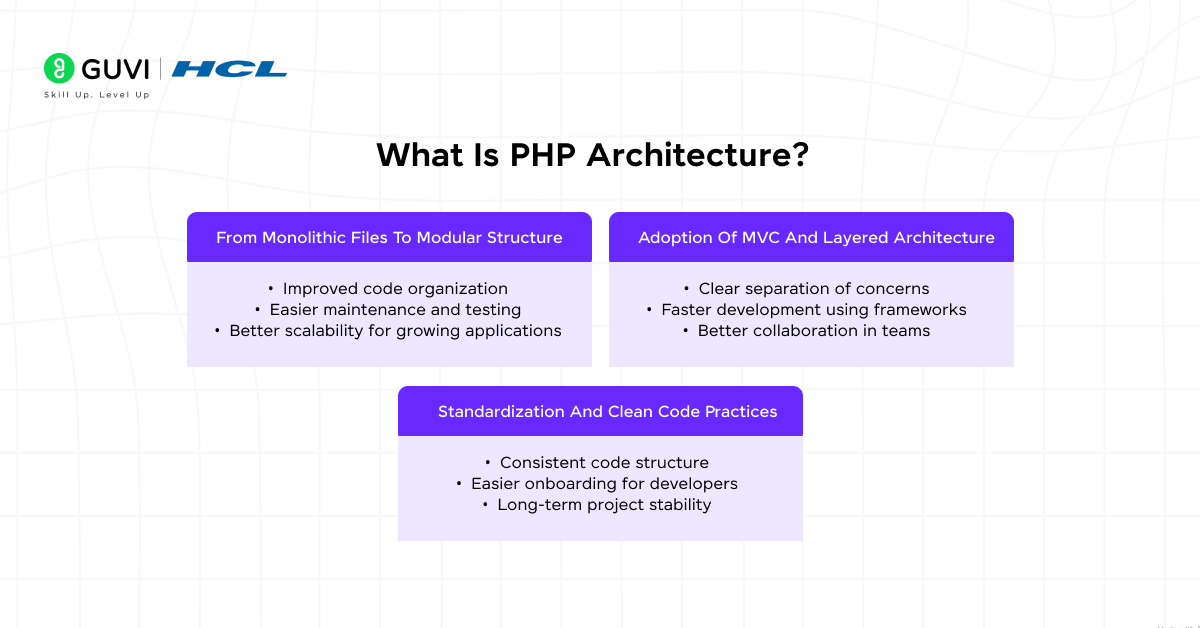
PHP architecture refers to how a PHP application is structured and organized to handle requests, business logic, and data efficiently. Modern PHP architecture focuses on separating code into clear layers so applications are easier to maintain and scale.
In modern PHP architecture, developers divide applications into controllers, services, and data layers, ensuring each part has a specific responsibility. This structured approach improves performance, readability, and long-term stability as applications grow.
How Modern PHP Architecture Has Evolved
Before deciding how PHP applications scale today, it is important to understand how modern PHP architecture evolved from basic scripting to structured application design. In this section, we will look at the key architectural shifts that shaped PHP development.
1. From Monolithic Files To Modular Structure
Early PHP applications mixed logic, database queries, and HTML in single files, which made maintenance difficult. Modern PHP architecture separates responsibilities into controllers, services, and data layers, making applications easier to scale and manage.
Key Points
- Improved code organization
- Easier maintenance and testing
- Better scalability for growing applications
2. Adoption Of MVC And Layered Architecture
PHP frameworks introduced MVC as a standard approach in modern PHP architecture. This separation allows developers to handle business logic, data access, and presentation independently.
Key Points
- Clear separation of concerns
- Faster development using frameworks
- Better collaboration in teams
3. Standardization And Clean Code Practices
Modern PHP architecture follows PSR coding standards to ensure consistency and readability. These standards help large teams maintain scalable applications over time.
Key Points
- Consistent code structure
- Easier onboarding for developers
- Long-term project stability
Core Building Blocks Of Modern PHP Architecture In 2026
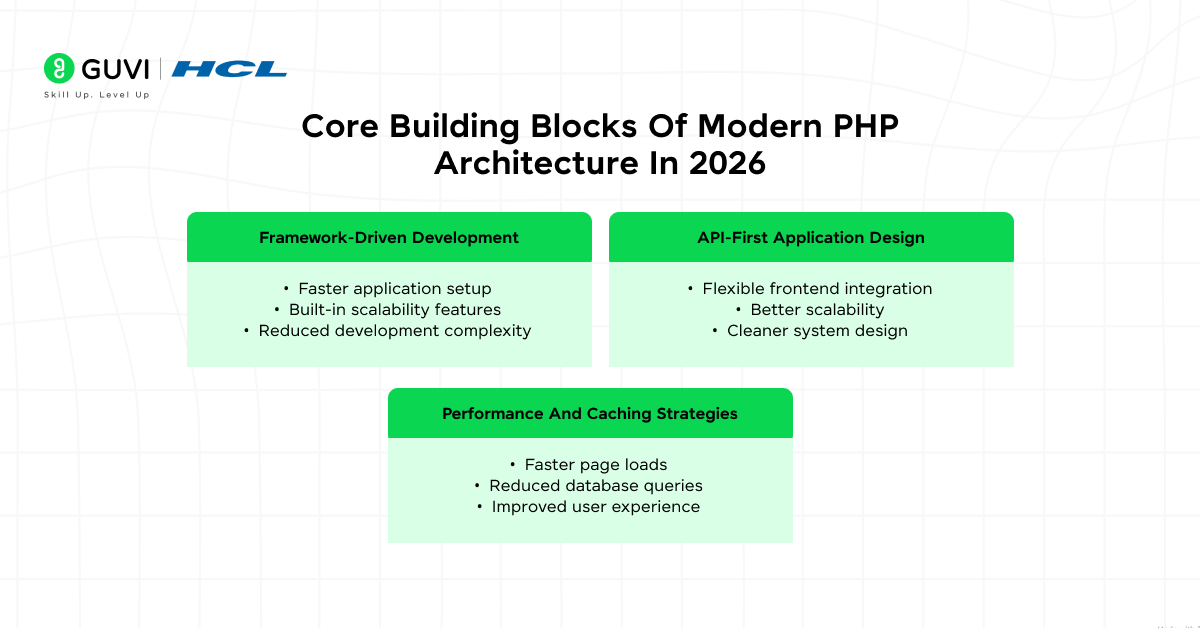
Scalable applications depend on strong architectural foundations rather than individual tools. This section explains the essential components developers use when implementing modern PHP architecture.
1. Framework-Driven Development
Frameworks like Laravel and Symfony provide built-in tools that support scalable PHP architecture. They handle routing, dependency injection, caching, and background jobs efficiently.
Key Points
- Faster application setup
- Built-in scalability features
- Reduced development complexity
2. API-First Application Design
Modern PHP architecture often treats PHP as a backend API instead of rendering full pages. This allows PHP to support web apps, mobile apps, and third-party integrations from a single backend.
Key Points
- Flexible frontend integration
- Better scalability
- Cleaner system design
3. Performance And Caching Strategies
Caching plays a major role in modern PHP architecture. Developers use tools like OPcache and in-memory stores to reduce server load and improve response times.
Key Points
- Faster page loads
- Reduced database queries
- Improved user experience
If you want a structured way to learn PHP and understand modern PHP architecture, do check out the HCL GUVI Web Development PHP course. This course teaches you how to build dynamic web applications, work with databases, and implement core backend logic using PHP with hands-on practice. It helps you strengthen fundamentals and prepares you to build scalable server-side applications just like the ones discussed in this blog.
How Developers Are Building Scalable Apps Using Modern PHP In 2026
In 2026, developers use modern PHP architecture to ensure applications remain fast, stable, focused on PHP security, and easy to scale as traffic and features grow. This section explains the key practices developers follow to build scalable PHP applications using proven architectural approaches.
1. Using Frameworks As The Foundation
Modern PHP frameworks provide a strong base that supports scalability from the start. Developers rely on these frameworks to maintain structure and consistency as applications grow.

Key Points
- Structured Codebase: Frameworks enforce a clean and organized project structure.
- Built-In Scalability Tools: Routing, dependency injection, and caching are available out of the box.
- Maintainability: Large codebases are easier to manage and update over time.
2. Applying Layered And Modular Architecture
Layered architecture helps developers isolate responsibilities and scale individual parts of an application independently. This approach is central to modern PHP architecture.
Key Points
- Separation Of Concerns: Controllers, services, and data layers handle specific roles.
- Reusability: Business logic can be reused across multiple features or services.
- Scalable Growth: New features can be added without breaking existing functionality.
3. Building API-Driven PHP Backends
Many PHP applications in 2026 function as backend APIs rather than full page renderers. This makes scaling and integration easier across platforms.
Key Points
- Multi-Platform Support: One PHP backend can power web, mobile, and external apps.
- Performance Efficiency: APIs reduce unnecessary processing and response size.
- Flexible Architecture: Frontends can evolve independently of the backend.
4. Optimizing Performance With Caching And Background Processing
Performance optimization is essential for scalability. Developers use caching and background tasks to keep applications responsive under heavy load.
Key Points
- Caching Layers: Frequently accessed data is stored for faster retrieval.
- Background Jobs: Time-consuming tasks run asynchronously without blocking users.
- Traffic Handling: Applications remain stable during high-traffic periods.
5. Deploying PHP Applications In Scalable Environments
Modern PHP architecture is designed to work smoothly with scalable hosting and deployment setups. Developers plan deployments with growth in mind.
Key Points
- Scalable Infrastructure: Applications can handle increasing users without redesign.
- Consistent Environments: Development and production environments stay aligned.
- Reliable Performance: Applications remain stable as demand increases.
If you want a hands-on space to practice PHP fundamentals before moving into modern architecture, do check out the HCL GUVI PHP Tutorial Hub. It provides interactive lessons and practical exercises that help you understand core concepts like syntax, functions, loops, and basic backend logic. Using this tutorial hub regularly can build your confidence and make learning scalable PHP architecture much easier.
💡 Did You Know?
- Some modern PHP apps can stay “awake” in memory, so page loads are faster because PHP does not start from scratch every time.
- PHP can quietly power large applications in the background while the frontend uses frameworks like React or Vue.
- Many developers think PHP is old-school, but modern PHP applications can scale just as smoothly as newer backend technologies.
Conclusion
Modern PHP architecture in 2026 focuses on scalability, clean design, and real-world performance. Developers now build PHP applications as structured systems that can evolve with growing business needs.
By learning modern PHP architecture, developers gain strong backend fundamentals that apply across technologies. With the right patterns and practices, PHP continues to be a reliable choice for building scalable applications.
FAQs
1. Is modern PHP architecture suitable for large applications?
Yes, modern PHP architecture is designed to handle large-scale applications with proper structure and tooling.
2. Which frameworks support modern PHP architecture best?
Laravel and Symfony are widely used for building scalable PHP applications.
3. Can PHP applications scale in cloud environments?
Yes, PHP works well with cloud platforms and containerized deployments
4. Does modern PHP architecture support APIs?
API-first design is a common approach in modern PHP architecture.
5. Should beginners learn architecture concepts early?
Beginners should start with PHP basics and gradually learn architecture to build scalable applications effectively.
Success Stories

About the Author
Jebasta
I translate the language of data into stories that anyone can understand. As a writer with a data science background, I simplify analytics, AI, and decision-making so beginners and enthusiasts can confidently explore the world of data.
View all posts by Jebasta
Connect with me @






























Did you enjoy this article?