


Full Stack Development Articles
Claude for Architecture and Engineering Documentation
Freelancing as a Python Developer: Getting Your First Client

Get In Touch For Details! Request More Information
Just Connect React to Express: The Shallow Knowledge Trap
Feb 23, 2026 4 Min Read 1212 Views
(Last Updated)
Surface-level knowledge, in other words, a lack of in-depth understanding in any particular field or domain, results in inefficiency and performance degradation. In conversation, we sometimes encounter people who are very articulate at conveying their ideas and explaining things with fancy words.
But if you are a highly competent professional who prefers hands-on experience over just flexing theoretical knowledge, you can clearly see that these individuals are just good at expressing shallow-level knowledge; they never delve into the intricacies of the topics.
Similarly, a beginner just starting their journey to becoming a full-stack developer (MERN stack) sometimes develops the misconception that simply connecting React to Express makes them an end-to-end web developer.
However, in reality, this is not the case; this integration process is just the starting point, or, you could say, the stepping stone. Now that you’ve gotten a reality check, let’s explore all the essential sections on this topic.
Note:
MERN stands for MongoDB (database), Express.js (backend framework), React (frontend library), and Node.js (runtime environment)
Quick Answer:
Connecting React to Express can become a knowledge trap, leading beginners to believe they have learned full-stack development when they have only learned the basics. Data passing between the frontend and backend looks impressive, but it ignores critical skills like backend design, security, validation, databases, and scaling, which actually matter in real-world development.
Transform your web development journey by learning from our free JavaScript eBook course, which is beginner-friendly and provides you with expert insights: JS eBook
Table of contents
- Possible Reasons Why Developers Get Stuck After Connecting React to Express
- Lack of Backend Fundamentals
- Weak Understanding of Databases
- No Knowledge of Authentication and Authorization
- Poor Error-Handling Practices
- Ignoring Security Concepts
- Over-Reliance on Tutorials
- No Exposure to Real-World Project Structure
- Fear of Breaking Things Beyond Basic Setup
- How to Move Beyond React to Express and Break the Knowledge Trap
- Connection Isn’t Completion
- Feature-Based Learning
- Backend-First Thinking
- API Failure Handling
- Tutorial Independence
- User-Flow Thinking
- Learning Through Debugging
- Conclusion
- FAQs
- Is connecting React to Express enough to become a full-stack developer?
- Why does connecting the frontend and backend feel like a significant achievement?
- How can beginners avoid this shallow knowledge trap?
Possible Reasons Why Developers Get Stuck After Connecting React to Express
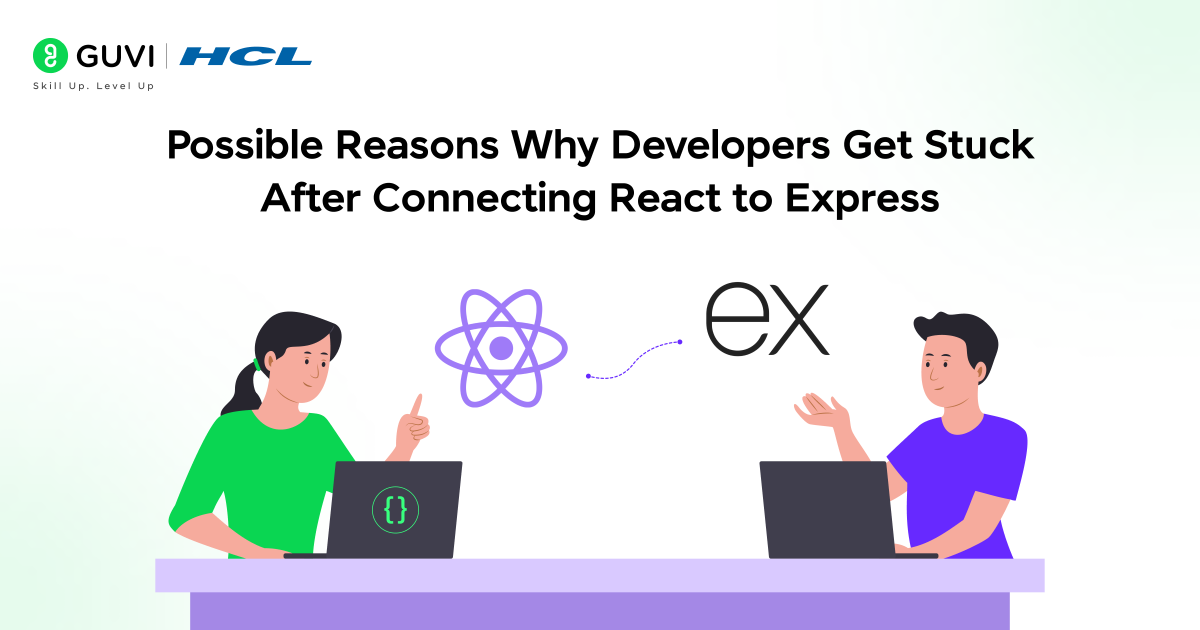
Full-stack developers go beyond just connecting React to Express. The connection process can be completed within a few minutes if you are already well-acquainted with the basics, such as sending a simple request and receiving a response from the backend.
But the real-world applications are very complex and advanced; they have a full-fledged system architecture with components such as servers, databases, API layers, load balancers, etc. These software applications and platforms must be flexible and scalable, and to achieve these objectives, full-stack developers need proficiency in handling logic, security, data flow, errors, and scalability.
At first, it might seem to be a great accomplishment, which is not wrong. Still, if that feeling persists for an extended period, it clearly shows that you are not sufficiently optimistic to handle the challenging aspects of software development, such as proper backend logic, secure authentication, clean database design, error handling, performance optimization, and deployment.
That’s why it’s called a shallow knowledge trap, because you are calling yourself skilled at a stage where you are just beginning.
Here are possible reasons why individuals are unable to go beyond:
1. Lack of Backend Fundamentals
Many developers put a lot of emphasis on the frontend and consequently overlook essential backend concepts such as request lifecycle, middleware flow, controllers, and services. If you do not understand how the backend fetches data, it will be a mystery to you as your app grows.
Such a difference is often implied in software related to the backend, like Node.js, Express.js, or any other framework that needs strict separation of logic. Postman (API testing tool) is one of the tools that can reveal such faults when APIs do not work as expected.
2. Weak Understanding of Databases
Usually, beginners can save and retrieve data but fail to grasp the concepts of relationships, indexing, or data normalization. As a result, their queries are slow, data is duplicated, and their database structures are messy.
This issue is very noticeable if one is using MongoDB or PostgreSQL (database systems), in particular when one is writing complex queries or handling large datasets using MongoDB Compass (database GUI tool).
Also Read: Top 7 Reasons To Learn MongoDB!
3. No Knowledge of Authentication and Authorization
Many applications can function without login systems; hence, developers sometimes postpone learning authentication. But after some time, it gets too overwhelming for them to add user roles, permissions, and protected routes.
This usually takes place when developers use tools such as JWT (an authentication method), bcrypt (a password hashing library), or Passport.js (an authentication middleware) without having a clear understanding of how sessions, tokens, and access control work.
4. Poor Error-Handling Practices
Errors are often overlooked or handled with standard messages; as a result, debugging becomes quite challenging. When a failure occurs, developers have no clue where or why it happened.
This is quite clear, especially when one is using Express.js error middleware or logging tools like Winston (a logging library), where structured error handling is a must for real-world applications.
5. Ignoring Security Concepts
Security is often neglected because the application “functions well” during development. However, this results in security holes such as exposed APIs, weak passwords, or malicious inputs.
Problems arise when dealing with tools such as Helmet (security middleware), CORS (security policy), or environment variables managed with dotenv (configuration tool).
6. Over-Reliance on Tutorials
Following tutorials step by step brings fast results, but it doesn’t develop inventiveness in finding solutions. Developers often say that when things change even a little bit, they are unable to continue.

This is common when copying code involving React, Express, or MongoDB setups without understanding why each step exists, even when using platforms like GitHub (a code hosting platform).
7. No Exposure to Real-World Project Structure
Small demo apps show less of the reality of how projects are structured. Projects without a clear folder structure and proper separation of concerns are becoming increasingly challenging to manage.
This issue occurs when working in larger codebases using tools like Git (a version control system) and Jira (a task-tracking tool).
8. Fear of Breaking Things Beyond Basic Setup
A lot of developers hesitate to experiment due to the fear of errors or crashes. Consequently, they miss out on understanding system failures and recoveries.
This fear reduces hands-on learning with tools like Docker (a containerization tool) or deployment platforms like AWS (a cloud platform), where breaking and fixing things is part of real growth.
How to Move Beyond React to Express and Break the Knowledge Trap

Based on the above points, we recommend avoiding them to ensure a highly successful full-stack career. Now, in this section, we have listed down the seven (7) most effective pointers that you need to consider to break this knowledge trap.
1. Connection Isn’t Completion
Connecting React to Express is just a demonstration of how data can flow between the frontend and the backend. The actual understanding comes when you develop full-featured applications that include validation, business logic, database interaction, security checks, and correct responses.
2. Feature-Based Learning
Rather than learning different concepts separately, understanding features will help you see how various parts of an application interact with each other. This way of working with the system strengthens your understanding of the actual workflows rather than just technical steps.
3. Backend-First Thinking
Starting with backend logic lets you think about data structure, rules, and edge cases before the user interface (UI). Such a mindset leads to the creation of stable systems rather than taking shortcuts that are frontend-driven.
4. API Failure Handling
Real-world apps regularly fail. Hence, it is necessary to understand the scenarios in which APIs fail, systems experience technical issues, and security layers are weakened. Knowing the different ways in which a system can fail allows you to build more robust applications and gives you a sense of readiness when confronted with issues in the production environment.
5. Tutorial Independence
Moving on from tutorials to figuring things out on your own helps enhance your problem-solving skills and build your confidence. Having a bit of struggle and coming up with your own solutions results in a much deeper and longer-lasting understanding.
Also Read: Why YouTube Tutorials Aren’t Enough for Interview Success (And What Actually Works)
6. User-Flow Thinking
Considering how a user would navigate through the application helps uncover missing logic and hidden bugs. In this way, it becomes easier to link technical decisions to actual user behavior.
7. Learning Through Debugging
Debugging teaches how systems actually work under the hood. By tracing issues, reading logs, and fixing mistakes, developers gain practical knowledge that tutorials cannot provide.
42.8% of developers use React and 48.6% use Node.js/Express, but simply connecting them isn’t enough to be a full-stack developer; skills in databases, security, and deployment are also required.
Unlock career guidance, hands-on projects, and expert-led learning—all in a single platform. Sounds exciting, right? If you’re ready to level up your tech career, enroll in the IITM Pravartak Certified MERN Full Stack Development Course with AI Integration. Gain all the key technical skills and boost your chances of landing roles at leading product-based companies.
Conclusion
Connecting React to Express is an essential first step, but it should not be mistaken for real full-stack expertise. Actual growth comes from understanding what happens beyond that connection—how data is handled securely, how systems scale, and how real-world problems are solved. By looking past this shallow knowledge trap, beginners can build stronger foundations and move forward with confidence and clarity in their development journey.
FAQs
Is connecting React to Express enough to become a full-stack developer?
No, it is only the starting point. Real full-stack development requires understanding databases, authentication, security, error handling, and application architecture.
Why does connecting the frontend and backend feel like a significant achievement?
Because it delivers visible results quickly, creating a sense of progress, even though most real-world challenges remain untouched.
How can beginners avoid this shallow knowledge trap?
By going deeper into backend logic, learning how real applications handle users and data, and focusing on fundamentals instead of just quick results.
Success Stories


























Did you enjoy this article?