


Data Science Articles
Accountant to Data Analyst: Skills, Roadmap and Career Path (2026)
SQL for customer support executives: What to Learn and How to Practice
Accounting Team Lead to Data Analytics Skills and Roadmap
Can an Insurance Professional Become a Data Analyst Early in Their Career?


Get In Touch For Details! Request More Information

Lambda Architecture Explained: A Simple Guide for Beginners [2026]
Oct 07, 2026 6 Min Read 2848 Views
(Last Updated)
Every second, your phone, your bank, and your favourite shopping app generate a flood of data. Some of it needs an answer right now, like a fraud alert or a live order status. The rest needs to be accurate down to the last decimal, even if it takes hours to process.
For years, engineers had to pick one: speed or accuracy. Lambda Architecture was built on the idea that you don’t have to choose, by running a fast layer for real-time results alongside a slower batch layer for complete, accurate ones.
Quick Answer: Lambda Architecture is a data-processing framework that combines batch processing and stream processing to deliver both accurate and real-time results. It has three layers: the batch layer processes all historical data for accuracy, the speed layer processes incoming data instantly to minimize delay, and the serving layer merges both outputs so users can query them in one place.
Table of contents
- What is Lambda Architecture?
- Why it matters in big data
- Where it is used today
- The Three Layers of Lambda Architecture
- 1) Batch Layer: Historical data processing
- 2) Speed Layer: Real-time data processing
- 3) Serving Layer: Querying and combining results
- Tools Commonly Used in Lambda Architecture
- 1) Apache Hadoop and HDFS
- 2) Apache Spark and Storm
- 3) Apache Kafka and Cassandra
- 4) HBase for serving layer
- Pros and Cons of Lambda Architecture
- 1) Advantages:
- 2) Disadvantages:
- Lambda Architecture vs Kappa Architecture: What's the Difference?
- Lambda Architecture Interview Questions: What to Expect
- A fraud detection system needs instant alerts and accurate historical reports. Would you use Lambda Architecture? (Scenario-Based)
- Why can't the speed layer replace the batch layer? (Reasoning-Based)
- Why is the raw data kept immutable in the batch layer? (Concept-Based)
- What role does Kafka play in this setup? (Tool-Based)
- What problems come with maintaining two layers? (Trade-Off Based)
- When would you choose Kappa Architecture over Lambda Architecture? (Decision-Based)
- Conclusion
- FAQs
- What is Lambda Architecture?
- What are the three layers of Lambda Architecture?
- What is the difference between Lambda and Kappa Architecture?
- Which tools are used in Lambda Architecture?
- Is Lambda Architecture still used today?
What is Lambda Architecture?
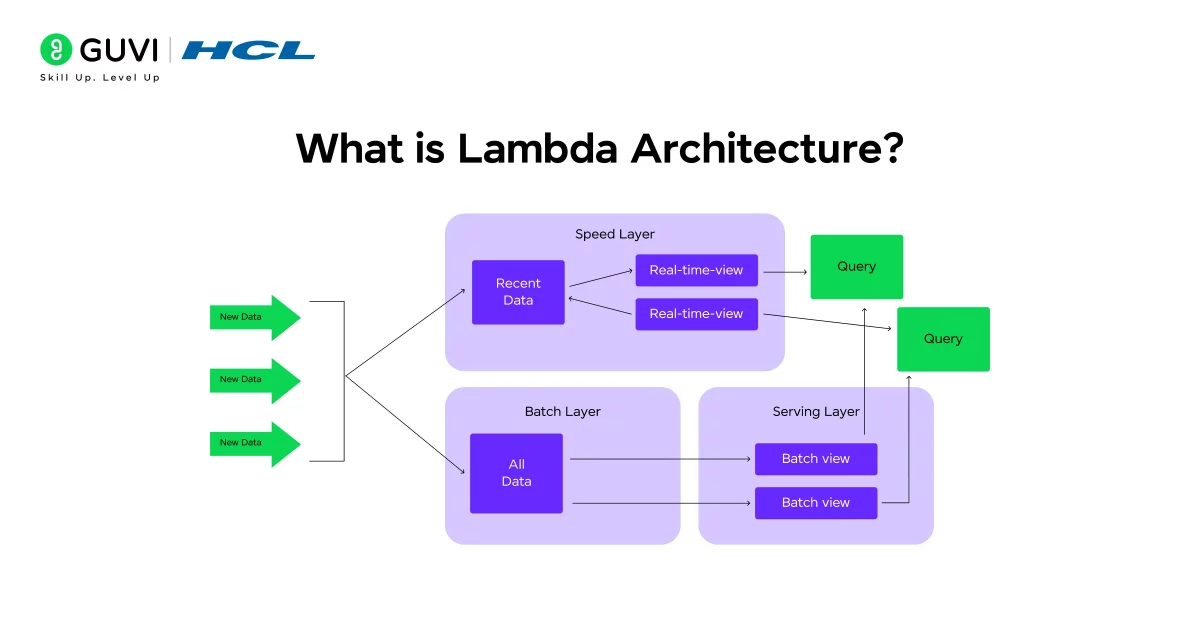
Lambda architecture is a data-processing framework that combines batch and stream-processing methods to balance latency, throughput, and fault tolerance. At its core, this architecture uses an append-only, immutable data source as the system of record.
The name “Lambda” was introduced by Nathan Marz, who initially called it the “batch/realtime architecture” in his blog post about overcoming the CAP theorem challenges. This hybrid approach consists of three fundamental layers:
- Batch Layer: Processes all available data for comprehensive accuracy
- Speed Layer: Handles real-time data streams for minimal latency
- Serving Layer: Responds to queries by combining results from both layers
This architecture also lets you preserve a complete historical record of your data alongside real-time processing, giving you the best of both worlds.
Data skills are in demand across every industry, and you can start building yours today. HCL GUVI’s Data Science Course gets you job-ready in 6 months, even if you have never written a line of code. Join live classes in English, Hindi, Telugu or Tamil, build 10+ projects, and earn an IITM Pravartak certification. With 1:1 doubt support, mock interviews, and placement assistance, you are never learning alone. Enroll today and build your future!
Why it matters in big data
Lambda architecture solves critical problems in the big data landscape. For instance, traditional batch processing systems excel at comprehensive data analysis but lack speed, whereas real-time processing sacrifices completeness for immediacy.
This architecture matters because:
- It enables real-time analytics while maintaining batch processing capabilities
- It creates a fault-tolerant system that guarantees data integrity
- It allows automatic scaling to meet fluctuating business demands
Above all, the Lambda architecture provides a solution for accessing real-time and near-real-time data, which is increasingly important as businesses strive to become more data-driven amid rapidly generated information.
Where it is used today
Lambda architecture has found practical applications across numerous industries. Many tech companies use this framework to process data for their most critical decisions and initiatives.
Notable use cases include:
- Financial systems: Processing transactions in real-time while analyzing historical patterns
- IoT environments: Managing sensor data from smart devices
- Real-time recommendation engines: Combining historical preferences with current behavior
Prominent examples include Metamarkets, which employs a version of lambda architecture using Druid for analytics in the programmatic advertising space. Similarly, Yahoo has implemented this approach for its advertising data warehouse using Apache Storm, Apache Hadoop, and Druid.
Despite its complexity and maintenance challenges, the lambda architecture remains an excellent choice when you need both real-time capabilities and comprehensive historical analysis.
The Three Layers of Lambda Architecture
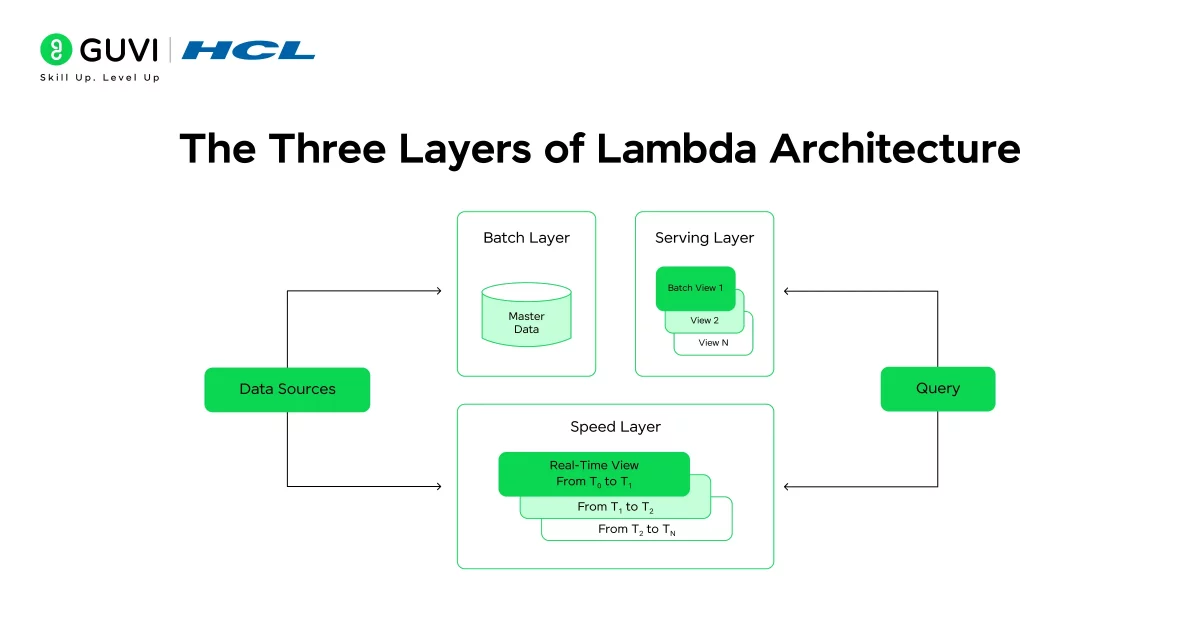
The power of lambda architecture lies in its three-layer approach to data processing, each serving a distinct purpose in the overall system. Together, these layers handle big data quickly and reliably.
1) Batch Layer: Historical data processing
The batch layer manages large volumes of historical data and processes it in groups. This layer:
- Handles complete datasets (both old and new) to provide a full, accurate view of your data
- Operates slowly but with high precision
- Stores raw data as immutable and append-only, creating a trusted historical record
- Runs on predefined schedules, typically once or twice daily
Common technologies in this layer include Apache Hadoop, Spark, Snowflake, and Amazon S3. The batch layer acts as the foundation of your data analysis, delivering comprehensive insights through pre-computed batch views.
2) Speed Layer: Real-time data processing
The speed layer complements the batch layer by processing data streams as they arrive. This layer:
- Processes incoming data immediately to minimize latency
- Handles real-time streams from IoT devices, social media, or financial transactions
- Fills the “gap” caused by the batch layer’s processing delay
- Creates real-time views that may be less accurate but are available instantly
Popular technologies for implementing the speed layer include Apache Kafka, Storm, Flink, and Spark Streaming. This layer ensures you have access to the latest information for time-sensitive decision-making.
3) Serving Layer: Querying and combining results
The serving layer bridges processed data and end users. This layer:
- Combines results from both the batch and speed layers into a unified view
- Indexes batch views for efficient querying on an ad-hoc basis
- Receives near real-time views from the speed layer and batch views from the batch layer
- Provides query capabilities for various applications and analytics tools
Notably, as the serving layer completes a new indexing job, it removes data previously handled by the speed layer. This coordination between layers ensures you have access to both comprehensive historical analysis and up-to-the-minute insights through a single interface.
Here are some interesting facts about the origins and evolution of Lambda Architecture that many beginners overlook:
1. The Concept Originated from Twitter: Nathan Marz developed the idea of Lambda Architecture while working at Twitter to handle massive real-time data streams efficiently.
2. The Name “Lambda” Isn’t About Math: Despite the name, it doesn’t directly reference the mathematical lambda (λ) symbol — it represents the architectural combination of batch and speed layers into one unified system.
3. It Inspired New Frameworks: Lambda Architecture later inspired the creation of Kappa Architecture, a simplified model proposed by Jay Kreps that eliminates the batch layer entirely.
These facts show how Lambda Architecture emerged from real-world scalability challenges and continues to shape modern big data design patterns today.
Tools Commonly Used in Lambda Architecture
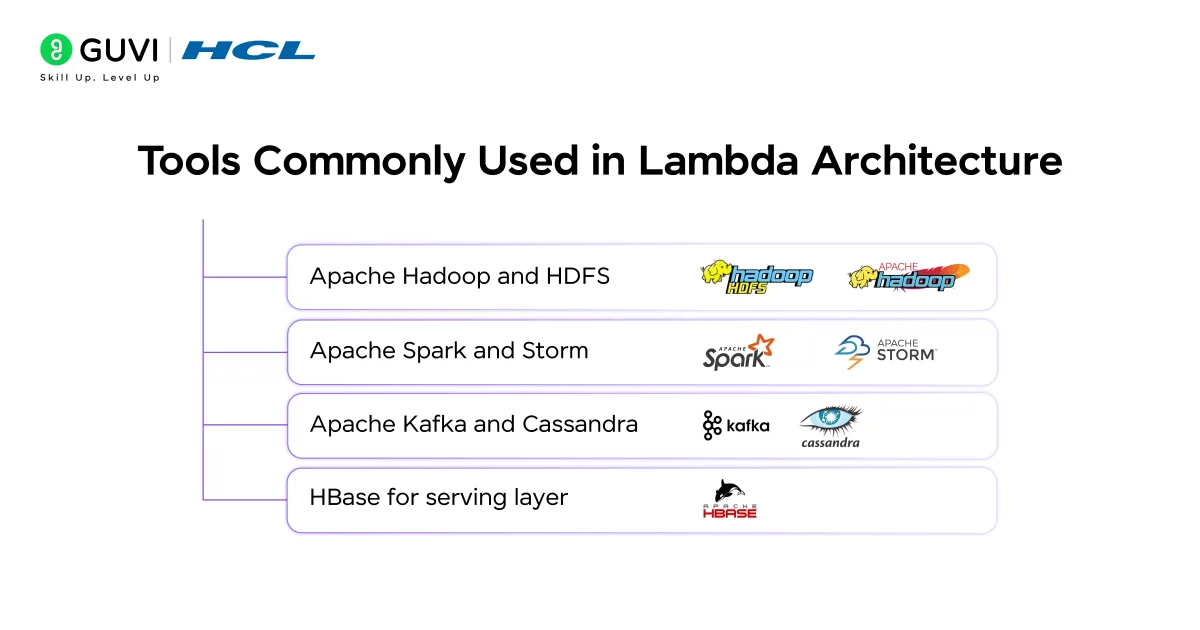
Implementing a successful lambda architecture requires specific technologies for each layer. Let’s examine the most popular tools that power this data processing framework.
1) Apache Hadoop and HDFS
Apache Hadoop emerged as a leading batch processing system by 2014. This highly scalable open-source framework excels at handling structured and unstructured data across computer clusters. Key components include:
- Hadoop Distributed File System (HDFS) – The most commonly used technology for storage in the batch layer, providing a resilient, append-only environment for your master dataset
- MapReduce – A programming paradigm that processes data in parallel, making it ideal for the batch layer’s historical data processing
Hadoop’s strength is its ability to scale from one server to hundreds while maintaining performance, though it processes data in batches rather than in real time.
2) Apache Spark and Storm
For real-time processing in the speed layer, two technologies stand out:
- Apache Spark processes data in memory and can be up to 100 times faster than Hadoop. It offers both batch and stream processing capabilities, allowing code sharing between layers. Spark Streaming divides input data streams into micro-batches for processing.
- Apache Storm, meanwhile, was the original speed layer technology suggested by Nathan Marz. Unlike Spark’s micro-batching approach, Storm processes each record individually, resulting in even lower latency for time-sensitive applications.
Also Read: Apache Storm vs Spark
3) Apache Kafka and Cassandra
a) Apache Kafka serves as the messaging backbone in the lambda architecture. This distributed pub-sub system:
- Ingests data from various sources (user activities, application logs, IoT sensors)
- Duplicates incoming data, sending copies to both batch and speed layers
- Allows message rewinding and replay in case of failures
b) Apache Cassandra typically stores the real-time views generated by the speed layer. This distributed database provides:
- Excellent write and read performance
- Linear scalability with no single point of failure
- Optimal storage for time-series data

4) HBase for serving layer
Apache HBase frequently powers the serving layer, where it:
- Stores and manages indexed data from both batch and speed layers
- Provides excellent read and write performance for real-time queries
- Handles large-scale data as part of the Hadoop ecosystem
Additionally, technologies like Apache Druid, Apache Pinot, ClickHouse and Tinybird offer single platforms that handle output from both layers, simplifying the architecture.
Pros and Cons of Lambda Architecture
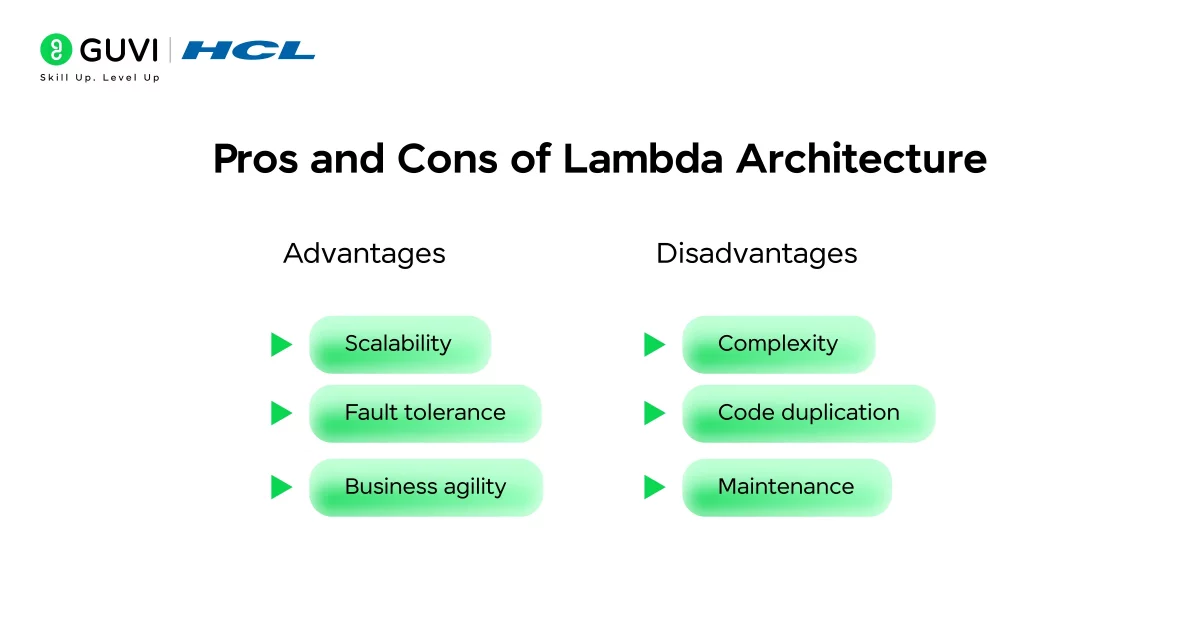
Every architectural approach comes with its own set of trade-offs. Lambda architecture offers compelling benefits alongside some significant challenges that you should consider before implementation.
1) Advantages:
Lambda architecture excels in several critical areas:
- Scalability: The framework scales horizontally at every layer by adding more nodes, making it suitable for any data volume.
- Fault tolerance: Because the batch layer preserves raw data as immutable, your system can recover from failures by reprocessing data, ensuring human fault tolerance as well.
- Business agility: The architecture allows you to react immediately to changing business scenarios through real-time processing.
- Flexibility: You can simultaneously analyze historical patterns and capture real-time insights, providing comprehensive data views.
- Automated high availability: Built-in redundancy ensures all requests receive responses, whether successful or not.
2) Disadvantages:
Alternatively, the lambda architecture presents several challenges:
- Complexity stands as the biggest drawback. Managing multiple layers with different technologies requires specialized skills across batch processing, streaming, and querying systems.
- Code duplication creates another significant hurdle. You’ll typically need to implement the same business logic twice—once for batch processing and once for real-time processing. This duplication increases both development effort and the risk of inconsistencies between layers.
- Maintenance becomes resource-intensive. Synchronizing batch and speed layers to ensure consistent results demands careful orchestration and ongoing monitoring. Organizations often need dedicated teams with specialized knowledge, increasing operational costs.
Indeed, these challenges have led some organizations to explore alternatives like kappa architecture, which aims to simplify the approach by using a single processing path.
Lambda Architecture vs Kappa Architecture: What’s the Difference?
Lambda Architecture uses two separate paths, a batch layer and a speed layer, while Kappa Architecture removes the batch layer and handles everything through a single processing path.
| Aspect | Lambda Architecture | Kappa Architecture |
|---|---|---|
| Processing paths | Two (batch and speed) | One |
| Batch layer | Yes | No |
| Layers involved | Three (batch, speed, and serving) | A single processing path |
| Historical data handling | A dedicated batch layer reprocesses the complete, immutable dataset | Handled through the same single path |
| Business logic | Written twice, once for batch and once for real-time | Written once |
| Complexity | Higher, with multiple layers and technologies to manage | Simpler |
| Maintenance | Batch and speed layers must be kept in sync | No layers to synchronize |
| Operational cost | Higher, as it often needs dedicated teams with specialized skills | Lower, as there is less to manage |
Lambda Architecture Interview Questions: What to Expect
Interviewers rarely ask for a plain definition of Lambda Architecture. They usually test whether you understand why it is built this way and when it makes sense to use it. Here are the kinds of questions to prepare for.
1. A fraud detection system needs instant alerts and accurate historical reports. Would you use Lambda Architecture? (Scenario-Based)
Yes, because the system needs both low latency and complete accuracy. The speed layer can flag suspicious transactions as they arrive, while the batch layer processes the full transaction history for accurate reports. The serving layer then lets both be queried together.
2. Why can’t the speed layer replace the batch layer? (Reasoning-Based)
The speed layer produces real-time views that are available instantly but may be less accurate. The batch layer works on the complete dataset and is the trusted, precise record. The speed layer fills the gap while the batch layer processes.
3. Why is the raw data kept immutable in the batch layer? (Concept-Based)
Because the raw data is append-only and never changed, the system can recover from failures or mistakes by simply reprocessing it. This also protects against human error, since the original data is always intact.
4. What role does Kafka play in this setup? (Tool-Based)
Kafka ingests data from sources like user activity, application logs, and IoT sensors, then sends copies to both the batch and speed layers. It also lets you rewind and replay messages if something fails.
5. What problems come with maintaining two layers? (Trade-Off Based)
The same business logic usually has to be written twice, once for batch and once for real-time, which adds development effort and the risk of inconsistent results. Keeping both layers in sync also needs careful monitoring and people with skills across batch, streaming, and querying systems.
6. When would you choose Kappa Architecture over Lambda Architecture? (Decision-Based)
When a simpler setup matters more. Kappa Architecture removes the batch layer and uses a single processing path, so you write the logic once and don’t have layers to keep in sync. Lambda Architecture is a better fit when you need real-time results and full historical analysis together.
Data skills are in demand across every industry, and you can start building yours today. HCL GUVI’s Data Science Course gets you job-ready in 6 months, even if you have never written a line of code. Join live classes in English, Hindi, Telugu or Tamil, build 10+ projects, and earn an IITM Pravartak certification. With 1:1 doubt support, mock interviews, and placement assistance, you are never learning alone. Enroll today and build your future!
Conclusion
Lambda Architecture solved the problem of getting both fast and accurate results from the same data system. By combining batch and real-time processing, it gives businesses a reliable way to work with large volumes of data without giving up speed or completeness. Many modern data systems still use ideas that come from Lambda Architecture, which makes it a valuable concept to understand.
FAQs
1. What is Lambda Architecture?
Lambda Architecture is a data-processing framework that combines batch and stream processing. Batch processing gives accurate results from all the data, and stream processing gives instant results from new data.
2. What are the three layers of Lambda Architecture?
The batch layer processes all historical data, the speed layer handles real-time data as it arrives, and the serving layer combines both results so they can be queried together.
3. What is the difference between Lambda and Kappa Architecture?
Lambda Architecture uses two paths, batch and speed, while Kappa Architecture removes the batch layer and uses a single processing path. This means Kappa needs the business logic written only once.
4. Which tools are used in Lambda Architecture?
Hadoop and HDFS are common in the batch layer, Spark, Storm, and Flink in the speed layer, Kafka for ingesting data, Cassandra for real-time views, and HBase for the serving layer.
5. Is Lambda Architecture still used today?
Yes. It still fits well for financial systems, IoT environments, and recommendation engines where real-time results and full historical analysis are both needed.
Success Stories










Did you enjoy this article?