


Artificial Intelligence and Machine Learning Articles
AI/ML Skills Gap 2026: Why Companies Can't Find Job-Ready Talent
20 AI/ML Interview Questions Recruiters Can Use Without a Tech Background - Best Guide
How Industry-Backed AI/ML Bootcamps Are Changing the AI/ML Hiring Pipeline - Best Guide 2026
From IT Support to AI Engineer: A Realistic Career Switch Guide 2026


Get In Touch For Details! Request More Information
What is the Minimax Algorithm? A Beginner’s Guide
Jul 21, 2026 10 Min Read 7064 Views
(Last Updated)
The Minimax Algorithm is a recursive decision-making rule used in two-player games, where one player tries to maximize their score while the other tries to minimize it. It works by building a game tree, a branching map of every possible move and countermove, then working backward from the end of the tree to pick the move that gives the best guaranteed outcome.
Have you ever wondered how IBM’s Deep Blue chess computer famously defeated world champion Garry Kasparov in 1997? The Minimax Algorithm was the key decision-making strategy behind this historic victory.
The Minimax Algorithm in artificial intelligence is a recursive program designed to make optimal decisions in two-player games like chess and tic-tac-toe. First formalized by John von Neumann in 1928, this cornerstone of game theory helps computers minimize potential losses while maximizing opportunities to win.
Table of contents
- TL;DR Summary
- What is the Minimax Algorithm?
- Origin in game theory and AI
- Why it's important in decision-making
- How the Minimax Algorithm Works
- Game tree and players (Max vs Min)
- Evaluating terminal states
- Backpropagating utility values
- Choosing the optimal move
- Minimax Step-by-Step Summary Table
- Minimax Algorithm in Artificial Intelligence
- 1) Use in two-player games like chess and tic-tac-toe
- 2) Handling perfect information scenarios
- Python Code: Minimax for Tic-Tac-Toe
- Minimax with Alpha-Beta Pruning - How It Makes Minimax Faster
- What is alpha-beta pruning?
- How it reduces computation
- When to use it
- Minimax in Chess Engines — Real-World Application
- Minimax Time and Space Complexity Analysis
- Strengths, Limitations, and Real-World Use Cases of the Minimax Algorithm
- 1) Advantages: optimality and clarity
- 2) Limitations: complexity and depth
- 3) Applications in robotics, economics, and games
- Concluding Thoughts…
- FAQs
- Q1. What is the main purpose of the minimax algorithm?
- Q2. How does the minimax algorithm work in chess?
- Q3. What is alpha-beta pruning and how does it improve the minimax algorithm?
- Q4. What are the limitations of the minimax algorithm?
- Q5. Where else can the minimax algorithm be applied besides games?
TL;DR Summary
- The Minimax Algorithm builds a game tree and works backward from terminal states to pick the move that minimizes your worst-case loss.
- A full, runnable Python implementation for Tic-Tac-Toe is included below, not just pseudocode.
- Alpha-beta pruning can cut the number of positions the Minimax Algorithm needs to evaluate by over 99% without changing the outcome.
- Chess engines still use Minimax Algorithm principles today, layered with alpha-beta pruning, transposition tables, and modern evaluation functions.
- Time complexity is O(b^d) in the worst case, where b is the branching factor and d is the search depth, which is exactly why real-world implementations almost never run plain, unoptimized Minimax.
This beginner-friendly guide will help you understand what the Minimax Algorithm is, how it works, and why it’s so important in AI decision-making. You’ll also learn about optimization techniques like alpha-beta pruning that made Deep Blue’s evaluation of millions of positions per second possible. Let’s begin!
What is the Minimax Algorithm?
The minimax algorithm is a decision rule designed to minimize the possible loss in a worst-case scenario. Think of it as a cautious strategy that helps you make the best move by assuming your opponent will always make their optimal move.
The name “minimax” perfectly captures its essence – “mini” refers to minimizing your maximum possible loss, essentially helping you make decisions that protect against worst outcomes. For games where you’re trying to maximize gains rather than minimize losses, it’s sometimes called “maximin”.
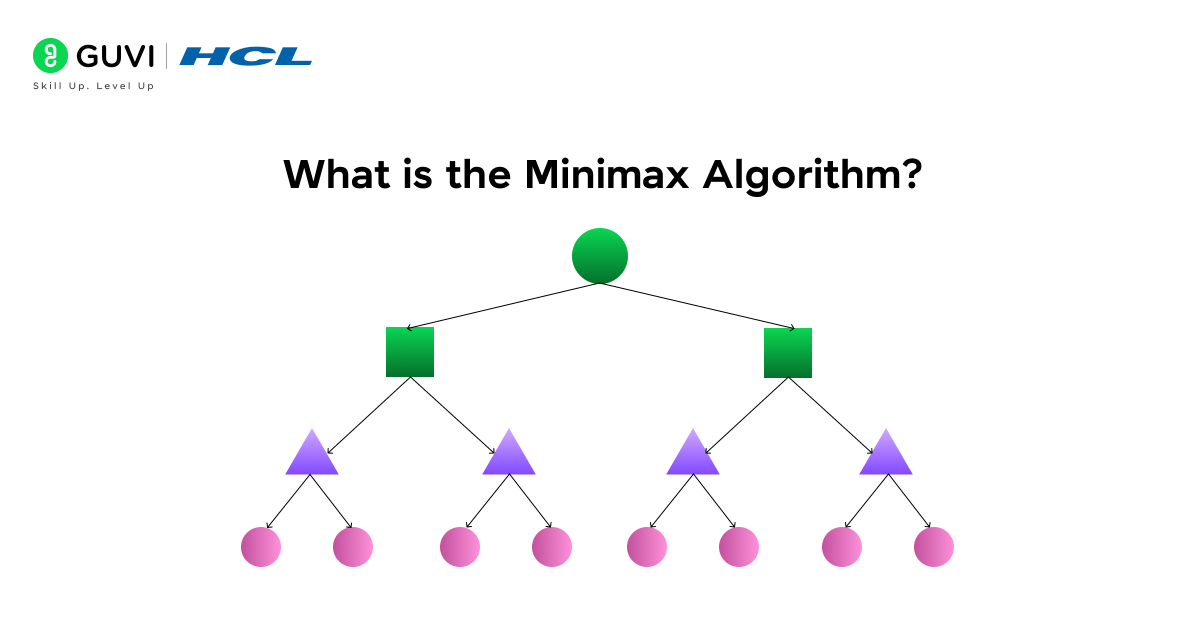
This algorithm works recursively, building a game tree where each node represents a potential game state. The two players take alternating roles:
- The maximizer (you) tries to get the highest score possible
- The minimizer (opponent) works to achieve the lowest score possible
Through this process, each position is assigned a value using an evaluation function that indicates how favorable that position is for the player.
Origin in game theory and AI
- The minimax concept has a rich history dating back to 1928 when John von Neumann first formalized it in his paper “On the Theory of Games of Strategy”. This groundbreaking work laid the foundation for modern game theory and decision-making algorithms.
- Furthermore, in 1950, Claude Shannon published a paper introducing the idea of an evaluation function and a minimax algorithm that could anticipate the effectiveness of future moves. This approach revolutionized how computers could analyze games.
- The algorithm reached mainstream recognition in 1997 when IBM’s Deep Blue chess computer, using minimax with alpha-beta pruning, defeated world champion Garry Kasparov. This historic victory demonstrated the power of minimax when combined with sufficient computing resources.
Why it’s important in decision-making
The minimax algorithm holds immense importance in decision-making for several key reasons.
First, it provides a strategic framework for making optimal decisions by considering all possible moves and their outcomes. This makes it particularly valuable in zero-sum games where one player’s gain equals the other’s loss.
Additionally, minimax excels in perfect information scenarios – games where both players have complete knowledge of all previous moves. This makes it ideal for classic games like chess, tic-tac-toe, backgammon, and Go.
Most importantly, the algorithm introduces a critical concept in artificial intelligence: the ability to look ahead and plan several moves in advance. By simulating potential future states, minimax enables computers to make decisions based not just on immediate outcomes but on long-term strategy.
The minimax approach also serves as the foundation for more sophisticated algorithms. When combined with techniques like alpha-beta pruning, it becomes even more powerful by dramatically reducing the computation needed to evaluate complex game trees.
How the Minimax Algorithm Works
The inner workings of the minimax algorithm might seem complex at first, yet its principles are surprisingly intuitive. Let’s break down this powerful decision-making process step by step.
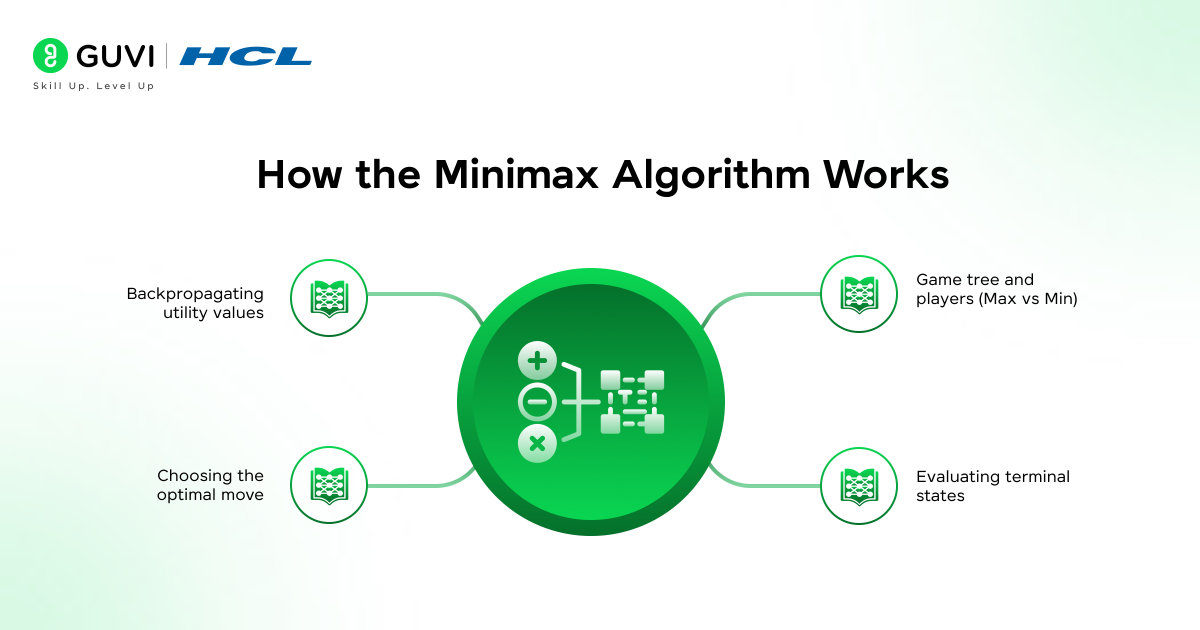
1. Game tree and players (Max vs Min)
The minimax algorithm begins by constructing a game tree, which maps out all possible moves and their resulting states. Picture this tree as a roadmap of every possible game scenario branching out from the current position.
Within this structure, two distinct players emerge:
- The maximizer (often called MAX), who tries to achieve the highest possible score
- The minimizer (often called MIN) works to obtain the lowest possible score
Each layer of the tree alternates between MAX and MIN nodes, representing the players taking turns. This pattern mirrors how games like chess or tic-tac-toe naturally progress, with players making moves one after another.
For instance, in a typical game scenario, you (as the maximizer) would control nodes where it’s your turn to move, whereas your opponent (the minimizer) controls nodes where it’s their turn. This fundamental dynamic forms the core of how the algorithm evaluates potential outcomes.
2. Evaluating terminal states
At the bottom of the game tree lie the terminal states – positions where the game has ended with a clear outcome (win, loss, or draw). The algorithm assigns specific values to these states:
| Outcome | Typical Value |
| MAX wins | +1 or +10 |
| MIN wins | -1 or -10 |
| Draw | 0 |
These values represent the utility or desirability of each outcome from the maximizer’s perspective. In practical applications, the exact numbers may vary, yet the principle remains consistent – higher values favor MAX, lower values favor MIN.
3. Backpropagating utility values
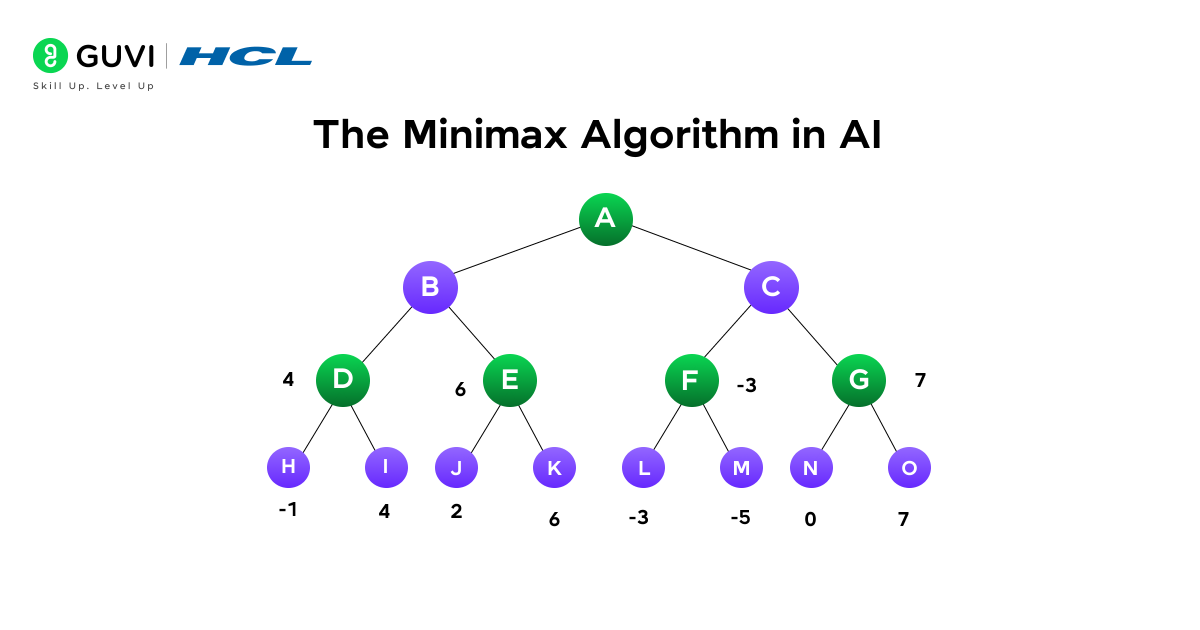
Once terminal states are evaluated, the algorithm works backward through the tree in a process called backpropagation. This recursive approach determines the value of each intermediate node:
- At MAX nodes, select the maximum value among all child nodes
- At MIN nodes, select the minimum value among all child nodes
Mathematically, this can be expressed as:
- For MAX nodes: V(s) = max(V(s’) for all successor states s’)
- For MIN nodes: V(s) = min(V(s’) for all successor states s’)
This recursive calculation continues until reaching the root node, effectively determining the best possible outcome assuming both players make optimal moves at every turn.
4. Choosing the optimal move
Finally, after all values have been backpropagated to the root, the algorithm selects the move that leads to the child node with the most favorable value.
For the maximizer at the root position, this means choosing the action that leads to the highest-valued child node. This selection represents the move most likely to result in victory (or minimize defeat) against an opponent playing optimally.
Moreover, advanced implementations consider the depth factor when evaluating moves, preferring:
- Faster wins (subtracting depth from positive scores)
- Slower losses (adding depth to negative scores)
This refinement ensures that the algorithm not only finds winning moves but prioritizes the most efficient paths to victory, making it an exceptionally powerful tool for game-playing artificial intelligence.
Minimax Step-by-Step Summary Table
Here’s the entire Minimax Algorithm process condensed into one reference table, tied to a concrete tic-tac-toe example that shows the Minimax Algorithm end to end:
| Minimax Step | What Happens | Depth | Example |
|---|---|---|---|
| 1. Build the game tree | Every possible move from the current position becomes a child node | Depth 0 (root) | Current tic-tac-toe board with 3 empty cells |
| 2. Expand recursively | Each child node expands further until the game ends or a depth limit is hit | Depth 1, 2, 3… | Each empty cell tried for X, then each response tried for O |
| 3. Evaluate terminal states | Assign +1, -1, or 0 for a win, loss, or draw | Deepest level reached | Board is full or someone has three in a row |
| 4. Backpropagate (MIN nodes) | At the opponent’s turn, pick the child with the lowest value | One level up from terminal | O picks the move that’s worst for X |
| 5. Backpropagate (MAX nodes) | At your turn, pick the child with the highest value | Continuing upward | X picks the move that’s best for X, assuming O plays optimally |
| 6. Reach the root and choose | The root node now has a value for every possible first move | Depth 0 (final decision) | X plays the cell that leads to the best guaranteed outcome |
Minimax Algorithm in Artificial Intelligence
The minimax algorithm represents one of artificial intelligence’s most successful strategies for decision-making in competitive scenarios. From classic board games to complex strategic challenges, this algorithm has proven its worth across numerous applications.
1) Use in two-player games like chess and tic-tac-toe
In the realm of artificial intelligence, the minimax algorithm shines brightest in two-player zero-sum games. These include popular games such as:
- Chess – where IBM’s Deep Blue famously used minimax with alpha-beta pruning to defeat world champion Garry Kasparov in 1997
- Tic-tac-toe – a perfect testing ground due to its manageable game tree size
- Checkers – where an AI called “Chinook” defeated champion Marion Tinsley in 1994
- Go – though more complex, still benefits from minimax principles
What makes these games ideal for minimax implementation is their deterministic nature—there’s no element of chance involved. Instead, the outcome depends entirely on player decisions, allowing the algorithm to predict and evaluate all possible future states.
The minimax strategy works by alternating between maximizing and minimizing players. In chess, for instance, every legal move from the current board state leads to a different node in the game tree. The algorithm evaluates each potential move by determining both its own and its opponent’s best strategies.
2) Handling perfect information scenarios
Minimax excels specifically in perfect information scenarios, where both players can see all aspects of the game state. This stands in contrast to games like poker, where players hold hidden cards.
In perfect information games, the algorithm operates under these key properties:
- Deterministic – The outcomes are predictable with no randomness involved
- Zero-sum – One player’s gain equals the other’s loss
- Sequential decision-making – Players take turns making moves
Through these properties, minimax ensures optimal decision-making by considering all possible moves and their outcomes within a given search depth. This strategic advantage comes from its ability to predict the opponent’s best responses and choose moves that maximize the player’s benefit.
Python Code: Minimax for Tic-Tac-Toe
To understand how the Minimax Algorithm works in practice for real, here’s a complete, runnable Python implementation of the Minimax Algorithm, not just pseudocode, that plays a perfect game of tic-tac-toe.
def check_winner(board, player):
    win_conditions = [
        [0, 1, 2], [3, 4, 5], [6, 7, 8],  # rows
        [0, 3, 6], [1, 4, 7], [2, 5, 8],  # columns
        [0, 4, 8], [2, 4, 6]              # diagonals
    ]
    return any(all(board[i] == player for i in combo) for combo in win_conditions)

def is_draw(board):
    return " " not in board

def minimax(board, depth, is_maximizing):
    if check_winner(board, "X"):
        return 10 - depth          # prefer faster wins
    if check_winner(board, "O"):
        return depth - 10          # prefer slower losses
    if is_draw(board):
        return 0

    if is_maximizing:
        best_score = float("-inf")
        for i in range(9):
            if board[i] == " ":
                board[i] = "X"
                score = minimax(board, depth + 1, False)
                board[i] = " "
                best_score = max(score, best_score)
        return best_score
    else:
        best_score = float("inf")
        for i in range(9):
            if board[i] == " ":
                board[i] = "O"
                score = minimax(board, depth + 1, True)
                board[i] = " "
                best_score = min(score, best_score)
        return best_score

def find_best_move(board):
    best_score = float("-inf")
    best_move = None
    for i in range(9):
        if board[i] == " ":
            board[i] = "X"
            score = minimax(board, 0, False)
            board[i] = " "
            if score > best_score:
                best_score = score
                best_move = i
    return best_move

# Example: X has just two moves left to consider
board = ["X", "O", "X",
         "O", "X", "O",
         " ", " ", " "]

move = find_best_move(board)
print(f"Best move for X is at position: {move}")
Sample Output:
Best move for X is at position: 6This works because the recursive calls explore every remaining branch of the game tree exhaustively, exactly as described in the summary table above, and the 10 - depth / depth - 10 scoring makes the algorithm prefer the fastest win and the slowest loss when multiple equally-good outcomes exist.
This recursive approach enables the AI to examine all possible futures of the game, making it impossible to defeat in simple games like tic-tac-toe when properly implemented. Nevertheless, for more complex games with larger game trees, optimizations like alpha-beta pruning become essential to make the algorithm computationally feasible.
Want to build AI systems that go beyond a single algorithm? Join our HCL GUVI’s AI Software Development Course and learn how to design, deploy, and scale real AI applications end-to-end, from search algorithms like Minimax to production-ready model serving.

Minimax with Alpha-Beta Pruning – How It Makes Minimax Faster
While the minimax algorithm is powerful, it faces a significant challenge: computational efficiency. This is where alpha-beta pruning comes to the rescue, dramatically improving performance without sacrificing accuracy.
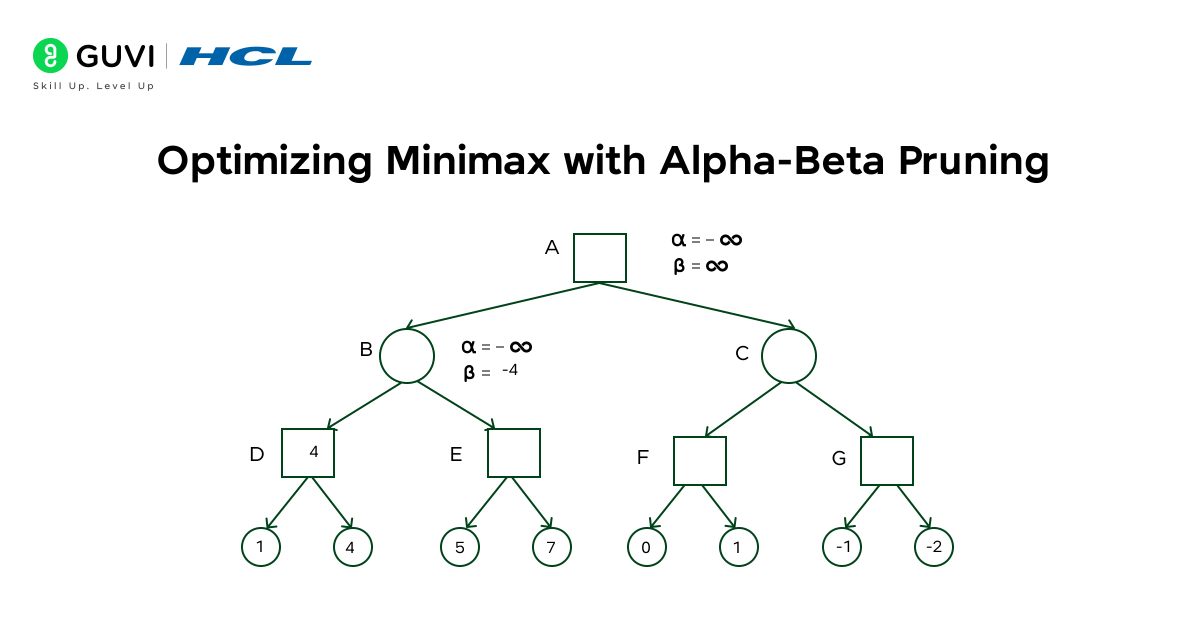
What is alpha-beta pruning?
Alpha-beta pruning is not a new algorithm but rather an optimization technique for the minimax algorithm. It works by eliminating branches in the game tree that cannot possibly influence the final decision. The technique maintains two values during tree traversal:
- Alpha (α): The best (highest) value that the maximizing player can guarantee so far
- Beta (β): The best (lowest) value that the minimizing player can guarantee so far
The algorithm stops evaluating a move when at least one possibility proves the move to be worse than a previously examined move.
Alpha-beta pruning added to the Minimax function:
def minimax_ab(board, depth, alpha, beta, is_maximizing):
    if check_winner(board, "X"):
        return 10 - depth
    if check_winner(board, "O"):
        return depth - 10
    if is_draw(board):
        return 0

    if is_maximizing:
        best_score = float("-inf")
        for i in range(9):
            if board[i] == " ":
                board[i] = "X"
                score = minimax_ab(board, depth + 1, alpha, beta, False)
                board[i] = " "
                best_score = max(score, best_score)
                alpha = max(alpha, best_score)
                if beta <= alpha:
                    break     # prune: MIN already has a better option elsewhere
        return best_score
    else:
        best_score = float("inf")
        for i in range(9):
            if board[i] == " ":
                board[i] = "O"
                score = minimax_ab(board, depth + 1, alpha, beta, True)
                board[i] = " "
                best_score = min(score, best_score)
                beta = min(beta, best_score)
                if beta <= alpha:
                    break     # prune: MAX already has a better option elsewhere
        return best_score
The only real change from plain Minimax is the alpha, beta tracking and the if beta <= alpha: break check, which is what actually discards branches that can no longer affect the final decision.
How it reduces computation
The primary benefit of alpha-beta pruning lies in its ability to eliminate entire branches of the search tree. Consequently, the search can focus on more promising subtrees, allowing for a deeper search in the same amount of time.
With a branching factor of b and search depth of d plies, standard Minimax evaluates O(b^d) leaf nodes. However, with optimal move ordering, alpha-beta pruning reduces this to approximately O(b^(d/2)).
In practical terms, a chess program that would normally evaluate more than one million terminal nodes at four plies depth could eliminate all but about 2,000 nodes, a reduction of 99.8%.
When to use it
Alpha-beta pruning should be used whenever you implement the minimax algorithm in practical applications. It’s particularly valuable for:
- Complex games with large branching factors
- Scenarios requiring deeper search depths
- Real-time decision-making systems
Furthermore, the effectiveness of alpha-beta pruning increases with better move ordering. Examining the most promising moves first (like captures in chess) maximizes the number of branches that can be pruned.
The minimax algorithm has some fascinating historical and practical roots you might not expect:
Von Neumann’s Legacy: The algorithm was first formalized by mathematician John von Neumann in 1928, laying the foundation for modern game theory and decision-making strategies.
Claude Shannon’s Vision: In 1950, Claude Shannon—known as the “father of information theory”—suggested using minimax for computers to play chess, revolutionizing early AI research.
From theoretical mathematics to world-famous chess matches, the minimax algorithm has played a surprising role in shaping the future of artificial intelligence!
Minimax in Chess Engines — Real-World Application
Chess is the classic proving ground for the Minimax Algorithm, and modern engines still build directly on the same core idea, even decades after Deep Blue’s Minimax Algorithm-powered victory.
How Deep Blue actually used it (1997): Deep Blue combined Minimax with alpha-beta pruning and specialized chess hardware to evaluate roughly 200 million positions per second. It didn’t just run plain Minimax, it used aggressive pruning, an opening book of grandmaster games, and a hand-tuned evaluation function refined by chess experts to score non-terminal positions.
Why chess needs an evaluation function: Unlike tic-tac-toe, a chess game tree is far too large to search all the way to a terminal state (checkmate, stalemate, or draw) within any reasonable time. Instead, engines apply Minimax down to a fixed depth, then use an evaluation function to score each non-terminal position, based on material count, king safety, piece mobility, and board control, and treat that score as if it were a terminal value.
Modern engines still use Minimax principles, layered with more:
- Transposition tables cache previously-evaluated positions so the engine never re-computes the same board state twice, since different move orders can reach identical positions.
- Iterative deepening runs Minimax at increasing depth limits (1 ply, then 2, then 3…) so the engine always has a usable answer ready if it runs out of time mid-search.
- Quiescence search extends the search selectively in “noisy” positions (like an ongoing capture sequence) to avoid the engine stopping mid-exchange and misjudging the position.
- Neural network evaluation (as in modern engines like AlphaZero and Stockfish NNUE) replaced hand-tuned evaluation functions with learned ones, but the underlying Minimax-style search with pruning is still very much present.
The honest takeaway: the Minimax Algorithm isn’t a historical curiosity that chess engines have moved past, it’s still the backbone of the search process. What’s changed since 1997 is almost entirely about smarter pruning, faster hardware, and better evaluation functions layered on top of the same fundamental recursive logic.
Minimax Time and Space Complexity Analysis
Understanding exactly why the plain Minimax Algorithm becomes impractical for real games requires looking at the actual numbers, not just the general idea that “it’s slow.”
Time complexity: O(b^d)
Here, b is the branching factor (the average number of legal moves available at each turn) and d is the search depth in plies (half-moves). This is the number of leaf nodes the algorithm must evaluate in the worst case.
| Game | Branching Factor (b) | Typical Depth (d) | Approximate Nodes (b^d) |
|---|---|---|---|
| Tic-Tac-Toe | ~4 (average) | 9 (full game) | ~255,168 total game states |
| Checkers | ~8 | 40 | Effectively infeasible to search exhaustively |
| Chess | ~35 | 80 (full game) | Far more than atoms in the observable universe |
| Go | ~250 | 150+ | Astronomically larger than chess |
Space complexity: O(b × d) for depth-first Minimax
Since Minimax explores the game tree depth-first, it only needs to keep the current path from root to leaf in memory at any one time, along with the sibling branches still waiting to be explored at each level. This makes Minimax memory-efficient even though it’s computationally expensive, the bottleneck is almost always time, not memory.
Why this matters practically: for tic-tac-toe, the entire game tree (at most 9! = 362,880 possible move sequences, with many pruned early by wins) is small enough for plain Minimax to solve instantly. For chess, with a branching factor of roughly 35 and games lasting around 80 plies, the full game tree is astronomically larger than the estimated 10^80 atoms in the observable universe, which is exactly why no chess engine, past or present, ever runs unoptimized Minimax to a full game-ending depth. Alpha-beta pruning, evaluation-function cutoffs, and modern hardware are not optional extras; they’re the only reason Minimax-based engines can function in real time at all.
Strengths, Limitations, and Real-World Use Cases of the Minimax Algorithm
Examining the minimax algorithm beyond its mechanics reveals both its remarkable capabilities and inherent constraints in practical applications.

1) Advantages: optimality and clarity
- The minimax algorithm guarantees optimal decision-making by exhaustively analyzing all possible moves. Its deterministic nature ensures consistent, predictable outcomes without randomness.
- Furthermore, the algorithm is remarkably simple to engineer and implement, making it an accessible starting point for understanding game-playing AI.
2) Limitations: complexity and depth
- Despite its strengths, the minimax algorithm faces significant computational challenges. The algorithm’s time complexity is O(b^d), where b represents the branching factor and d is the depth.
- In chess, with an average branching factor of 35 and typical game length of 80 moves, this creates more possible states than atoms in the universe. Additionally, minimax struggles with games involving hidden information or chance elements like poker.
3) Applications in robotics, economics, and games
Beyond gaming, minimax principles extend to:
- Robotics: Helping autonomous systems navigate and allocate resources in competitive environments
- Economics: Modeling auction strategies and price negotiations between buyers and sellers
- Security systems: Predicting and countering threats in adversarial scenarios
Level up beyond algorithms like Minimax with HCL GUVI’s Intel-powered AI & ML Course, co-created with IITM Pravartak—delivering hands-on experience across Generative AI, Agentic AI, Deep Learning, and MLOps. With live weekend classes in English, Hindi, or Tamil, flexible EMI plans, and real-world projects plus placement guidance, this course bridges the gap from theory to career-ready practice
Concluding Thoughts…
The minimax algorithm stands as a fundamental concept in artificial intelligence that transforms how computers make decisions in competitive scenarios. Throughout this guide, you’ve learned how this recursive algorithm evaluates potential moves by building game trees and assigning values to different positions.
You can start implementing this powerful algorithm in simple games like tic-tac-toe to gain hands-on experience. The beauty of minimax lies in its straightforward logic – always assume your opponent will make their best move while you seek your optimal path. This foundational concept will serve you well as you explore more advanced AI decision-making strategies. Good Luck!
FAQs
Q1. What is the main purpose of the minimax algorithm?
The minimax algorithm is designed to make optimal decisions in two-player games by minimizing potential losses while maximizing opportunities to win. It works by recursively evaluating all possible moves and their outcomes, assuming that the opponent will always make their best move.
Q2. How does the minimax algorithm work in chess?
In chess, the minimax algorithm builds a game tree representing all possible moves and their resulting board states. It then evaluates these states, assigning values to each position. The algorithm works backwards from these evaluations, choosing the move that leads to the best possible outcome for the player, assuming the opponent also plays optimally.
Q3. What is alpha-beta pruning and how does it improve the minimax algorithm?
Alpha-beta pruning is an optimization technique for the minimax algorithm that significantly reduces the number of nodes evaluated in the game tree. It works by eliminating branches that cannot possibly influence the final decision, allowing for a deeper search in the same amount of time without sacrificing accuracy.
Q4. What are the limitations of the minimax algorithm?
The main limitation of the minimax algorithm is its computational complexity, especially for games with large branching factors. It can become impractical for complex games without optimizations. Additionally, the algorithm struggles with games involving hidden information or chance elements, and requires a complete game tree and predefined utility values.
Q5. Where else can the minimax algorithm be applied besides games?
Beyond gaming, the minimax algorithm and its principles have applications in various fields. It’s used in robotics for navigation and resource allocation in competitive environments, in economics for modeling auction strategies and price negotiations, and in security systems for predicting and countering threats in adversarial scenarios.
Success Stories

About the Author
Jebasta
I translate the language of data into stories that anyone can understand. As a writer with a data science background, I simplify analytics, AI, and decision-making so beginners and enthusiasts can confidently explore the world of data.
View all posts by Jebasta
Connect with me @











Did you enjoy this article?