


Artificial Intelligence and Machine Learning Articles
Finance Manager to Data Analytics: Career Growth, Salary and Seniority
How to Evaluate LLM Outputs in Production Deployments
AI/ML Skills Gap 2026: Why Companies Can't Find Job-Ready Talent
20 AI/ML Interview Questions Recruiters Can Use Without a Tech Background - Best Guide


Get In Touch For Details! Request More Information

Knowledge Representation in AI: A Beginner’s Guide (2026)
Jul 21, 2026 4 Min Read 5617 Views
(Last Updated)
Knowledge representation in AI is what lets a machine turn raw information into something it can actually reason with. You already interact with it daily, whether that’s a chatbot answering a question or Google Search showing you a quick fact box.
This guide walks you through what it is, how it works, and where you’ll run into it in real AI systems.
Table of contents
- TL;DR Summary
- What is Knowledge Representation in AI?
- Types of Knowledge in AI
- Techniques of Knowledge Representation in AI
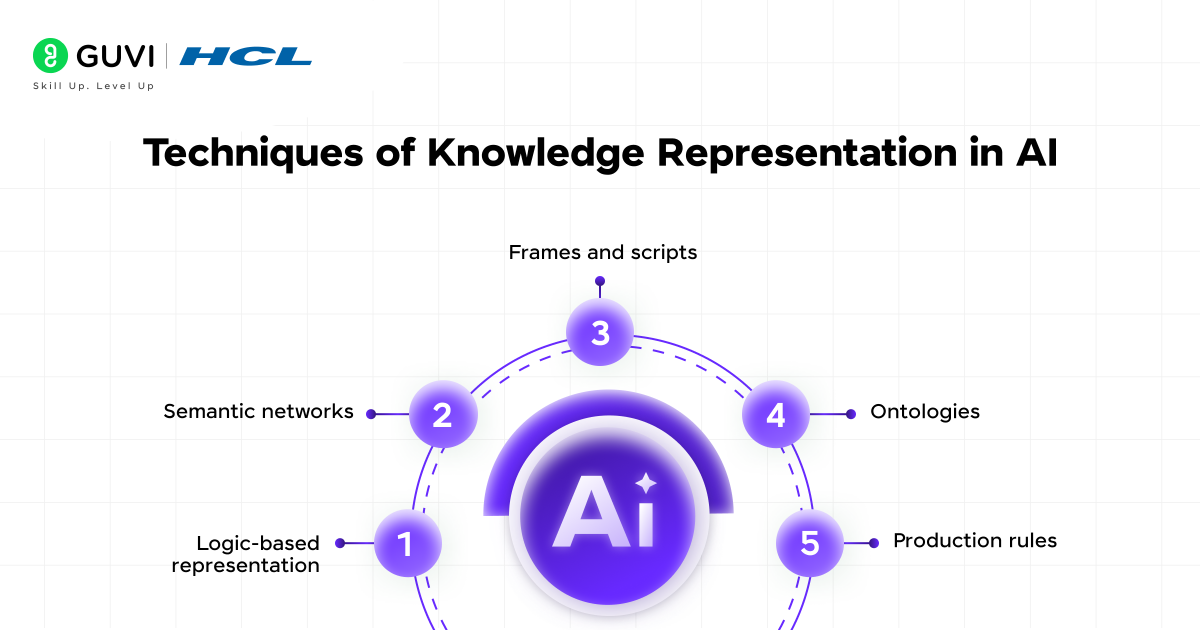
- 1) Logic-based representation
- 2) Semantic networks
- 3) Frames and scripts
- 4) Ontologies
- 5) Production rules
- Semantic Networks vs Frames vs Production Rules: Comparison
- Knowledge Representation in Modern AI Systems (LLMs, Knowledge Graphs)
- Real-world example: Medical AI diagnosis
- Common Mistakes
- Knowledge Representation Interview Questions for AI Roles
- Conclusion
- FAQs
- Q1. What is knowledge representation in AI?
- Q2. What are the main techniques of knowledge representation?
- Q3. How is knowledge representation used in LLMs today?
- Q4. What's the difference between a knowledge graph and a knowledge base?
- Q5. Where is knowledge representation used in real life?
- Q6. Is knowledge representation still relevant with modern AI?
TL;DR Summary
- Knowledge representation lets AI systems store facts and relationships in a form they can reason with, not just retrieve.
- Five knowledge types exist: declarative, procedural, meta, heuristic, and structural.
- The four core techniques are logic, semantic networks, frames, and production rules.
- Modern AI blends these classic ideas with knowledge graphs and LLMs through approaches like GraphRAG.
- You’ll see it in action in expert systems, chatbots, robotics, and medical diagnosis tools.
What is Knowledge Representation in AI?
Knowledge Representation and Reasoning (KR, KRR) serves as the foundation for how AI systems interpret and interact with the world around them. Rather than simply warehousing information in databases, knowledge representation creates symbolic systems that allow machines to comprehend their environment.
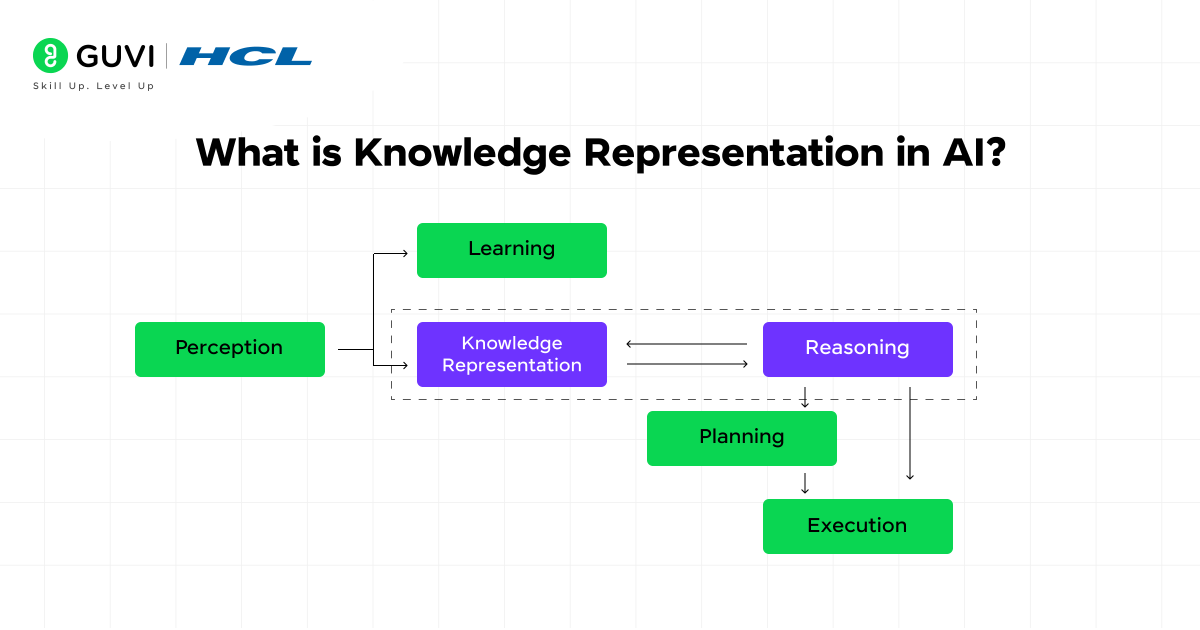
The primary purpose is enabling AI programs to make intelligent inferences about real-world facts and solve complex problems.
A successful knowledge representation system should demonstrate several key capabilities:
- Represent any required knowledge comprehensively
- Manipulate representational structures to generate new knowledge
- Steer inferential mechanisms productively
- Acquire new information quickly and easily
Through these capabilities, knowledge representation bridges the gap between raw information and machine intelligence, allowing computers to communicate in natural language, plan activities, and tackle challenges that typically require human expertise.
“`html id=”k9g3m7″- Google’s Knowledge Graph has collected over 500 billion facts about more than 5 billion entities, including people, places, and things, helping search engines understand relationships, context, and real-world meaning instead of simply matching keywords.
Types of Knowledge in AI
In AI systems, different forms of knowledge enable machines to understand and interact with the world. These knowledge types serve as building blocks for effective knowledge representation in AI, each playing a unique role in how machines process information.
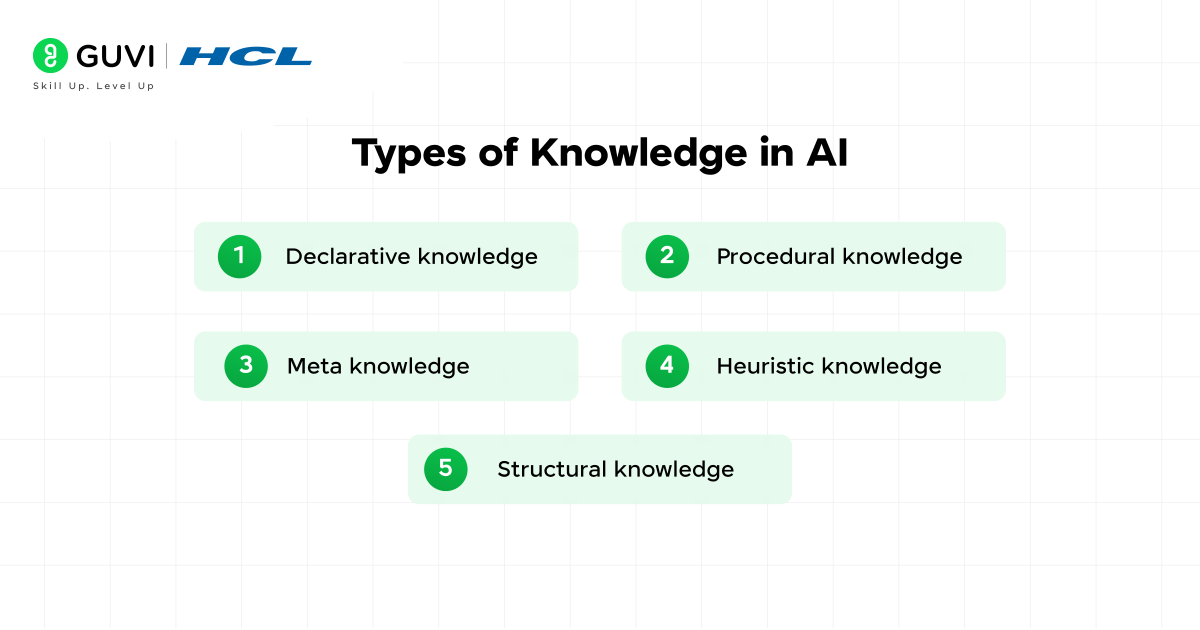
Before machines can reason, they need something to reason with. AI systems typically work with five knowledge types:
- Declarative knowledge — facts, like “Chennai is in Tamil Nadu.”
- Procedural knowledge — how to do something, like the steps in a sorting algorithm.
- Meta knowledge — knowledge about knowledge, such as knowing which data source is reliable.
- Heuristic knowledge — rules of thumb built from experience, used in chess engines and quick decision-making.
- Structural knowledge — relationships between concepts, like knowing a poodle is a type of dog.
Techniques of Knowledge Representation in AI
To implement intelligent behavior in machines, various techniques of knowledge representation in AI have been developed over time. These methods serve as the bridge between raw data and machine reasoning, each with distinct approaches to organizing and utilizing information.
| Representation Type | Example | Pros | Cons | Used In |
|---|---|---|---|---|
| Logic-based | “IF it rains THEN ground is wet” | Precise, supports formal proof | Struggles with uncertainty | Automated theorem provers, rule engines |
| Semantic networks | Dog → is-a → Animal | Intuitive, easy to visualize | Gets messy at scale | NLP, search engines |
| Frames | “Car” frame with slots for wheels, engine, color | Groups related info well | Rigid structure | Expert systems, object modeling |
| Production rules | IF-THEN condition-action pairs | Modular, easy to update | No learning ability, rule overload | Expert systems, fraud detection |
1) Logic-based representation
Logic-based representation forms the foundation of formal reasoning in AI systems. This approach uses precise rules and symbols to represent facts, making it ideal for deterministic environments where information is definite.
Propositional logic utilizes simple declarative statements connected by operators like AND, OR, and NOT. First-order logic (FOL) extends this foundation by introducing variables, quantifiers, and predicates, enabling AI to express more nuanced relationships between objects.
2) Semantic networks
Semantic networks represent knowledge as interconnected concepts through a graph structure. In these networks, nodes represent objects or concepts while edges define the relationships between them.
The structure consists of:
- Nodes: Representing concepts, objects, or ideas
- Edges: Showing relationships between nodes (e.g., “is-a,” “has-a”)
- Labels: Specifying the nature of relationships
For example, a semantic network might connect “Dog” to “Animal” with an “is-a” relationship, enabling the system to infer that dogs inherit properties of animals.
3) Frames and scripts
Frames organize knowledge into structured units resembling record-like structures. Each frame contains slots (attributes) and fillers (values) describing an entity or concept. This approach was introduced by Marvin Minsky in the 1970s to represent stereotypical situations.
Scripts expand on frames by representing sequences of events or actions in particular contexts. Generally, they capture expected patterns of behavior in common scenarios, making them valuable for understanding narratives or planning actions.
4) Ontologies
Ontologies provide formal frameworks for defining concepts, categories, and relationships within a specific domain. As computational artifacts, they offer both a conceptual and computational model of particular domains of interest.
5) Production rules
Production rules represent knowledge through conditional statements following an “IF-THEN” format. These rules link conditions to actions, making them particularly useful for expert systems.
The production rule system consists of three main components:
- A set of rules (knowledge base)
- Working memory (current state)
- A recognize-act cycle (reasoning mechanism)
Semantic Networks vs Frames vs Production Rules: Comparison
These three techniques often get confused, so here’s how you can tell them apart:

- Semantic networks focus on relationships. You use them when connections between concepts matter most, like in language understanding.
- Frames focus on grouping. You use them when an object has multiple attributes that belong together, like a customer profile.
- Production rules focus on action. You use them when you need a system to react to conditions, like triggering an alert when a fraud pattern matches.
If you’re building a system that needs to explain relationships, go with semantic networks. If you need structured records, use frames. If you need decision-triggered actions, production rules fit best.
Knowledge Representation in Modern AI Systems (LLMs, Knowledge Graphs)
You might assume KR is an older AI concept that’s been replaced by large language models. It hasn’t. It’s been paired with them instead.
LLMs are excellent at language but weak on factual precision. They can hallucinate. Knowledge graphs solve this by giving LLMs a factual backbone to check against.
This is where GraphRAG comes in, a technique from Microsoft Research that builds a knowledge graph from text and then lets an LLM query it for grounded, traceable answers. It’s now a common pattern in production AI systems, because it combines the language fluency of LLMs with the accuracy of structured KR.
Real-world example: Medical AI diagnosis
A hospital’s AI diagnostic assistant uses a knowledge graph linking symptoms, diseases, lab results, and treatment protocols. When you enter a patient’s symptoms, the system doesn’t just pattern-match against training data.
It traces relationships in the graph, such as connecting a symptom to a set of possible conditions and cross-checking them against the patient’s lab history, before suggesting a diagnosis for a doctor to review.
Common Mistakes
- Treating KR as just data storage: Structured data alone isn’t KR. It only counts once the system can reason over it.
- Overcomplicating frames: Adding too many slots makes frames hard to maintain. Keep them focused on what actually matters for the task.
- Ignoring uncertainty: Real-world facts aren’t always black and white. Plain logic-based systems often need fuzzy logic or probability layers.
- Skipping validation of knowledge graphs: Feeding an LLM a poorly built graph can introduce new errors instead of fixing hallucinations.
Knowledge Representation Interview Questions for AI Roles
If you’re prepping for an AI or ML interview, these commonly come up:
- What is knowledge representation in AI, and why is it needed?
- What’s the difference between declarative and procedural knowledge?
- How do semantic networks differ from frames?
- Explain the IF-THEN structure of production rules with an example.
- How do knowledge graphs help reduce LLM hallucinations?
- What are the limitations of first-order logic in KR?
Keep your answers example-driven. Interviewers usually care more about your reasoning than textbook definitions.
Master AI & ML with HCL GUVI’s IIT-M-Pravartak and Intel-certified AI and ML Course, designed with Intel. Learn Knowledge Representation, Generative AI, Deep Learning, and MLOps through hands-on projects—plus gain career support from 1000+ hiring partners.
Conclusion
Knowledge representation stands as the fundamental bridge between how machines understand our world and how they use that understanding to demonstrate intelligent behavior. Throughout this guide, you’ve seen how AI systems utilize various knowledge types—from declarative facts to procedural methods—to make sense of complex information.
FAQs
Q1. What is knowledge representation in AI?
It’s how AI systems store facts and relationships in a structured form so they can reason and make decisions, rather than just retrieving stored data.
Q2. What are the main techniques of knowledge representation?
The four core techniques are logic-based representation, semantic networks, frames, and production rules. Ontologies are also widely used for domain-specific knowledge.
Q3. How is knowledge representation used in LLMs today?
LLMs are often paired with knowledge graphs through techniques like GraphRAG, which grounds language generation in verified, structured facts to reduce hallucinations.
Q4. What’s the difference between a knowledge graph and a knowledge base?
A knowledge base stores facts as records. A knowledge graph stores facts as connected relationships, which supports multi-hop reasoning.
Q5. Where is knowledge representation used in real life?
You’ll find it in expert systems, medical diagnosis tools, chatbots, search engines, and robotics.
Q6. Is knowledge representation still relevant with modern AI?
Yes. It’s become more relevant, since structured knowledge is what keeps large language models factually grounded.
Success Stories

About the Author
Lukesh S
A professional content writer who has experience in freelancing and now working as a Technical Content Writer at HCL GUVI having sound knowledge in Blog Writing and Creative Writing!
View all posts by Lukesh S
Connect with me @











Did you enjoy this article?