


Interview Articles
InfyTQ Interview Experience 2026: Process, Questions, Preparation & Tips
Deloitte NLA Interview Experience 2026: Rounds, Questions and Preparation - Best Guide
Capgemini Exceller Interview Questions 2026: Coding, Technical, HR, and AI Prep - Best Guide
Wipro Elite NTH Interview Experience 2026: What Candidates Say


Get In Touch For Details! Request More Information
Top 40 HR Interview Questions and Answers for Professionals
Sep 28, 2026 9 Min Read 5388 Views
(Last Updated)
An HR interview may seem less technical than other stages of the hiring process, but the questions can still be tricky to answer. You may be asked about your strengths, career goals, salary expectations, workplace preferences, past experiences, and how you handle different situations at work.
A little preparation can help you answer naturally without sounding rehearsed. In this guide, we have covered 40 HR interview questions and answers, including basic, tricky, scenario-based, and job-specific questions, along with cues and sample answers you can adapt to your own experience.
Table of contents
- TL;DR
- Skills to Ace an HR Interview
- Top 25 HR Interview Questions and Answers
- Basic Questions
- Tricky Questions
- Scenario-Based Questions
- Job-Specific Questions
- Conclusion
- FAQs
- Q1. What is the best way to prepare for an HR interview?
- Q2. How long should my answers be during an HR interview?
- Q3. How important is body language during an HR interview?
- Q4. Should I memorize answers to HR interview questions?
TL;DR
- HR interviews assess your communication, goals, attitude, and workplace approach.
- Prepare for common, tricky, scenario-based, and job-specific questions.
- Use real examples when answering behavioral and situational questions.
- Keep answers clear, relevant, and natural, rather than memorizing responses.
- Research the company and role before your HR interview.
Skills to Ace an HR Interview
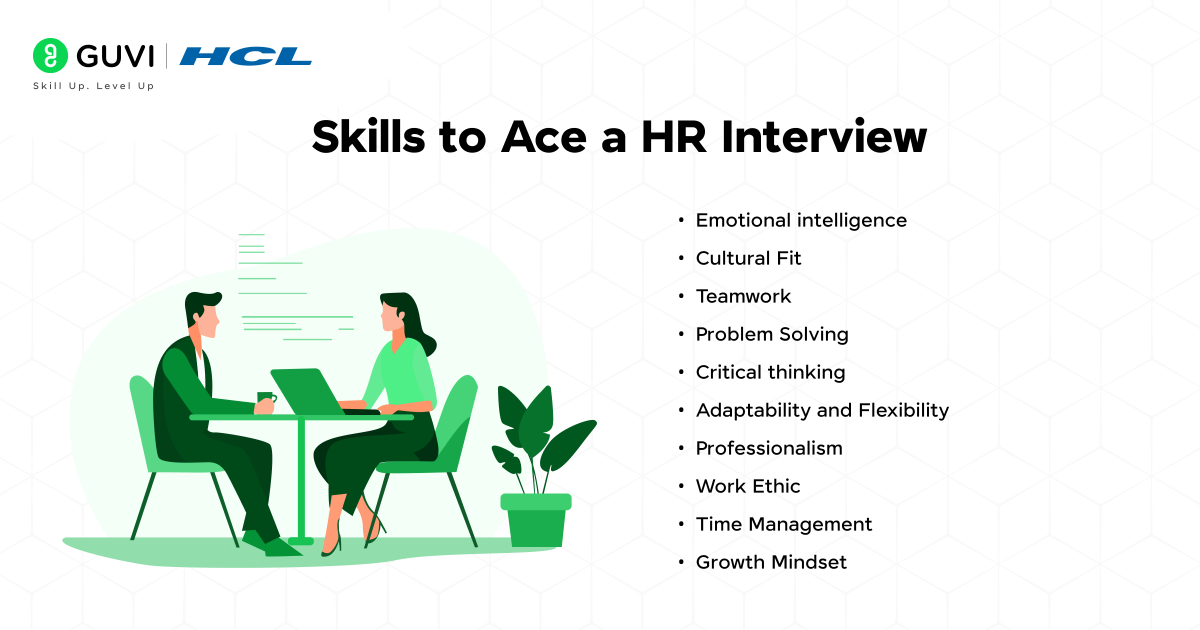
This section covers the necessary knowledge about HR interviews. HR will evaluate your soft skills. Having a decent knowledge of English and being able to communicate effectively will boost your confidence in answering the questions. Other than communication skills, here are some of the important skills you need to know.
- Emotional intelligence: It is the ability to manage your emotions, empathize, and interact with others.
- Cultural Fit: It involves assessing whether your values align with the company’s culture.
- Teamwork: It highlights your ability to collaborate, respect others, and work well in a team.
- Problem Solving: It is the ability to approach challenges and make decisions to solve the problem.
- Critical thinking: It is the ability to think and handle critical situations using the STAR method.
- Adaptability and Flexibility: It is the ability to adapt in today’s fast-changing work environment.
- Professionalism: It involves punctuality, preparedness, and respectful attitudes towards the work environment.
- Work Ethic: It demonstrates reliability, accountability, and motivation to contribute meaningfully.
- Time Management: It involves task prioritization, meeting deadlines, and working under pressure.
- Growth Mindset: It tells about your eagerness to learn, develop, and take a new challenge to grow.
Top 25 HR Interview Questions and Answers
This section covers the top 25 HR interview questions and answers. We will provide you with the sample answers, and customize the answers according to your experience and story. Let’s get into it.
Basic Questions
1. Tell me about yourself
While introducing yourself, do not start with your name since the HR already knows it. Focus on your professional journey, relevant experience, skills, and achievements that boost your candidacy for this role. Keep it concise, i.e., 1 or 2 minutes, and tailored to the job.
Sample Answer:
I have a strong background in software development with 2 years of experience in web development. I have worked on projects that involve JavaScript, Version Control, and backend, which helped me to become a full-stack developer. I am currently looking to grow further in a dynamic environment like yours, where I can contribute to HCL Guvi’s growth.
2. What are your weaknesses?
Mention one or two genuine weaknesses that you have and how you overcame them.
Sample Answer:
I used to have multitasking as my weakness, two years back I started to pursue various domains in software development, such as DevOps, web development, and AI. This leads me to no effective results, and I struggle with coping with the different concepts. Later, I started to pursue one domain, which is web development, where I explored different concepts such as frontend, backend, and UI/UX to enhance my multitasking skills. It was both easy and effective.
3. What are your strengths?
Mention one or two strengths that you have that will be helpful in the organization you are applying to.
Sample Answer:
One of my key strengths is problem-solving. In my previous job, I streamlined a reporting process that reduced monthly turnaround time by 30%. I enjoy identifying inefficiencies and finding smart solutions.
4. Why should we hire you?
Mention your skills, experience, and how they align with the company’s expectations and goals.
Sample Answer:
I am a perfect fit for this position because I bring both experience and drive to contribute from day one of joining your company. I have a proven track record in web development, and I am passionate about continuous development and improvement. I am confident that my skills will be a great asset to your team.
5. How do you handle criticism?
Show your calmness, maturity, openness, and a growth mindset in your response.
Sample Answer:
I take criticism as a chance to improve myself and my work. I once received feedback about my tendency to rush through QA checks. I took it seriously, adjusted my workflow, and started using checklists, which significantly reduced errors.
6. How would your coworkers/friends describe you?
Sample Answer:
My friends/coworkers would describe me as a person who delivers tasks on time and motivates my team members to complete their tasks. I’m usually the one people come to when they need help troubleshooting or organizing tasks under pressure.
7. Where do you see yourself in five years?
In five years, I see myself in a leadership role where I can contribute to decision-making and mentor my junior team members. I want to grow with a company that values development and innovation, like yours.
Sample Answer:
8. Why did you choose this career?
Explain what genuinely attracted you to the field and connect it with your interests, strengths, or experiences.
Sample Answer:
I chose this career because it matches both my interests and strengths. I enjoy solving problems, learning new skills, and working on projects where I can see a clear outcome. As I gained more practical experience, I became more certain that this is the field in which I want to build my long-term career.
9. What motivates you at work?
Mention 1–2 factors that genuinely motivate you, such as learning, solving problems, taking ownership, or seeing the impact of your work.
Sample Answer:
I am motivated by work where I can solve meaningful problems and see the impact of what I contribute. I also value opportunities to learn, take on greater responsibility, and work with people who challenge me to improve.
10. What are your short-term and long-term career goals?
Keep your goals realistic and connect them with skill development, increasing responsibility, and long-term professional growth.
Sample Answer:
My short-term goal is to strengthen my skills, understand the role deeply, and become someone the team can rely on. In the longer term, I want to take on greater responsibilities, contribute to larger projects, and gradually move into a position where I can also guide others.
Tricky Questions
11. Can you work under pressure?
Sample Answer:
Yes, I perform well under pressure. I believe that working under pressure boosts my confidence and perfection in work. In my last job, we had a system failure before submitting our work to the client. I coordinated with the IT team, prioritized this issue, and we delivered the work on time.
12. Why do you want to work for our company?
Show your knowledge you have about the company and how it aligns with your experience or culture.
Sample Answer:
I have researched the company, and I am excited about their vision and innovation in the technology field. The recent project ‘project name’ by your company impressed me. I want to be part of a team where I can grow and contribute to meaningful work.
13. Why are you looking for a change?
Mention your genuine reason for looking for a job change. It can be anything from monetary increase, growth, and opportunity. Do not mention any complaints from previous employers.
Sample Answer:
I am currently looking for a job change because this role aligns with my long-term goals. I am especially interested in your company because of its innovation and recent contributions in the AI field.
14. How would you rate yourself on a scale of 1 to 10?
Avoid saying 10 because HR knows that no one can be 10. Go somewhere between 7.5 to 9 with justification and openness to learning.
Sample Answer:
I would rate myself an 8. I have a strong technical background, and I consistently meet expectations. I believe that there is always room for improvement, and I am committed to learning and improving continuously.
15. If you got an offer from a product-based company, would you still be working?
Sample Answer:
My focus is on finding the right role and environment where I can grow and contribute meaningfully. If I’m selected here, I’ll be fully committed and won’t entertain other opportunities.
16. What is your dream company like?
Make sure your answer aligns with the company you applied for.
Sample Answer:
I am looking for a place where I can learn, create impact, collaborate, and grow with the organization. My dream company values innovation, supports employee development,t and inclusive culture.
17. What did you dislike about your last job?
Avoid complaining and negative feedback. Focus on growth and your reason for looking a new job.
Sample Answer:
My last job was a great learning experience, but the role became quite repetitive, and I was looking for more opportunities to challenge myself and grow. That’s why I’m seeking a role that offers more variety and development.
18. Why is there a gap in your employment?
Be honest about the reason for the gap, briefly explain how you used the time, and shift the focus towards your readiness to return to work.
Sample Answer:
I took a career break for personal reasons, and during that period, I also spent time updating my skills and thinking carefully about my next career move. I am now ready to return to work and looking for a role where I can apply my experience while continuing to grow professionally.
19. Why did you leave your previous job?
Keep your answer positive and professional. Focus on career growth, new responsibilities, or better alignment with your goals instead of criticizing your previous employer.
Sample Answer:
I learned a lot in my previous role, but I reached a stage where I wanted to take on new challenges and broaden my experience. I am now looking for an opportunity that gives me greater responsibility and aligns more closely with my long-term career goals.
20. Are you interviewing with other companies?
Answer honestly without sharing unnecessary details. Show that you are exploring suitable opportunities while explaining why this particular role interests you.
Sample Answer:
Yes, I am exploring a few opportunities that align with my skills and career goals. However, I am particularly interested in this role because of the responsibilities involved and the opportunity to contribute while developing my skills further.
21. What would you do if you received a better offer after joining us?
Focus on your commitment to the role rather than making unrealistic promises about never considering another opportunity.
Sample Answer:
When I accept a role, I do so after carefully considering the responsibilities, growth opportunities, and company fit. My focus after joining would be on performing well, learning the role, and contributing to the team rather than continuing to look for other opportunities.
Scenario-Based Questions
22. What is your biggest achievement so far?
Make sure to choose a measurable achievement and relevant to the role you are applying for. The achievement can be from your college days or a previous company.
Sample Answer:
My biggest achievement was publishing an open-source npm package to automate the project setup for frontend development using HTML, CSS, and JavaScript. It received 400+ downloads in its first week of deployment. It is a game changer in my open-source journey.

23. Tell me how you will handle it if suddenly the priorities of a project were changed?
Sample Answer:
I understand that there are many reasons for a company to change the priority of a project. If the priority of the task that I work on gets changed, I will put efforts into understanding why this happened and I will consider that it is in the best interest of the company and start to work on the new task of higher priority rather than crib about it.
24. Tell me about a time when you were not satisfied with your performance.
Be honest in your response, and show that you are capable of rectifying your mistakes by learning.
Sample Answer:
During my first job after college, I missed a detail in a report that delayed a deliverable. I took full responsibility at that time and learned from the mistake not to repeat it. I implemented a more thorough review process before submitting, which prevented me from making similar mistakes in the future.
25. Tell me about a time when you experienced difficulty at work while working on a project.
Your response should state the difficulty and focus more on how you overcame the difficulty.
Sample Answer:
During a project, we faced delays from a third-party vendor. I proactively restructured the project timeline and worked closely with the vendor and stakeholders to mitigate risks. We still completed the project with minimal impact.
26. How would you handle disagreements with your manager?
Your response should clearly emphasize professionalism, communication, and respect.
Sample Answer:
I would request a one-on-one meeting with my manager to calmly discuss our perspectives. If needed, I’d suggest a compromise approach or bring data to support my view while remaining open-minded.
27. Can you give me an example of a time when you showed leadership?
Use the STAR(Situation, Task, Action, Result) method to answer behavioral questions like this.
Sample Answer:
I remember when I was in college, and my teammates were working on a project that required us to learn new technologies. I took the initiative to allocate work among us to achieve the best results. I began the process by asking each member of the team about their knowledge in specific areas, and started to allocate the task according to their comfort level with the technology. Finally, we were able to complete the task on time and received appreciation from our mentors.
28. What do you do to ensure that a certain number of tasks are completed effectively?
Your response should include details about planning, prioritizing, and time management.
Sample Answer:
I begin to organize them based on the priorities and come up with a plan to set deadlines for each of them and begin to work on the task. Whenever I feel like I am blocked or I am facing roadblocks, I let my supervisor know of this, and I don’t hesitate to seek help from my colleagues. If I see that I am not able to meet the deadlines, then I will inform my manager well in advance by detailing whatever I have done.
29. Tell me about a time you made a mistake at work. How did you handle it?
Choose a genuine mistake, take responsibility for it, and focus on how you corrected it and prevented it from happening again.
Sample Answer:
In one project, I misunderstood a requirement and completed part of the task incorrectly. As soon as I realized the mistake, I informed my manager, corrected the work, and clarified the remaining requirements before proceeding. Since then, I make it a point to confirm important requirements at the beginning of a task.
30. Tell me about a time you had to meet a tight deadline.
Use the STAR method to explain how you prioritized tasks, managed your time, and maintained the quality of your work.
Sample Answer:
During a previous project, our deadline was moved forward unexpectedly. I listed the remaining tasks based on priority, coordinated with my teammates, and focused first on the work that could affect the final delivery. We completed the project within the revised deadline without compromising the key requirements.
31. How would you handle a conflict with a coworker?
Show that you can address disagreements professionally through direct communication rather than allowing them to affect the team’s work.
Sample Answer:
I would first speak with my coworker privately to understand their perspective and explain mine. I would focus on the issue rather than making it personal and try to find a solution that works for the project. If we still could not resolve it, I would involve the appropriate manager for guidance.
32. Tell me about a time you had to learn something quickly.
Choose an example that demonstrates adaptability, initiative, and your ability to apply a new skill under a practical deadline.
Sample Answer:
During a project, I had to use a tool I had very little experience with. I went through the documentation, practised the features relevant to my task, and asked an experienced teammate for guidance when needed. I was able to learn enough to complete the task on time and later continued improving my knowledge of the tool.
Interviewers sometimes use silence deliberately after an answer. Candidates often feel compelled to keep talking, which can lead them to reveal more than they originally intended.
Job-Specific Questions
33. What is your salary expectation?
Make sure to research market rates and learn from previous employees about the salary. Provide a range and show flexibility.
Sample Answer:
Based on my research on Glassdoor and experience, I believe a fair range would be ₹5 to ₹7 LPA. I’m flexible and more focused on the role, growth opportunities, and company culture.
34. Do you prefer working alone or in a team?
Show your ability to work with teams, team management skills, and highlight your comfort.
Sample Answer:
I enjoy working with a team because it brings ideas from different perspectives, collaborative energy and we can learn many things from each other. I am also comfortable working independently when tasks require me to focus and be accountable.
35. What do you know about our company?
Sample Answer:
I know your company is a great leader in the service provider industry with a strong reputation for innovation and employee development. I was impressed with recent initiatives and the launch of the new project in AI. It aligns well with what I am looking for in a workplace.
36. Are you willing to relocate?
Sample Answer:
Yes, I am open to relocating. I view it as a great opportunity to explore a new environment and grow personally and professionally.
37. When can you join us?
Be clear about your availability or notice period. Avoid promising an earlier joining date unless you know you can commit to it.
Sample Answer:
I am currently serving a 30-day notice period, so I would be available to join after completing it. I can discuss the timeline with my current employer if an earlier joining date is required, but I would prefer to commit to a date I can realistically meet.
38. Are you comfortable working flexible hours or shifts?
Answer based on your actual availability rather than agreeing simply to impress the interviewer. If you have limitations, communicate them professionally.
Sample Answer:
Yes, I am comfortable with flexible working hours when the role requires them. I would like to understand the usual schedule and expectations so that I can plan accordingly and maintain consistency in my work.
39. What are your expectations from this role?
Connect your expectations with the responsibilities of the position, opportunities to learn, and the contribution you hope to make.
Sample Answer:
I am looking for a role where I can apply my existing skills while taking on new responsibilities. I would also like opportunities to learn, contribute to meaningful projects, and gradually take greater ownership as I gain experience.
40. Do you have any questions for us?
Prepare 2–3 thoughtful questions about the role, team, expectations, or growth opportunities instead of saying that you have no questions.
Sample Answer:
Yes. I would like to know what success in this role would look like during the first six months. I would also be interested in understanding the team I would be working with and the key priorities for the person joining this position.
Conclusion
In conclusion, this blog is the perfect last-minute guide to ace your HR interview. It covers HR related topics ranging from communication, problem solving, critical thinking, adaptability, professionalism, work ethics, culture, time management, and other soft skills. Mastering these skills will not only help you in acing HR interviews for most of the roles. Happy Learning!
FAQs
Q1. What is the best way to prepare for an HR interview?
The best way to prepare is to research the company, review common HR interview questions, and practice your answers using the STAR method (Situation, Task, Action, Result). Focus on communication, body language, and understanding the job requirements thoroughly.
Q2. How long should my answers be during an HR interview?
Your answers should be concise and relevant — ideally 1 to 2 minutes long. Avoid rambling, and make sure to directly address the question with a structured response, especially when sharing examples or experiences.
Q3. How important is body language during an HR interview?
Body language plays a crucial role. Maintaining eye contact, sitting upright, offering a firm handshake (if in person), and using open gestures show confidence and professionalism. Avoid fidgeting or looking disinterested.
Q4. Should I memorize answers to HR interview questions?
You don’t need to memorize exact answers. Instead, understand the key points you want to convey and practice delivering them naturally. Authenticity and adaptability are more important than rehearsed responses.
Success Stories

About the Author
Roopa Dharshini
I am an open Source contributor & project admin, full stack developer, and technical content writer. A core member of the Guvi's SHECODES community, with expertise in Data Structures, Generative AI, MERN Stack, and Cloud Platforms. Fun Fact: Hates Bootstrap!
View all posts by Roopa Dharshini
Connect with me @













Did you enjoy this article?