


Artificial Intelligence and Machine Learning Articles
Finance Manager to Data Analytics: Career Growth, Salary and Seniority
How to Evaluate LLM Outputs in Production Deployments
AI/ML Skills Gap 2026: Why Companies Can't Find Job-Ready Talent
20 AI/ML Interview Questions Recruiters Can Use Without a Tech Background - Best Guide
Get In Touch For Details! Request More Information

Artificial Intelligence Professional Portfolio
May 04, 2026 8 Min Read 5418 Views
(Last Updated)
The AI market is projected to hit 4.8 trillion dollars by 2033, emerging as the dominant frontier of global innovation and job creation. Saying you are interested in AI is not enough. Recruiters no longer rely only on resumes. They evaluate your GitHub projects, Kaggle notebooks, and real AI experiments because companies want proof of skill, not just potential.
If you are applying for roles like AI or ML engineer, prompt engineer, or data scientist, a strong portfolio is no longer optional. It is your proof of work. Unlike a resume, it shows how you solve problems, apply concepts, and connect your work to real outcomes. In AI, your portfolio is your prototype. It tells employers what you have built and how you think.
This guide on an Artificial Intelligence professional portfolio will show you exactly what to include, what to skip, and how to stand out.
Quick Answer-
A strong AI portfolio proves real skills through 3 to 5 end-to-end projects with clear problem, approach, metrics, and deployment. It uses visuals, clean GitHub, live demos, and regular updates to show depth, impact, and role alignment. It focuses on real-world problems, measurable outcomes, and clear storytelling to make your work easy to evaluate and hard to ignore.
Table of contents
- What is an AI Professional Portfolio
- Key Components of an Artificial Intelligence Professional Portfolio
- What Not to Include in Your Artificial Intelligence Professional Portfolio
- How to Structure Your AI Portfolio for Maximum Impact
- Ideal Portfolio Structure
- Best Practices
- AI Portfolio Project Ideas That Actually Get You Hired
- Industry-Relevant AI Projects
- Generative AI Projects (High Demand)
- Deployment-Focused Projects
- Best Platforms to Build and Host Your AI Portfolio
- Portfolio Hosting Platforms
- Project & Demo Platforms
- Optimization Tips
- Resume vs Portfolio: The Ultimate Comparison for AI Professionals (2025)
- Tips for Showcasing Your Skills and Experience
- How to Tailor Your AI Portfolio for Different Roles
- For AI/ML Engineers
- For Data Scientists
- For Prompt Engineers / Gen AI Roles
- For AI Product Managers
- Best Tools and Technologies to Include in an AI Portfolio
- Core Tools
- Advanced AI/ML Frameworks
- Deployment & MLOps
- Visualization & Dashboards
- How Often Should You Update Your AI Portfolio
- Ideal Update Frequency
- What to Update
- Conclusion
- FAQs
- How to create a portfolio for a job?
- Are portfolio and CV the same?
- Can I send a portfolio instead of a CV?
- How do I create my own portfolio?
- How many pages should a digital portfolio be?
What is an AI Professional Portfolio
An Artificial Intelligence professional portfolio is a structured, evidence-driven collection of your work that demonstrates your ability to design, build, evaluate, and deploy AI systems. Unlike a resume that lists skills, an AI portfolio proves how you apply them across real-world problems, datasets, and production-like environments.
Key Components of an Artificial Intelligence Professional Portfolio
Imagine walking into a room filled with equally qualified AI professionals – same certifications, same degrees, even similar GitHub activity. What makes you unforgettable?
It’s not just the code you write. It’s how you present the story behind it.
Think of your AI portfolio as a product demo for your brain. It’s not just showing what you know – it’s how you think, how you build, and how your work fits into the real world. Below are the non-negotiable elements your portfolio needs to stand out in today’s hiring climate.
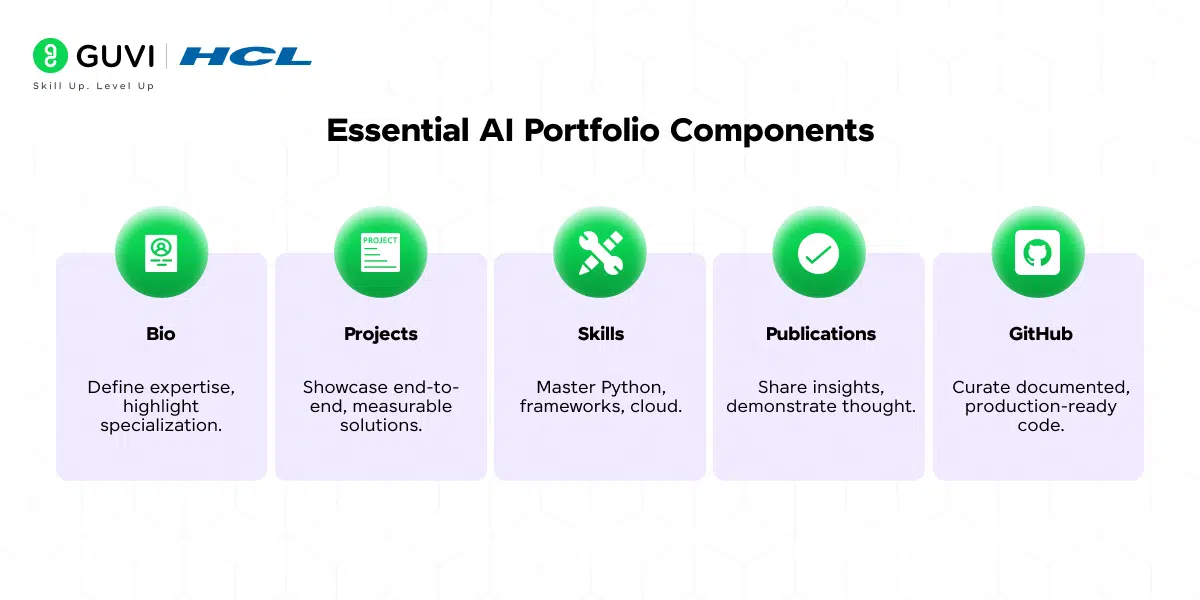
- About Me
If your portfolio were a Netflix series, this would be the 30-second teaser that makes someone binge-watch the rest.
Keep it tight, human, and professional. Include:
- A crisp 3–5 line bio
- A clear headline (e.g., “AI Engineer focused on NLP in healthcare workflows”)
- Profile links — GitHub, LinkedIn, personal site
- Optional: a friendly, professional photo
Why it matters: It sets the tone. It tells visitors what kind of problems you like to solve, and how you fit into the AI landscape, in just a few seconds.
- Projects
This is the meat of your portfolio. If your skills were a band, these projects would be the chart-toppers.
What to showcase:
- 3–5 high-quality, end-to-end projects
- Problem → Approach → Result (keep it visual when possible)
- Charts, model architectures, even screenshots of working UIs
- GitHub, Colab, or live demo links
Why it matters: Projects are proof that you can move from theory to execution. And that’s what hiring teams are paying attention to.
- Technical Skills
Every craftsman is judged by their tools — and how well they use them. This is your snapshot.
Organize clearly:
- Languages: Python (non-negotiable), R, SQL, etc.
- Libraries: TensorFlow, PyTorch, Scikit-learn, etc.
- Cloud & MLOps: Docker, Kubernetes, SageMaker, Azure ML
- Specializations: Hugging Face, OpenCV, LangChain (if relevant)
- Proficiency labels: Basic / Intermediate / Expert
Why it matters: Recruiters scan this like a checklist. ATS bots do too. Make their job easy, and you’re already ahead.
- Publications & Blogs
If your projects are in your hands, this is your voice.
Add:
- Research papers (published or under review)
- Blog posts that simplify complex AI topics
- Thought pieces on trends or ethical considerations
Why it matters: Communication is gold in AI. If you can build and explain, you’re rare. Hiring managers know it.
- Certifications
Think of these like verified badges. They don’t make you great, but they do make you searchable and trustworthy.
List:
- Role-relevant certifications (e.g., AWS ML Specialty, Google ML Engineer)
- Completion of rigorous online programs (Fast.ai, DeepLearning.ai)
- Academic specializations
Why it matters: When recruiters are choosing between 2 solid candidates, certifications are often the tie-breaker. They can also influence starting salary.
- GitHub
A good GitHub isn’t just a code dump — it’s a museum of how you think.
Stand out with:
- Neatly organized, documented repos
- Clear READMEs with setup instructions and use cases
- Open-source contributions that show collaboration
- Annotated notebooks that teach, not just show
Why it matters: Hiring managers are looking here even before they speak with you. What they find (or don’t) could make or break the next step.
- Real-World Impact
Here’s where you shift from “I built this” to “This is what it did in the real world.”
Add:
- Deployed projects (on APIs, websites, internal tools)
- Freelance/consulting work with tangible results
- Hackathon wins or Kaggle leaderboard placements
- Social impact projects (agri-tech, med-tech, etc.)
Why it matters: Artificial Intelligence that lives only in Jupyter isn’t enough. Showing business or community impact helps you cross the line from ‘skilled’ to ‘hired’.
What Not to Include in Your Artificial Intelligence Professional Portfolio
A portfolio is not a dump of everything you’ve ever done. It’s a curated space that should reflect quality, relevance, and clarity.
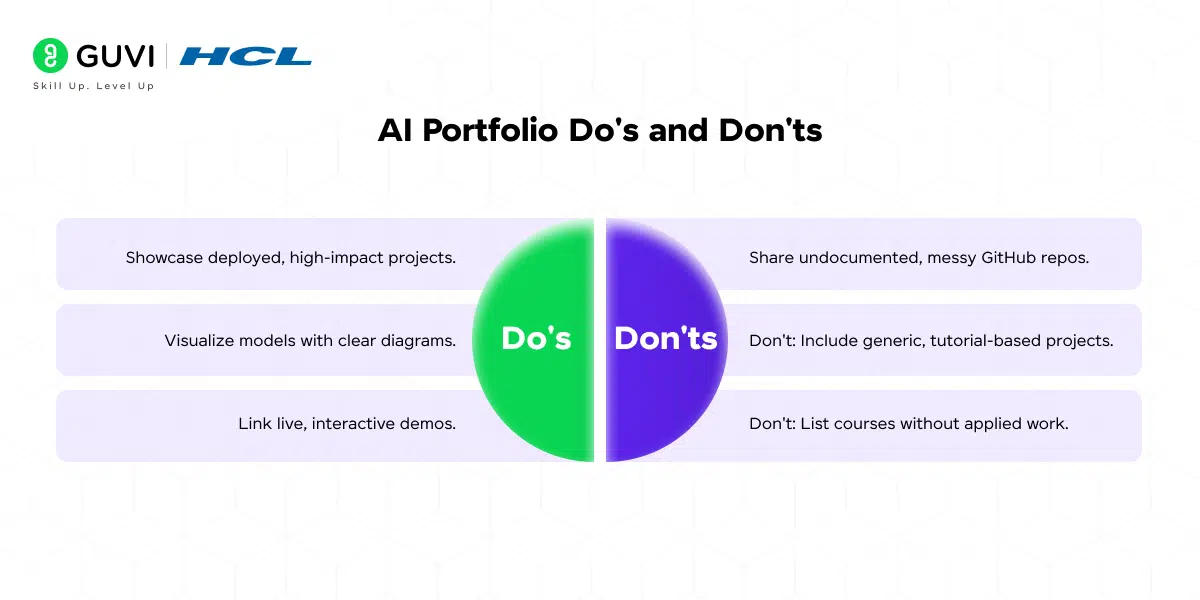
Here’s what to leave out if you want your portfolio to work in your favor:
- Toy Projects with No Business Context or Depth
Basic models like MNIST digit recognizers or Titanic survival predictions are useful for learning, but they don’t show depth or real-world thinking. If a project doesn’t solve a practical problem or simulate a real use case, it won’t stand out.
What to do instead: Focus on projects that apply to industry contexts or show clear impact, even if they’re small in scale.
- Unexplained or Unmaintained GitHub Repos
A GitHub repo without a clear README, comments, or documentation doesn’t help anyone. It raises questions about how well you can communicate your work or maintain production-grade code.
What to do instead: Add a simple README explaining what the project does, how to run it, and the outcome.
- Screenshots of Jupyter Notebooks Without Interactivity
Static screenshots tell very little. They can’t show your logic, execution, or results in action.
What to do instead: Share working links to Colab notebooks or interactive dashboards. Let your reviewers test or explore the output themselves.
- Overloading with Courses Instead of Original Work
Listing 10 courses without any application of the knowledge signals passive learning. Recruiters care more about what you’ve built than what you’ve watched.
What to do instead: For every few courses, include at least one applied project that uses the concepts.
- Generic Code Copied from Tutorials
Projects that look exactly like standard tutorials show no original thought or skill. Recruiters recognize copied work instantly.
What to do instead: Build on what you learn. Use different datasets, tweak the model, or deploy it in a new context to make it your own.
Your portfolio should reflect initiative, clarity, and relevance. If a piece of content doesn’t add value, remove it. A few solid, well-presented projects will always beat a long list of half-finished or unoriginal work.
How to Structure Your AI Portfolio for Maximum Impact
A strong portfolio is not just about what you include, but how you present it. Structure directly affects how quickly recruiters understand your value.
Ideal Portfolio Structure
- Homepage: Clear headline, role focus, and key highlights
- Projects Section: 3–5 featured projects with visuals and outcomes
- Skills Section: Categorized tools, frameworks, and technologies
- About Section: Short, focused bio with your niche
- Contact Section: Easy access to email, LinkedIn, and GitHub
Best Practices
- Keep navigation simple and intuitive
- Use visuals like charts and architecture diagrams
- Highlight impact before technical details
- Ensure fast loading and mobile optimization
AI Portfolio Project Ideas That Actually Get You Hired
Most portfolios fail not because of poor execution, but because of weak project selection. Recruiters are not impressed by generic models. They are looking for problem-solving ability in real-world scenarios.
Here are high-impact AI portfolio project ideas that align with current hiring trends:
Industry-Relevant AI Projects
- AI-powered Resume Screener: Build an NLP model that ranks resumes based on job descriptions.
- Fraud Detection System: Use anomaly detection with real financial datasets.
- Healthcare Diagnosis Model: Predict diseases using patient data with explainability (SHAP/LIME).
- Customer Churn Prediction: Combine ML + business insights to show revenue impact.
Generative AI Projects (High Demand)
- Custom Chatbot using LLMs: Build using LangChain + OpenAI APIs with memory and context.
- Document Summarization Tool: Upload PDFs and generate summaries using transformers.
- AI Content Generator: Generate blogs, ads, or product descriptions with prompts.
Deployment-Focused Projects
- End-to-End ML Pipeline: From data ingestion to deployment using Docker or FastAPI
- Streamlit AI App: Interactive UI for model predictions
- API-based Model Serving: Deploy models using Flask or FastAPI
Why this is important: Recruiters prefer fewer, high-quality, deployed projects over multiple incomplete ones. The right project can position you directly for specific roles.
Best Platforms to Build and Host Your AI Portfolio
Your work is only as visible as the platform you showcase it on. Choosing the right platform can significantly improve discoverability and recruiter engagement.
Portfolio Hosting Platforms
- GitHub Pages: Best for developers who want full control and versioning
- Notion: Clean, minimal, and easy to update
- Webflow: Ideal for visually polished portfolios
- WordPress: Good for combining blogs + portfolio
Project & Demo Platforms
- GitHub: Code hosting with collaboration and version control
- Kaggle: Showcase notebooks and competition rankings
- Hugging Face Spaces: Deploy ML demos and LLM apps
- Streamlit Cloud: Turn models into interactive apps instantly
Optimization Tips
- Use a custom domain for credibility
- Ensure mobile responsiveness
- Add clear navigation and CTAs
- Link all platforms back to a central portfolio hub
Why this is important: Even strong projects fail if they are hard to access. A well-structured platform ensures recruiters can explore your work within seconds.
Resume vs Portfolio: The Ultimate Comparison for AI Professionals (2025)
| Aspect | Resume | Portfolio |
| Primary Purpose | Quick snapshot of qualifications for ATS and recruiters | Deep dive into skills, projects, and real-world impact |
| Best Used For | Job applications (LinkedIn, Naukri, company portals) | Showcasing work to hiring managers, clients, or freelance opportunities |
| Format | 1-2 pages, text-heavy, structured (reverse-chronological) | Interactive, visual, project-based (web/GitHub/PDF) |
| Key Content | – Education – Work Experience – Skills (bullet points) – Certifications – Contact Info | – Projects with code/results – Live demos – Technical blogs – GitHub repos – Case studies |
| Advantages | – Fast to scan – ATS-friendly – Standardized format – Good for initial screening | – Demonstrates skills – Visual and engaging – Proves real-world ability – Stands out in competitive markets |
| Limitations | – Limited depth – Doesn’t showcase projects – Generic for AI roles | – Time-consuming to build – Not always ATS-friendly – Overkill for some traditional roles |
| When to Use | – Applying via job portals – Career fairs – Initial recruiter screening | – AI/ML job interviews – Freelancing/consulting – Tech-heavy roles (research, startups) |
| Complementary Value | A resume gets you the interview | Portfolio wins the job by backing up resume claims with proof |
| Ideal for AI Careers | Necessary but insufficient alone | Critical for standing out in 2025’s skill-driven market |
Takeaway message: You don’t need to choose between a resume and a portfolio. You need both, one opens the door, the other builds trust. In a competitive AI market, especially in India’s hiring landscape, combining a clean, keyword-optimized resume with a strong, project-rich portfolio gives you a clear edge over others.

Tips for Showcasing Your Skills and Experience
- Make It Visual. Let Your Work Speak Clearly
Use visuals to explain system design and model performance instead of relying only on text.
What to include:
- Architecture diagrams showing data flow and model pipeline
- Confusion matrix, ROC curve, precision recall curve
- Feature importance plots using SHAP or LIME
- Before vs after model performance comparison
Example:
Fraud detection system with pipeline → data ingestion → feature engineering → model → API → dashboard
A clear visual reduces explanation time and improves understanding instantly.
- Build a Personal Site That Feels Like a Product
Your portfolio should feel structured, navigable, and intentional.
Must-have sections:
- Homepage with role and specialization
- Featured projects with outcomes
- Skills mapped to tools and use cases
- Contact section with direct links
Enhancements:
- Add a custom domain for credibility
- Include a project filter by domain such as NLP, CV, GenAI
- Add a search bar if you have multiple projects
Your portfolio should guide the recruiter, not confuse them.
- Explain Your Thought Process Clearly
Every project must show how you think, not just what you built.
Structure each project like this:
- Problem statement
- Dataset and preprocessing steps
- Model selection and reasoning
- Experiments and iterations
- Final results and tradeoffs
Go deeper with:
- Why you chose XGBoost over Random Forest
- What failed and how you fixed it
- How you handled data imbalance or overfitting
Clarity in thinking signals maturity.
- Focus on Depth Over Quantity
Avoid adding too many surface-level projects.
What strong projects include:
- End-to-end pipeline from data to deployment
- Real-world dataset or use case
- Performance metrics and evaluation
- Documentation and reproducibility
Ideal setup:
- 3 to 5 strong projects
- At least 1 deployed project
- At least 1 domain-specific project such as healthcare, finance, or NLP
Depth shows real capability.
- Show Live Work Wherever Possible
Static code is not enough. Make your work interactive.
Ways to do this:
- Deploy apps using Streamlit or Gradio
- Host APIs using FastAPI or Flask
- Share runnable notebooks on Colab
- Use Hugging Face Spaces for LLM demos
What to ensure:
- Links are working
- Setup instructions are clear
- Demo loads quickly
If someone can use your project, they trust your skill more.
- Keep Your Portfolio Updated Regularly
An outdated portfolio signals stagnation.
Monthly update checklist:
- Add one new learning or tool
- Improve an existing project
- Refactor code for clarity
- Update README files with better explanations
Version improvements:
- v1 basic model
- v2 tuned model
- v3 deployed version
This shows progression, not just completion.
- Include a Failures and Learnings Section
Strong portfolios show problem-solving and not just success.
What to include:
- Model that failed due to overfitting
- Data issues such as imbalance or noise
- Performance bottlenecks
Explain clearly:
- What went wrong
- What you changed
- What improved
This reflects real engineering thinking.
- Create Content That Drives Traffic to Your Portfolio
Your portfolio should not exist in isolation.
Content strategies:
- Write LinkedIn posts breaking down projects
- Publish short technical blogs
- Record 2 to 3 minute walkthrough videos
- Share insights from experiments
Link everything back to:
- GitHub repository
- Live demo
- Portfolio site
This builds visibility and credibility.
- Optimize for Recruiter and ATS Discovery
Make your portfolio easy to find and scan.
SEO and discoverability tips:
- Use keywords like AI projects, machine learning portfolio, NLP projects
- Add meta title and description to your site
- Use clear headings and structured content
- Keep GitHub repo names meaningful
Example repo names:
- Customer-churn-prediction-ml
- LLM-chatbot-langchain
- Fraud-detection-system
- Align Your Portfolio with Real Job Descriptions
A strong portfolio is not generic. It is aligned with the roles you are targeting.
How to do it:
- Analyze 5 to 10 job descriptions for roles like AI engineer or data scientist
- Identify common tools, skills, and requirements
- Match your projects to those requirements
Example:
If jobs require NLP and LLMs
- Include a chatbot or text classification project
- Highlight tools like Transformers, LangChain, or OpenAI APIs
If jobs require deployment
- Add API-based projects using FastAPI or Flask
- Show cloud or container usage
What to update:
- Project descriptions with relevant keywords
- Skills section based on job demand
- README files to reflect role-specific relevance
If you’re serious about building a portfolio that recruiters can’t ignore, it’s not just about what you learn, it’s about how you apply it. That’s where GUVI’s Zen Class in Artificial Intelligence and Machine Learning Course comes in. Unlike theory-heavy courses that leave you guessing, this program is completely project-driven. You’ll work on real-world AI applications, master tools like Python, TensorFlow, and NLP libraries, and even deploy models that can go straight into your portfolio. If you’ve been stuck in tutorial loops or struggling to find impactful projects, this course could be the shortcut you’ve been waiting for, and the bridge between learning and getting hired. Check it out here
How to Tailor Your AI Portfolio for Different Roles
A generic portfolio does not work for specialized AI roles. Customization increases relevance and shortlisting chances.
For AI/ML Engineers
- Focus on model building, pipelines, and deployment
- Highlight scalability and system design
For Data Scientists
- Emphasize data analysis, visualization, and insights
- Showcase storytelling with data
For Prompt Engineers / Gen AI Roles
- Include LLM applications, prompt frameworks, and outputs
- Show experimentation and iteration
For AI Product Managers
- Focus on problem statements, user impact, and product thinking
- Highlight case studies over code
Best Tools and Technologies to Include in an AI Portfolio
Your tool stack signals your readiness for real-world AI roles. Listing the right tools improves both ATS visibility and recruiter confidence.
Core Tools
- Python, SQL
- Pandas, NumPy, Scikit-learn
Advanced AI/ML Frameworks
- TensorFlow, PyTorch
- Hugging Face Transformers
- OpenCV for computer vision
Deployment & MLOps
- Docker, Kubernetes
- FastAPI or Flask
- AWS, Azure ML, or Google Cloud
Visualization & Dashboards
- Matplotlib, Seaborn
- Power BI or Tableau
- Streamlit for interactive apps
How Often Should You Update Your AI Portfolio
An outdated portfolio can hurt your chances, even if your skills have improved.
Ideal Update Frequency
- Review and update every 30-45 days
- Add new projects or improve existing ones
- Replace weaker projects with stronger ones
What to Update
- New tools or frameworks you learned
- Improved versions of existing models
- Better documentation and visuals
- Latest achievements or certifications
Pro Tip: Treat your portfolio like a product. Iterate, improve, and refine based on feedback.
Conclusion
In a field where everyone knows Python and everyone has taken a Coursera course, your AI portfolio is the only proof that you can actually build something that works. It’s more than a collection of projects — it’s your silent pitch to every recruiter, hiring manager, and collaborator who lands on your page.
Think of your portfolio not as a formality, but as a living product. One that reflects how you solve problems, how you write code, how you learn, and how you think. And in a market that moves as fast as AI does, this single asset can fast-track opportunities you didn’t even know existed.
So don’t just make a portfolio. Design it. Curate it. Evolve it.
Make it so good that it stops people mid-scroll.
Because in 2025, resumes may get you seen.
But portfolios? They get you hired.
FAQs
1. How to create a portfolio for a job?
Start by showcasing 3–5 impactful projects with clear problem statements, your approach, results, and code/demo links. Include skills, certifications, and visuals to highlight your thought process.
2. Are portfolio and CV the same?
No. A CV lists qualifications and experience, while a portfolio shows proof of work through real projects, visuals, and interactive demos. Both serve different purposes and complement each other.
3. Can I send a portfolio instead of a CV?
You shouldn’t. Most recruiters expect a CV for initial screening. Use the portfolio as an added asset, a clickable link that strengthens your credibility and proves your hands-on skills.
4. How do I create my own portfolio?
Use platforms like GitHub Pages, Notion, or Webflow. Keep it clean, updated, and project-focused. Include code, visuals, metrics, and insights to make your experience stand out professionally.
5. How many pages should a digital portfolio be?
There’s no fixed number. Aim for clarity over length, typically, 1–3 main pages with sections like About, Projects, Skills, and Contact. Make it easy to navigate and focused.
Success Stories

About the Author
Vaishali
I'm a seasoned writer with four years of experience across technical, non-technical, and just about every genre or niche you can imagine. Adaptable and curious, I enjoy exploring new topics and making information engaging and easy to understand. Fueled by a steady stream of tea, I approach each project with creativity, reliability, and genuine enthusiasm for storytelling.
View all posts by Vaishali
Connect with me @









Did you enjoy this article?